
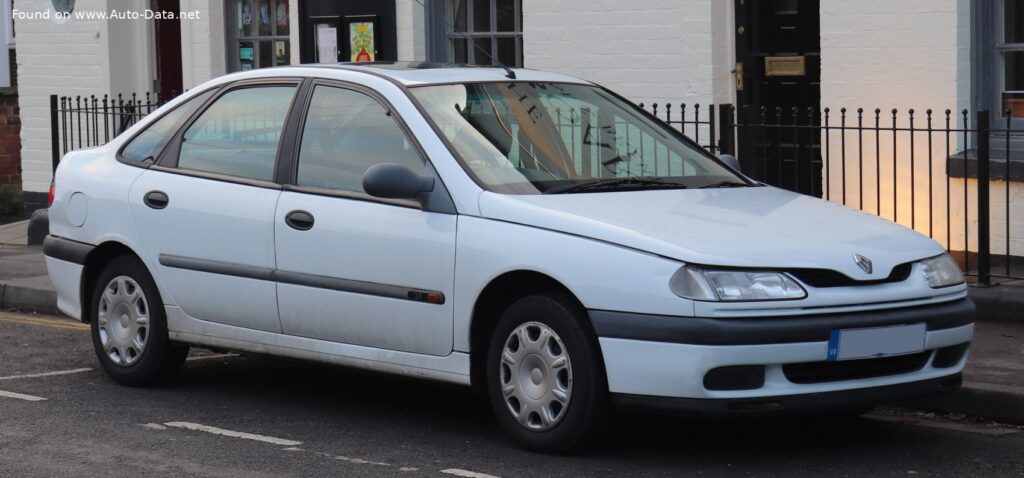
The Renault Laguna, a prominent D-segment family car in the European market, represented Renault’s commitment to combining practicality, comfort, and advanced engineering for its time. The specific variant under review, the Renault Laguna 2.9 24V (190 Hp) Automatic, produced between 1997 and 2000, stood out as a performance-oriented offering within the Laguna’s first generation. This model, characterized by its powerful V6 engine and automatic transmission, aimed to provide a refined driving experience for discerning European consumers. While never officially sold in the United States, the Laguna’s design and technical specifications reflect the global automotive trends of the late 1990s, emphasizing a blend of dynamic capabilities with everyday usability in a five-door hatchback body style.
Powering the Renault Laguna 2.9 24V (190 Hp) Automatic: Engine and Performance
At the heart of the Renault Laguna 2.9 24V (190 Hp) Automatic lies a robust 2.9-liter (2946 cm3 or 179.78 cubic inches) naturally aspirated V6 engine, designated as the L7X. This powerplant was a significant feature for the Laguna, elevating its status within the competitive European mid-size segment. Delivering a substantial 190 horsepower at 5750 revolutions per minute, the engine was engineered for smooth power delivery and responsive acceleration, a notable characteristic for a family hatchback of its era. The power output translated to a healthy 64.5 horsepower per liter, indicating a well-tuned and efficient design for a non-turbocharged engine.
The torque figures further underscore the engine’s capability, peaking at 267 Newton-meters (196.93 lb.-ft.) at a respectable 4000 rpm. This ample torque, available across a broad rev range, ensured strong pulling power, making the Laguna suitable for both urban commuting and long-distance highway cruising. The engine’s configuration as a V-engine with six cylinders, each featuring four valves, contributed to its smooth operation and efficient combustion. A DOHC (Double Overhead Camshaft) valvetrain further optimized valve timing for improved performance and efficiency. Fuel delivery was managed by a multi-port manifold injection system, a standard advanced technology for gasoline engines of the late 1990s, ensuring precise fuel metering.
Performance metrics for the Renault Laguna 2.9 24V (190 Hp) Automatic were impressive for its class. The car could accelerate from 0 to 60 mph in a swift 8.5 seconds, showcasing its sporting credentials. Its maximum speed was rated at 142.92 mph (230 km/h), allowing for confident highway travel. The powertrain was mated to a 4-speed automatic transmission, which provided a comfortable and effortless driving experience, particularly in congested European city traffic. The drivetrain architecture was front-wheel drive, a common and effective layout for optimizing interior space and fuel efficiency in family vehicles.
Despite its performance focus, the Laguna also demonstrated reasonable fuel economy for a V6-powered vehicle of its size. Official figures indicated an urban consumption of 17.1 liters per 100 kilometers, equating to approximately 13.8 US miles per gallon. On extra-urban cycles, this improved significantly to 8.1 liters per 100 kilometers, or around 29 US miles per gallon, highlighting its efficiency on longer journeys. The 66-liter (17.44 US gallons) fuel tank provided a commendable range between fill-ups, a practical consideration for European drivers.
Design and Features of the Renault Laguna
The Renault Laguna, in its first generation (1997-2000), was designed as a five-door hatchback, a highly versatile body style popular in Europe for its blend of sedan-like driving dynamics and wagon-like cargo capacity. Measuring 177.56 inches (4510 mm) in length, 68.9 inches (1750 mm) in width, and 56.3 inches (1430 mm) in height, the Laguna presented a sleek and aerodynamic profile for its time. The 105.12-inch (2670 mm) wheelbase contributed to a stable ride and a spacious interior, accommodating five occupants comfortably.
Inside, the Laguna aimed for a practical yet comfortable environment. While specific interior features varied by trim, the 2.9 24V Automatic variant would have typically included higher-grade upholstery and amenities befitting its position as a top-tier model. The car offered a generous minimum trunk space of 15.89 cubic feet (450 liters), which could be expanded to an impressive 47.15 cubic feet (1335 liters) with the rear seats folded, making it highly adaptable for various cargo needs, from grocery runs to family vacations.
In terms of chassis and safety, the Laguna incorporated technologies that were becoming standard for late 1990s vehicles. The front suspension utilized a Spring Strut system, known for its balance of ride comfort and handling precision, while the rear featured a Torsion beam setup, providing a compact and efficient solution for the rear axle. Braking performance was assured by ventilated discs at the front and disc brakes at the rear, complemented by an Anti-lock Braking System (ABS), a crucial safety feature that prevented wheel lock-up during hard braking and improved steerability. Steering was managed by a hydraulic rack and pinion system, offering direct feedback and assistance, enhancing the driving experience. The car rode on 195/60 R15 tires mounted on 15-inch wheel rims, providing a good balance of grip and ride quality.
The overall design ethos of the Laguna was one of understated elegance and functional efficiency, typical of European family cars of the era. Its smooth lines and integrated bumpers contributed to a modern aesthetic that remained relevant throughout its production run. The focus was on creating a car that was not only pleasant to drive but also practical and safe for families, embodying Renault’s reputation for producing vehicles that combined innovative engineering with everyday usability.
Technical Specifications: Renault Laguna 2.9 24V (190 Hp) Automatic (1997-2000)
| Brand | Renault |
| Model | Laguna |
| Generation | Laguna |
| Type (Engine) | 2.9 24V (190 Hp) Automatic |
| Start of Production | 1997 year |
| End of Production | 2000 year |
| Powertrain Architecture | Internal Combustion engine |
| Body type | Hatchback |
| Seats | 5 |
| Doors | 5 |
| Fuel Consumption (Urban) | 13.8 US mpg (17.1 l/100 km) |
| Fuel Consumption (Extra Urban) | 29 US mpg (8.1 l/100 km) |
| Fuel Type | Petrol (Gasoline) |
| Acceleration 0 – 60 mph | 8.5 sec |
| Maximum Speed | 142.92 mph (230 km/h) |
| Weight-to-power ratio | 7.2 kg/Hp, 138.2 Hp/tonne |
| Weight-to-torque ratio | 5.1 kg/Nm, 194.2 Nm/tonne |
| Power | 190 Hp @ 5750 rpm |
| Power per liter | 64.5 Hp/l |
| Torque | 196.93 lb.-ft. @ 4000 rpm (267 Nm) |
| Engine Layout | Front, Transverse |
| Engine Model/Code | L7X |
| Engine Displacement | 2.9 Liters (2946 cm3 / 179.78 cu. in.) |
| Number of Cylinders | 6 |
| Engine Configuration | V-engine |
| Cylinder Bore | 3.43 in. (87 mm) |
| Piston Stroke | 3.25 in. (82.6 mm) |
| Compression Ratio | 10.5:1 |
| Number of Valves per Cylinder | 4 |
| Fuel Injection System | Multi-port manifold injection |
| Engine Aspiration | Naturally aspirated engine |
| Valvetrain | DOHC |
| Engine Oil Capacity | 5.71 US qt (5.4 l) |
| Coolant Capacity | 7.4 US qt (7 l) |
| Kerb Weight | 3031.36 lbs. (1375 kg) |
| Max. Weight | 4332.08 lbs. (1965 kg) |
| Max Load | 1300.73 lbs. (590 kg) |
| Trunk (boot) Space – Minimum | 15.89 cu. ft. (450 l) |
| Trunk (boot) Space – Maximum | 47.15 cu. ft. (1335 l) |
| Fuel Tank Capacity | 17.44 US gal (66 l) |
| Length | 177.56 in. (4510 mm) |
| Width | 68.9 in. (1750 mm) |
| Height | 56.3 in. (1430 mm) |
| Wheelbase | 105.12 in. (2670 mm) |
| Front Track | 58.27 in. (1480 mm) |
| Rear (Back) Track | 57.48 in. (1460 mm) |
| Drivetrain Architecture | Internal combustion engine (ICE) drives the front wheels |
| Drive Wheel | Front wheel drive |
| Number of Gears and Type of Gearbox | 4 gears, automatic transmission |
| Front Suspension | Spring Strut |
| Rear Suspension | Torsion |
| Front Brakes | Ventilated discs |
| Rear Brakes | Disc |
| Assisting Systems | ABS (Anti-lock braking system) |
| Steering Type | Steering rack and pinion |
| Power Steering | Hydraulic Steering |
| Tires Size | 195/60 R15 |
| Wheel Rims Size | 15 inches |
