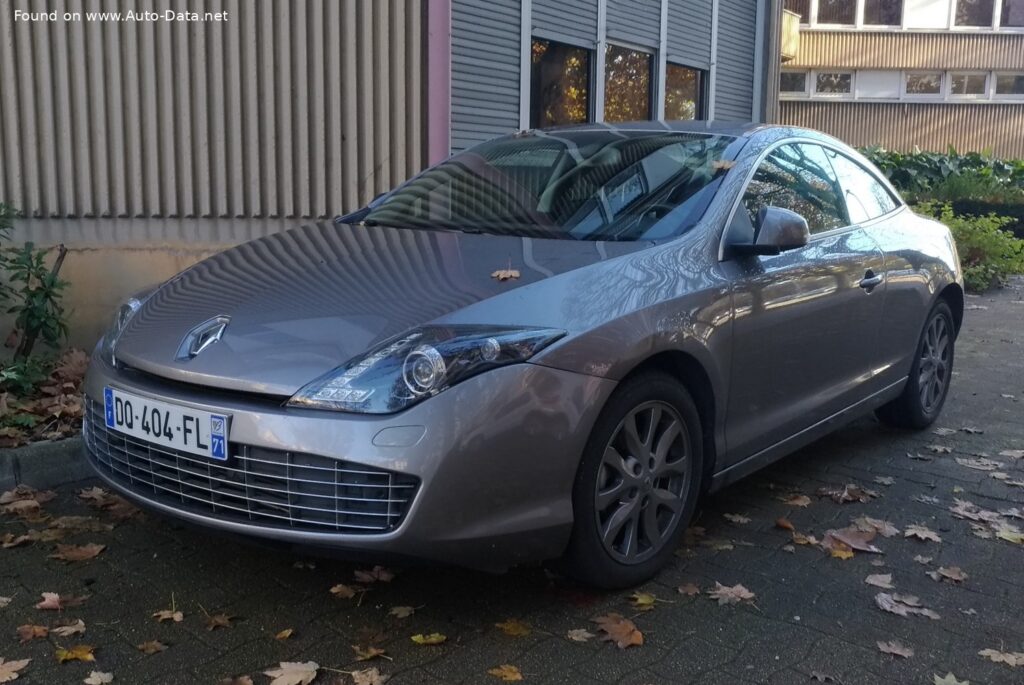
The Renault Laguna Coupe (Phase II) 2.0 dCi (173 Hp), produced between 2012 and 2015, represented a compelling offering in the European D-segment for stylish, diesel-powered grand tourers. As a distinctive two-door, four-seat coupe, it was part of the final iteration of the Laguna line, aiming to combine elegant aesthetics with practical performance and commendable fuel efficiency. While never officially sold in the United States, this model carved out a niche in its primary European markets, appealing to drivers seeking a blend of sophisticated design, comfortable long-distance cruising capability, and the economic benefits inherent in a modern diesel powertrain. The Phase II update brought subtle refinements to an already well-regarded platform, enhancing its appeal in a competitive segment dominated by premium German marques, by offering a unique French alternative focused on distinctive styling and a refined driving experience.
Engine & Performance: The Robust 2.0 dCi (173 Hp) in the Renault Laguna Coupe (Phase II)
At the heart of the Renault Laguna Coupe (Phase II) lay the formidable 2.0 dCi (173 Hp) diesel engine, an inline-four unit known by its M9R engine code. This robust powertrain, with a displacement of 1995 cubic centimeters (approximately 2.0 liters or 121.74 cubic inches), was engineered for a harmonious blend of power and economy. It delivered a peak output of 173 horsepower at 3750 revolutions per minute, providing ample motivation for spirited driving and effortless highway cruising. More impressively, the engine generated a substantial 280.27 lb.-ft. of torque at a low 2000 rpm, a characteristic trait of modern diesel engines that translates into strong, accessible pulling power across a wide range of speeds.
The M9R engine utilized a sophisticated diesel common rail fuel injection system, ensuring precise fuel delivery and optimal combustion efficiency. This was further augmented by a turbocharger and an intercooler, which worked in tandem to force more air into the cylinders, significantly boosting power and torque output while maintaining thermal efficiency. The compression ratio of 16:1 was typical for a direct-injection diesel, contributing to its strong performance characteristics. With a maximum engine speed of 5200 rpm, the 2.0 dCi proved to be a flexible and eager powerplant. Its front, transverse engine layout contributed to a balanced front-wheel-drive architecture, a common setup for efficiency and packaging in this class.
Performance figures for the Renault Laguna Coupe (Phase II) 2.0 dCi (173 Hp) were quite respectable for a car of its type. It could accelerate from 0 to 60 mph in a swift 8.4 seconds, demonstrating its capability to merge quickly onto highways or overtake with confidence. The maximum speed was recorded at 138.57 mph (223 km/h), firmly placing it in the realm of capable grand tourers. These performance metrics were achieved while adhering to the Euro 4 emission standard, reflecting a commitment to environmental responsibility during its production run.
One of the most compelling aspects of this diesel coupe was its exceptional fuel economy. The combined fuel consumption was an impressive 41.3 US mpg (5.7 liters per 100 km), showcasing the inherent efficiency of the dCi engine. In extra-urban driving, this figure could climb even higher to an outstanding 48 US mpg (4.9 liters per 100 km), making it an ideal choice for long-distance travel. Even in urban environments, it managed a respectable 31.4 US mpg (7.5 liters per 100 km). These figures, combined with CO2 emissions of 150 g/km, underscored its role as an economical and relatively clean option in its segment. Power was delivered to the front wheels via a smooth and precise 6-speed manual transmission, offering drivers an engaging and direct connection to the car’s performance capabilities.
Design & Features: The Stylish Renault Laguna Coupe (Phase II)
The Renault Laguna Coupe (Phase II) was a testament to sophisticated European automotive design, blending elegant lines with a distinctly sporty stance. As a dedicated two-door coupe, it offered seating for four occupants, emphasizing a more intimate and driver-focused experience compared to its sedan or hatchback siblings. Measuring 182.8 inches (4643 mm) in length, 71.34 inches (1812 mm) in width (81.97 inches or 2082 mm including mirrors), and 55.04 inches (1398 mm) in height, the Laguna Coupe possessed graceful proportions that exuded a sense of dynamism and class. Its substantial wheelbase of 106.06 inches (2694 mm) contributed to both its visual balance and its stable ride quality, a hallmark of a good grand tourer.
A low drag coefficient (Cd) of 0.30 indicated careful aerodynamic sculpting, not only contributing to its sleek appearance but also enhancing fuel efficiency and reducing wind noise at higher speeds. The exterior design was characterized by flowing contours, a distinctive front fascia, and a gracefully sloping roofline that culminated in a neatly integrated rear. The choice of wheel sizes, ranging from 16 to 18 inches, allowed for various aesthetic and handling preferences, with larger wheels typically enhancing the car’s visual presence and grip.
Inside, the cabin of the Renault Laguna Coupe (Phase II) offered a comfortable and well-appointed environment. While specific luxury features varied by trim level, Renault typically equipped its higher-end models with a comprehensive suite of amenities designed for convenience and comfort. The trunk space, at 14.94 cubic feet (423 liters), was generous for a coupe, providing ample room for luggage for weekend trips or daily errands. The 17.44 US gallon (66 liter) fuel tank capacity, combined with its impressive fuel economy, ensured an excellent cruising range, further cementing its credentials as a long-distance cruiser.
In terms of ride and handling, the Laguna Coupe featured an independent McPherson strut front suspension, renowned for its balance of comfort and precise steering response. The rear utilized a semi-independent, coil spring setup, providing a compliant ride while maintaining composure. The steering system was a steering rack and pinion type, complemented by hydraulic power steering, which delivered a natural and communicative feel to the driver. Braking duties were handled by ventilated discs at the front and solid discs at the rear, coupled with an Anti-lock Braking System (ABS) for enhanced safety and control during emergency stops. The car’s robust kerb weight of 3348.82 lbs (1519 kg) and a maximum permissible weight of 4373.97 lbs (1984 kg) spoke to its solid construction, contributing to a feeling of security and stability on the road. With a minimum turning circle between 35.43 and 38.71 feet, it maintained reasonable maneuverability for a car of its size.
Technical Specifications: Renault Laguna Coupe (Phase II) 2.0 dCi (173 Hp)
| Brand | Renault |
| Model | Laguna |
| Generation | Laguna Coupe (Phase II) |
| Type (Engine) | 2.0 dCi (173 Hp) |
| Start of production | 2012 year |
| End of production | 2015 year |
| Powertrain Architecture | Internal Combustion engine |
| Body type | Coupe |
| Seats | 4 |
| Doors | 2 |
| Fuel consumption (economy) – urban | 7.5 l/100 km (31.4 US mpg) |
| Fuel consumption (economy) – extra urban | 4.9 l/100 km (48 US mpg) |
| Fuel consumption (economy) – combined | 5.7 l/100 km (41.3 US mpg) |
| CO2 emissions | 150 g/km |
| Fuel Type | Diesel |
| Acceleration 0 – 60 mph | 8.4 sec |
| Acceleration 0 – 100 km/h | 8.8 sec |
| Maximum speed | 223 km/h (138.57 mph) |
| Emission standard | Euro 4 |
| Weight-to-power ratio | 8.8 kg/Hp (113.9 Hp/tonne) |
| Weight-to-torque ratio | 4 kg/Nm (250.2 Nm/tonne) |
| Power | 173 Hp @ 3750 rpm |
| Power per litre | 86.7 Hp/l |
| Torque | 380 Nm @ 2000 rpm (280.27 lb.-ft.) |
| Maximum engine speed | 5200 rpm |
| Engine layout | Front, Transverse |
| Engine Model/Code | M9R |
| Engine displacement | 1995 cm3 (2.0 l / 121.74 cu. in.) |
| Number of cylinders | 4 |
| Engine configuration | Inline |
| Cylinder Bore | 84 mm (3.31 in.) |
| Piston Stroke | 90 mm (3.54 in.) |
| Compression ratio | 16:1 |
| Number of valves per cylinder | 4 |
| Fuel injection system | Diesel Commonrail |
| Engine aspiration | Turbocharger, Intercooler |
| Engine oil capacity | 7.4 l (7.82 US qt) |
| Coolant | 7.8 l (8.24 US qt) |
| Kerb Weight | 1519 kg (3348.82 lbs.) |
| Max. weight | 1984 kg (4373.97 lbs.) |
| Max load | 465 kg (1025.15 lbs.) |
| Trunk (boot) space – minimum | 423 l (14.94 cu. ft.) |
| Fuel tank capacity | 66 l (17.44 US gal) |
| Permitted trailer load with brakes (12%) | 1500 kg (3306.93 lbs.) |
| Permitted trailer load without brakes | 650 kg (1433 lbs.) |
| Length | 4643 mm (182.8 in.) |
| Width | 1812 mm (71.34 in.) |
| Width including mirrors | 2082 mm (81.97 in.) |
| Height | 1398 mm (55.04 in.) |
| Wheelbase | 2694 mm (106.06 in.) |
| Front track | 1548 mm (60.94 in.) |
| Rear (Back) track | 1542 mm (60.71 in.) |
| Front overhang | 1022 mm (40.24 in.) |
| Rear overhang | 927 mm (36.5 in.) |
| Ride height (ground clearance) | 120 mm (4.72 in.) |
| Drag coefficient (Cd) | 0.30 |
| Minimum turning circle (turning diameter) | 10.8-11.8 m (35.43 – 38.71 ft.) |
| Drivetrain Architecture | Front wheel drive. Internal Combustion engine. |
| Drive wheel | Front wheel drive |
| Number of gears and type of gearbox | 6 gears, manual transmission |
| Front suspension | Independent type McPherson |
| Rear suspension | Semi-independent, coil spring |
| Front brakes | Ventilated discs |
| Rear brakes | Disc |
| Assisting systems | ABS (Anti-lock braking system) |
| Steering type | Steering rack and pinion |
| Power steering | Hydraulic Steering |
| Tires size | 185/65 R16; 215/50 R17; 225/45 R18 |
| Wheel rims size | 16; 17; 18 |