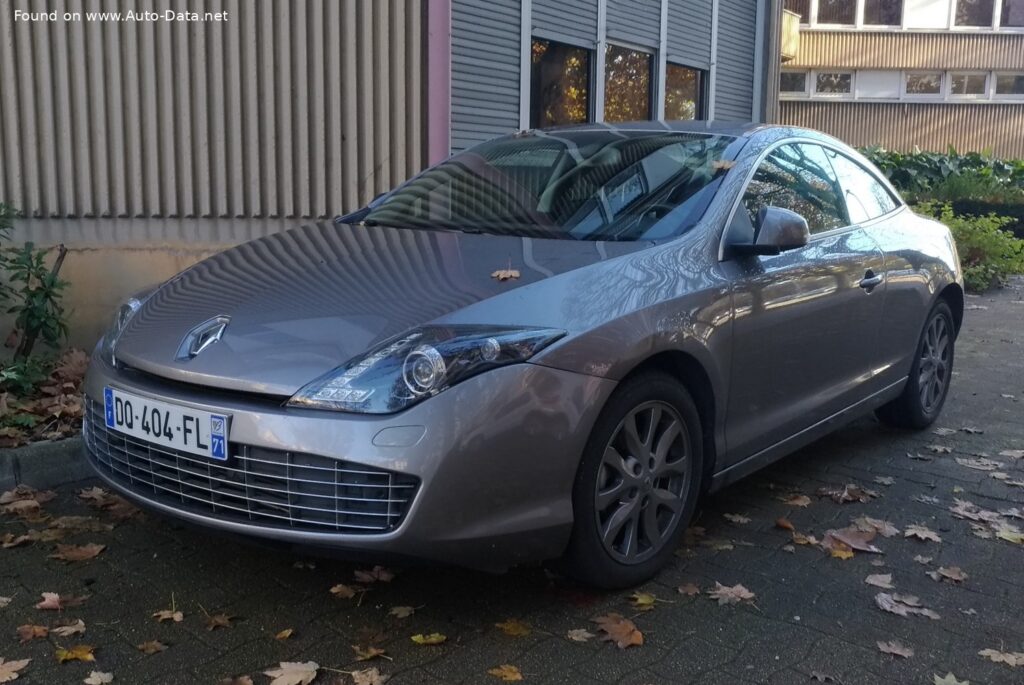
The Renault Laguna Coupe (Phase II) 2.0 Turbo (170 Hp) Automatic, produced between 2012 and 2015, represents a sophisticated and stylish offering from the French automaker, primarily targeting the European market. As a distinctive two-door, four-seat coupe, it carved out a niche for itself within the competitive grand tourer segment, blending elegant design with a comfortable, engaging driving experience. While not officially sold in the United States, this model exemplifies Renault’s commitment to combining aesthetic appeal with practical performance, offering a compelling package for buyers seeking a blend of luxury and everyday usability without the premium price tag of more exotic marques. The Phase II designation indicates a mid-cycle refresh, bringing subtle updates to its styling and perhaps minor mechanical refinements to keep it competitive during its production run.
Engine & Performance: The Heart of the Renault Laguna Coupe (Phase II) 2.0 Turbo (170 Hp) Automatic
At the core of the Laguna Coupe (Phase II) lies a robust 2.0-liter turbocharged inline-four engine, designated by Renault as the F4R. This powerplant is engineered for a harmonious blend of power delivery and efficiency, a characteristic highly valued in its primary European market. Generating a respectable 170 horsepower at 5000 revolutions per minute (rpm), the engine provides ample motivation for the coupe, allowing for confident highway cruising and spirited backroad excursions. Torque delivery is equally impressive, peaking at 199.14 pound-feet (270 Nm) at a relatively low 3250 rpm. This broad torque band ensures responsive acceleration across a wide range of engine speeds, minimizing the need for constant downshifts and contributing to a relaxed driving demeanor.
The F4R engine benefits from a twin-turbocharged setup, complemented by an intercooler, which optimizes air intake density for enhanced power output and efficiency. Fuel is delivered via a multi-port manifold injection system, ensuring precise fuel atomization and combustion. With a compression ratio of 9.5:1 and four valves per cylinder, the engine is designed for both performance and longevity. Mated to a smooth-shifting 6-speed automatic transmission, the powertrain delivers power seamlessly to the front wheels, prioritizing comfort and ease of use in diverse driving conditions.
Performance figures for the Laguna Coupe (Phase II) 2.0 Turbo (170 Hp) Automatic are competitive for its class. It accelerates from 0 to 60 miles per hour in a brisk 8.7 seconds, with the 0-100 km/h sprint completed in 9.2 seconds. Its top speed is rated at 136.7 mph (220 km/h), making it a capable performer on unrestricted European highways. Despite its performance capabilities, Renault engineered the Laguna Coupe for reasonable fuel economy. The combined fuel consumption is rated at 26.7 US mpg (8.8 liters per 100 km), which is commendable for a turbocharged gasoline engine of this era. Emissions are controlled to meet the Euro 4 standard, with CO2 output recorded at 207 grams per kilometer, reflecting a balance between performance and environmental considerations.
The vehicle’s weight-to-power ratio stands at 8.7 kg/Hp (114.9 Hp/tonne), while the weight-to-torque ratio is 5.5 kg/Nm (182.4 Nm/tonne). These figures underscore the engine’s ability to move the 3262.84-pound (1480 kg) curb weight with relative ease, contributing to the car’s agile feel and responsive nature.
Design & Features: Elegance and Practicality
The design of the Renault Laguna Coupe (Phase II) is characterized by its sleek, flowing lines and distinctive proportions, embodying a sense of understated elegance. As a two-door coupe, it offers a more sporting and personal aesthetic compared to its sedan counterpart. Its dimensions—182.8 inches in length, 71.34 inches in width (81.97 inches including mirrors), and 55.04 inches in height—give it a substantial yet graceful road presence. The long wheelbase of 106.06 inches contributes to both its stable ride quality and the spaciousness of its cabin.
Inside, the Laguna Coupe offers seating for four occupants, designed with comfort in mind for longer journeys. While specific interior features are not detailed, Renault typically equips its higher-tier models with premium materials, ergonomic layouts, and a good array of infotainment and convenience technologies for its time. The trunk space is practical for a coupe, offering 14.94 cubic feet (423 liters) of capacity, sufficient for weekend trips or daily errands. The fuel tank capacity of 17.44 US gallons (66 liters) further enhances its grand touring credentials, allowing for extended driving ranges between fill-ups.
Handling and ride comfort are key aspects of the Laguna Coupe’s appeal. It features an independent McPherson strut front suspension, known for its ability to balance ride comfort with precise steering response. The rear utilizes a semi-independent setup with coil springs, providing a compliant ride while maintaining good body control. Braking performance is assured by ventilated discs at the front and solid discs at the rear, complemented by an Anti-lock Braking System (ABS) for enhanced safety during emergency stops. The hydraulic power steering system, employing a rack and pinion setup, delivers tactile feedback to the driver, contributing to a more engaging driving experience. The car’s minimum turning circle ranges from 35.43 to 38.71 feet, indicating decent maneuverability for its size.
A notable design element is the vehicle’s low drag coefficient (Cd) of 0.30, which not only contributes to its aerodynamic efficiency and fuel economy but also reduces wind noise at higher speeds, enhancing cabin refinement. The car could be equipped with various tire sizes, including 185/65 R16, 215/50 R17, or 225/45 R18, mounted on corresponding 16, 17, or 18-inch wheel rims, allowing for customization of both aesthetics and handling characteristics.
Technical Specifications
Below is a comprehensive breakdown of the technical specifications for the Renault Laguna Coupe (Phase II) 2.0 Turbo (170 Hp) Automatic, providing a detailed look at its mechanical and dimensional characteristics.
| Brand | Renault |
| Model | Laguna |
| Generation | Laguna Coupe (Phase II) |
| Type (Engine) | 2.0 Turbo (170 Hp) Automatic |
| Start of production | 2012 year |
| End of production | 2015 year |
| Powertrain Architecture | Internal Combustion engine |
| Body type | Coupe |
| Seats | 4 |
| Doors | 2 |
| Fuel consumption (economy) – urban | 13 l/100 km (18.1 US mpg) |
| Fuel consumption (economy) – extra urban | 6.5 l/100 km (36.2 US mpg) |
| Fuel consumption (economy) – combined | 8.8 l/100 km (26.7 US mpg) |
| CO2 emissions | 207 g/km |
| Fuel Type | Petrol (Gasoline) |
| Acceleration 0 – 60 mph | 8.7 sec |
| Acceleration 0 – 100 km/h | 9.2 sec |
| Maximum speed | 220 km/h (136.7 mph) |
| Emission standard | Euro 4 |
| Weight-to-power ratio | 8.7 kg/Hp (114.9 Hp/tonne) |
| Weight-to-torque ratio | 5.5 kg/Nm (182.4 Nm/tonne) |
| Power | 170 Hp @ 5000 rpm |
| Power per liter | 85.1 Hp/l |
| Torque | 270 Nm @ 3250 rpm (199.14 lb.-ft. @ 3250 rpm) |
| Maximum engine speed | 6250 rpm |
| Engine layout | Front, Transverse |
| Engine Model/Code | F4R |
| Engine displacement | 1998 cm3 (121.93 cu. in.) |
| Number of cylinders | 4 |
| Engine configuration | Inline |
| Cylinder Bore | 82.7 mm (3.26 in.) |
| Piston Stroke | 93 mm (3.66 in.) |
| Compression ratio | 9.5:1 |
| Number of valves per cylinder | 4 |
| Fuel injection system | Multi-port manifold injection |
| Engine aspiration | Twin-Turbo, Intercooler |
| Engine oil capacity | 5.4 l (5.71 US qt) |
| Coolant | 7.7 l (8.14 US qt) |
| Kerb Weight | 1480 kg (3262.84 lbs) |
| Max. weight | 1950 kg (4299.01 lbs) |
| Max load | 470 kg (1036.17 lbs) |
| Trunk (boot) space – minimum | 423 l (14.94 cu. ft.) |
| Fuel tank capacity | 66 l (17.44 US gal) |
| Permitted trailer load with brakes (12%) | 1300 kg (2866.01 lbs) |
| Permitted trailer load without brakes | 650 kg (1433 lbs) |
| Length | 4643 mm (182.8 in.) |
| Width | 1812 mm (71.34 in.) |
| Width including mirrors | 2082 mm (81.97 in.) |
| Height | 1398 mm (55.04 in.) |
| Wheelbase | 2694 mm (106.06 in.) |
| Front track | 1548 mm (60.94 in.) |
| Rear (Back) track | 1542 mm (60.71 in.) |
| Front overhang | 1022 mm (40.24 in.) |
| Rear overhang | 927 mm (36.5 in.) |
| Ride height (ground clearance) | 120 mm (4.72 in.) |
| Drag coefficient (Cd) | 0.30 |
| Minimum turning circle (turning diameter) | 10.8-11.8 m (35.43 – 38.71 ft.) |
| Drivetrain Architecture | Front wheel drive (Internal Combustion engine) |
| Drive wheel | Front wheel drive |
| Number of gears and type of gearbox | 6 gears, automatic transmission |
| Front suspension | Independent type McPherson |
| Rear suspension | Semi-independent, coil spring |
| Front brakes | Ventilated discs |
| Rear brakes | Disc |
| Assisting systems | ABS (Anti-lock braking system) |
| Steering type | Steering rack and pinion |
| Power steering | Hydraulic Steering |
| Tires size | 185/65 R16; 215/50 R17; 225/45 R18 |
| Wheel rims size | 16; 17; 18 |