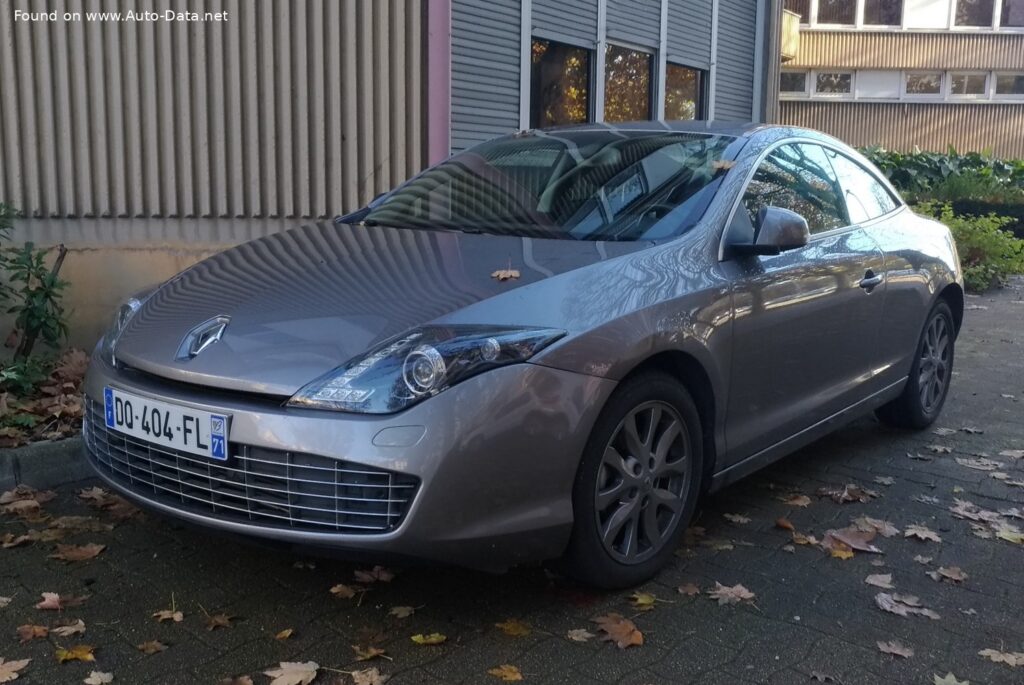
The Renault Laguna Coupe (Phase II) 2.0 Turbo (204 Hp), produced from 2012 to 2015, represented a compelling offering in the European D-segment coupe market. As a sophisticated two-door variant of the third-generation Laguna, this particular iteration showcased Renault’s commitment to combining elegant styling with spirited performance and practicality. While not officially sold in the United States, the Laguna Coupe was a significant player in its primary European market, aiming to capture buyers seeking a blend of grand touring comfort, distinctive design, and a dynamic driving experience. This Phase II model brought refined aesthetics and updated technical specifications, ensuring its competitive edge in a segment increasingly focused on premium appeal and efficiency.
The Renault Laguna Coupe (Phase II) 2.0 Turbo (204 Hp): Engineering and Performance
At the heart of the Laguna Coupe (Phase II) 2.0 Turbo (204 Hp) lies a robust and efficient 2.0-liter inline-four engine, designated with the F4R code. This powerplant, engineered for a balance of performance and fuel economy, utilizes a multi-port manifold injection system and benefits from twin-turbocharging coupled with an intercooler. This sophisticated setup allows the engine to produce a respectable 204 horsepower at 5000 revolutions per minute, delivering a power-per-liter output of 102.1 HP/l, a commendable figure for its era. More impressively, the engine generates a substantial 221.27 pound-feet of torque at a relatively low 3000 rpm, providing a broad and accessible powerband that makes for responsive acceleration in everyday driving conditions.
Mated to a precise 6-speed manual transmission, the front-wheel-drive architecture ensures engaging control for the driver. The vehicle’s performance figures underscore its sporting intentions: it accelerates from 0 to 60 mph in a swift 7.4 seconds (calculated by Auto-Data.net) and reaches a maximum speed of 144.16 mph. These metrics position the Laguna Coupe 2.0 Turbo as a capable performer within its class, offering both straight-line speed and the agility expected of a European coupe. Despite its performance capabilities, Renault also focused on efficiency. The combined fuel economy is rated at 28.7 US mpg (8.2 l/100 km), with urban consumption at 20.5 US mpg and extra-urban at an impressive 36.2 US mpg. This balance of power and parsimony was crucial for European markets, where fuel costs and emissions regulations are significant considerations. The vehicle’s CO2 emissions stand at 194 g/km, adhering to the Euro 4 emission standard, which was relevant for its production period.
The engine’s technical details further highlight its thoughtful design. With a displacement of 1998 cubic centimeters (121.93 cu. in.), a bore of 3.26 inches, and a stroke of 3.66 inches, the engine features a conservative 9:1 compression ratio, optimized for forced induction. Four valves per cylinder contribute to efficient breathing and combustion, while a maximum engine speed of 6500 rpm indicates its willingness to rev. The engine oil capacity is 5.4 liters, and the coolant system holds 7.5 liters, indicating robust thermal management for sustained performance.
Design and Features of the Laguna Coupe (Phase II)
The Renault Laguna Coupe (Phase II) is instantly recognizable by its sleek, flowing lines and distinctive silhouette. As a two-door, four-seat coupe, its design eschews the more conventional sedan form for a sportier, more elegant aesthetic. Measuring 182.8 inches in length, 71.34 inches in width (81.97 inches including mirrors), and 55.04 inches in height, the Laguna Coupe possesses a substantial road presence. Its long wheelbase of 106.06 inches contributes to both its graceful profile and its stable ride quality, while a low drag coefficient of 0.30 aids in both aerodynamic efficiency and reduced wind noise at higher speeds.
The exterior styling of the Phase II model refined the original Laguna Coupe’s already attractive design, featuring subtle updates that kept it fresh and contemporary. Its assertive front fascia, with sculpted headlights and an integrated grille, seamlessly flows into a muscular hood and pronounced fender flares. The side profile is characterized by a strong character line that rises towards the rear, emphasizing its dynamic stance. The rear design is equally striking, often featuring sophisticated LED taillights and a smoothly integrated trunk lid that hints at its practical side. The vehicle offered a choice of tire sizes, from 185/65 R16 to more performance-oriented 225/45 R18, mounted on corresponding 16, 17, or 18-inch wheel rims, allowing for customization of both aesthetics and handling characteristics.
Inside, the Laguna Coupe offers a refined and comfortable cabin, designed to accommodate four occupants. Despite its coupe designation, the trunk space is surprisingly generous, providing 14.94 cubic feet (423 liters) of cargo capacity, making it practical for weekend getaways or daily use. The fuel tank capacity of 17.44 US gallons ensures a decent cruising range between fill-ups. Safety features are paramount, and the Laguna Coupe comes equipped with an Anti-lock Braking System (ABS) as standard, enhancing control during emergency braking maneuvers. The braking system itself comprises ventilated discs at the front and solid discs at the rear, providing strong and consistent stopping power. The steering system is a hydraulic rack and pinion setup, offering direct feedback and a connected feel to the road, which enthusiasts often prefer over purely electric systems. The suspension architecture, featuring an independent McPherson type at the front and a semi-independent coil spring setup at the rear, is tuned to provide a comfortable ride without sacrificing dynamic handling. With a curb weight of 3148.2 pounds, the car achieves a weight-to-power ratio of 7 kg/HP, further contributing to its agile feel.
Market Positioning and Legacy
The Renault Laguna Coupe (Phase II) 2.0 Turbo (204 Hp) occupied a niche in the European market, appealing to buyers who desired something more distinctive than a conventional sedan but still required a degree of practicality and comfort. It competed with other European coupes, often from more premium brands, by offering a unique blend of French design flair, a well-appointed interior, and competent performance at a competitive price point. Its role was to elevate Renault’s image, showcasing its ability to produce stylish, emotionally resonant vehicles beyond its core family car offerings. The Laguna Coupe, with its elegant proportions and refined driving dynamics, served as a halo car for the Laguna range, demonstrating Renault’s engineering prowess and design philosophy.
Though its production run concluded in 2015, the Laguna Coupe remains a testament to Renault’s ambition in the premium and sporting segments. It highlighted the brand’s capacity to deliver sophisticated powertrains and chassis tuning, combined with a focus on passenger comfort and aesthetic appeal. For those in its primary markets, it offered a compelling alternative that stood out from its German and Japanese rivals, embodying a distinctive French interpretation of the modern grand touring coupe. Its legacy is one of understated elegance and a balanced approach to performance and luxury, making it a memorable chapter in Renault’s recent history.
Technical Specifications
| Brand | Renault |
| Model | Laguna |
| Generation | Laguna Coupe (Phase II) |
| Type (Engine) | 2.0 Turbo (204 Hp) |
| Start of production | 2012 year |
| End of production | 2015 year |
| Powertrain Architecture | Internal Combustion engine |
| Body type | Coupe |
| Seats | 4 |
| Doors | 2 |
| Fuel consumption (economy) – urban | 11.5 l/100 km (20.5 US mpg) |
| Fuel consumption (economy) – extra urban | 6.5 l/100 km (36.2 US mpg) |
| Fuel consumption (economy) – combined | 8.2 l/100 km (28.7 US mpg) |
| CO2 emissions | 194 g/km |
| Fuel Type | Petrol (Gasoline) |
| Acceleration 0 – 60 mph | 7.4 sec |
| Acceleration 0 – 100 km/h | 7.8 sec |
| Maximum speed | 232 km/h (144.16 mph) |
| Emission standard | Euro 4 |
| Weight-to-power ratio | 7 kg/Hp (142.9 Hp/tonne) |
| Weight-to-torque ratio | 4.8 kg/Nm (210.1 Nm/tonne) |
| Power | 204 Hp @ 5000 rpm |
| Power per liter | 102.1 Hp/l |
| Torque | 300 Nm @ 3000 rpm (221.27 lb.-ft.) |
| Maximum engine speed | 6500 rpm |
| Engine layout | Front, Transverse |
| Engine Model/Code | F4R |
| Engine displacement | 1998 cm3 (121.93 cu. in.) |
| Number of cylinders | 4 |
| Engine configuration | Inline |
| Cylinder Bore | 82.7 mm (3.26 in.) |
| Piston Stroke | 93 mm (3.66 in.) |
| Compression ratio | 9:1 |
| Number of valves per cylinder | 4 |
| Fuel injection system | Multi-port manifold injection |
| Engine aspiration | Twin-Turbo, Intercooler |
| Engine oil capacity | 5.4 l (5.71 US qt) |
| Coolant | 7.5 l (7.93 US qt) |
| Kerb Weight | 1428 kg (3148.2 lbs) |
| Max. weight | 1923 kg (4239.49 lbs) |
| Max load | 495 kg (1091.29 lbs) |
| Trunk (boot) space – minimum | 423 l (14.94 cu. ft.) |
| Fuel tank capacity | 66 l (17.44 US gal) |
| Permitted trailer load with brakes (12%) | 1500 kg (3306.93 lbs) |
| Permitted trailer load without brakes | 650 kg (1433 lbs) |
| Length | 4643 mm (182.8 in.) |
| Width | 1812 mm (71.34 in.) |
| Width including mirrors | 2082 mm (81.97 in.) |
| Height | 1398 mm (55.04 in.) |
| Wheelbase | 2694 mm (106.06 in.) |
| Front track | 1548 mm (60.94 in.) |
| Rear (Back) track | 1542 mm (60.71 in.) |
| Front overhang | 1022 mm (40.24 in.) |
| Rear overhang | 927 mm (36.5 in.) |
| Ride height (ground clearance) | 120 mm (4.72 in.) |
| Drag coefficient (Cd) | 0.30 |
| Minimum turning circle (turning diameter) | 10.8-11.8 m (35.43 – 38.71 ft.) |
| Drivetrain Architecture | Front wheel drive, Internal Combustion engine |
| Drive wheel | Front wheel drive |
| Number of gears and type of gearbox | 6 gears, manual transmission |
| Front suspension | Independent type McPherson |
| Rear suspension | Semi-independent, coil spring |
| Front brakes | Ventilated discs |
| Rear brakes | Disc |
| Assisting systems | ABS (Anti-lock braking system) |
| Steering type | Steering rack and pinion |
| Power steering | Hydraulic Steering |
| Tires size | 185/65 R16; 215/50 R17; 225/45 R18 |
| Wheel rims size | 16; 17; 18 |