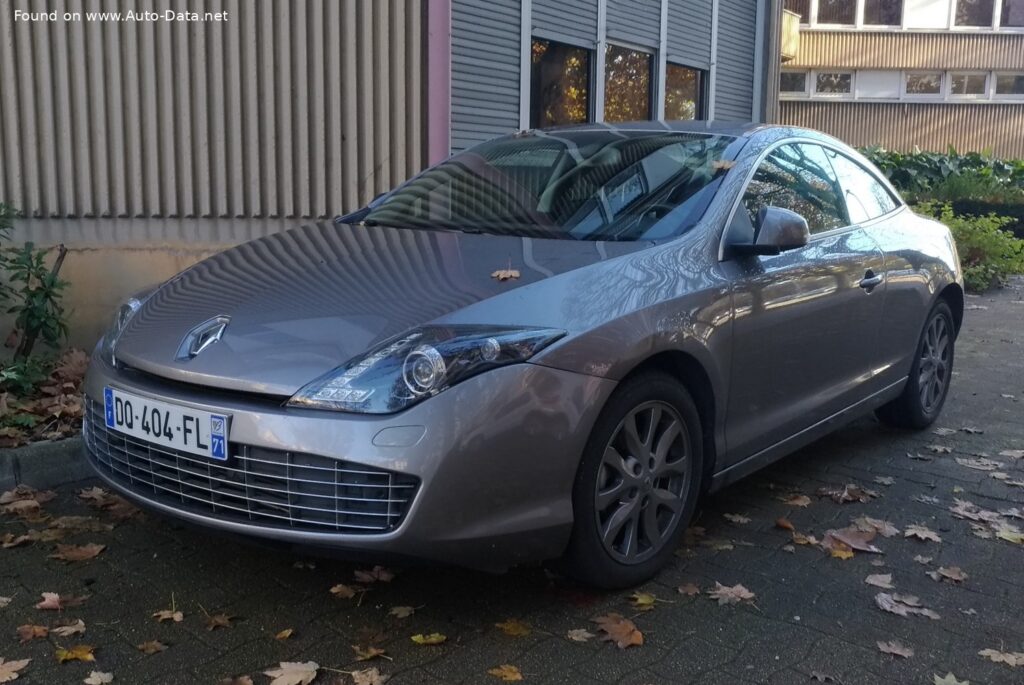
The Renault Laguna Coupe (Phase II) 3.0 V6 dCi (235 Hp) Automatic represents a sophisticated offering from the French automaker, Renault, designed primarily for the discerning European market. Produced between 2012 and 2015, this vehicle was a distinctive two-door, four-seat grand tourer, standing out in a segment often dominated by German rivals. As a Phase II iteration, it benefited from subtle refinements and updates over its predecessor, solidifying its position as a stylish and performance-oriented coupe. While never officially sold in the United States, its technical prowess and design philosophy offer a compelling glimpse into European automotive engineering, blending elegant aesthetics with a potent diesel powertrain and a focus on comfortable, long-distance touring. This particular configuration, featuring a robust 3.0-liter V6 dCi engine paired with an automatic transmission, was positioned at the upper end of the Laguna Coupe lineup, targeting buyers seeking a blend of luxury, dynamic performance, and impressive fuel efficiency for its class.
The Renault Laguna Coupe (Phase II): A Grand Tourer for the European Market
The Renault Laguna Coupe (Phase II) carved out a unique niche within the European automotive landscape. Emerging from a brand renowned for its innovative design and comfort, the Laguna Coupe was an ambitious venture into the premium coupe segment. Its role was to elevate Renault’s image, demonstrating a capacity for crafting vehicles that combined emotional appeal with robust engineering. Unlike its sedan and wagon siblings, the Coupe was conceived as a standalone design statement, sharing only its platform with the broader Laguna family, yet boasting a distinct identity. The “Phase II” designation indicates a mid-cycle refresh, typically involving minor styling tweaks, updated technology, and powertrain optimizations to keep the model competitive. For the 2012-2015 production run, the Laguna Coupe continued to emphasize a refined driving experience, superior comfort, and a commitment to safety, aligning with the expectations of European consumers who valued both elegance and practicality in a two-door format.
Its market segment, that of a mid-size executive coupe, placed it in direct competition with established players, though the Laguna Coupe often offered a more distinctive, less conventional choice. Renault aimed to provide a compelling alternative for buyers seeking something beyond the ubiquitous German marques, injecting French flair into the segment. The integration of advanced diesel technology, particularly with the 3.0 V6 dCi engine, was a strategic move to cater to Europe’s strong diesel preference, offering a blend of high torque, cruising refinement, and commendable fuel economy – qualities highly prized for long-distance European journeys. This specific variant, the Renault Laguna Coupe (Phase II) 3.0 V6 dCi (235 Hp) Automatic, therefore represented the pinnacle of Renault’s vision for a stylish, powerful, and efficient grand touring coupe.
Powertrain and Performance: The 3.0 V6 dCi Heart
Engine Architecture and Power Delivery
At the core of the Renault Laguna Coupe (Phase II)’s performance lies the impressive 3.0 V6 dCi engine, designated internally as the V9X. This powerplant is a testament to modern diesel engineering, offering a compelling blend of power, torque, and efficiency. With a displacement of 2993 cubic centimeters (approximately 3.0 liters or 182.64 cubic inches), this V-engine configuration features six cylinders, each with four valves, totaling 24 valves for optimal breathing. The engine layout is front, transverse, driving the front wheels, a common configuration for European vehicles prioritizing interior space and packaging efficiency. Key specifications include an 84 mm (3.31 in) cylinder bore and a 90 mm (3.54 in) piston stroke, resulting in a compression ratio of 16:1, typical for a direct-injection diesel.
The V9X engine generates a robust 235 horsepower at 3750 revolutions per minute, delivering a power output of 78.5 horsepower per liter. However, the true strength of this diesel lies in its prodigious torque output: a staggering 450 Newton-meters (331.9 lb.-ft.) available from a remarkably low 1500 rpm. This broad and accessible torque band is a hallmark of turbocharged diesel engines, providing effortless acceleration and strong in-gear flexibility, making it ideal for both city driving and high-speed highway cruising. Power delivery is further enhanced by a turbocharger and intercooler system, ensuring efficient combustion and a responsive throttle. The engine is mated to a 6-speed automatic transmission, providing smooth and seamless gear changes, perfectly complementing the engine’s power characteristics for a refined driving experience. With a maximum engine speed of 5000 rpm, the V6 dCi provides a surprisingly broad powerband for a diesel.
Performance figures for the Laguna Coupe 3.0 V6 dCi are competitive for its class. It accelerates from 0 to 60 miles per hour in a brisk 6.9 seconds (calculated by Auto-Data.net), and from 0 to 100 kilometers per hour in 7.3 seconds. The top speed is an impressive 242 kilometers per hour, or 150.37 miles per hour, underscoring its capabilities as a true grand tourer. The weight-to-power ratio stands at 6.9 kg/Hp (144.2 Hp/tonne), while the weight-to-torque ratio is 3.6 kg/Nm (276.1 Nm/tonne), indicating a well-balanced power-to-weight characteristic that translates into confident and engaging performance.
Fuel Efficiency and Emissions
Despite its performance credentials, the 3.0 V6 dCi engine also prioritizes fuel efficiency, a crucial factor in the European market. The combined fuel consumption is rated at 7.2 liters per 100 kilometers, which translates to an impressive 32.7 US miles per gallon or 39.2 UK miles per gallon. For urban driving, the consumption rises to 10.6 liters per 100 kilometers (22.2 US mpg), while extra-urban cruising sees it drop to a frugal 5.7 liters per 100 kilometers (41.3 US mpg). These figures highlight the inherent efficiency advantages of modern diesel engines, particularly for highway travel. The fuel tank capacity of 66 liters (17.44 US gallons) ensures a substantial cruising range between fill-ups.
In terms of environmental impact, the Laguna Coupe 3.0 V6 dCi produces 192 grams of CO2 per kilometer, adhering to the Euro 4 emission standard. While this standard has been superseded by stricter regulations in newer vehicles, it was a respectable figure for its production era (2012-2015), reflecting Renault’s commitment to balancing performance with environmental responsibility through its advanced Diesel Commonrail fuel injection system.
Exterior Design and Interior Refinement of the Renault Laguna Coupe (Phase II)
The design of the Renault Laguna Coupe (Phase II) is arguably its most striking feature. As a two-door coupe with four seats, it exudes a sophisticated and athletic presence. Its silhouette is sleek and flowing, characterized by a long hood, a gracefully sloping roofline, and a muscular rear end. The overall aesthetic is one of understated elegance, avoiding overly aggressive styling in favor of timeless proportions. The Phase II updates were subtle, maintaining the original design’s integrity while perhaps incorporating minor tweaks to lighting elements, grille details, or wheel designs to keep it fresh. The drag coefficient (Cd) of 0.30 is a testament to its aerodynamic efficiency, contributing to both fuel economy and reduced wind noise at speed.
Dimensionally, the Laguna Coupe measures 4643 mm (182.8 inches) in length, 1812 mm (71.34 inches) in width (2082 mm or 81.97 inches including mirrors), and 1398 mm (55.04 inches) in height. Its wheelbase of 2694 mm (106.06 inches) contributes to a stable ride and generous cabin space for a coupe. The front and rear tracks are 1548 mm (60.94 inches) and 1542 mm (60.71 inches), respectively, providing a wide stance for improved handling. Despite its coupe profile, the Laguna offers a respectable minimum trunk (boot) space of 423 liters (14.94 cubic feet), making it practical enough for weekend getaways or daily use. The minimum turning circle of 10.8-11.8 meters (35.43 – 38.71 feet) indicates good maneuverability for its size.
Chassis, Drivetrain, and Safety Systems
The chassis of the Laguna Coupe (Phase II) was engineered to provide a comfortable yet engaging driving experience. It features an independent McPherson-type front suspension, a widely used and effective setup for balancing ride comfort and handling precision. The rear suspension is a semi-independent coil spring design, offering a good compromise between cost, packaging, and dynamic performance for a front-wheel-drive vehicle. The drivetrain architecture is front-wheel drive, with the internal combustion engine driving the front wheels, a typical layout for Renault models emphasizing stability and predictable handling.
Braking performance is handled by ventilated discs at the front and disc brakes at the rear, providing strong and consistent stopping power. These are complemented by an Anti-lock Braking System (ABS), a fundamental safety feature that prevents wheel lock-up during hard braking, maintaining steering control. The steering system is a hydraulic rack and pinion setup, known for providing a more direct and communicative feel compared to purely electric power steering systems, enhancing driver involvement. The vehicle typically came with tire sizes of 215/50 R17 or 225/45 R18, mounted on corresponding 17-inch or 18-inch wheel rims, providing a balance of grip, comfort, and aesthetic appeal. With a kerb weight of 1630 kg (3593.53 lbs.) and a maximum permissible weight of 2050 kg (4519.48 lbs.), the Laguna Coupe is a substantial vehicle, capable of carrying a maximum load of 420 kg (925.94 lbs.). It also has a permitted trailer load with brakes of 1500 kg (3306.93 lbs.), and 650 kg (1433 lbs.) without brakes, adding to its versatility.
Technical Specifications
| Brand | Renault |
| Model | Laguna |
| Generation | Laguna Coupe (Phase II) |
| Type (Engine) | 3.0 V6 dCi (235 Hp) Automatic |
| Start of production | 2012 year |
| End of production | 2015 year |
| Powertrain Architecture | Internal Combustion engine |
| Body type | Coupe |
| Seats | 4 |
| Doors | 2 |
| Fuel consumption (economy) – urban | 10.6 l/100 km (22.2 US mpg) |
| Fuel consumption (economy) – extra urban | 5.7 l/100 km (41.3 US mpg) |
| Fuel consumption (economy) – combined | 7.2 l/100 km (32.7 US mpg) |
| CO2 emissions | 192 g/km |
| Fuel Type | Diesel |
| Acceleration 0 – 100 km/h | 7.3 sec |
| Acceleration 0 – 62 mph | 7.3 sec |
| Acceleration 0 – 60 mph (Calculated by Auto-Data.net) | 6.9 sec |
| Maximum speed | 242 km/h (150.37 mph) |
| Emission standard | Euro 4 |
| Weight-to-power ratio | 6.9 kg/Hp (144.2 Hp/tonne) |
| Weight-to-torque ratio | 3.6 kg/Nm (276.1 Nm/tonne) |
| Power | 235 Hp @ 3750 rpm. |
| Power per litre | 78.5 Hp/l |
| Torque | 450 Nm @ 1500 rpm. (331.9 lb.-ft. @ 1500 rpm) |
| Maximum engine speed | 5000 rpm. |
| Engine layout | Front, Transverse |
| Engine Model/Code | V9X |
| Engine displacement | 2993 cm3 (182.64 cu. in.) |
| Number of cylinders | 6 |
| Engine configuration | V-engine |
| Cylinder Bore | 84 mm (3.31 in.) |
| Piston Stroke | 90 mm (3.54 in.) |
| Compression ratio | 16:1 |
| Number of valves per cylinder | 4 |
| Fuel injection system | Diesel Commonrail |
| Engine aspiration | Turbocharger, Intercooler |
| Engine oil capacity | 6.8 l (7.19 US qt | 5.98 UK qt) |
| Coolant | 9.2 l (9.72 US qt | 8.09 UK qt) |
| Kerb Weight | 1630 kg (3593.53 lbs.) |
| Max. weight | 2050 kg (4519.48 lbs.) |
| Max load | 420 kg (925.94 lbs.) |
| Trunk (boot) space – minimum | 423 l (14.94 cu. ft.) |
| Fuel tank capacity | 66 l (17.44 US gal | 14.52 UK gal) |
| Permitted trailer load with brakes (12%) | 1500 kg (3306.93 lbs.) |
| Permitted trailer load without brakes | 650 kg (1433 lbs.) |
| Length | 4643 mm (182.8 in.) |
| Width | 1812 mm (71.34 in.) |
| Width including mirrors | 2082 mm (81.97 in.) |
| Height | 1398 mm (55.04 in.) |
| Wheelbase | 2694 mm (106.06 in.) |
| Front track | 1548 mm (60.94 in.) |
| Rear (Back) track | 1542 mm (60.71 in.) |
| Front overhang | 1022 mm (40.24 in.) |
| Rear overhang | 927 mm (36.5 in.) |
| Ride height (ground clearance) | 120 mm (4.72 in.) |
| Drag coefficient (Cd) | 0.30 |
| Minimum turning circle (turning diameter) | 10.8-11.8 m (35.43 – 38.71 ft.) |
| Drivetrain Architecture | The Internal combustion engine (ICE) drives the front wheels of the vehicle. |
| Drive wheel | Front wheel drive |
| Number of gears and type of gearbox | 6 gears, automatic transmission |
| Front suspension | Independent type McPherson |
| Rear suspension | Semi-independent, coil spring |
| Front brakes | Ventilated discs |
| Rear brakes | Disc |
| Assisting systems | ABS (Anti-lock braking system) |
| Steering type | Steering rack and pinion |
| Power steering | Hydraulic Steering |
| Tires size | 215/50 R17; 225/45 R18 |
| Wheel rims size | 17; 18 |