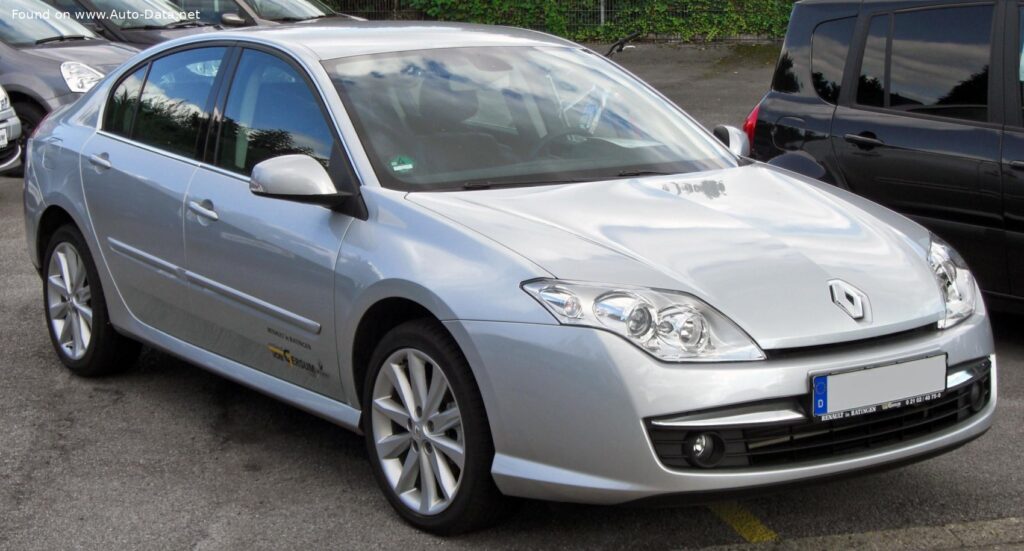
The Renault Laguna III 2.0 dCi FAP (131 Hp) is a compact executive car produced by the French manufacturer Renault between 2007 and 2010. Representing the third generation of the Laguna, this model aimed to compete with established rivals like the Ford Mondeo, Vauxhall/Opel Vectra, and Peugeot 407. While not officially sold in the United States, the Laguna was a significant vehicle in the European market, offering a blend of comfort, practicality, and modern technology for its time. The “dCi FAP” designation indicates a common-rail direct injection diesel engine equipped with a particulate filter, reflecting growing environmental concerns and stricter emissions regulations in Europe.
Renault Laguna III 2.0 dCi FAP: An Overview
The Laguna III represented a substantial step forward for Renault in terms of design and build quality. It moved away from the somewhat controversial styling of the second generation, adopting a more conservative and refined aesthetic. The 2.0 dCi FAP variant was a popular choice, offering a balance between fuel efficiency and performance. It was positioned as a practical and comfortable family car, suitable for both daily commuting and longer journeys. The Laguna III was available in both hatchback and estate (wagon) body styles, with the hatchback being the more common configuration.
Engine & Performance
At the heart of the Laguna III 2.0 dCi FAP lies a 1,995 cc (121.74 cu. in.) inline-four cylinder diesel engine. This engine, designated M9R, produces 131 horsepower (Hp) at 4,000 rpm and 320 Newton-meters (236.02 lb.-ft.) of torque at 2,000 rpm. The engine utilizes a turbocharger and intercooler to enhance performance and efficiency. Power is delivered to the front wheels via a six-speed manual transmission. Acceleration from 0 to 100 km/h (0-62 mph) takes 10.6 seconds, while 0 to 60 mph is achieved in approximately 10.1 seconds. The top speed is rated at 203 km/h (126.14 mph). The engine’s specific output is 65.7 Hp per liter, demonstrating a reasonable level of power extraction from its displacement.
Fuel economy is a strong point of the 2.0 dCi FAP. Combined fuel consumption is rated at 6 liters per 100 kilometers (39.2 US mpg, 47.1 UK mpg, 16.7 km/l). In urban driving, it achieves 7.8 l/100 km (30.2 US mpg, 36.2 UK mpg, 12.8 km/l), while extra-urban consumption drops to 5.1 l/100 km (46.1 US mpg, 55.4 UK mpg, 19.6 km/l). The inclusion of a diesel particulate filter (FAP) ensures compliance with Euro 4 emission standards, reducing harmful particulate matter emissions.
Design & Features
The Renault Laguna III 2.0 dCi FAP is a five-door hatchback, offering a practical and spacious interior for five occupants. The design is characterized by clean lines and a relatively understated aesthetic. Key features include a comfortable cabin, a well-equipped dashboard, and a generous amount of trunk space – 508 liters (17.94 cu. ft.) minimum. The car’s kerb weight is 1,555 kg (3,428.19 lbs), with a maximum permissible weight of 2,025 kg (4,464.36 lbs) and a maximum load capacity of 470 kg (1,036.17 lbs).
Safety features were becoming increasingly important during the Laguna III’s production run. The car is equipped with an Anti-lock Braking System (ABS) as standard, contributing to improved braking performance and stability. The steering system utilizes a hydraulic power steering rack and pinion for precise and responsive handling. The vehicle rides on 205/60 R16 tires mounted on 16-inch wheel rims. The Laguna III aimed to provide a comfortable and safe driving experience, making it a viable option for families and individuals alike.
Technical Specifications
| Brand | Renault |
| Model | Laguna |
| Generation | Laguna III |
| Type (Engine) | 2.0 dCi FAP (131 Hp) |
| Start of production | 2007 |
| End of production | 2010 |
| Powertrain Architecture | Internal Combustion engine |
| Body type | Hatchback |
| Seats | 5 |
| Doors | 5 |
| Fuel consumption (urban) | 7.8 l/100 km (30.2 US mpg, 36.2 UK mpg, 12.8 km/l) |
| Fuel consumption (extra urban) | 5.1 l/100 km (46.1 US mpg, 55.4 UK mpg, 19.6 km/l) |
| Fuel consumption (combined) | 6 l/100 km (39.2 US mpg, 47.1 UK mpg, 16.7 km/l) |
| Fuel Type | Diesel |
| Acceleration 0 – 100 km/h | 10.6 sec |
| Acceleration 0 – 62 mph | 10.6 sec |
| Acceleration 0 – 60 mph | 10.1 sec |
| Maximum speed | 203 km/h (126.14 mph) |
| Emission standard | Euro 4 |
| Weight-to-power ratio | 11.9 kg/Hp |
| Weight-to-torque ratio | 4.9 kg/Nm |
| Power | 131 Hp @ 4000 rpm |
| Torque | 320 Nm @ 2000 rpm (236.02 lb.-ft. @ 2000 rpm) |
| Engine layout | Front, Transverse |
| Engine Model/Code | M9R |
| Engine displacement | 1995 cm3 (121.74 cu. in.) |
| Number of cylinders | 4 |
| Engine configuration | Inline |
| Number of valves per cylinder | 4 |
| Fuel injection system | Diesel Commonrail |
| Engine aspiration | Turbocharger, Intercooler |
| Engine oil capacity | 6.6 l (6.97 US qt | 5.81 UK qt) |
| Coolant capacity | 7.8 l (8.24 US qt | 6.86 UK qt) |
| Kerb Weight | 1555 kg (3428.19 lbs.) |
| Max. weight | 2025 kg (4464.36 lbs.) |
| Max load | 470 kg (1036.17 lbs.) |
| Trunk (boot) space – minimum | 508 l (17.94 cu. ft.) |
| Fuel tank capacity | 66 l (17.44 US gal | 14.52 UK gal) |
| Length | 4803 mm (189.09 in.) |
| Width | 1811 mm (71.3 in.) |
| Height | 1445 mm (56.89 in.) |
| Wheelbase | 2756 mm (108.5 in.) |
| Drivetrain | Front wheel drive |
| Number of gears | 6 gears, manual transmission |