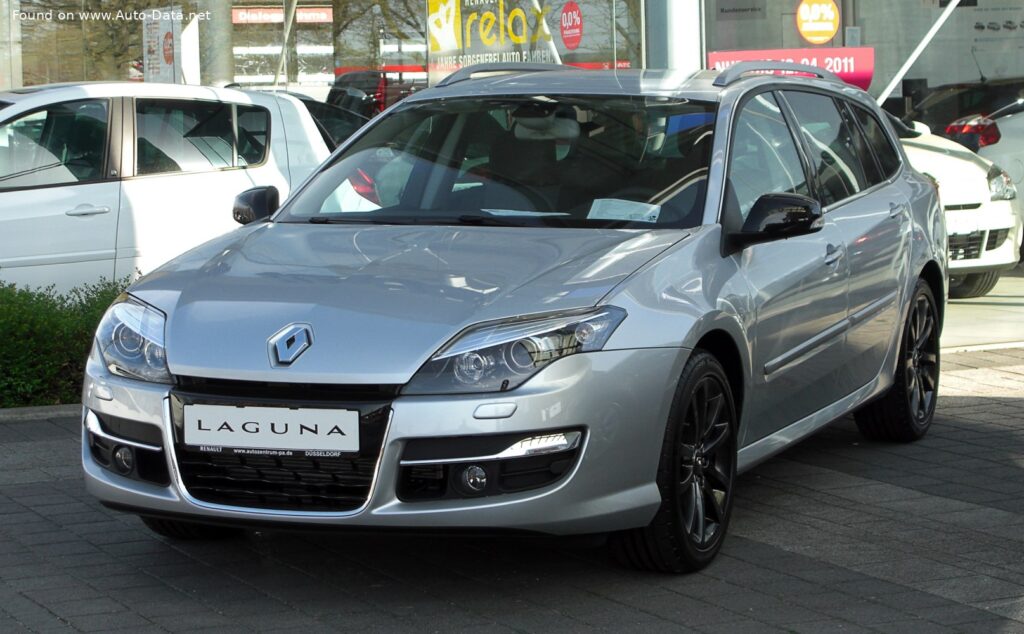
The Renault Laguna III Grandtour (Phase II) GT 2.0 dCi, produced from 2010 to 2015, represents a significant evolution in Renault’s mid-size offerings. As a station wagon (estate) body style, it aimed to combine practicality with a degree of sporting flair, particularly in the GT trim level. While the Laguna nameplate was discontinued in 2015, the III generation, and specifically the Grandtour variant, offered a compelling package for European buyers seeking a comfortable, well-equipped, and relatively efficient family vehicle. The Laguna was never officially sold in the United States, but it was a popular choice in Europe, competing with vehicles like the Ford Mondeo, Volkswagen Passat, and Peugeot 508.
Renault Laguna III Grandtour GT 2.0 dCi: An Overview
The Laguna III, launched in 2007, was Renault’s attempt to move upmarket and challenge established players in the D-segment. The Grandtour, the station wagon version, added a crucial element of versatility. The Phase II update, introduced in 2010, brought styling revisions, improved interior quality, and, importantly, more efficient engine options. The GT 2.0 dCi model, with its 173 horsepower diesel engine and standard Start & Stop technology, was positioned as the performance-oriented version of the Grandtour, offering a balance between fuel economy and driving enjoyment.
Engine & Performance
The heart of the Laguna III Grandtour GT 2.0 dCi is Renault’s M9R engine, a 2.0-liter inline four-cylinder diesel. This engine produces 173 horsepower (Hp) and 360 Newton-meters (265.52 lb.-ft.) of torque. The engine utilizes a turbocharger with an intercooler and a diesel commonrail fuel injection system to optimize performance and efficiency. Power is delivered to the front wheels via a six-speed manual transmission. Acceleration from 0 to 100 km/h (0-62 mph) takes 9.3 seconds, while 0 to 60 mph is achieved in a calculated 8.8 seconds. The top speed is electronically limited to 210 km/h (130.49 mph). The inclusion of the Start & Stop system contributes to improved fuel economy, particularly in urban driving conditions. Fuel consumption figures are rated at 5.5 l/100 km (42.8 US mpg) in the urban cycle, 4.1 l/100 km (57.4 US mpg) in the extra-urban cycle, and 4.6 l/100 km (51.1 US mpg) combined. CO2 emissions are rated at 120 g/km, placing it within Euro 5 emission standards.
Design & Features
The Laguna III Grandtour boasts a sleek, contemporary design typical of early 21st-century European styling. The Grandtour body style offers a generous 508 liters (17.94 cu. ft.) of trunk space with the rear seats up, expanding to a substantial 1593 liters (56.26 cu. ft.) when the seats are folded down. The GT trim level adds several distinctive features, including unique alloy wheels (18-inch), a sport-tuned suspension, and subtle aerodynamic enhancements. Inside, the Laguna III Grandtour offers seating for five passengers and features a well-appointed interior with a focus on comfort and practicality. Standard equipment typically includes air conditioning, power windows, a radio/CD player, and ABS brakes. Safety features were a key consideration, with the Laguna III receiving good ratings in Euro NCAP crash tests. The Phase II update brought improvements to interior materials and ergonomics, enhancing the overall driving experience. The vehicle’s kerb weight is 1505 kg (3317.96 lbs), with a maximum permissible weight of 2051 kg (4521.68 lbs).
Technical Specifications
| Brand | Renault |
| Model | Laguna |
| Generation | Laguna III Grandtour (Phase II) |
| Type (Engine) | GT 2.0 dCi (173 Hp) start&stop |
| Start of production | 2010 |
| End of production | 2015 |
| Powertrain Architecture | Internal Combustion engine |
| Body type | Station wagon (estate) |
| Seats | 5 |
| Doors | 5 |
| Fuel consumption (urban) | 5.5 l/100 km (42.8 US mpg) |
| Fuel consumption (extra urban) | 4.1 l/100 km (57.4 US mpg) |
| Fuel consumption (combined) | 4.6 l/100 km (51.1 US mpg) |
| CO2 emissions | 120 g/km |
| Fuel Type | Diesel |
| Acceleration 0 – 100 km/h | 9.3 sec |
| Acceleration 0 – 62 mph | 9.3 sec |
| Acceleration 0 – 60 mph | 8.8 sec |
| Maximum speed | 210 km/h (130.49 mph) |
| Emission standard | Euro 5 |
| Weight-to-power ratio | 8.7 kg/Hp |
| Weight-to-torque ratio | 4.2 kg/Nm |
| Power | 173 Hp |
| Torque | 360 Nm (265.52 lb.-ft.) |
| Engine layout | Front, Transverse |
| Engine Model/Code | M9R |
| Engine displacement | 1995 cm3 (121.74 cu. in.) |
| Engine configuration | Inline |
| Fuel injection system | Diesel Commonrail |
| Engine oil capacity | 7.4 l (7.82 US qt | 6.51 UK qt) |
| Coolant capacity | 7.8 l (8.24 US qt | 6.86 UK qt) |
| Kerb Weight | 1505 kg (3317.96 lbs.) |
| Max. weight | 2051 kg (4521.68 lbs.) |
| Max load | 546 kg (1203.72 lbs.) |
| Trunk (boot) space – minimum | 508 l (17.94 cu. ft.) |
| Trunk (boot) space – maximum | 1593 l (56.26 cu. ft.) |
| Fuel tank capacity | 66 l (17.44 US gal | 14.52 UK gal) |
| Length | 4803 mm (189.09 in.) |
| Width | 1811 mm (71.3 in.) |
| Minimum turning circle | 10.3 m (33.79 ft.) |
| Drive wheel | Front wheel drive |
| Number of gears | 6 gears, manual transmission |
| Front brakes | Ventilated discs |
| Rear brakes | Disc |
| Tires size | 225/45 R18 |
| Wheel rims size | 18 |
The Renault Laguna III Grandtour GT 2.0 dCi (Phase II) offered a compelling blend of practicality, performance, and efficiency for European buyers. While not sold in the US market, it represents a significant example of Renault’s engineering capabilities and its commitment to providing a competitive offering in the mid-size segment. Its combination of a refined diesel engine, spacious interior, and well-equipped features made it a popular choice for families and individuals alike.