Renault Megane II Classic 1.9 dCi (130 Hp) FAP: A Detailed Overview
The Renault Megane II Classic 1.9 dCi (130 Hp) FAP represents a significant offering within the European C-segment during the mid-2000s. Launched as part of the second generation of the highly successful Renault Megane line, the “Classic” variant specifically denoted the four-door sedan body style, which catered to a distinct market preference for more traditional three-box designs, particularly in Southern and Eastern Europe, as well as several Asian and Latin American markets. While the Megane II hatchback gained notoriety for its unconventional “bustle-back” rear styling, the Classic sedan adopted a more conservative and elegant profile. Produced for a concise period in 2005, this particular iteration, powered by a 1.9-liter dCi diesel engine, emphasized a blend of fuel efficiency, robust performance, and compliance with the then-emerging Euro 4 emission standards, thanks to its integrated Particulate Filter (FAP). As a model primarily focused on non-North American markets, the Megane II Classic was a testament to Renault’s engineering prowess in delivering competitive and environmentally conscious vehicles for its global audience.
Engine and Performance: The Heart of the Renault Megane II Classic 1.9 dCi (130 Hp) FAP
At the core of the Renault Megane II Classic 1.9 dCi (130 Hp) FAP lies a potent and efficient F9Q series 1.9-liter (1870 cm3 or 114.11 cu. in.) inline four-cylinder diesel engine. This powertrain was a cornerstone of Renault’s diesel offerings, renowned for its balance of power and economy. Generating a respectable 130 horsepower at 4000 rpm, it provided ample motivation for the sedan, allowing for confident highway cruising and brisk acceleration. More impressively, the engine delivered a substantial 221.27 lb.-ft. of torque at a low 2000 rpm, ensuring strong pulling power and excellent responsiveness from low engine speeds. This characteristic torque delivery was a hallmark of modern diesel engines and a key factor in the Megane Classic’s driving appeal.
Mated exclusively to a precise 6-speed manual transmission, the front-wheel-drive architecture ensured efficient power transfer and engaging driving dynamics. Performance figures for this sedan were quite competitive for its class: it could sprint from 0 to 60 mph in an estimated 8.6 seconds, with a top speed reaching 124.27 mph.
Fuel efficiency was a major selling point, especially in markets where diesel fuel was prevalent and economically advantageous. The Megane II Classic 1.9 dCi boasted impressive economy ratings: 33.1 US mpg in urban driving, an outstanding 53.5 US mpg on the extra-urban cycle, and a combined average of 43.6 US mpg. These figures, coupled with a 15.85 US gallon fuel tank, provided a considerable cruising range, making it an ideal choice for long-distance travel. Furthermore, the inclusion of a Particulate Filter (FAP) was critical in meeting the stringent Euro 4 emission standards, limiting CO2 emissions to 148 g/km and demonstrating Renault’s commitment to cleaner diesel technology during a transitional period for automotive emissions. The engine’s design featured an OHC valvetrain, a common rail diesel injection system, and was augmented by both a turbocharger and an intercooler to optimize performance and efficiency.
Design and Features: Practicality Meets European Style
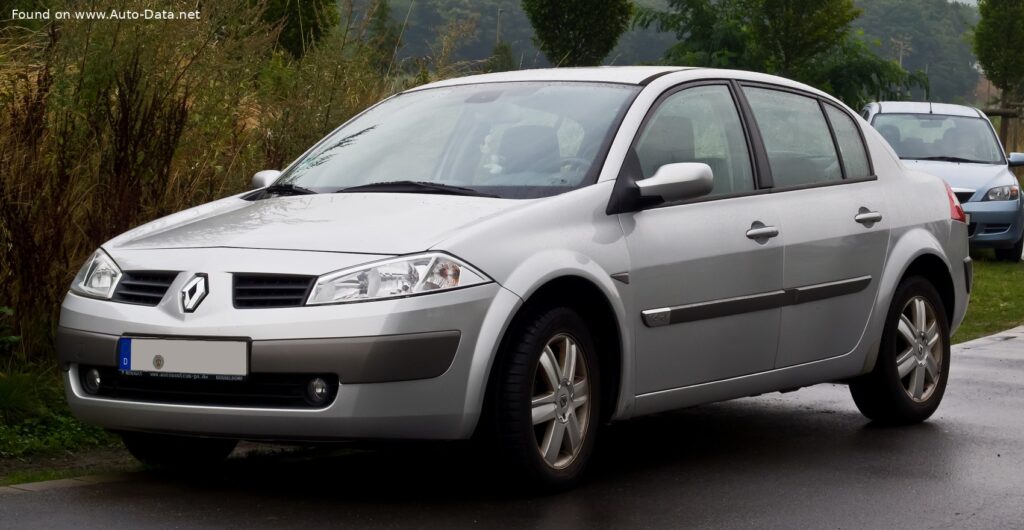
The design of the Renault Megane II Classic was a deliberate counterpoint to the more avant-garde styling of its hatchback sibling. As a four-door sedan, it offered a conventional yet refined aesthetic that appealed to buyers seeking a more traditional family car or a sophisticated fleet vehicle. With a length of 177.09 inches, a width of 69.96 inches (79.76 inches including mirrors), and a height of 57.48 inches, the Megane Classic presented a substantial and well-proportioned stance. Its wheelbase of 105.75 inches contributed to a comfortable ride and generous interior space for its class.
Inside, the Megane II Classic was designed for practicality and comfort, accommodating five occupants across its two rows of seating. The trunk space was particularly impressive for a C-segment sedan, offering a minimum of 18.36 cu. ft. (520 liters) of cargo capacity, making it highly suitable for families and individuals requiring significant luggage room.
Key features for the 2005 model year included a focus on safety and driving convenience. Standard safety equipment typically encompassed an Anti-lock Braking System (ABS), which was crucial for maintaining control during hard braking. The drivetrain featured front-wheel drive, paired with a sophisticated suspension setup comprising an independent McPherson strut system at the front and a torsion beam axle at the rear, providing a balanced ride quality and competent handling. Braking power was supplied by ventilated discs at the front and solid discs at the rear. The vehicle also benefited from electric power steering, offering light and precise control, particularly at lower speeds, and a minimum turning circle of 35.1 feet, aiding maneuverability in urban environments. Depending on the trim level, tire sizes ranged from 195/65 R15 to 205/50 R17, mounted on corresponding 15-inch, 16-inch, or 17-inch wheel rims, allowing for varying degrees of grip and visual appeal.
Technical Specifications
| Category | Specification |
|---|---|
| General Information | |
| Brand | Renault |
| Model | Megane |
| Generation | Megane II Classic |
| Type (Engine) | 1.9 dCi (130 Hp) FAP |
| Start of Production | 2005 year |
| End of Production | 2005 year |
| Powertrain Architecture | Internal Combustion engine |
| Body type | Sedan |
| Seats | 5 |
| Doors | 4 |
| Performance Specs | |
| Fuel consumption (economy) – urban | 33.1 US mpg (7.1 l/100 km) |
| Fuel consumption (economy) – extra urban | 53.5 US mpg (4.4 l/100 km) |
| Fuel consumption (economy) – combined | 43.6 US mpg (5.4 l/100 km) |
| CO2 emissions | 148 g/km |
| Fuel Type | Diesel |
| Acceleration 0 – 60 mph | 8.6 sec |
| Acceleration 0 – 100 km/h | 9.1 sec |
| Maximum speed | 124.27 mph (200 km/h) |
| Emission standard | Euro 4 |
| Weight-to-power ratio | 10 kg/Hp, 100.4 Hp/tonne |
| Weight-to-torque ratio | 4.3 kg/Nm, 231.7 Nm/tonne |
| Engine Specs | |
| Power | 130 Hp @ 4000 rpm |
| Power per liter | 69.5 Hp/l |
| Torque | 221.27 lb.-ft. @ 2000 rpm (300 Nm) |
| Engine layout | Front, Transverse |
| Engine Model/Code | F9Q |
| Engine displacement | 114.11 cu. in. (1870 cm3) |
| Number of cylinders | 4 |
| Engine configuration | Inline |
| Cylinder Bore | 3.15 in. (80 mm) |
| Piston Stroke | 3.66 in. (93 mm) |
| Compression ratio | 19:1 |
| Number of valves per cylinder | 2 |
| Fuel injection system | Diesel Commonrail |
| Engine aspiration | Turbocharger, Intercooler |
| Valvetrain | OHC |
| Engine oil capacity | 4.76 US qt (4.5 l) |
| Coolant capacity | 8.03 US qt (7.6 l) |
| Engine systems | Particulate filter |
| Space, Volume and Weights | |
| Kerb Weight | 2854.99 lbs. (1295 kg) |
| Max. weight | 4067.53 lbs. (1845 kg) |
| Max load | 1212.54 lbs. (550 kg) |
| Trunk (boot) space – minimum | 18.36 cu. ft. (520 l) |
| Fuel tank capacity | 15.85 US gal (60 l) |
| Max. roof load | 176.37 lbs. (80 kg) |
| Permitted trailer load with brakes (12%) | 2866.01 lbs. (1300 kg) |
| Permitted trailer load without brakes | 1433 lbs. (650 kg) |
| Permitted towbar download | 165.35 lbs. (75 kg) |
| Dimensions | |
| Length | 177.09 in. (4498 mm) |
| Width | 69.96 in. (1777 mm) |
| Width including mirrors | 79.76 in. (2026 mm) |
| Height | 57.48 in. (1460 mm) |
| Wheelbase | 105.75 in. (2686 mm) |
| Front track | 59.76 in. (1518 mm) |
| Rear (Back) track | 59.61 in. (1514 mm) |
| Front overhang | 33.15 in. (842 mm) |
| Rear overhang | 38.19 in. (970 mm) |
| Minimum turning circle (turning diameter) | 35.1 ft. (10.7 m) |
| Drivetrain, Brakes and Suspension Specs | |
| Drivetrain Architecture | Front-wheel drive. Internal Combustion engine (ICE) drives the front wheels. |
| Drive wheel | Front wheel drive |
| Number of gears and type of gearbox | 6 gears, manual transmission |
| Front suspension | Independent type McPherson |
| Rear suspension | Torsion |
| Front brakes | Ventilated discs |
| Rear brakes | Disc |
| Assisting systems | ABS (Anti-lock braking system) |
| Steering type | Steering rack and pinion |
| Power steering | Electric Steering |
| Tires size | 195/65 R15; 195/55 R16; 205/50 R17 |
| Wheel rims size | 6.5J x 15; 6.5J x 16; 6.5J x 17 |
Legacy and Market Impact: The Renault Megane II Classic in its Segment
The Renault Megane II, in all its forms, was a critical model for Renault, embodying a design philosophy that aimed to differentiate it from its competitors. While the hatchback’s polarizing design garnered much attention, the Megane II Classic sedan played a vital, often understated, role in securing market share in segments that favored more traditional vehicle aesthetics. Its primary markets were regions where sedans were preferred for their perceived prestige, secure trunk space, and more formal appearance, such as in Eastern Europe, Turkey, and various developing markets where it was often sold as the Renault Megane Sedan or Renault Megane Saloon.
In its competitive landscape, the Megane II Classic 1.9 dCi (130 Hp) FAP faced off against a strong array of European C-segment sedans. Key rivals included the Ford Focus Sedan, Opel Astra Sedan (marketed as Saturn Astra in some regions), Volkswagen Jetta (known as Bora in some markets), and potentially the Peugeot 307 Sedan. The Megane Classic distinguished itself with its comfortable ride, strong diesel powertrain, and comprehensive safety features for its time. Its diesel engine, particularly the 130 Hp 1.9 dCi with its FAP system, was a significant advantage in terms of fuel economy and lower running costs, appealing to both private buyers and fleet operators.
The Megane II generation, including the Classic sedan, was instrumental in solidifying Renault’s reputation for innovation and safety, having achieved a groundbreaking five-star Euro NCAP crash test rating. This enhanced its appeal to safety-conscious buyers across Europe. The 2005 model year, with its Euro 4 compliant diesel engine, highlighted a growing industry trend towards reducing emissions, a challenge that Renault met effectively with its FAP technology.
Ultimately, the Renault Megane II Classic 1.9 dCi (130 Hp) FAP cemented its place as a robust, efficient, and practical family sedan. Although not available in the United States, its impact on European and other global markets was substantial, offering a compelling blend of performance, economy, and traditional styling that contributed significantly to Renault’s sales success in the mid-2000s. Its legacy is that of a reliable workhorse and a comfortable cruiser, showcasing the strengths of European diesel engineering and design for a broad international audience.