The Renault Megane II Classic (Phase II, 2006): A European Sedan for the Masses
The Renault Megane II Classic (Phase II, 2006) represents a significant iteration of Renault’s popular C-segment offering, specifically the four-door sedan variant of the second-generation Megane. Launched in 2006 as part of the “Phase II” or facelifted series, this model aimed to refresh the Megane’s appeal in markets where traditional sedans remained strong, particularly across Europe, Eastern Europe, and parts of Asia. While the Megane II hatchback garnered significant attention for its distinctive styling and advanced features, the Classic sedan offered a more conventional, yet equally practical, proposition. This particular configuration, equipped with the 1.6-liter 16V engine and an automatic transmission, provided a comfortable and reliable option for families and business users seeking a blend of efficiency, space, and modern amenities within its class. Not typically sold in the United States, the Megane II Classic played a crucial role in Renault’s global strategy, reinforcing its presence in a highly competitive compact car segment.
Engine and Performance of the Renault Megane II Classic
Under the hood, the Renault Megane II Classic (Phase II, 2006) 1.6 16V (112 Hp) Automatic featured Renault’s well-regarded K4M engine. This 1.6-liter (1598 cm³) naturally aspirated inline-four gasoline engine was a staple across many Renault models of the era, known for its balance of performance and fuel economy. With 112 horsepower delivered at 6000 rpm and a peak torque of 112.11 lb.-ft. (152 Nm) arriving at 4200 rpm, the engine provided adequate power for daily driving and highway cruising. Its multi-port manifold injection system and DOHC (Double Overhead Camshaft) valvetrain with four valves per cylinder ensured efficient combustion and responsiveness.
Power was sent to the front wheels via a 4-speed automatic transmission. While a 4-speed automatic might be considered somewhat basic by today’s standards, it was a common offering in the segment at the time, prioritizing smooth operation and ease of use over outright performance. This setup allowed the Megane II Classic to accelerate from 0 to 60 mph in a respectable 12.4 seconds, with a top speed of 119.3 mph (192 km/h).
Fuel efficiency for this powertrain was rated at a combined 30.5 US mpg (7.7 l/100 km), which was competitive for a compact sedan with an automatic transmission in the mid-2000s. Urban consumption stood at 22 US mpg (10.7 l/100 km), while extra-urban driving could achieve 39.2 US mpg (6 l/100 km). These figures, coupled with its Euro 4 emission standard compliance and CO2 emissions of 184 g/km, highlighted Renault’s commitment to delivering reasonably economical and environmentally conscious vehicles for its target markets. The engine’s robust design and widespread use also meant good reliability and serviceability.
Design and Features of the Megane II Classic
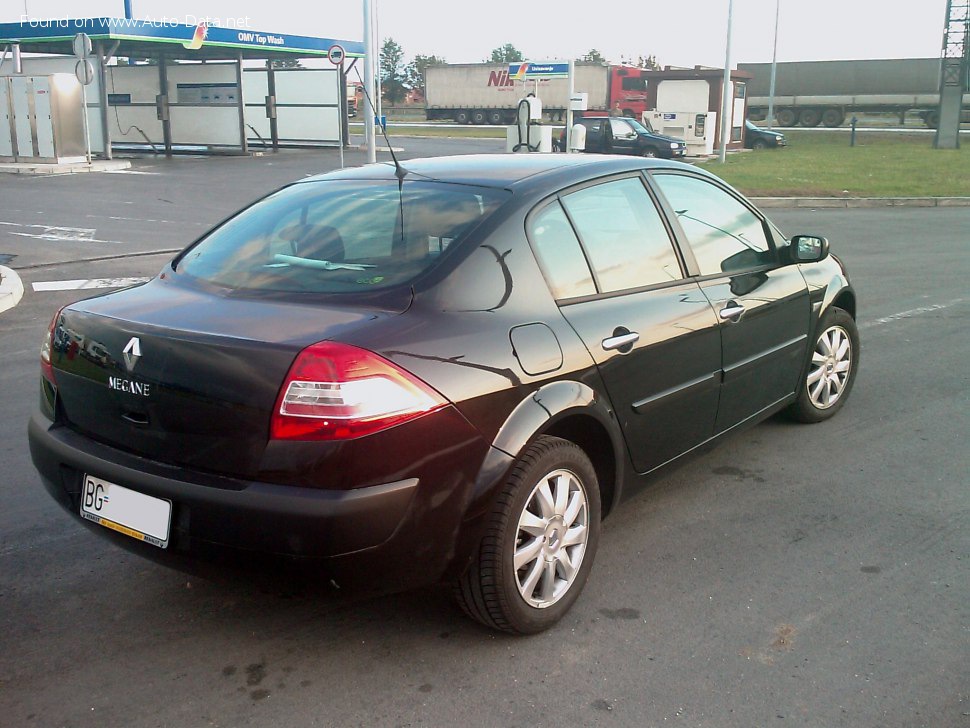
The design of the Megane II Classic sedan maintained the distinctive styling cues of the second-generation Megane lineup, albeit with a more conventional three-box profile compared to the avant-garde hatchback. The Phase II refresh, introduced in 2006, brought subtle updates to the front fascia, including revised headlights, grille, and bumper designs, enhancing its contemporary appeal. The overall aesthetic was characterized by smooth lines and a somewhat understated elegance, appealing to buyers who preferred a more traditional sedan silhouette.
Measuring 177.09 inches (4498 mm) in length, 69.96 inches (1777 mm) in width, and 57.48 inches (1460 mm) in height, the Megane II Classic offered a spacious cabin for five occupants. The wheelbase of 105.75 inches (2686 mm) contributed to a comfortable ride and ample legroom for rear passengers. A key selling point for the sedan was its generous trunk space, boasting a minimum of 18.36 cubic feet (520 liters), making it highly practical for families and long journeys. This substantial cargo capacity set it apart from many hatchback rivals and even some larger sedans.
In terms of features, the Megane II Classic offered a range of amenities designed for comfort and convenience. Standard safety features typically included ABS (Anti-lock Braking System), and depending on the trim level, multiple airbags. The vehicle featured an independent McPherson strut front suspension and a torsion beam rear suspension, a common and effective setup for the segment, providing a good balance between ride comfort and handling stability. Steering was handled by an electric power steering system, offering light and precise control, particularly beneficial for urban maneuvering with a minimum turning circle of 35.1 feet (10.7 m). The car came with various tire and wheel options, including 195/65 R15, 195/55 R16, and 205/50 R17, mounted on 6.5J x 15, 6.5J x 16, or 6.5J x 17 rims, respectively, allowing for different levels of grip and aesthetic preference.
Technical Specifications: Renault Megane II Classic (Phase II, 2006) 1.6 16V (112 Hp) Automatic
| Category | Specification | Value |
|---|---|---|
| General Information | Brand | Renault |
| Model | Megane | |
| Generation | Megane II Classic (Phase II, 2006) | |
| Type (Engine) | 1.6 16V (112 Hp) Automatic | |
| Start of production | 2006 year | |
| End of production | 2008 year | |
| Powertrain Architecture | Internal Combustion engine | |
| Body type | Sedan | |
| Seats | 5 | |
| Doors | 4 | |
| Performance Specs | Fuel consumption (economy) – urban | 10.7 l/100 km (22 US mpg) |
| Fuel consumption (economy) – extra urban | 6 l/100 km (39.2 US mpg) | |
| Fuel consumption (economy) – combined | 7.7 l/100 km (30.5 US mpg) | |
| CO2 emissions | 184 g/km | |
| Fuel Type | Petrol (Gasoline) | |
| Acceleration 0 – 60 mph | 12.4 sec | |
| Acceleration 0 – 100 km/h | 13.1 sec | |
| Maximum speed | 119.3 mph (192 km/h) | |
| Emission standard | Euro 4 | |
| Weight-to-power ratio | 11.2 kg/Hp (89.6 Hp/tonne) | |
| Weight-to-torque ratio | 8.2 kg/Nm (121.6 Nm/tonne) | |
| Engine Specs | Power | 112 Hp @ 6000 rpm |
| Power per liter | 70.1 Hp/l | |
| Torque | 112.11 lb.-ft. (152 Nm) @ 4200 rpm | |
| Engine layout | Front, Transverse | |
| Engine Model/Code | K4M | |
| Engine displacement | 1598 cm³ (97.52 cu. in.) | |
| Number of cylinders | 4 | |
| Engine configuration | Inline | |
| Cylinder Bore | 3.13 in. (79.5 mm) | |
| Piston Stroke | 3.17 in. (80.5 mm) | |
| Compression ratio | 10:1 | |
| Number of valves per cylinder | 4 | |
| Fuel injection system | Multi-port manifold injection | |
| Engine aspiration | Naturally aspirated engine | |
| Valvetrain | DOHC | |
| Engine oil capacity | 4.8 l (5.07 US qt) | |
| Coolant | 6.5 l (6.87 US qt) | |
| Space, Volume and Weights | Kerb Weight | 2755.78 lbs. (1250 kg) |
| Max. weight | 3968.32 lbs. (1800 kg) | |
| Max load | 1212.54 lbs. (550 kg) | |
| Trunk (boot) space – minimum | 18.36 cu. ft. (520 l) | |
| Fuel tank capacity | 15.85 US gal (60 l) | |
| Max. roof load | 176.37 lbs. (80 kg) | |
| Permitted trailer load with brakes (12%) | 2755.78 lbs. (1250 kg) | |
| Permitted trailer load without brakes | 1433 lbs. (650 kg) | |
| Permitted towbar download | 165.35 lbs. (75 kg) | |
| Dimensions | Length | 177.09 in. (4498 mm) |
| Width | 69.96 in. (1777 mm) | |
| Width including mirrors | 79.76 in. (2026 mm) | |
| Height | 57.48 in. (1460 mm) | |
| Wheelbase | 105.75 in. (2686 mm) | |
| Front track | 59.76 in. (1518 mm) | |
| Rear (Back) track | 59.61 in. (1514 mm) | |
| Front overhang | 33.15 in. (842 mm) | |
| Rear overhang | 38.19 in. (970 mm) | |
| Ride height (ground clearance) | 4.72 in. (120 mm) | |
| Minimum turning circle (turning diameter) | 35.1 ft. (10.7 m) | |
| Drivetrain, Brakes and Suspension Specs | Drivetrain Architecture | The Internal combustion engine (ICE) drives the front wheels of the vehicle. |
| Drive wheel | Front wheel drive | |
| Number of gears and type of gearbox | 4 gears, automatic transmission | |
| Front suspension | Independent type McPherson | |
| Rear suspension | Torsion | |
| Front brakes | Ventilated discs | |
| Rear brakes | Disc | |
| Assisting systems | ABS (Anti-lock braking system) | |
| Steering type | Steering rack and pinion | |
| Power steering | Electric Steering | |
| Tires size | 195/65 R15; 195/55 R16; 205/50 R17 | |
| Wheel rims size | 6.5J x 15; 6.5J x 16; 6.5J x 17 |
Legacy and Market Impact of the Renault Megane II Classic
The Renault Megane II Classic (Phase II, 2006) carved out a significant niche for itself in the highly competitive European and emerging markets during its production run from 2006 to 2008. While its hatchback sibling often stole the limelight with its bold, distinctive rear styling, the Classic sedan offered a more conservative yet equally appealing alternative. It was particularly popular in countries where sedans were traditionally preferred for their perceived prestige and practicality, such as in Eastern Europe, Turkey, and parts of Latin America.
In its segment, the Megane II Classic faced stiff competition from established rivals like the Volkswagen Jetta (known as Bora in some markets), Ford Focus Sedan, Opel Astra Sedan, and Peugeot 307 Sedan. Renault’s strategy was to offer a compelling package that emphasized comfort, safety, and value. The Megane II platform, on which the Classic was based, had already earned a reputation for excellent safety, notably achieving a 5-star Euro NCAP rating for the hatchback, a characteristic that largely carried over to the sedan variant and instilled confidence in buyers.
The 1.6 16V engine with the automatic transmission was a popular choice for its ease of use in urban environments and its respectable fuel economy for longer journeys. This made the Megane II Classic a strong contender for both private buyers seeking a reliable family car and fleet operators looking for cost-effective transportation. Its spacious interior and substantial trunk capacity further enhanced its appeal as a practical and versatile vehicle.
The Megane II Classic contributed significantly to Renault’s overall market share in the compact segment, showcasing the brand’s ability to cater to diverse regional preferences. Its blend of French design sensibilities, practical engineering, and competitive pricing ensured its enduring popularity. Although superseded by the third-generation Megane in 2008, the Megane II Classic left a legacy as a well-rounded and dependable vehicle that successfully navigated the demands of its primary markets, solidifying Renault’s position as a major player in the global automotive landscape. Its presence on roads across Europe and beyond for many years after its production ceased is a testament to its robust construction and lasting appeal.