Introduction to the Renault Megane II Coupe 1.4 16V (82 Hp)
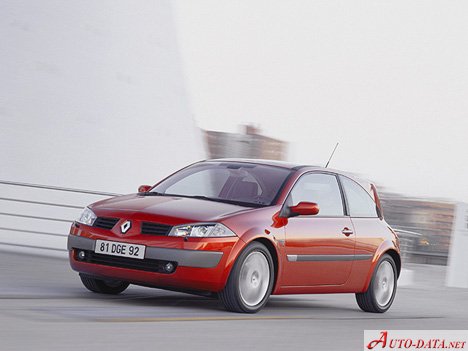
The Renault Megane II Coupe 1.4 16V (82 Hp) represents a specific and entry-level iteration of the second-generation Renault Megane, a prominent compact car produced by the French automaker Renault. Launched in 2003 and manufactured through 2005, this particular model was part of the highly successful Megane II lineup, which garnered significant acclaim, including being named European Car of the Year in 2003. While the Megane II offered a diverse range of body styles, including hatchback, sedan, and convertible, the three-door coupe variant was designed to appeal to buyers seeking a sportier aesthetic and a more dynamic driving experience within the C-segment market.
Primarily aimed at the European market, where compact cars dominate sales charts, the Renault Megane II Coupe 1.4 16V (82 Hp) was positioned as an accessible option, balancing economical operation with modern design. Its distinct styling, particularly the groundbreaking “bustle-back” rear design, set it apart from many of its contemporaries and became a hallmark of the Megane II generation. This article will delve into the specific characteristics, performance metrics, and market context of this particular powertrain and body style combination, offering an expert perspective on its role within Renault’s extensive portfolio and the broader European automotive landscape.
Engine and Performance Characteristics of the Renault Megane II Coupe 1.4 16V (82 Hp)
Powertrain Overview
At the heart of the Renault Megane II Coupe 1.4 16V (82 Hp) lies a naturally aspirated, 1.4-liter (1390 cm3 or 84.82 cu. in.) inline four-cylinder engine, designated by the internal code K4J. This powerplant features a DOHC (Double Overhead Camshaft) valvetrain with four valves per cylinder, a common and efficient setup for its era. Fuel delivery is handled by a multi-port manifold injection system, ensuring precise fuel metering for optimal combustion. With a compression ratio of 10:1, the engine was designed to run on readily available gasoline (petrol).
This specific iteration of the Megane II Coupe produces 82 horsepower (Hp) at 6000 rpm, delivering a power output of approximately 59 Hp per liter of displacement. Torque peaks at 124 Newton-meters (Nm), which translates to 91.46 lb.-ft., available at a relatively accessible 3750 rpm. Power is sent to the front wheels via a standard five-speed manual transmission, a configuration typical for compact cars of this period, emphasizing driver engagement and fuel efficiency.
Performance Metrics and Efficiency
While the 1.4-liter engine was not engineered for outright blistering performance, it provided adequate propulsion for daily driving and urban commuting. The Renault Megane II Coupe 1.4 16V (82 Hp) could accelerate from 0 to 60 mph in a calculated 12.8 seconds (0-100 km/h in 13.5 seconds), with a top speed reaching 106.25 mph (171 km/h). These figures placed it firmly in the mainstream of compact cars, suitable for drivers prioritizing economy over raw speed.
Fuel efficiency was a key selling point for this model, reflecting its role as an economical choice. The combined fuel consumption was rated at 6.9 liters per 100 kilometers, which translates to an impressive 34.1 US miles per gallon. Urban driving yielded 25.6 US mpg (9.2 l/100 km), while extra-urban cycles achieved a thrifty 42 US mpg (5.6 l/100 km). With CO2 emissions of 162 g/km, the vehicle met the Euro 3 emission standard, which was current during its production run, underscoring its environmental compliance for the early 2000s.
The vehicle’s weight-to-power ratio stood at 14 kg/Hp (71.6 Hp/tonne), and its weight-to-torque ratio was 9.2 kg/Nm (108.3 Nm/tonne), indicating a balanced approach to its powertrain design, prioritizing usability and efficiency within its segment.
Design and Features of the Renault Megane II Coupe
Exterior Design Philosophy
The Renault Megane II Coupe, like its hatchback sibling, was a revolutionary design for Renault, significantly departing from the more conservative styling of its predecessor. Measuring 165.71 inches (4209 mm) in length, 69.96 inches (1777 mm) in width, and 57.4 inches (1458 mm) in height, the coupe presented a compact yet assertive stance. Its most striking feature was the distinctive “bustle-back” rear, characterized by a steeply raked rear window and a prominent, almost vertical trunk lid. This bold aesthetic was a polarizing but ultimately influential design choice, making the Megane II instantly recognizable.
The three-door coupe body style accentuated the Megane II’s sporty intentions, offering a sleeker profile than the five-door hatchback. The design language included sharp creases, pronounced wheel arches, and a cohesive front fascia that integrated the headlights and grille into a modern, aerodynamic shape. The drag coefficient (Cd) of 0.35 indicated a respectable aerodynamic performance for a car of its class and era.
Interior and Safety Features
Inside, the Megane II Coupe offered a comfortable and ergonomically designed cabin with seating for five, though the rear seats in a coupe naturally offered less headroom and legroom than in the larger body styles. The trunk space was practical, ranging from 11.65 cu. ft. (330 liters) with the rear seats up, expanding to a generous 42.02 cu. ft. (1190 liters) when folded. The interior reflected Renault’s focus on user-friendliness and perceived quality, with materials and finishes that were competitive for the segment.
Safety was a paramount concern for Renault, and the Megane II was a pioneer in passive safety, famously being one of the first cars to achieve a full five-star rating in Euro NCAP crash tests for adult occupant protection. While specific features for the 1.4 16V model might have been more basic than higher trims, standard safety equipment typically included ABS (Anti-lock Braking System), multiple airbags, and seatbelt pretensioners. The vehicle also featured an electric power steering system, offering light steering effort for urban maneuvers and a minimum turning circle of 34.45 feet (10.5 meters).
The suspension system comprised an independent McPherson-type setup at the front and a torsion beam axle at the rear, a common and cost-effective arrangement for front-wheel-drive compacts. Braking was handled by ventilated discs at the front and solid discs at the rear, providing confident stopping power. Various tire and wheel options were available, ranging from 195/65 R15 to 205/50 R17, allowing for different levels of grip and ride comfort.
Technical Specifications
| Category | Specification |
|---|---|
| Brand | Renault |
| Model | Megane II Coupe |
| Type (Engine) | 1.4 16V (82 Hp) |
| Production Start | 2003 |
| Production End | 2005 |
| Body Type | Coupe, 3 Doors, 5 Seats |
| Fuel Type | Petrol (Gasoline) |
| Engine Model/Code | K4J |
| Engine Layout | Front, Transverse |
| Engine Displacement | 1390 cm3 (1.4 Liters / 84.82 cu. in.) |
| Number of Cylinders | 4, Inline |
| Valvetrain | DOHC, 4 valves per cylinder |
| Engine Aspiration | Naturally aspirated |
| Fuel Injection System | Multi-port manifold injection |
| Compression Ratio | 10:1 |
| Cylinder Bore x Piston Stroke | 79.5 mm x 70 mm (3.13 in. x 2.76 in.) |
| Power | 82 Hp @ 6000 rpm |
| Torque | 124 Nm @ 3750 rpm (91.46 lb.-ft. @ 3750 rpm) |
| Acceleration 0-60 mph | 12.8 sec |
| Maximum Speed | 106.25 mph (171 km/h) |
| Fuel Consumption (Combined) | 6.9 l/100 km (34.1 US mpg) |
| Fuel Consumption (Urban) | 9.2 l/100 km (25.6 US mpg) |
| Fuel Consumption (Extra Urban) | 5.6 l/100 km (42 US mpg) |
| CO2 Emissions | 162 g/km |
| Emission Standard | Euro 3 |
| Drivetrain Architecture | Front-wheel drive, Internal Combustion Engine |
| Gearbox | 5 gears, manual transmission |
| Front Suspension | Independent type McPherson |
| Rear Suspension | Torsion beam |
| Front Brakes | Ventilated discs |
| Rear Brakes | Disc |
| Assisting Systems | ABS (Anti-lock braking system) |
| Steering Type | Steering rack and pinion, Electric Power Steering |
| Tires Size | 195/65 R15; 195/55 R16; 205/50 R17 |
| Wheel Rims Size | 6.5J x 15; 6.5J x 16; 6.5J x 17 |
| Length | 4209 mm (165.71 in.) |
| Width | 1777 mm (69.96 in.) |
| Height | 1458 mm (57.4 in.) |
| Wheelbase | 2625 mm (103.35 in.) |
| Front Track | 1518 mm (59.76 in.) |
| Rear Track | 1514 mm (59.61 in.) |
| Minimum Turning Circle | 10.5 m (34.45 ft) |
| Kerb Weight | 1145 kg (2524.29 lbs.) |
| Max. Weight | 1695 kg (3736.84 lbs.) |
| Max Load | 550 kg (1212.54 lbs.) |
| Trunk Space (Minimum) | 330 l (11.65 cu. ft.) |
| Trunk Space (Maximum) | 1190 l (42.02 cu. ft.) |
| Fuel Tank Capacity | 60 l (15.85 US gal) |
| Engine Oil Capacity | 4.8 l (5.07 US qt) |
| Coolant Capacity | 6 l (6.34 US qt) |
| Max. Roof Load | 80 kg (176.37 lbs.) |
| Permitted Trailer Load (with brakes) | 1300 kg (2866.01 lbs.) |
| Permitted Trailer Load (without brakes) | 650 kg (1433 lbs.) |
| Permitted Towbar Download | 75 kg (165.35 lbs.) |
| Drag Coefficient (Cd) | 0.35 |
Legacy and Market Impact of the Renault Megane II Coupe
The Renault Megane II, and specifically its coupe variant, carved out a significant niche in the highly competitive European compact car segment during its production run. While the 1.4 16V (82 Hp) model was an entry-level offering, it contributed to the overall success and distinctive image of the Megane II lineup. Its primary competitors included established players like the Volkswagen Golf (Mk4/Mk5 generations during this period), Peugeot 307, Opel/Vauxhall Astra (G/H generations), and Ford Focus (Mk1/Mk2 generations). Against these rivals, the Megane II stood out primarily for its avant-garde design and its pioneering safety features.
The initial reception of the Megane II’s design was mixed; some found it too radical, while others praised its boldness and originality. Ultimately, its distinctiveness proved to be a major asset, helping it capture attention in a crowded market. The coupe, with its sportier two-door configuration, appealed to a younger demographic or those seeking a more personal vehicle with a flair for style, even with the more modest 1.4-liter engine.
In terms of historical significance, the Megane II represented a pivotal moment for Renault’s design language, influencing subsequent models and solidifying the brand’s reputation for innovative, albeit sometimes unconventional, styling. Its five-star Euro NCAP safety rating was a benchmark for the industry and significantly raised consumer expectations for vehicle safety. The 1.4 16V engine, while not a performance powerhouse, embodied the practical and economical aspects that many European buyers prioritize for daily commuting, contributing to the Megane II’s widespread appeal and commercial success.
The Megane II Coupe 1.4 16V (82 Hp) is remembered as a competent and stylish compact car that offered a compelling blend of design, safety, and economy for its time. It showcased Renault’s ability to innovate and challenge conventional automotive aesthetics, leaving a lasting impression on the European automotive landscape and contributing to the Megane’s enduring legacy as a core model for the French automaker.