The Renault Megane II Coupe 1.4 16V: A Distinctive European Compact
The Renault Megane II Coupe 1.4 16V represents a specific variant of the second-generation Renault Megane, a pivotal compact car produced by the French automaker Renault. Launched in 2002, the Megane II was a bold departure from its predecessor, renowned for its distinctive and often polarizing design language, particularly its “bustle-back” rear styling. While the Megane II was never officially sold in the United States, it played a crucial role in the highly competitive European C-segment, offering a range of body styles including a hatchback, sedan, wagon, and the more sporting 3-door coupe. This particular 1.4 16V model, produced from 2002 to 2005, served as an accessible entry point into the coupe lineup, balancing economy with a youthful aesthetic targeted at European buyers seeking style and practicality in a compact package.
The second-generation Megane quickly garnered international recognition, earning the prestigious European Car of the Year award in 2003, a testament to its innovative design, advanced safety features for its time, and overall market appeal within its primary European market. The Renault Megane II Coupe 1.4 16V, with its 98 horsepower engine, was designed for urban agility and economical cruising, embodying Renault’s commitment to offering diverse options to meet varied consumer needs across the continent.
Engine and Performance of the Renault Megane II Coupe
At the heart of the Renault Megane II Coupe 1.4 16V is a modest yet efficient 1.4-liter (1390 cm³, or 84.82 cubic inches) K4J inline-four cylinder engine. This naturally aspirated gasoline (petrol) unit features a DOHC (Double Overhead Camshaft) valvetrain with four valves per cylinder, totaling 16 valves, which was a modern specification for a compact engine of its era. Power output for this specific variant is rated at a respectable 98 horsepower at 6000 rpm, translating to a power-per-liter figure of 70.5 horsepower per liter. Torque peaks at 93.67 lb.-ft. (127 Nm) delivered at 3750 rpm, providing adequate pulling power for city driving and highway cruising.
The powertrain architecture is a conventional front, transverse engine layout driving the front wheels, a standard configuration for compact cars emphasizing packaging efficiency and predictable handling. Power is routed through a 5-speed manual transmission, offering direct driver engagement and optimizing the engine’s output for various driving conditions.
In terms of performance, the Renault Megane II Coupe 1.4 16V delivers a 0 to 60 mph acceleration time of approximately 11.9 seconds (0-100 km/h in 12.5 seconds), with a top speed of 113.71 mph (183 km/h). While not a performance leader, these figures are entirely adequate for its market segment and intended use. Fuel efficiency was a key selling point in Europe, with combined consumption rated at 35.1 US mpg (6.7 liters per 100 km). Urban driving yielded 25.8 US mpg (9.1 liters per 100 km), while extra-urban (highway) driving improved significantly to 43.6 US mpg (5.4 liters per 100 km). With CO2 emissions of 156 g/km and adherence to the Euro 4 emission standard, this model demonstrated a balance between performance and environmental responsibility for its time.
Design and Features of the Renault Megane II Coupe
Exterior Design
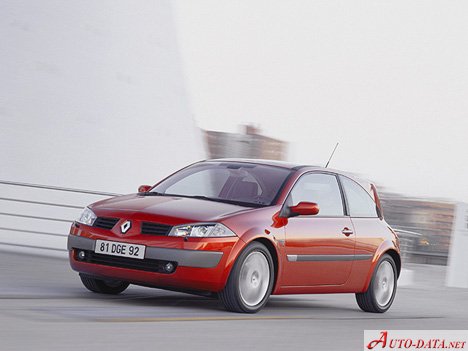
The Renault Megane II Coupe stood out significantly from its peers due to its avant-garde styling, spearheaded by Patrick Le Quément. Measuring 165.71 inches (4209 mm) in length, 69.96 inches (1777 mm) in width, and 57.4 inches (1458 mm) in height, the coupe variant maintained a compact footprint suitable for European urban environments. Its most striking feature was the distinctive “bustle-back” rear, characterized by a sharply truncated rear window and a prominent, almost vertical tailgate. This design element, while polarizing, gave the Megane II an unmistakable identity. The 3-door coupe body style, with its sleeker roofline and extended doors compared to the 5-door hatchback, further emphasized its sporty pretensions. The car’s drag coefficient (Cd) of 0.35 was competitive for its class, contributing to its fuel efficiency.
Interior and Comfort
Despite its coupe designation, the Megane II Coupe offered a surprisingly spacious interior for five occupants, though rear-seat comfort for adults on long journeys might be compromised due to the sloping roofline. The cabin design was modern and functional, reflecting Renault’s focus on user-friendliness and perceived quality. Key interior features typically included comfortable seating and a driver-focused cockpit. The trunk space was practical for a compact coupe, offering 11.65 cubic feet (330 liters) with the rear seats up, expandable to a generous 42.02 cubic feet (1190 liters) when the rear seats were folded, enhancing its versatility.
Chassis and Safety
The Megane II Coupe was built on a robust platform, featuring an independent McPherson strut front suspension and a torsion beam rear suspension, a common and effective setup for front-wheel-drive compact cars balancing ride comfort and handling. Stopping power was provided by ventilated disc brakes at the front and disc brakes at the rear, augmented by a standard Anti-lock Braking System (ABS) for enhanced safety. The steering system utilized a rack and pinion setup with electric power steering, offering light and responsive handling, particularly beneficial in congested city driving and parking maneuvers. Various tire and wheel options were available, ranging from 195/65 R15 to 205/50 R17, allowing for different levels of grip and aesthetic preference.
Technical Specifications
| Category | Specification |
|---|---|
| General Information | |
| Brand | Renault |
| Model | Megane |
| Generation | Megane II Coupe |
| Type (Engine) | 1.4 16V (98 Hp) |
| Production Start | 2002 |
| Production End | 2005 |
| Powertrain Architecture | Internal Combustion Engine, Front-Wheel Drive |
| Body Type | Coupe |
| Seats | 5 |
| Doors | 3 |
| Performance Specifications | |
| Fuel Consumption (Urban) | 25.8 US mpg (9.1 l/100 km) |
| Fuel Consumption (Extra Urban) | 43.6 US mpg (5.4 l/100 km) |
| Fuel Consumption (Combined) | 35.1 US mpg (6.7 l/100 km) |
| CO2 Emissions | 156 g/km |
| Fuel Type | Petrol (Gasoline) |
| Acceleration 0-60 mph | 11.9 seconds |
| Acceleration 0-62 mph (0-100 km/h) | 12.5 seconds |
| Maximum Speed | 113.71 mph (183 km/h) |
| Emission Standard | Euro 4 |
| Weight-to-Power Ratio | 11.7 kg/Hp, 85.6 Hp/tonne |
| Weight-to-Torque Ratio | 9 kg/Nm, 110.9 Nm/tonne |
| Engine Specifications | |
| Power | 98 Hp @ 6000 rpm |
| Power per Liter | 70.5 Hp/l |
| Torque | 93.67 lb.-ft. (127 Nm) @ 3750 rpm |
| Engine Layout | Front, Transverse |
| Engine Model/Code | K4J |
| Engine Displacement | 1.4 liters (1390 cm³, 84.82 cu. in.) |
| Number of Cylinders | 4 |
| Engine Configuration | Inline |
| Cylinder Bore | 3.13 inches (79.5 mm) |
| Piston Stroke | 2.76 inches (70 mm) |
| Compression Ratio | 10:1 |
| Valves per Cylinder | 4 |
| Fuel Injection System | Multi-port manifold injection |
| Engine Aspiration | Naturally aspirated |
| Valvetrain | DOHC |
| Engine Oil Capacity | 5.07 US quarts (4.8 l) |
| Coolant Capacity | 6.34 US quarts (6 l) |
| Dimensions, Volume, and Weights | |
| Kerb Weight | 2524.29 lbs (1145 kg) |
| Maximum Weight (GVWR) | 3736.84 lbs (1695 kg) |
| Maximum Load | 1212.54 lbs (550 kg) |
| Trunk (Boot) Space (Min) | 11.65 cu. ft. (330 l) |
| Trunk (Boot) Space (Max) | 42.02 cu. ft. (1190 l) |
| Fuel Tank Capacity | 15.85 US gallons (60 l) |
| Maximum Roof Load | 176.37 lbs (80 kg) |
| Permitted Trailer Load with Brakes (12%) | 2866.01 lbs (1300 kg) |
| Permitted Trailer Load without Brakes | 1433 lbs (650 kg) |
| Permitted Towbar Download | 165.35 lbs (75 kg) |
| Length | 165.71 inches (4209 mm) |
| Width | 69.96 inches (1777 mm) |
| Height | 57.4 inches (1458 mm) |
| Wheelbase | 103.35 inches (2625 mm) |
| Front Track | 59.76 inches (1518 mm) |
| Rear Track | 59.61 inches (1514 mm) |
| Drag Coefficient (Cd) | 0.35 |
| Minimum Turning Circle | 34.45 ft (10.5 m) |
| Drivetrain, Brakes, and Suspension | |
| Drivetrain Architecture | Front-wheel drive |
| Drive Wheel | Front-wheel drive |
| Gearbox Type | 5-speed, manual transmission |
| Front Suspension | Independent type McPherson |
| Rear Suspension | Torsion beam |
| Front Brakes | Ventilated discs |
| Rear Brakes | Disc |
| Assisting Systems | ABS (Anti-lock Braking System) |
| Steering Type | Steering rack and pinion |
| Power Steering | Electric Steering |
| Tire Sizes | 195/65 R15; 195/55 R16; 205/50 R17 |
| Wheel Rims Sizes | 6.5J x 15; 6.5Jx 16; 6.5J x 17 |
Legacy and Market Impact of the Megane II Coupe
The Renault Megane II, including its coupe variant, left a significant mark on the European automotive landscape. Its audacious styling was a clear statement from Renault, aiming to differentiate itself in a segment often characterized by conservative designs. While its “bustle-back” rear was initially controversial, it ultimately contributed to the car’s strong identity and helped it stand out against rivals. The Megane II’s success was crucial for Renault, solidifying its position as a major player in the compact car market.
In its primary market, the Megane II Coupe 1.4 16V competed directly with other popular European compacts such as the Volkswagen Golf, Ford Focus, Opel Astra, and Peugeot 307. What set the Megane apart was its unique blend of distinctive French design, a strong emphasis on passenger safety (it was one of the first cars in its class to achieve a 5-star Euro NCAP crash test rating), and a comfortable, refined ride quality that Renault was known for. The 1.4 16V model, in particular, offered an attractive proposition for younger buyers or those seeking a stylish, economical, and practical daily driver without the need for high-performance capabilities.
Beyond its design, the Megane II introduced several technological innovations for its class, such as keyless entry and start (Renault Card), automatic parking brake, and advanced safety features, which contributed to its “Car of the Year” accolade. The electric power steering, standard ABS, and disc brakes all around underscored Renault’s commitment to modern automotive engineering.
While the Megane II Coupe 1.4 16V never reached American shores, its impact in Europe was profound. It showcased Renault’s ability to innovate in design and technology, proving that a compact car could be both practical and visually striking. Its legacy is one of a car that dared to be different, successfully carving out its niche and contributing to the diverse tapestry of the European automotive market in the early 2000s. Today, it remains a testament to Renault’s bold design philosophy and its strength in delivering well-rounded vehicles for its core markets.