The Renault Megane II Coupe 1.5 dCi (86 Hp): A European Compact with Distinctive Style and Diesel Efficiency
The Renault Megane II Coupe 1.5 dCi (86 Hp) represents a significant chapter in the history of compact cars, particularly within the highly competitive European C-segment. Produced by the French automaker Renault between 2005 and 2006, this specific variant of the second-generation Megane stood out not only for its distinctive and often polarizing design but also for its commitment to fuel efficiency through its advanced diesel powertrain. While never officially sold in the United States, the Megane II was a cornerstone of Renault’s lineup, showcasing the brand’s innovative spirit and its mastery of compact vehicle engineering tailored for the European market’s demanding blend of performance, economy, and practicality. As a three-door coupe, it offered a sportier aesthetic compared to its hatchback and sedan siblings, appealing to buyers seeking a blend of style and everyday usability.
Evolution of the Renault Megane II Coupe
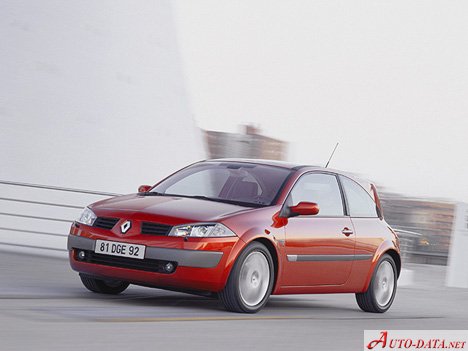
The second generation of the Renault Megane, launched in 2002, marked a radical departure from its predecessor’s more conventional styling. Designed under the leadership of Patrick le Quément, Renault’s then-head of design, the Megane II embraced a bold, angular aesthetic, most famously characterized by its “bustle-back” rear end. This design language was particularly striking on the three-door coupe variant, which exuded a sportier, more dynamic posture. The 2005-2006 model year, featuring the 1.5 dCi (86 Hp) engine, was part of the Megane II’s mid-life update, which saw refinements across the range, enhancing both its visual appeal and its mechanical offerings. This period saw a heightened focus on diesel engines in Europe, driven by rising fuel prices and stricter emission standards, making the efficient dCi powertrain a highly relevant and popular choice for the Megane II.
Engine and Performance of the Renault Megane II Coupe
At the heart of the Renault Megane II Coupe 1.5 dCi (86 Hp) lies Renault’s venerable K9K engine, a 1.5-liter (1461 cm³ or 89.16 cu. in.) inline-four cylinder diesel powerplant. This engine, renowned for its efficiency and widespread use across various Renault and Nissan models, was equipped with a common rail fuel injection system and a turbocharger with an intercooler. These technologies were crucial for extracting respectable power and torque from a relatively small displacement, while simultaneously ensuring excellent fuel economy and meeting the Euro 4 emission standards prevalent at the time.
The engine produced a modest but highly usable 86 horsepower (HP) at 3750 revolutions per minute (rpm). More importantly for everyday driving, it delivered a robust 147.51 lb.-ft. (200 Nm) of torque at a low 1900 rpm. This low-end torque characteristic made the Megane II Coupe feel responsive in city traffic and provided ample pulling power for highway cruising, despite its moderate peak horsepower. Power was channeled to the front wheels via a smooth-shifting 5-speed manual transmission, a common and reliable setup for compact cars of this era.
In terms of performance, the Megane II Coupe 1.5 dCi (86 Hp) was designed more for economical motoring than outright speed. It could accelerate from 0 to 60 mph in a respectable 12.1 seconds, with a top speed of 108.12 mph (174 km/h). These figures were competitive for a diesel-powered compact coupe in its segment, emphasizing its role as an efficient daily driver. Where this powertrain truly excelled was in its fuel economy. The vehicle achieved an impressive combined fuel consumption of 52.3 US mpg (4.5 l/100 km), with even higher figures in extra-urban driving (58.8 US mpg or 4 l/100 km). Urban consumption was rated at 42.8 US mpg (5.5 l/100 km). Its CO2 emissions of 120 g/km were also commendably low, making it an environmentally conscious choice for European consumers seeking to minimize their carbon footprint and benefit from lower road taxes.
Design and Features
The Renault Megane II Coupe was a visual standout in the compact segment. Its three-door body style emphasized the car’s dynamic lines and the distinctive “bustle-back” rear, which incorporated a vertically oriented rear window and prominent taillights. This design choice, while polarizing, gave the Megane II an unmistakable identity and a sense of modernity that set it apart from its more conservatively styled rivals. With a length of 165.71 inches (4209 mm), a width of 69.96 inches (1777 mm), and a height of 57.4 inches (1458 mm), the Megane II Coupe presented a compact yet substantial road presence. Its 103.35-inch (2625 mm) wheelbase contributed to a stable ride and a surprisingly spacious interior for a coupe.
Inside, the Megane II Coupe offered seating for five, although the rear seats, typical of a coupe, were best suited for shorter journeys or smaller passengers. Renault prioritized comfort and ergonomics, featuring well-appointed seats and a dashboard layout that was intuitive and driver-focused. While the data provided doesn’t detail every interior feature, cars of this era typically included power windows, central locking, and a basic audio system as standard. The trunk space was practical for its class, offering 11.65 cubic feet (330 liters) with the rear seats up, expandable to a generous 42.02 cubic feet (1190 liters) when the rear seats were folded down, enhancing its versatility.
From a chassis and safety perspective, the Megane II Coupe utilized a proven independent MacPherson strut front suspension and a torsion beam rear suspension, a common and cost-effective setup for front-wheel-drive compacts that offered a good balance of ride comfort and handling. Stopping power came from ventilated discs at the front and solid discs at the rear, augmented by an Anti-lock Braking System (ABS), a crucial safety feature for the time. The steering system was a rack and pinion setup with electric power steering, providing light and precise steering feel, particularly beneficial for urban maneuvering. The car rode on 195/65 R15 tires mounted on 6J x 15-inch wheel rims, a practical choice offering a good compromise between comfort and grip.
Technical Specifications
| Category | Specification |
|---|---|
| General Information | |
| Brand | Renault |
| Model | Megane |
| Generation | Megane II Coupe |
| Type (Engine) | 1.5 dCi (86 Hp) |
| Start of Production | 2005 year |
| End of Production | 2006 year |
| Powertrain Architecture | Internal Combustion engine |
| Body Type | Coupe |
| Seats | 5 |
| Doors | 3 |
| Performance Specs | |
| Fuel Consumption (Urban) | 5.5 l/100 km (42.8 US mpg) |
| Fuel Consumption (Extra Urban) | 4 l/100 km (58.8 US mpg) |
| Fuel Consumption (Combined) | 4.5 l/100 km (52.3 US mpg) |
| CO2 Emissions | 120 g/km |
| Fuel Type | Diesel |
| Acceleration 0-60 mph | 12.1 sec |
| Acceleration 0-100 km/h | 12.7 sec |
| Maximum Speed | 108.12 mph (174 km/h) |
| Emission Standard | Euro 4 |
| Weight-to-Power Ratio | 13.7 kg/Hp, 73.2 Hp/tonne |
| Weight-to-Torque Ratio | 5.9 kg/Nm, 170.2 Nm/tonne |
| Engine Specs | |
| Power | 86 Hp @ 3750 rpm |
| Power per liter | 58.9 Hp/l |
| Torque | 147.51 lb.-ft. (200 Nm) @ 1900 rpm |
| Engine Layout | Front, Transverse |
| Engine Model/Code | K9K |
| Engine Displacement | 1.5 l (1461 cm³, 89.16 cu. in.) |
| Number of Cylinders | 4 |
| Engine Configuration | Inline |
| Cylinder Bore | 2.99 in. (76 mm) |
| Piston Stroke | 3.17 in. (80.5 mm) |
| Compression Ratio | 18.8:1 |
| Number of Valves per Cylinder | 2 |
| Fuel Injection System | Diesel Commonrail |
| Engine Aspiration | Turbocharger, Intercooler |
| Engine Oil Capacity | 4.76 US qt (4.5 l) |
| Engine Oil Specification | (Not provided in data) |
| Coolant Capacity | 5.6 US qt (5.3 l) |
| Space, Volume and Weights | |
| Kerb Weight | 2590.43 lbs. (1175 kg) |
| Max. Weight | 3802.97 lbs. (1725 kg) |
| Max Load | 1212.54 lbs. (550 kg) |
| Trunk (Boot) Space – Minimum | 11.65 cu. ft. (330 l) |
| Trunk (Boot) Space – Maximum | 42.02 cu. ft. (1190 l) |
| Fuel Tank Capacity | 15.85 US gal (60 l) |
| Max. Roof Load | 176.37 lbs. (80 kg) |
| Permitted Trailer Load with Brakes (12%) | 2866.01 lbs. (1300 kg) |
| Permitted Trailer Load without Brakes | 1433 lbs. (650 kg) |
| Permitted Towbar Download | 165.35 lbs. (75 kg) |
| Dimensions | |
| Length | 165.71 in. (4209 mm) |
| Width | 69.96 in. (1777 mm) |
| Height | 57.4 in. (1458 mm) |
| Wheelbase | 103.35 in. (2625 mm) |
| Front Track | 59.76 in. (1518 mm) |
| Rear (Back) Track | 59.61 in. (1514 mm) |
| Drag Coefficient (Cd) | 0.35 |
| Minimum Turning Circle (Turning Diameter) | 34.45 ft. (10.5 m) |
| Drivetrain, Brakes and Suspension Specs | |
| Drivetrain Architecture | Front wheel drive, Internal Combustion engine |
| Drive Wheel | Front wheel drive |
| Number of Gears and Type of Gearbox | 5 gears, manual transmission |
| Front Suspension | Independent type McPherson |
| Rear Suspension | Torsion |
| Front Brakes | Ventilated discs |
| Rear Brakes | Disc |
| Assisting Systems | ABS (Anti-lock braking system) |
| Steering Type | Steering rack and pinion |
| Power Steering | Electric Steering |
| Tires Size | 195/65 R15 |
| Wheel Rims Size | 6J x 15 |
Legacy and Market Impact of the Renault Megane II Coupe
The Renault Megane II, and particularly its distinctive coupe variant with the efficient 1.5 dCi engine, left a significant mark on the European automotive landscape. Its bold styling was a brave move for Renault, and it largely paid off, helping the Megane II achieve widespread sales success and critical acclaim, including being crowned European Car of the Year in 2003. The 1.5 dCi (86 Hp) engine was a testament to Renault’s engineering prowess in diesel technology, offering a compelling blend of low running costs, decent performance, and environmental responsibility that resonated deeply with European consumers.
In its primary market, the Megane II Coupe faced stiff competition from a host of established players in the compact segment. Key rivals included the evergreen Volkswagen Golf, the dynamic Ford Focus, the stylish Peugeot 307, and the practical Opel Astra. While many of these competitors offered their own diesel variants and various body styles, the Megane II Coupe carved out its niche through its unique design and strong emphasis on safety, achieving a pioneering five-star Euro NCAP crash test rating, which was a major selling point.
The reputation of the Megane II Coupe was largely positive. Owners appreciated its comfortable ride, distinctive looks, and the exceptional fuel economy of the dCi engines. The 1.5 dCi in particular became a workhorse, known for its reliability and efficiency, powering not just the Megane but a wide array of vehicles within the Renault-Nissan Alliance. This engine helped solidify the trend of smaller, high-efficiency diesel engines becoming the default choice for many European compact car buyers.
Historically, the Megane II Coupe showcased Renault’s willingness to push design boundaries and integrate advanced technologies into mainstream vehicles. Its impact extended beyond sales figures; it influenced automotive design trends and reinforced the viability of diesel power for everyday driving. Even today, the Megane II Coupe remains a recognizable and fondly remembered model, representing an era when European automakers were at the forefront of combining distinctive style with practical, economical engineering, proving that a compact car could be both charismatic and cost-effective. Its legacy is one of innovation, efficiency, and a bold aesthetic that helped define a generation of French automotive design.