The Renault Megane II Coupe 2.0 16V (135 Hp): A Distinctive European Compact
The Renault Megane II Coupe 2.0 16V (135 Hp) represents a significant chapter in the history of Renault’s compact car offerings, produced between 2002 and 2004. This particular variant of the second-generation Megane, known for its bold and unconventional styling, carved out a unique niche in the highly competitive European C-segment. While never officially sold in the United States, the Megane II Coupe was a prevalent sight across European roads, embodying Renault’s commitment to design innovation, advanced safety, and accessible technology for the mass market. It stood as a testament to the brand’s willingness to challenge automotive design norms, particularly with its distinctive “bustle-back” rear end and angular lines that set it apart from its more conservatively styled rivals.
The Megane II generation, launched in 2002, quickly gained critical acclaim, notably winning the prestigious European Car of the Year award in 2003. The Coupe variant, with its three-door body and five-seat configuration, offered a sportier aesthetic and driving experience compared to the more ubiquitous five-door hatchback. The 2.0 16V (135 Hp) engine option was positioned as a strong performer within the lineup, providing a compelling blend of power and efficiency for the European driver, making the Renault Megane II Coupe 2.0 16V (135 Hp) a notable choice for those seeking a stylish yet practical compact car.
Engine and Performance of the Renault Megane II Coupe 2.0 16V (135 Hp)
At the heart of the Renault Megane II Coupe 2.0 16V (135 Hp) lies a robust and well-regarded F4R inline four-cylinder engine. This naturally aspirated 2.0-liter (1998 cm3 or 121.93 cubic inches) powerplant was engineered with a Double Overhead Camshaft (DOHC) valvetrain and four valves per cylinder, a configuration that allowed for efficient breathing and a broad powerband. It delivered a respectable 135 horsepower at 5500 rpm, which, coupled with 140.87 lb.-ft. (191 Nm) of torque peaking at a relatively low 3250 rpm, provided eager acceleration and flexible everyday driving. The multi-port manifold injection system ensured precise fuel delivery, contributing to both performance and fuel efficiency.
Power was sent to the front wheels via a slick-shifting 6-speed manual transmission, a feature that was still considered somewhat premium for a compact car in the early 2000s. This gearbox not only enhanced the driving engagement but also allowed the engine to operate efficiently across various speeds, contributing to better fuel economy on highways. The performance figures were commendable for its class: the Megane II Coupe 2.0 16V could accelerate from 0 to 60 mph in a brisk 8.7 seconds, with a top speed of 124.27 mph (200 km/h).
Despite its spirited performance, the engine was also designed with efficiency and environmental considerations in mind. It achieved a combined fuel economy of 29.4 US mpg (8 liters per 100 km), which was competitive for its segment. The CO2 emissions stood at 191 g/km, meeting the stringent Euro 4 emission standard, a testament to Renault’s focus on cleaner powertrains even two decades ago. The engine’s layout, front and transverse, contributed to optimized weight distribution and interior space.
Design and Features
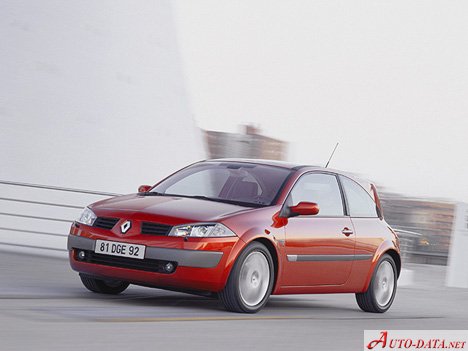
The design of the Megane II Coupe was arguably its most defining characteristic. Breaking away from the more conventional styling of its predecessor, the Megane II adopted a radical new aesthetic under the direction of then-chief designer Patrick Le Quément. The three-door coupe variant accentuated this bold direction with its distinctive “bustle-back” rear end, characterized by a steeply raked rear window and a prominent, almost vertical trunk lid. This design was polarizing but undeniably unique, making the car instantly recognizable on European roads. The overall silhouette was sporty and dynamic, with clean lines and pronounced wheel arches accommodating 205/55 R16 tires on 6.5J x 16-inch wheel rims.
Inside, the Megane II Coupe offered a modern and ergonomic cabin designed for comfort and practicality. Despite its coupe designation, it provided seating for five occupants, although rear-seat access was naturally more restricted than in the five-door hatchback. The trunk space was practical, ranging from 11.65 cubic feet (330 liters) with the rear seats up, expanding significantly to 42.02 cubic feet (1190 liters) when the rear seats were folded down, making it surprisingly versatile for a compact coupe.
Safety was a paramount concern for Renault during this era, and the Megane II was at the forefront of automotive safety technology. It was one of the first compact cars to achieve a full five-star rating in Euro NCAP crash tests, setting a new benchmark for its class. Key safety features included an Anti-lock Braking System (ABS), which was standard, complementing the ventilated disc brakes at the front and disc brakes at the rear. The car also featured an electric power steering system, offering precise control and ease of maneuvering, particularly in urban environments, with a minimum turning circle of 34.45 feet (10.5 meters). The independent McPherson front suspension and torsion beam rear suspension provided a comfortable yet composed ride, characteristic of European compacts.
Technical Specifications: Renault Megane II Coupe 2.0 16V (135 Hp) (2002-2004)
| Category | Specification | US Equivalent (if applicable) |
|---|---|---|
| **General Information** | ||
| Brand | Renault | |
| Model | Megane II Coupe | |
| Type (Engine) | 2.0 16V (135 Hp) | |
| Production Start | 2002 | |
| Production End | 2004 | |
| Body Type | Coupe, 3 Doors | |
| Seats | 5 | |
| Powertrain Architecture | Internal Combustion Engine, Front-Wheel Drive | |
| **Performance Specs** | ||
| Power | 135 Hp @ 5500 rpm | |
| Torque | 191 Nm @ 3250 rpm | 140.87 lb.-ft. @ 3250 rpm |
| Acceleration 0-60 mph | 8.7 sec (Calculated) | |
| Maximum Speed | 200 km/h | 124.27 mph |
| Fuel Type | Petrol (Gasoline) | |
| Fuel Consumption (Combined) | 8 l/100 km | 29.4 US mpg |
| Fuel Consumption (Urban) | 10.9 l/100 km | 21.6 US mpg |
| Fuel Consumption (Extra Urban) | 6.4 l/100 km | 36.8 US mpg |
| CO2 Emissions | 191 g/km | |
| Emission Standard | Euro 4 | |
| Weight-to-Power Ratio | 9.1 kg/Hp | |
| **Engine Specs** | ||
| Engine Model/Code | F4R | |
| Engine Displacement | 1998 cm3 | 2.0 Liters / 121.93 cu. in. |
| Number of Cylinders | 4 | |
| Engine Configuration | Inline | |
| Cylinder Bore | 82.7 mm | 3.26 in. |
| Piston Stroke | 93 mm | 3.66 in. |
| Compression Ratio | 10:1 | |
| Valvetrain | DOHC, 4 valves per cylinder | |
| Fuel Injection System | Multi-port manifold injection | |
| Engine Aspiration | Naturally Aspirated | |
| Engine Oil Capacity | 5.4 l | 5.71 US qt |
| Coolant Capacity | 6 l | 6.34 US qt |
| **Dimensions, Volume & Weights** | ||
| Length | 4209 mm | 165.71 in. |
| Width | 1777 mm | 69.96 in. |
| Height | 1458 mm | 57.40 in. |
| Wheelbase | 2625 mm | 103.35 in. |
| Front Track | 1518 mm | 59.76 in. |
| Rear Track | 1514 mm | 59.61 in. |
| Kerb Weight | 1230 kg | 2711.69 lbs. |
| Maximum Weight | 1770 kg | 3902.18 lbs. |
| Maximum Load | 540 kg | 1190.5 lbs. |
| Trunk (Boot) Space (Min) | 330 l | 11.65 cu. ft. |
| Trunk (Boot) Space (Max) | 1190 l | 42.02 cu. ft. |
| Fuel Tank Capacity | 60 l | 15.85 US gal |
| Drag Coefficient (Cd) | 0.35 | |
| Minimum Turning Circle | 10.5 m | 34.45 ft. |
| **Drivetrain, Brakes & Suspension** | ||
| Drive Wheel | Front-Wheel Drive | |
| Gearbox Type | 6-speed Manual Transmission | |
| Front Suspension | Independent, McPherson Strut | |
| Rear Suspension | Torsion Beam | |
| Front Brakes | Ventilated Discs | |
| Rear Brakes | Discs | |
| Assisting Systems | ABS (Anti-lock Braking System) | |
| Steering Type | Rack and Pinion | |
| Power Steering | Electric Steering | |
| Tire Size | 205/55 R16 | |
| Wheel Rim Size | 6.5J x 16 |
Legacy and Market Impact
The Renault Megane II Coupe, particularly the 2.0 16V (135 Hp) variant, left a significant mark on the European automotive landscape. Its audacious styling, which initially garnered both praise and criticism, ultimately proved to be a design trendsetter, influencing other manufacturers to adopt more distinctive and expressive forms. Renault’s commitment to prioritizing safety, exemplified by the Megane II’s pioneering Euro NCAP 5-star rating, forced competitors to elevate their own safety standards, benefiting consumers across the continent.
In its primary market of Europe, the Megane II competed fiercely with established rivals such as the Volkswagen Golf, Ford Focus, Opel Astra (Vauxhall Astra in the UK), and Peugeot 307. While the Golf was often seen as the benchmark for build quality and the Focus for driving dynamics, the Megane II carved out its niche through its unique design, emphasis on comfort, and advanced safety features. The 2.0 16V engine provided a sporty alternative to the more common smaller displacement engines, offering a compelling blend of performance and daily usability that appealed to a broad range of drivers.
The Megane II’s historical significance extends beyond its sales figures. It showcased Renault’s bold vision for the future of compact cars, demonstrating that practicality and safety didn’t have to come at the expense of distinctive styling. The car’s technology, from its DOHC engine and multi-port injection to its electric power steering and comprehensive safety systems, highlighted a forward-thinking approach that brought advanced features to the mass market. Today, the Renault Megane II Coupe 2.0 16V (135 Hp) is remembered as a vehicle that dared to be different, successfully combining innovative design with strong performance and an unwavering commitment to occupant safety, cementing its place as an iconic European compact.