Introduction to the Renault Megane II Coupe (Phase II, 2006)
The Renault Megane II Coupe (Phase II, 2006) represents a significant chapter in the history of compact European automobiles, particularly within the C-segment. Launched as part of the Megane’s second generation, the Phase II update in 2006 brought a series of refinements to a model already renowned for its distinctive, avant-garde design. This particular variant, the 1.6 16V (112 Hp) Automatic, offered a blend of practicality, comfort, and modest performance, tailored for the urban and suburban landscapes of its primary European market.
The Megane II, produced from 2002 to 2009, was a critical model for the French automaker, continuing its tradition of innovative design and engineering in the competitive compact class. The coupe body style, with its three doors and five seats, was a stylish alternative to the more common hatchback, offering a sportier aesthetic without sacrificing too much everyday usability. While never officially sold in the United States, the Megane II carved out a strong niche in Europe, competing against segment stalwarts with its unique character and advanced features for its time. The 2006 Phase II update introduced subtle cosmetic tweaks, improved interior materials, and enhanced equipment levels, keeping the model fresh against newer rivals.
Powertrain and Performance of the Renault Megane II Coupe (Phase II, 2006) 1.6 16V (112 Hp) Automatic
Engine Architecture and Output
At the heart of this particular Renault Megane II Coupe variant is the venerable K4M engine, a 1.6-liter (1598 cm³) 16-valve inline-four gasoline unit. This naturally aspirated engine, featuring a Double Overhead Camshaft (DOHC) valvetrain and multi-port manifold injection, was a workhorse for Renault across various models in the mid-2000s. It was designed for a balance of efficiency and accessible power, delivering 112 horsepower at 6000 rpm. Torque output peaked at 112.11 lb.-ft. (152 Nm) at 4200 rpm, providing sufficient pulling power for daily driving scenarios. With a compression ratio of 10:1 and a bore of 3.13 inches (79.5 mm) matched with a piston stroke of 3.17 inches (80.5 mm), the engine was optimized for smooth operation and responsive acceleration in its class.
Driving Dynamics and Efficiency
Power is channeled to the front wheels via a 4-speed automatic transmission. While modern vehicles often boast more gears, a 4-speed automatic was a common offering in compact cars during this era, prioritizing smooth shifts and ease of use over outright performance or hyper-efficiency. The combination allowed the Megane II Coupe to accelerate from 0 to 60 mph in a respectable 12.2 seconds, with a top speed of 113.09 mph (182 km/h).
Fuel economy, a significant consideration for European buyers, was rated at a combined 30.5 US mpg (7.7 l/100 km), with urban consumption at 22 US mpg (10.7 l/100 km) and extra-urban figures reaching 39.2 US mpg (6 l/100 km). These figures were competitive for a compact coupe of its time equipped with an automatic transmission. The vehicle met the Euro 4 emission standard, emitting 184 g/km of CO2, reflecting its compliance with the environmental regulations prevalent in Europe during its production run from 2006 to 2008. The front-wheel-drive architecture, combined with an Independent McPherson front suspension and a torsion beam rear suspension, provided a comfortable and predictable ride, well-suited to a variety of road conditions. Electric power steering further enhanced maneuverability, particularly in city driving.
Distinctive Design and Interior Features
Exterior Styling
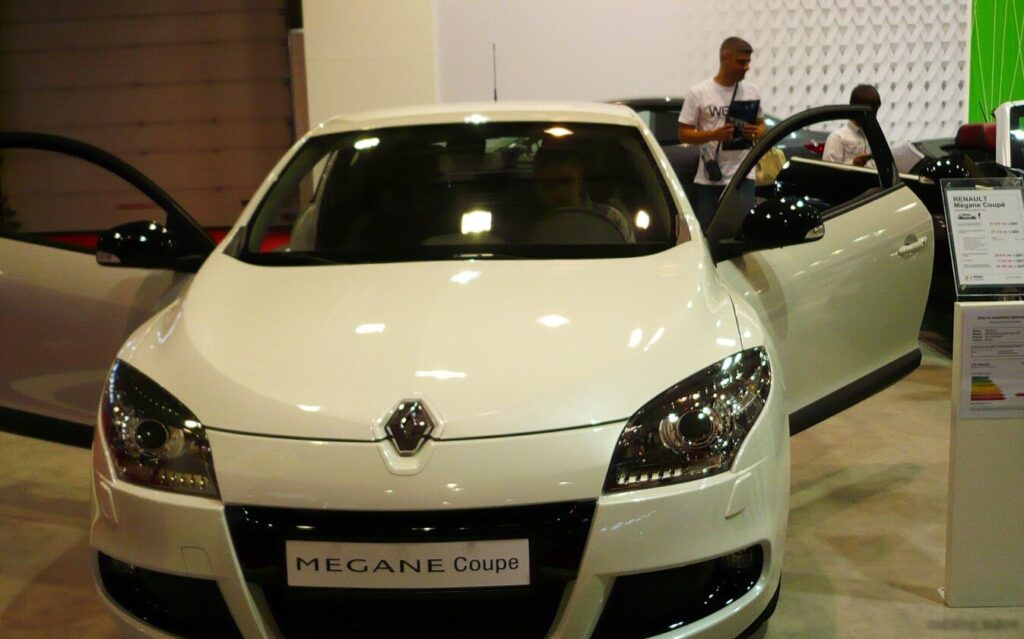
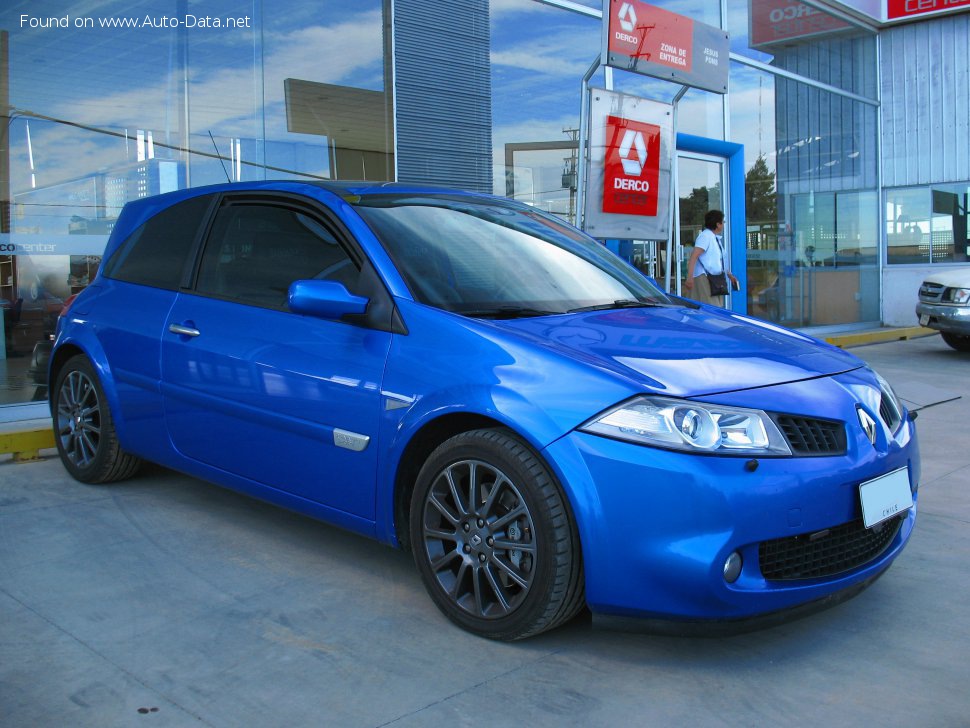
The Renault Megane II Coupe stands out with its distinctive and often polarizing design, a hallmark of Renault’s aesthetic direction in the early 2000s. The Phase II refresh in 2006 maintained the original’s bold styling, characterized by its prominent “bustle back” rear end and sharp, angular lines. As a 3-door coupe, it presented a sportier profile than its hatchback sibling, with a sleeker roofline and more aggressive stance. Its dimensions – 165.71 inches (4209 mm) long, 69.96 inches (1777 mm) wide (79.76 inches or 2026 mm including mirrors), and 57.4 inches (1458 mm) tall – gave it a compact footprint, ideal for navigating crowded European cities. The wheelbase measured 103.35 inches (2625 mm), contributing to a stable ride, while a drag coefficient (Cd) of 0.35 was typical for a vehicle of its class and era. The vehicle rode on 195/65 R15 tires mounted on 6.5J x 15-inch wheel rims.
Interior Comfort and Technology
Despite its coupe designation, the Megane II Coupe offered a surprisingly practical interior with seating for five occupants. The cabin reflected Renault’s focus on user-friendliness and comfort. Trunk space was versatile, offering a minimum of 11.65 cubic feet (330 liters) and expanding to a generous 42.02 cubic feet (1190 liters) with the rear seats folded, making it suitable for varying cargo needs. Key features for safety and convenience included an Anti-lock Braking System (ABS) with ventilated discs at the front and disc brakes at the rear, providing reliable stopping power. The electric power steering system offered light and precise control, enhancing the driving experience. The interior design, for its time, was modern and functional, emphasizing ergonomics and material quality appropriate for its segment.
Technical Specifications
| Parameter | Value |
|---|---|
| General Information | |
| Brand | Renault |
| Model | Megane |
| Generation | Megane II Coupe (Phase II, 2006) |
| Type (Engine) | 1.6 16V (112 Hp) Automatic |
| Start of Production | 2006 year |
| End of Production | 2008 year |
| Powertrain Architecture | Internal Combustion engine |
| Body type | Coupe |
| Seats | 5 |
| Doors | 3 |
| Performance Specifications | |
| Fuel consumption (economy) – urban | 10.7 l/100 km (22 US mpg) |
| Fuel consumption (economy) – extra urban | 6 l/100 km (39.2 US mpg) |
| Fuel consumption (economy) – combined | 7.7 l/100 km (30.5 US mpg) |
| CO2 emissions | 184 g/km |
| Fuel Type | Petrol (Gasoline) |
| Acceleration 0 – 60 mph | 12.2 sec |
| Maximum speed | 113.09 mph (182 km/h) |
| Emission standard | Euro 4 |
| Weight-to-power ratio | 11 kg/Hp (91.1 Hp/tonne) |
| Weight-to-torque ratio | 8.1 kg/Nm (123.6 Nm/tonne) |
| Engine Specifications | |
| Power | 112 Hp @ 6000 rpm |
| Power per liter | 70.1 Hp/l |
| Torque | 112.11 lb.-ft. (152 Nm) @ 4200 rpm |
| Engine layout | Front, Transverse |
| Engine Model/Code | K4M |
| Engine displacement | 1.6 l (1598 cm³ / 97.52 cu. in.) |
| Number of cylinders | 4 |
| Engine configuration | Inline |
| Cylinder Bore | 3.13 in. (79.5 mm) |
| Piston Stroke | 3.17 in. (80.5 mm) |
| Compression ratio | 10:1 |
| Number of valves per cylinder | 4 |
| Fuel injection system | Multi-port manifold injection |
| Engine aspiration | Naturally aspirated engine |
| Valvetrain | DOHC |
| Engine oil capacity | 5.07 US qt (4.8 l) |
| Engine oil specification | Not specified in available data |
| Coolant | 6.87 US qt (6.5 l) |
| Space, Volume and Weights | |
| Kerb Weight | 2711.69 lbs. (1230 kg) |
| Max. weight | 3913.21 lbs. (1775 kg) |
| Max load | 1201.52 lbs. (545 kg) |
| Trunk (boot) space – minimum | 11.65 cu. ft. (330 l) |
| Trunk (boot) space – maximum | 42.02 cu. ft. (1190 l) |
| Fuel tank capacity | 15.85 US gal (60 l) |
| Max. roof load | 176.37 lbs. (80 kg) |
| Permitted trailer load with brakes | 2866.01 lbs. (1300 kg) |
| Permitted trailer load without brakes | 1433 lbs. (650 kg) |
| Permitted towbar download | 165.35 lbs. (75 kg) |
| Dimensions | |
| Length | 165.71 in. (4209 mm) |
| Width | 69.96 in. (1777 mm) |
| Width including mirrors | 79.76 in. (2026 mm) |
| Height | 57.4 in. (1458 mm) |
| Wheelbase | 103.35 in. (2625 mm) |
| Front track | 59.76 in. (1518 mm) |
| Rear (Back) track | 59.61 in. (1514 mm) |
| Front overhang | 33.15 in. (842 mm) |
| Rear overhang | 29.21 in. (742 mm) |
| Drag coefficient (Cd) | 0.35 |
| Minimum turning circle (turning diameter) | 34.45 ft. (10.5 m) |
| Drivetrain, Brakes and Suspension Specifications | |
| Drivetrain Architecture | The Internal combustion engine (ICE) drives the front wheels of the vehicle. |
| Drive wheel | Front wheel drive |
| Number of gears and type of gearbox | 4 gears, automatic transmission |
| Front suspension | Independent type McPherson |
| Rear suspension | Torsion |
| Front brakes | Ventilated discs |
| Rear brakes | Disc |
| Assisting systems | ABS (Anti-lock braking system) |
| Steering type | Steering rack and pinion |
| Power steering | Electric Steering |
| Tires size | 195/65 R15 |
| Wheel rims size | 6.5J x 15 |
Legacy and Market Impact
The Renault Megane II, and particularly its distinctive coupe variant, left a notable mark on the European automotive landscape during its production. It was a bold statement from Renault, moving away from conventional design norms to create a car that truly stood out. The “bustle back” styling, though initially controversial, became an iconic feature, contributing to the Megane II’s strong identity in a highly competitive market. For many, it represented a refreshing departure from the often conservative designs of its German and Japanese rivals.
In its segment, the Megane II Coupe competed fiercely with a host of established players such as the Volkswagen Golf, Opel Astra, Ford Focus, Peugeot 307, and Citroën C4. Its strengths lay in its unique design, comfortable ride, and the generous standard equipment levels often offered by Renault. While the 1.6-liter automatic variant wasn’t designed for outright performance, it delivered a smooth, refined driving experience that appealed to a broad demographic seeking a stylish yet practical compact car for daily commutes and longer journeys.
Beyond aesthetics, the Megane II generation was also lauded for its safety, being one of the first cars in its class to achieve a full five-star Euro NCAP safety rating (though specific to the hatchback, the platform’s integrity extended to the coupe). This commitment to safety, combined with its innovative design and accessible technology, helped reinforce Renault’s reputation as a forward-thinking automaker. The Megane II Coupe, therefore, is remembered not just as a compact car, but as a vehicle that embodied Renault’s adventurous spirit, offering European consumers a distinctive and well-rounded option in a crowded market. Its legacy is one of bold design, practical innovation, and a firm place in the evolution of the modern European compact car.