The Renault Megane II Grandtour 1.5 dCi (101 Hp) Automatic: A European Compact Workhorse
The Renault Megane II Grandtour, specifically the 1.5 dCi (101 Hp) Automatic variant produced between 2004 and 2005,
represents a significant chapter in the history of compact family vehicles in Europe. As a member of the second generation
Megane lineup, this model built upon the innovative design and practical functionality that characterized its predecessors,
while pushing boundaries with its distinctive styling and a focus on efficiency, a hallmark of European automotive engineering.
The Megane II generation, launched in 2002, was globally recognized for its unconventional “bustle-back” rear end on the hatchback
and its strong emphasis on safety, earning a groundbreaking five-star Euro NCAP rating.
While never officially sold in the United States, the Renault Megane II Grandtour played a crucial role in the competitive
European C-segment, offering a compelling blend of space, comfort, and economical operation. The “Grandtour” designation
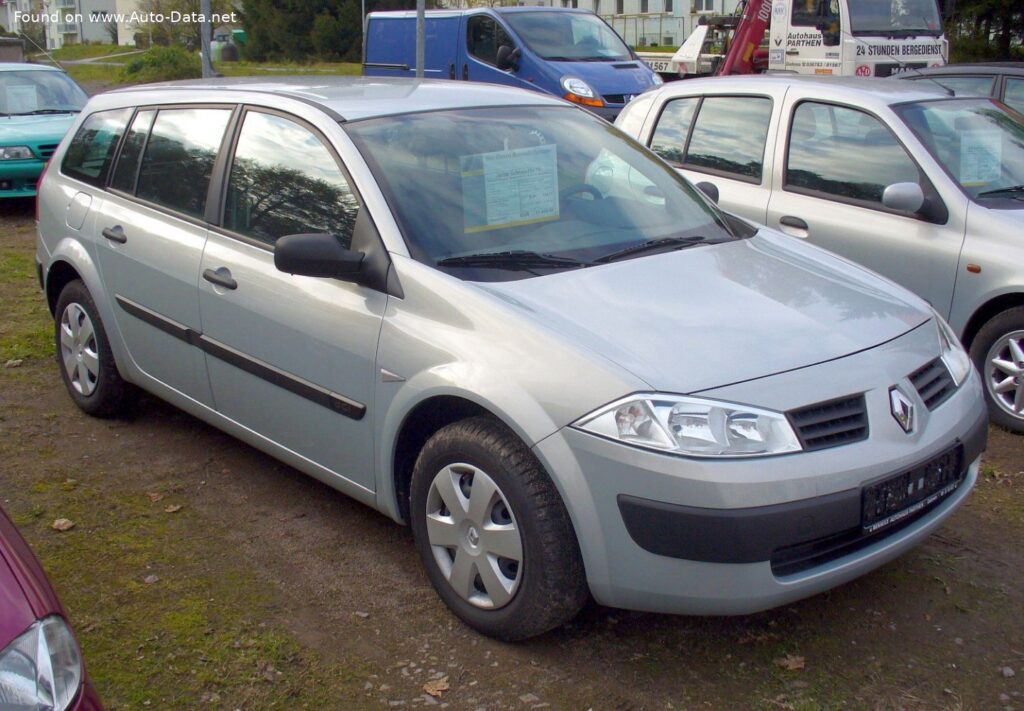
signified its station wagon (estate) body style, catering to families and individuals who required greater cargo capacity
than the standard hatchback or sedan, without sacrificing the maneuverability and fuel efficiency of a compact car.
The 1.5 dCi engine, a popular diesel choice, underscored Renault’s commitment to delivering practical, low-running-cost vehicles
for its primary markets across the continent.
Engine and Performance of the Renault Megane II Grandtour 1.5 dCi (101 Hp) Automatic
At the heart of the 2004-2005 Renault Megane II Grandtour 1.5 dCi (101 Hp) Automatic lies Renault’s well-regarded K9K
diesel engine. This 1.5-liter (1461 cm³ or 89.16 cu. in.) inline-four powerplant was designed with a focus on
fuel economy and usable torque, making it ideal for both urban commuting and longer highway journeys typical in Europe.
The engine features a common rail direct fuel injection system, combined with a turbocharger and intercooler, to
optimize combustion efficiency and power delivery.
The K9K engine produces a respectable 101 horsepower at 4000 rpm, which, while not designed for outright speed,
provides ample motivation for a family station wagon. More significant for daily driving is its torque output:
200 Nm (147.51 lb.-ft.) available at a low 1900 rpm. This strong low-end torque is characteristic of modern diesel engines
and contributes to the vehicle’s effortless feel in city traffic and its ability to maintain speed on inclines without
frequent downshifts.
Paired with a 4-speed automatic transmission, the powertrain architecture drives the front wheels, prioritizing ease of
use and efficiency. Performance figures reflect its practical orientation: the Megane II Grandtour 1.5 dCi accelerates
from 0 to 60 mph in a calculated 14.3 seconds, with a top speed of 108.12 mph (174 km/h). Fuel economy was a major selling
point, with a combined rating of 40.6 US mpg (5.8 l/100 km), an urban rating of 30.5 US mpg (7.7 l/100 km), and an
impressive extra-urban rating of 50 US mpg (4.7 l/100 km). These figures were highly competitive for its era and helped
offset the higher fuel prices common in European markets. The engine met the Euro 3 emission standard, reflecting
the environmental regulations of the time.
Design and Features of the Megane II Grandtour
The Renault Megane II Grandtour carried over the distinctive design language of the second-generation Megane,
characterized by its bold, angular lines and a somewhat avant-garde aesthetic that set it apart from its rivals.
While the hatchback’s rear styling was polarizing, the Grandtour’s station wagon form factor integrated the design
elements more cohesively, creating a sleek and functional profile. With a length of 177.17 inches (4500 mm) and
a width of 69.96 inches (1777 mm), the Grandtour offered a substantial road presence for a compact vehicle.
The five-door, five-seat configuration made it a versatile family hauler. The extended wheelbase of 105.75 inches (2686 mm)
compared to the hatchback contributed to improved rear passenger legroom and, critically, a generous cargo area.
The trunk space was a standout feature, offering a minimum of 18.36 cubic feet (520 liters) with the rear seats up,
expanding to a cavernous 56.5 cubic feet (1600 liters) when the rear seats were folded down. This flexibility allowed
the Megane II Grandtour to accommodate everything from weekly groceries to vacation luggage and sports equipment,
making it a true utility vehicle for European families.
Key features for the era included an independent McPherson type front suspension and a torsion beam rear suspension,
tuned for a comfortable ride and stable handling. Braking was handled by ventilated discs at the front and disc brakes
at the rear, complemented by an Anti-lock Braking System (ABS) for enhanced safety. The electric power steering system
provided light and responsive steering, particularly beneficial for urban maneuvering and parking. The vehicle rode
on 205/50 R17 tires mounted on 6.5J x 17-inch wheel rims, contributing to both its aesthetic appeal and road holding.
Safety was a paramount concern for Renault, and the Megane II generation was at the forefront of passive safety,
though specific active safety features beyond ABS were less common in mainstream compacts of this period.
Technical Specifications
| Category | Specification | US Equivalent |
|---|---|---|
| Brand | Renault | |
| Model | Megane | |
| Generation | Megane II Grandtour | |
| Type (Engine) | 1.5 dCi (101 Hp) Automatic | |
| Start of production | 2004 year | |
| End of production | 2005 year | |
| Powertrain Architecture | Internal Combustion engine | |
| Body type | Station wagon (estate) | |
| Seats | 5 | |
| Doors | 5 | |
| Performance Specs | ||
| Fuel consumption (economy) – urban | 7.7 l/100 km | 30.5 US mpg |
| Fuel consumption (economy) – extra urban | 4.7 l/100 km | 50 US mpg |
| Fuel consumption (economy) – combined | 5.8 l/100 km | 40.6 US mpg |
| CO2 emissions | 153 g/km | |
| Fuel Type | Diesel | |
| Acceleration 0 – 60 mph | 14.3 sec | |
| Acceleration 0 – 100 km/h | 15.1 sec | |
| Maximum speed | 174 km/h | 108.12 mph |
| Emission standard | Euro 3 | |
| Weight-to-power ratio | 12.7 kg/Hp | |
| Weight-to-torque ratio | 6.4 kg/Nm | |
| Engine Specs | ||
| Power | 101 Hp @ 4000 rpm | |
| Power per liter | 69.1 Hp/l | |
| Torque | 200 Nm @ 1900 rpm | 147.51 lb.-ft. @ 1900 rpm |
| Engine layout | Front, Transverse | |
| Engine Model/Code | K9K | |
| Engine displacement | 1461 cm³ | 1.5 liters (89.16 cu. in.) |
| Number of cylinders | 4 | |
| Engine configuration | Inline | |
| Cylinder Bore | 76 mm | 2.99 in. |
| Piston Stroke | 80.5 mm | 3.17 in. |
| Compression ratio | 18.8:1 | |
| Number of valves per cylinder | 2 | |
| Fuel injection system | Diesel Commonrail | |
| Engine aspiration | Turbocharger, Intercooler | |
| Valvetrain | OHC | |
| Engine oil capacity | 4.5 l | 4.76 US qt |
| Coolant | 6.8 l | 7.19 US qt |
| Space, Volume and Weights | ||
| Kerb Weight | 1285 kg | 2832.94 lbs. |
| Max. weight | 1865 kg | 4111.62 lbs. |
| Max load | 580 kg | 1278.68 lbs. |
| Trunk (boot) space – minimum | 520 l | 18.36 cu. ft. |
| Trunk (boot) space – maximum | 1600 l | 56.5 cu. ft. |
| Fuel tank capacity | 60 l | 15.85 US gal |
| Max. roof load | 80 kg | 176.37 lbs. |
| Permitted trailer load with brakes (12%) | 1300 kg | 2866.01 lbs. |
| Permitted trailer load without brakes | 650 kg | 1433 lbs. |
| Permitted towbar download | 75 kg | 165.35 lbs. |
| Dimensions | ||
| Length | 4500 mm | 177.17 in. |
| Width | 1777 mm | 69.96 in. |
| Width including mirrors | 2026 mm | 79.76 in. |
| Height | 1467 mm | 57.76 in. |
| Wheelbase | 2686 mm | 105.75 in. |
| Front track | 1518 mm | 59.76 in. |
| Rear (Back) track | 1514 mm | 59.61 in. |
| Front overhang | 842 mm | 33.15 in. |
| Rear overhang | 972 mm | 38.27 in. |
| Minimum turning circle (turning diameter) | 11 m | 36.09 ft. |
| Drivetrain, Brakes and Suspension Specs | ||
| Drivetrain Architecture | Front wheel drive. Internal Combustion engine. | |
| Drive wheel | Front wheel drive | |
| Number of gears and type of gearbox | 4 gears, automatic transmission | |
| Front suspension | Independent type McPherson | |
| Rear suspension | Torsion | |
| Front brakes | Ventilated discs | |
| Rear brakes | Disc | |
| Assisting systems | ABS (Anti-lock braking system) | |
| Steering type | Steering rack and pinion | |
| Power steering | Electric Steering | |
| Tires size | 205/50 R17 | |
| Wheel rims size | 6.5J x 17 | |
Legacy and Market Impact of the Renault Megane II Grandtour
The Renault Megane II Grandtour, particularly with its efficient 1.5 dCi engine, carved out a significant niche
in the intensely competitive European compact segment. Its primary rivals included established players like the
Volkswagen Golf Variant (known as the Jetta SportWagen in some markets), Ford Focus Estate, Peugeot 307 SW,
and Opel Astra Caravan. What set the Megane II apart was its distinctive design, which, despite initial mixed
reactions for the hatchback, matured well into the Grandtour’s more conventional yet stylish station wagon form.
It offered a fresh alternative to the more conservative designs of its German competitors.
Its legacy is largely defined by its commitment to practicality, safety, and economical operation. The Megane II
was instrumental in solidifying Renault’s reputation as a leader in vehicle safety, a characteristic that resonated
strongly with European families. The widespread adoption of common rail diesel engines like the 1.5 dCi in models
such as the Megane was also a critical factor in shaping the European automotive landscape, where diesel power
was (and to some extent, still is) favored for its fuel efficiency and lower CO2 emissions compared to gasoline engines.
The automatic transmission option, while a 4-speed unit, provided a level of convenience increasingly sought after
by drivers in congested urban environments.
The Megane II Grandtour proved to be a reliable and versatile choice for many European households, serving as a
comfortable daily driver and a capable long-distance cruiser. Its generous cargo volume and thoughtful interior
design made it highly adaptable to varying lifestyle needs. While its performance figures might seem modest by
today’s standards, for its time, the blend of 101 horsepower and strong torque, coupled with excellent fuel economy,
represented a pragmatic and effective solution for the mass market. The model’s production run from 2004 to 2005
for this specific variant indicates a focused market offering, leading into subsequent updates and refinements
for the broader Megane II range. Ultimately, the Renault Megane II Grandtour 1.5 dCi (101 Hp) Automatic stands
as an enduring example of European automotive ingenuity, prioritizing functional design, efficiency, and safety
for its intended audience.