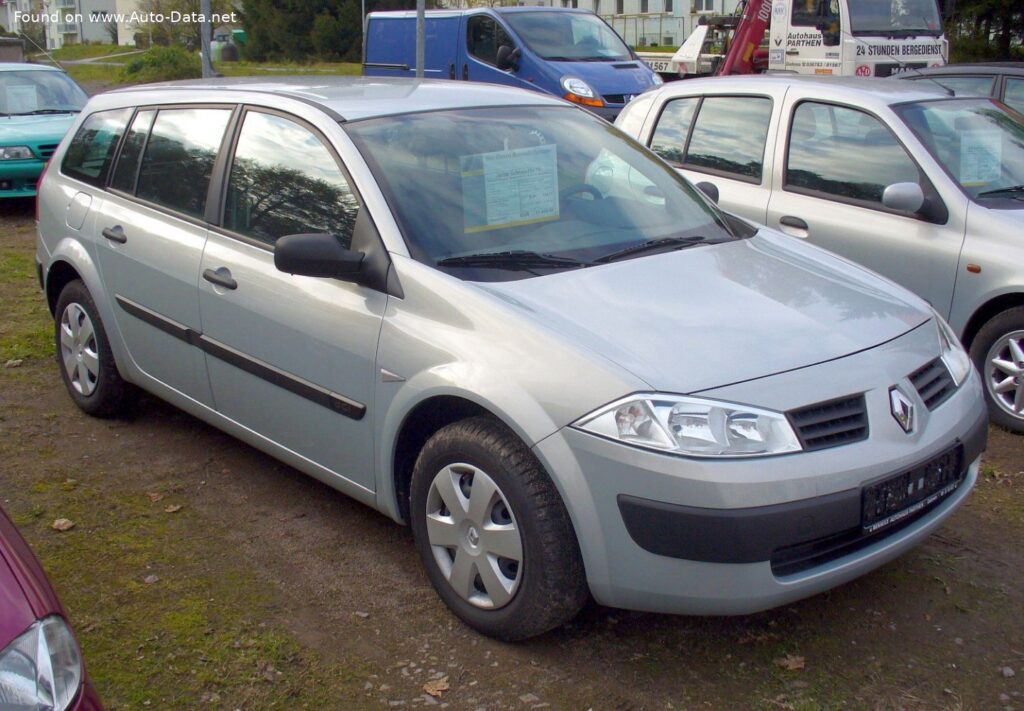
Renault Megane II Grandtour 1.5 dCi (86 Hp): A European Workhorse
The Renault Megane II Grandtour 1.5 dCi (86 Hp), produced specifically for the 2005 model year, represents a key offering in the European C-segment, a fiercely competitive class dominated by compact family vehicles. While the Renault brand has had a limited presence in the United States market, with its most recent major foray ending in the late 1980s, the Megane series has been a cornerstone of its global strategy, particularly across Europe and other international markets. The Megane II generation, launched in 2002, was notable for its distinctive styling and a strong emphasis on safety, earning high marks in Euro NCAP crash tests.
The Grandtour designation signifies the station wagon (or estate) body style, a highly popular and practical choice for families and businesses in Europe. This particular variant, equipped with the 1.5 dCi diesel engine, was designed to offer exceptional fuel economy and reasonable performance for everyday driving, embodying the European preference for efficient, high-torque diesel powertrains in this vehicle class. It was a five-door, five-seat vehicle, prioritizing versatility and cargo capacity within a relatively compact footprint, making it an ideal choice for navigating both urban environments and longer journeys.
Engine & Performance: The Economical Heart of the Renault Megane II Grandtour
At the core of the 2005 Renault Megane II Grandtour 1.5 dCi (86 Hp) lies the renowned K9K engine, a 1.5-liter (1461 cm³ or 89.16 cu. in.) inline four-cylinder diesel unit. This engine was a testament to Renault’s commitment to diesel technology, featuring a common rail fuel injection system, a turbocharger, and an intercooler to optimize combustion and efficiency. Despite its modest displacement, the engine delivered a respectable 86 horsepower at 3750 revolutions per minute (rpm), making it a capable performer for its segment.
However, where this powertrain truly shined was in its torque output and fuel efficiency. It generated a robust 147.51 lb.-ft. (200 Nm) of torque at a low 1900 rpm. This characteristic low-end torque is typical of modern diesel engines and provided the Megane II Grandtour with brisk acceleration from a standstill and strong pulling power, particularly beneficial when carrying a full load or navigating hilly terrain. The power was channeled to the front wheels via a smooth-shifting 5-speed manual transmission, a common and reliable setup for European compacts.
Performance figures reflected its economical nature rather than outright speed. The vehicle accelerated from 0 to 60 mph in 12.4 seconds, with a maximum speed of 108.12 mph (174 km/h). While not a sports car, these figures were perfectly adequate for daily driving and highway cruising. More impressively, the fuel economy was a standout feature, with a combined rating of 50 US miles per gallon (4.7 liters per 100 km). Urban driving yielded 41.3 US mpg (5.7 l/100 km), and extra-urban conditions saw an excellent 56 US mpg (4.2 l/100 km). These figures, combined with CO2 emissions of 125 g/km and compliance with the Euro 4 emission standard, underscored its environmental consciousness for its era and its cost-effectiveness for owners. The engine’s layout was front, transverse, contributing to efficient packaging and a favorable weight distribution for front-wheel-drive dynamics.
Design & Features: Practicality Meets Distinctive Styling
The Megane II generation, including the Grandtour, was a significant departure from its predecessor in terms of design, showcasing a bold and somewhat polarizing aesthetic. While the hatchback famously featured a “bustle back” rear design, the Grandtour adopted a more conventional, yet still distinctive, station wagon profile. Its elongated roofline and expansive rear window contributed to a spacious and airy cabin, enhancing its practical appeal. The overall length of 177.17 inches (4500 mm), width of 69.96 inches (1777 mm), and height of 57.76 inches (1467 mm) placed it firmly in the compact segment, yet its generous 105.75-inch (2686 mm) wheelbase ensured a comfortable ride and ample interior space for five occupants.
The Grandtour body style was specifically designed for utility, offering a substantial minimum trunk (boot) space of 18.36 cubic feet (520 liters). With the rear seats folded down, this expanded to a cavernous 56.5 cubic feet (1600 liters), making it highly capable of accommodating luggage, sports equipment, or even small furniture. The maximum roof load capacity of 176.37 lbs (80 kg) further extended its cargo-carrying versatility, allowing for roof boxes or bicycle racks.
Standard features for the 2005 Megane II Grandtour 1.5 dCi included a range of safety and convenience technologies. The vehicle was equipped with an Anti-lock Braking System (ABS) for enhanced stopping control, coupled with ventilated discs at the front and disc brakes at the rear. The steering system utilized a rack and pinion setup with electric power steering, providing light and responsive handling, particularly beneficial in urban maneuvering and parking. The car rode on 205/50 R17 tires mounted on 6.5J x 17-inch wheel rims, contributing to a stable and comfortable ride. The independent McPherson front suspension and torsion beam rear suspension provided a good balance of ride comfort and handling characteristics, typical for vehicles in this class.
Technical Specifications
| Category | Specification | Value |
|---|---|---|
General Information |
||
| Brand | Renault | |
| Model | Megane II Grandtour | 1.5 dCi (86 Hp) |
| Production Years | Start of production | 2005 |
| End of production | 2005 | |
| Body Type | Station wagon (estate) | 5 Doors, 5 Seats |
| Powertrain Architecture | Internal Combustion Engine | |
Performance Specifications |
||
| Fuel Consumption (Urban) | 41.3 US mpg (5.7 l/100 km) | |
| Fuel Consumption (Extra Urban) | 56 US mpg (4.2 l/100 km) | |
| Fuel Consumption (Combined) | 50 US mpg (4.7 l/100 km) | |
| CO2 Emissions | 125 g/km | |
| Emission Standard | Euro 4 | |
| Fuel Type | Diesel | |
| Acceleration (0-60 mph) | 12.4 seconds | |
| Maximum Speed | 108.12 mph (174 km/h) | |
| Weight-to-power ratio | 14.4 kg/Hp | |
| Weight-to-torque ratio | 6.2 kg/Nm | |
Engine Specifications |
||
| Power | 86 Hp @ 3750 rpm | |
| Torque | 147.51 lb.-ft. (200 Nm) @ 1900 rpm | |
| Engine Displacement | 1.5 Liters (1461 cm³ / 89.16 cu. in.) | |
| Number of Cylinders | 4, Inline | |
| Engine Layout | Front, Transverse | |
| Engine Model/Code | K9K | |
| Cylinder Bore | 2.99 in. (76 mm) | |
| Piston Stroke | 3.17 in. (80.5 mm) | |
| Compression Ratio | 18.8:1 | |
| Valves per Cylinder | 2 | |
| Fuel Injection System | Diesel Commonrail | |
| Engine Aspiration | Turbocharger, Intercooler | |
| Engine Oil Capacity | 4.76 US qt (4.5 l) | |
| Coolant Capacity | 5.6 US qt (5.3 l) | |
Space, Volume and Weights |
||
| Kerb Weight | 2722.71 lbs (1235 kg) | |
| Maximum Weight | 4001.39 lbs (1815 kg) | |
| Maximum Load | 1278.68 lbs (580 kg) | |
| Trunk (Boot) Space (Minimum) | 18.36 cu. ft. (520 l) | |
| Trunk (Boot) Space (Maximum) | 56.5 cu. ft. (1600 l) | |
| Fuel Tank Capacity | 15.85 US gal (60 l) | |
| Max. Roof Load | 176.37 lbs (80 kg) | |
| Permitted Trailer Load with Brakes (12%) | 2866.01 lbs (1300 kg) | |
| Permitted Trailer Load without Brakes | 1433 lbs (650 kg) | |
| Permitted Towbar Download | 165.35 lbs (75 kg) | |
Dimensions |
||
| Length | 177.17 in. (4500 mm) | |
| Width | 69.96 in. (1777 mm) | |
| Width Including Mirrors | 79.76 in. (2026 mm) | |
| Height | 57.76 in. (1467 mm) | |
| Wheelbase | 105.75 in. (2686 mm) | |
| Front Track | 59.76 in. (1518 mm) | |
| Rear Track | 59.61 in. (1514 mm) | |
| Front Overhang | 33.15 in. (842 mm) | |
| Rear Overhang | 38.27 in. (972 mm) | |
| Minimum Turning Circle | 36.09 ft. (11 m) | |
Drivetrain, Brakes and Suspension |
||
| Drivetrain Architecture | Front-wheel drive (ICE drives front wheels) | |
| Drive Wheel | Front wheel drive | |
| Gearbox Type | 5 gears, manual transmission | |
| Front Suspension | Independent type McPherson | |
| Rear Suspension | Torsion | |
| Front Brakes | Ventilated discs | |
| Rear Brakes | Disc | |
| Assisting Systems | ABS (Anti-lock braking system) | |
| Steering Type | Steering rack and pinion | |
| Power Steering | Electric Steering | |
| Tires Size | 205/50 R17 | |
| Wheel Rims Size | 6.5J x 17 | |
Legacy & Market Impact of the Renault Megane II Grandtour
The Renault Megane II Grandtour, particularly in its 1.5 dCi (86 Hp) guise, carved out a significant niche in the highly competitive European compact segment during its production run. It competed directly with formidable rivals such as the Volkswagen Golf Variant, Opel Astra Estate, Ford Focus Estate, and Peugeot 307 SW. In this context, the Megane II Grandtour stood out for its distinctive styling, a comfortable ride, and, crucially, its exceptional fuel economy offered by the dCi diesel engines.
At a time when diesel engines were gaining immense popularity in Europe due to their efficiency and lower fuel costs, the 1.5 dCi engine was a strategic asset for Renault. It provided a compelling package for families and fleet operators seeking to minimize running costs without sacrificing practicality. The 86-horsepower version, while not the most powerful in the lineup, was a volume seller due to its optimal balance of performance and economy, making it a sensible choice for everyday commuters and those who valued fuel efficiency above all else. Its Euro 4 compliance also positioned it favorably as environmental concerns began to play a more prominent role in purchasing decisions.
The Megane II generation as a whole was instrumental in solidifying Renault’s position as a major player in the European market. Its bold design language, while initially divisive, ultimately helped it stand out in a crowded segment. The Grandtour variant, in particular, was praised for its cavernous cargo space and family-friendly features, embodying the traditional strengths of a station wagon. Its impact was felt in its contribution to Renault’s sales volumes and its role in demonstrating the viability and appeal of compact, efficient diesel-powered family cars. While it never reached American shores, the Renault Megane II Grandtour 1.5 dCi (86 Hp) remains a significant chapter in European automotive history, remembered as a practical, economical, and stylish workhorse that served countless families across the continent.