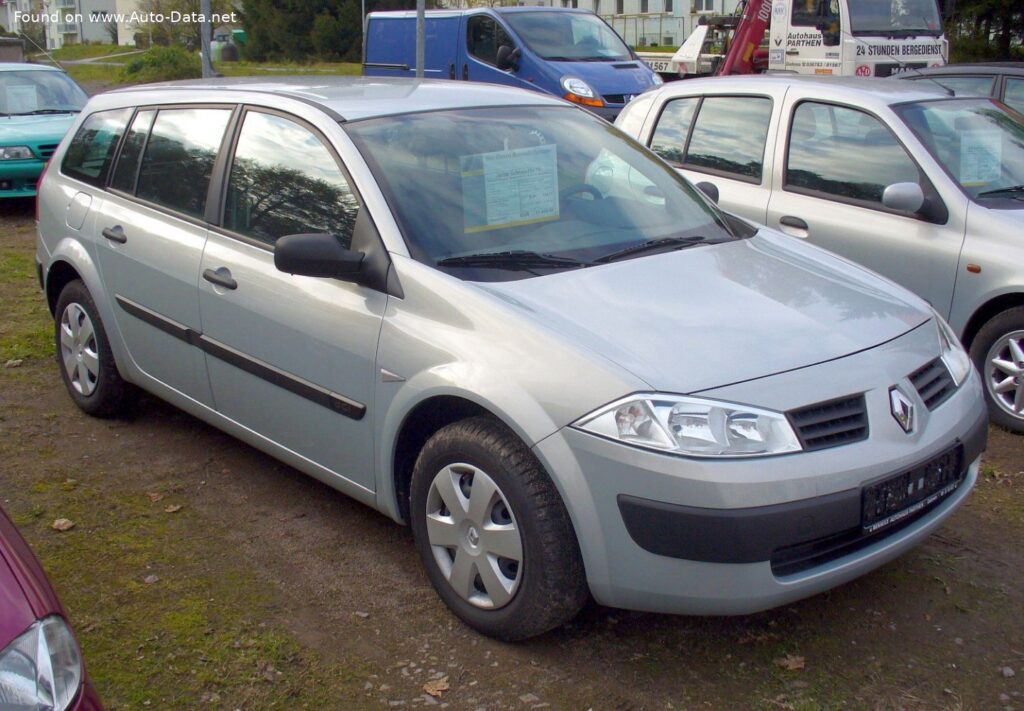
The Renault Megane II Grandtour 1.6 16V (112 Hp): A European Workhorse
The Renault Megane II Grandtour 1.6 16V (112 Hp) represents a crucial offering in the European compact segment, specifically tailored for families and individuals prioritizing practicality, space, and a comfortable driving experience. As part of the second generation of the Megane lineup (Megane II), which was globally acclaimed for its distinctive styling and advanced features upon its introduction in 2002, the Grandtour variant extended its appeal by adopting a station wagon body style. This particular iteration, featuring the 1.6-liter 16-valve engine with 112 horsepower, was produced for the 2005 model year, offering a balanced proposition of performance and fuel efficiency for its target market.
While Renault models are not widely sold in the United States today, the Megane II Grandtour played a significant role in the highly competitive European C-segment. It vied for market share against formidable rivals like the Ford Focus Wagon, Opel Astra Caravan, and Peugeot 307 SW. Renault’s strategy with the Megane II series was to push boundaries in design, safety, and interior packaging, and the Grandtour capitalized on these strengths by adding substantial cargo capacity and enhanced versatility, making it a popular choice for long-distance travel and daily family duties across the continent.
Engine and Performance Characteristics of the Renault Megane II Grandtour
At the heart of this particular Renault Megane II Grandtour model lies a naturally aspirated 1.6-liter (1598 cm³) 16-valve inline-four cylinder petrol engine, designated by the internal code K4M. This powerplant was a well-regarded unit in Renault’s lineup, known for its robust design and reliable performance. Delivering a respectable 112 horsepower at 6000 rpm, it provided sufficient motivation for the compact station wagon, enabling confident highway cruising and adequate acceleration for urban environments. The engine’s power per liter stood at 70.1 Hp/l, indicating an efficient use of its displacement for power output.
Torque figures for this engine were rated at 152 Nm (approximately 112.11 lb.-ft.) peaking at 4200 rpm. This mid-range torque delivery was well-suited to the vehicle’s intended purpose, providing flexibility in daily driving without constant downshifting. Power was sent to the front wheels via a smooth-shifting 5-speed manual transmission, a common and reliable setup for vehicles in this class during the mid-2000s. The drivetrain architecture ensured direct power delivery and contributed to the vehicle’s overall efficiency.
In terms of outright performance, the Megane II Grandtour 1.6 16V was capable of accelerating from 0 to 60 mph in a calculated 10.7 seconds, with a top speed reaching 118.06 mph (190 km/h). While not a performance-oriented vehicle, these figures were competitive for a family-focused station wagon of its era. Fuel economy was a strong point, with a combined rating of 33.6 US mpg (7 liters per 100 km). Urban driving yielded 25.3 US mpg, while extra-urban cruising could achieve an impressive 41.3 US mpg, highlighting the engine’s efficiency on longer journeys. The vehicle complied with the Euro 4 emission standard, emitting 166 g/km of CO2, reflecting its relatively clean operation for the time. The engine’s DOHC valvetrain and multi-port manifold injection system were standard technologies contributing to its efficiency and responsiveness.
Design and Features: Practicality Meets Distinctive Styling
The Renault Megane II Grandtour adopted a more conventional, yet still characterful, design compared to the hatchback’s polarizing “bustle back” rear. As a five-door, five-seat station wagon, its primary focus was on maximizing interior space and cargo versatility. The exterior dimensions—a length of 177.17 inches, a width of 69.96 inches, and a height of 57.76 inches—provided a substantial footprint, ensuring a spacious cabin for all occupants. The 105.75-inch wheelbase contributed to a stable ride and generous rear legroom.
The Grandtour’s most compelling feature was its cargo capacity. With the rear seats in place, it offered a commendable 18.36 cubic feet (520 liters) of trunk space. Folding the rear seats down expanded this volume significantly to 56.5 cubic feet (1600 liters), transforming the vehicle into a highly capable load-hauler, ideal for family vacations, sports equipment, or larger purchases. The maximum load capacity was 1267.66 lbs, further underscoring its utility. A robust roof load capacity of 176.37 lbs and impressive towing capabilities (2866.01 lbs with brakes, 1433 lbs without) cemented its position as a practical and versatile family vehicle.
Underneath, the Megane II Grandtour featured an independent McPherson strut front suspension and a torsion beam rear suspension. This setup provided a comfortable ride quality, absorbing road imperfections effectively, which was a hallmark of Renault vehicles. Braking was handled by ventilated discs at the front and solid discs at the rear, augmented by an Anti-lock Braking System (ABS) for enhanced safety and control during emergency stops. The electric power steering system offered light and precise control, making urban maneuvers and parking effortless with a minimum turning circle of 36.09 feet. Standard tire options included 195/65 R15 or 205/55 R16, mounted on 6.5J x 15 or 6.5J x 16 wheel rims, respectively, contributing to both comfort and grip.
Technical Specifications
| Category | Specification | Metric Value | US Customary Value |
|---|---|---|---|
| General Information | |||
| Brand | Renault | ||
| Model | Megane | ||
| Generation | Megane II Grandtour | ||
| Type (Engine) | 1.6 16V (112 Hp) | ||
| Start of Production | 2005 year | ||
| End of Production | 2005 year | ||
| Powertrain Architecture | Internal Combustion engine | ||
| Body Type | Station wagon (estate) | ||
| Seats | 5 | ||
| Doors | 5 | ||
| Performance Specs | |||
| Fuel Consumption (Economy) – Urban | 9.3 l/100 km | 25.3 US mpg | |
| Fuel Consumption (Economy) – Extra Urban | 5.7 l/100 km | 41.3 US mpg | |
| Fuel Consumption (Economy) – Combined | 7 l/100 km | 33.6 US mpg | |
| CO2 Emissions | 166 g/km | ||
| Fuel Type | Petrol (Gasoline) | ||
| Acceleration 0 – 60 mph | 10.7 sec | ||
| Maximum Speed | 190 km/h | 118.06 mph | |
| Emission Standard | Euro 4 | ||
| Weight-to-power ratio | 10.9 kg/Hp | 91.8 Hp/tonne | |
| Engine Specs | |||
| Power | 112 Hp @ 6000 rpm | ||
| Power per liter | 70.1 Hp/l | ||
| Torque | 152 Nm @ 4200 rpm | 112.11 lb.-ft. @ 4200 rpm | |
| Engine Layout | Front, Transverse | ||
| Engine Model/Code | K4M | ||
| Engine Displacement | 1598 cm3 | 97.52 cu. in. (1.6 Liters) | |
| Number of Cylinders | 4 | ||
| Engine Configuration | Inline | ||
| Cylinder Bore | 79.5 mm | 3.13 in. | |
| Piston Stroke | 80.5 mm | 3.17 in. | |
| Compression Ratio | 10:1 | ||
| Number of Valves per Cylinder | 4 | ||
| Fuel Injection System | Multi-port manifold injection | ||
| Engine Aspiration | Naturally aspirated engine | ||
| Valvetrain | DOHC | ||
| Engine Oil Capacity | 4.8 l | 5.07 US qt | |
| Coolant Capacity | 6 l | 6.34 US qt | |
| Space, Volume and Weights | |||
| Kerb Weight | 1220 kg | 2689.64 lbs. | |
| Max. Weight | 1795 kg | 3957.3 lbs. | |
| Max Load | 575 kg | 1267.66 lbs. | |
| Trunk (boot) space – minimum | 520 l | 18.36 cu. ft. | |
| Trunk (boot) space – maximum | 1600 l | 56.5 cu. ft. | |
| Fuel Tank Capacity | 60 l | 15.85 US gal | |
| Max. Roof Load | 80 kg | 176.37 lbs. | |
| Permitted Trailer Load with brakes (12%) | 1300 kg | 2866.01 lbs. | |
| Permitted Trailer Load without brakes | 650 kg | 1433 lbs. | |
| Permitted Towbar Download | 75 kg | 165.35 lbs. | |
| Dimensions | |||
| Length | 4500 mm | 177.17 in. | |
| Width | 1777 mm | 69.96 in. | |
| Width including mirrors | 2026 mm | 79.76 in. | |
| Height | 1467 mm | 57.76 in. | |
| Wheelbase | 2686 mm | 105.75 in. | |
| Front Track | 1518 mm | 59.76 in. | |
| Rear (Back) Track | 1514 mm | 59.61 in. | |
| Front Overhang | 842 mm | 33.15 in. | |
| Rear Overhang | 972 mm | 38.27 in. | |
| Minimum Turning Circle (turning diameter) | 11 m | 36.09 ft. | |
| Drivetrain, Brakes and Suspension Specs | |||
| Drivetrain Architecture | The Internal combustion engine (ICE) drives the front wheels of the vehicle. | ||
| Drive Wheel | Front wheel drive | ||
| Number of Gears and Type of Gearbox | 5 gears, manual transmission | ||
| Front Suspension | Independent type McPherson | ||
| Rear Suspension | Torsion | ||
| Front Brakes | Ventilated discs | ||
| Rear Brakes | Disc | ||
| Assisting Systems | ABS (Anti-lock braking system) | ||
| Steering Type | Steering rack and pinion | ||
| Power Steering | Electric Steering | ||
| Tires Size | 195/65 R15; 205/55 R16 | ||
| Wheel Rims Size | 6.5J x 15; 6.5J x 16 | ||
Legacy and Market Impact of the Renault Megane II Grandtour
The Renault Megane II generation, including the Grandtour variant, left a notable mark on the European automotive landscape. It was praised for its distinctive and often avant-garde design, which helped it stand out in a crowded segment. The Megane II was also a pioneer in safety, being one of the first vehicles in its class to achieve a five-star Euro NCAP crash test rating, a significant selling point for family-oriented buyers. This emphasis on safety, combined with comfortable interiors and a smooth ride, contributed to its strong reputation for providing a secure and pleasant driving experience.
In its primary market, the Renault Megane II Grandtour faced fierce competition from established players. Key rivals included the Ford Focus Wagon, renowned for its driving dynamics; the Opel Astra Caravan, known for its solid engineering; and the Peugeot 307 SW, which offered similar versatility and French flair. Despite this stiff competition, the Megane Grandtour carved out its niche by offering a compelling blend of idiosyncratic style, practical functionality, and a focus on occupant comfort and safety. Its ability to swallow large amounts of luggage while comfortably seating five passengers made it a popular choice for families and those requiring substantial cargo capacity without opting for a larger, more expensive SUV or minivan.
Historically, the Megane II Grandtour, and the Megane line in general, underscored Renault’s commitment to innovation and design leadership in the European compact segment. While Renault had withdrawn from the U.S. market decades prior, models like the Megane II demonstrated the brand’s engineering prowess and design philosophy that continued to influence global automotive trends. The 1.6 16V (112 Hp) variant, specifically, epitomized the sensible yet capable family car for the mid-2000s, balancing everyday usability with acceptable performance and good fuel economy. Its legacy is one of a practical, safe, and distinctively styled station wagon that was a cornerstone of Renault’s offerings in Europe, serving as a reliable and versatile vehicle for countless households.