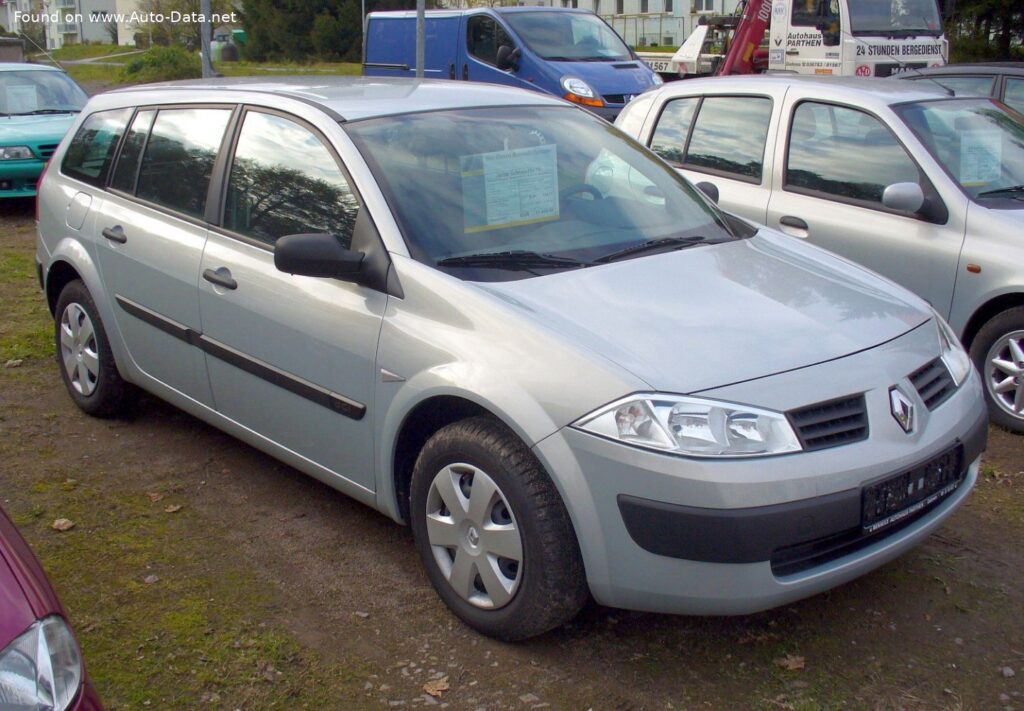
Renault Megane II Grandtour 1.6 16V (113 Hp)
The Renault Megane II Grandtour 1.6 16V (113 Hp) represents a significant offering within the compact family car segment during the early 2000s. Produced by the French automaker Renault between 2003 and 2004, this particular variant of the second-generation Megane was designed as a practical and versatile station wagon, or “estate” as it’s commonly known in Europe. While the Renault Megane nameplate has enjoyed global recognition, particularly in Europe, it was not officially sold in the United States market. Therefore, its primary role was to cater to European families and individuals seeking a blend of comfort, fuel efficiency, and substantial cargo capacity without the larger footprint or higher costs associated with mid-size sedans or SUVs. This specific model, powered by a 1.6-liter 16-valve gasoline engine, aimed to strike a balance between everyday usability and adequate performance for both urban commuting and longer journeys.
Engine and Performance of the Renault Megane II Grandtour 1.6 16V (113 Hp)
At the heart of the Renault Megane II Grandtour 1.6 16V (113 Hp) lies Renault’s venerable K4M engine, a naturally aspirated inline-four gasoline unit known for its reliability and smooth operation. With a displacement of 1598 cubic centimeters (97.52 cubic inches), this powerplant features a dual overhead camshaft (DOHC) valvetrain with four valves per cylinder, optimizing airflow for improved efficiency and power delivery. The engine is fed by a multi-port manifold injection system, ensuring precise fuel metering.
This 1.6-liter engine produces a respectable 113 horsepower at 6000 rpm, translating to a power-per-liter output of 70.7 horsepower per liter. Torque peaks at 152 Newton-meters (112.11 pound-feet) at 4200 rpm, providing sufficient pulling power for daily driving tasks, especially when coupled with the standard five-speed manual transmission. The powertrain architecture is a front, transverse layout, driving the front wheels, a common and efficient configuration for this class of vehicle.
In terms of performance, the Megane II Grandtour 1.6 16V could accelerate from 0 to 60 mph in a calculated 10.7 seconds, or 0 to 100 km/h in 11.3 seconds. Its maximum speed was rated at 190 km/h (118.06 mph). While not a performance-oriented vehicle, these figures were competitive for a compact family station wagon of its era, offering enough grunt for highway cruising and overtaking.
Fuel economy was a key consideration for European buyers, and this Megane variant delivered a combined fuel consumption of 7.0 liters per 100 kilometers, which translates to approximately 33.6 US miles per gallon. Urban driving resulted in about 25.3 US mpg (9.3 l/100 km), while extra-urban driving could achieve an impressive 41.3 US mpg (5.7 l/100 km). With CO2 emissions of 166 grams per kilometer, the vehicle met the Euro 4 emission standard, demonstrating Renault’s commitment to environmental considerations within the context of early 2000s automotive technology. The substantial 60-liter (15.85 US gallon) fuel tank provided a commendable driving range between fill-ups.
Design and Features
The Renault Megane II Grandtour adopted the distinctive and often polarizing “bustle-back” design language introduced with the Megane II hatchback, albeit in a more elongated and practical station wagon form. Its five-door, five-seat configuration made it a highly versatile family vehicle. The exterior dimensions were well-proportioned for its segment, with a length of 4500 mm (177.17 inches), a width of 1777 mm (69.96 inches), and a height of 1467 mm (57.76 inches). The wheelbase stretched to 2686 mm (105.75 inches), contributing to a stable ride and generous interior space.
One of the Grandtour’s most significant selling points was its cargo capacity. With the rear seats in place, it offered a substantial 520 liters (18.36 cubic feet) of trunk space. Folding the rear seats down expanded this volume to an impressive 1600 liters (56.5 cubic feet), making it highly capable of carrying luggage, sports equipment, or even small furniture. The maximum payload capacity stood at 580 kg (1278.68 lbs), further enhancing its utility.
The interior design of the Megane II was characterized by its modern, if somewhat unconventional, approach for the time. Features typically included a digital speedometer, keyless entry and start (on higher trims), and a focus on ergonomics. For a car of its era, safety was a strong point for the Megane II, which was among the first compact cars to achieve a five-star Euro NCAP crash test rating. Standard safety features for the Grandtour included ABS (Anti-lock Braking System) and multiple airbags. The vehicle was equipped with ventilated disc brakes at the front and disc brakes at the rear, providing confident stopping power.
Suspension-wise, the Megane II Grandtour featured an independent McPherson strut setup at the front and a torsion beam axle at the rear, a common and cost-effective solution for compact front-wheel-drive vehicles that offered a good balance between ride comfort and handling. Steering was managed by an electric power-assisted rack and pinion system, providing light and precise control, particularly beneficial for urban maneuvering. The car came with tire sizes such as 195/65 R15 or 205/55 R16, mounted on 6.5J x 15 or 6.5J x 16 wheel rims, respectively.
Technical Specifications
| Category | Specification | US Equivalent |
|---|---|---|
| Brand | Renault | Renault |
| Model | Megane II Grandtour | Megane II Grandtour |
| Engine Type | 1.6 16V (113 Hp) | 1.6 16V (113 Hp) |
| Production Start | 2003 | 2003 |
| Production End | 2004 | 2004 |
| Body Type | Station wagon (estate) | Station wagon |
| Seats | 5 | 5 |
| Doors | 5 | 5 |
| Fuel Type | Petrol (Gasoline) | Gasoline |
| Fuel Consumption – Urban | 9.3 l/100 km | 25.3 US mpg |
| Fuel Consumption – Extra Urban | 5.7 l/100 km | 41.3 US mpg |
| Fuel Consumption – Combined | 7.0 l/100 km | 33.6 US mpg |
| CO2 Emissions | 166 g/km | 166 g/km |
| Acceleration 0-60 mph | 10.7 sec | 10.7 sec |
| Maximum Speed | 190 km/h | 118.06 mph |
| Emission Standard | Euro 4 | Euro 4 |
| Power | 113 Hp @ 6000 rpm | 113 Hp @ 6000 rpm |
| Torque | 152 Nm @ 4200 rpm | 112.11 lb.-ft. @ 4200 rpm |
| Engine Displacement | 1598 cm³ | 1.6 Liters (97.52 cu. in.) |
| Number of Cylinders | 4, Inline | 4, Inline |
| Valves per Cylinder | 4 | 4 |
| Aspiration | Naturally aspirated | Naturally aspirated |
| Valvetrain | DOHC | DOHC |
| Kerb Weight | 1215 kg | 2678.62 lbs |
| Maximum Weight | 1795 kg | 3957.3 lbs |
| Trunk Space (Min/Max) | 520 – 1600 l | 18.36 – 56.5 cu. ft. |
| Fuel Tank Capacity | 60 l | 15.85 US gallons |
| Length | 4500 mm | 177.17 inches |
| Width | 1777 mm | 69.96 inches |
| Height | 1467 mm | 57.76 inches |
| Wheelbase | 2686 mm | 105.75 inches |
| Drive Wheel | Front wheel drive | Front wheel drive |
| Gearbox Type | 5 gears, manual transmission | 5-speed manual |
| Front Suspension | Independent type McPherson | Independent McPherson Strut |
| Rear Suspension | Torsion | Torsion Beam |
| Front Brakes | Ventilated discs | Ventilated Discs |
| Rear Brakes | Disc | Discs |
| Assisting Systems | ABS | ABS |
| Steering Type | Steering rack and pinion, Electric Steering | Electric Power Steering Rack and Pinion |
| Tire Size | 195/65 R15; 205/55 R16 | 195/65 R15; 205/55 R16 |
Legacy and Market Impact
The Renault Megane II Grandtour 1.6 16V (113 Hp), along with its Megane II siblings, played a crucial role in Renault’s strategy to maintain its strong presence in the highly competitive European compact segment. Positioned against rivals such as the Ford Focus Estate, Opel Astra Caravan, and Volkswagen Golf Variant, the Megane II Grandtour stood out with its distinctive styling, a strong emphasis on safety (being one of the first in its class to achieve a 5-star Euro NCAP rating), and innovative features like the card-based keyless entry system.
Its reputation was built on offering a comfortable ride, practical interior space, and competitive running costs. The 1.6-liter 16V engine was a popular choice, providing a good balance of power and fuel efficiency for the average family user. While not the most powerful or dynamically engaging option in its class, its strengths lay in its overall competence as a family workhorse. The ample trunk space, easily expandable, made it a favored choice for those who frequently transported luggage, groceries, or sports equipment, cementing its status as a versatile daily driver.
The Megane II generation, in general, was a commercial success for Renault, selling millions of units across various body styles. The Grandtour variant specifically addressed the needs of European buyers who favored the practicality of a station wagon over SUVs, which were still gaining traction in the market. Its impact was felt in its ability to offer a compelling alternative to more conservative German and Japanese rivals, bringing a touch of French flair and innovation to the mainstream compact segment.
Today, the Renault Megane II Grandtour 1.6 16V (113 Hp) remains a testament to Renault’s design philosophy and engineering capabilities of the early 2000s. While it has been succeeded by multiple generations, its legacy endures as a practical, safe, and efficient family vehicle that carved out a significant niche in the European automotive landscape. It underscored Renault’s ability to produce mass-market cars that were not only functional but also visually distinctive and forward-thinking in terms of technology and safety for their time.