The Renault Megane II Grandtour 1.9 dCi (110 Hp) FAP: A Practical European Workhorse
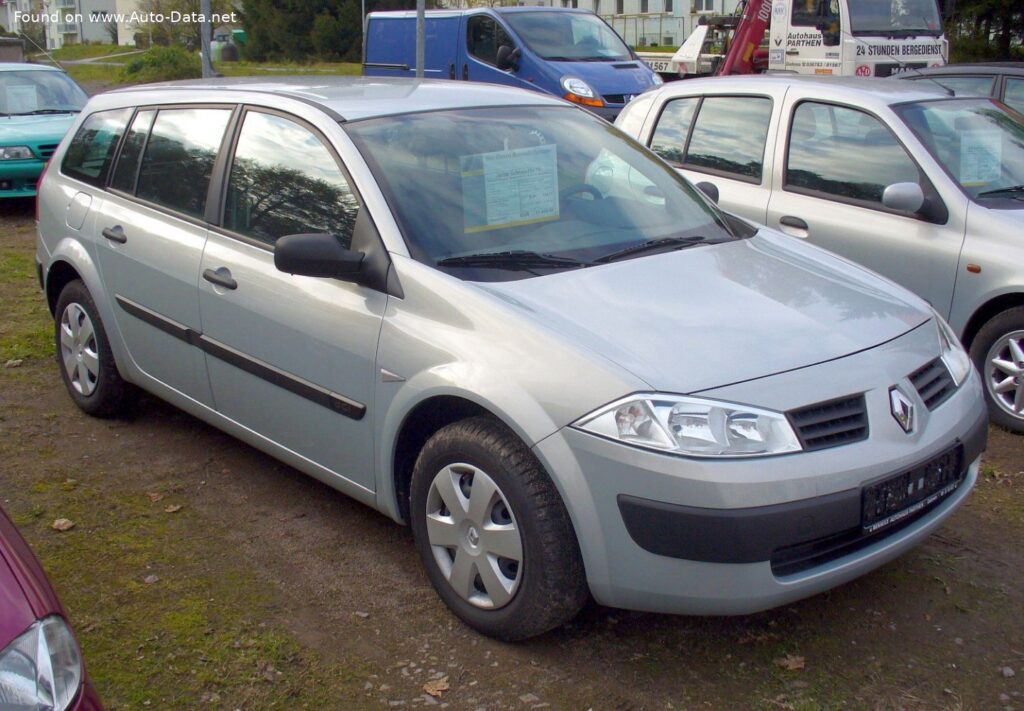
The Renault Megane II Grandtour, specifically the 1.9 dCi (110 Hp) FAP variant produced in 2005, represents a significant chapter in the history of compact family vehicles in Europe. While never officially sold in the United States, the Megane II Grandtour was a staple of the European C-segment, offering a compelling blend of practicality, efficiency, and comfort to a wide array of customers. This particular model, a five-door, five-seat station wagon (or estate car, as it’s known across the Atlantic), was part of the second generation of the Megane lineup, which gained notoriety for its distinctive styling and advanced features for its time. The “Grandtour” designation signified its extended body, providing increased cargo capacity and versatility compared to its hatchback sibling, making it an ideal choice for families and professionals needing extra space.
The 2005 Renault Megane II Grandtour 1.9 dCi (110 Hp) FAP was designed to meet the evolving demands of the European market, where diesel engines were highly favored for their fuel economy and robust torque. The inclusion of a FAP (Filtre à Particules, or Diesel Particulate Filter) system in this model year highlighted Renault’s commitment to meeting stricter Euro 4 emission standards, a forward-thinking move in an era of growing environmental awareness. This particular variant combined a capable powertrain with a spacious interior and a comfortable ride, cementing its reputation as a sensible and reliable option in its competitive class.
Engine and Performance of the Renault Megane II Grandtour
Under the hood of the 2005 Renault Megane II Grandtour 1.9 dCi (110 Hp) FAP lay Renault’s venerable F9Q engine, a 1.9-liter (1870 cm³, or 114.11 cubic inches) inline-four turbodiesel unit. This powerplant was transversely mounted at the front, driving the front wheels through a precise 6-speed manual transmission. The engine utilized a common rail direct fuel injection system, a sophisticated technology for its time that allowed for finer control over fuel delivery, optimizing both performance and efficiency. Further enhancing its capabilities were a turbocharger and an intercooler, which worked in tandem to force more air into the cylinders, resulting in a healthier power output and improved throttle response.
The engine delivered a respectable 110 horsepower at 4000 rpm, which, while not segment-leading, was more than adequate for daily driving and highway cruising. More importantly for a diesel of its class was its torque output: a substantial 260 Newton-meters (191.77 lb-ft) available at a low 2000 rpm. This low-end torque was a key characteristic, providing strong pulling power, excellent flexibility in traffic, and making the car feel effortless even when loaded or tackling inclines. The Megane II Grandtour 1.9 dCi accelerated from 0 to 60 mph in a reasonable 10.4 seconds, with a top speed of 116.82 mph (188 km/h). These figures underscored its capability as a practical and competent family vehicle, rather than a performance-oriented machine.
Fuel efficiency was a major selling point for this diesel variant. The official combined fuel consumption figure stood at an impressive 5.8 liters per 100 kilometers, translating to approximately 40.6 US miles per gallon. Urban driving saw consumption at 7.4 l/100 km (31.8 US mpg), while extra-urban cycles achieved an excellent 4.9 l/100 km (48 US mpg). Coupled with a 15.85 US gallon (60 liter) fuel tank, the Megane II Grandtour offered a substantial driving range, a highly valued attribute for European motorists.
Design and Features
The Renault Megane II Grandtour distinguished itself with a design language that was both innovative and polarizing upon its initial release. While the hatchback’s prominent “bustle back” rear was its most talked-about feature, the Grandtour adopted a more conventional, yet still characterful, station wagon profile. Its extended length of 177.17 inches (4500 mm) and a wheelbase of 105.75 inches (2686 mm) contributed to a stable ride and maximized interior volume. The width, at 69.96 inches (1777 mm), provided ample shoulder room for occupants.
Practicality was at the core of the Grandtour’s design. The five-door configuration offered easy access to both front and rear seats, while the generous trunk space was a standout feature. With the rear seats in place, the cargo area provided a substantial 18.36 cubic feet (520 liters) of volume. Folding down the rear seats expanded this to an impressive 56.5 cubic feet (1600 liters), making it highly versatile for carrying luggage, sports equipment, or larger items. The maximum payload capacity was 1278.68 lbs (580 kg), further emphasizing its utility.
In terms of driver aids and safety, the 2005 Megane II Grandtour was equipped with features that were standard or optional for its class. An Anti-lock Braking System (ABS) was a crucial safety inclusion, providing enhanced control during emergency braking. The braking system itself comprised ventilated discs at the front and solid discs at the rear, offering reliable stopping power. Steering was handled by a rack and pinion system with electric power steering, providing ease of maneuverability, particularly in urban environments. The car rode on 205/50 R17 tires mounted on 6.5J x 17-inch wheel rims, a common size for balancing ride comfort and handling dynamics.
The interior, while not explicitly detailed in the provided data, typically featured a modern, ergonomic dashboard layout with digital readouts and a focus on user-friendliness. Depending on the trim level, features like automatic climate control, a multi-function steering wheel, and various infotainment options would have been available, reflecting the Megane II’s position as a well-equipped family car.
Technical Specifications
| Category | Specification | US Equivalent / Notes |
|---|---|---|
| General Information | ||
| Brand | Renault | |
| Model | Megane II Grandtour | |
| Type (Engine) | 1.9 dCi (110 Hp) FAP | |
| Production Years | 2005 – 2005 (specific variant) | |
| Powertrain Architecture | Internal Combustion Engine | |
| Body Type | Station wagon (estate) | 5 Doors, 5 Seats |
| Performance Specs | ||
| Fuel Consumption (Urban) | 7.4 l/100 km | 31.8 US mpg |
| Fuel Consumption (Extra Urban) | 4.9 l/100 km | 48 US mpg |
| Fuel Consumption (Combined) | 5.8 l/100 km | 40.6 US mpg |
| CO2 Emissions | 154 g/km | |
| Fuel Type | Diesel | |
| Acceleration 0 – 60 mph | 10.4 sec | |
| Maximum Speed | 188 km/h | 116.82 mph |
| Emission Standard | Euro 4 | |
| Weight-to-power ratio | 11.9 kg/Hp | 84 Hp/tonne |
| Weight-to-torque ratio | 5 kg/Nm | 198.5 Nm/tonne |
| Engine Specs | ||
| Power | 110 Hp @ 4000 rpm | |
| Power per liter | 58.8 Hp/l | |
| Torque | 260 Nm @ 2000 rpm | 191.77 lb.-ft. @ 2000 rpm |
| Engine Layout | Front, Transverse | |
| Engine Model/Code | F9Q | |
| Engine Displacement | 1870 cm3 | 1.9 Liters (114.11 cu. in.) |
| Number of Cylinders | 4 | Inline configuration |
| Cylinder Bore | 80 mm | 3.15 in. |
| Piston Stroke | 93 mm | 3.66 in. |
| Compression Ratio | 19:1 | |
| Valves per Cylinder | 2 | |
| Fuel Injection System | Diesel Commonrail | |
| Engine Aspiration | Turbocharger, Intercooler | |
| Valvetrain | OHC (Overhead Camshaft) | |
| Engine Oil Capacity | 4.5 l | 4.76 US qt |
| Engine Oil Specification | Not specified | |
| Coolant Capacity | 7.6 l | 8.03 US qt |
| Engine Systems | Particulate filter (FAP) | |
| Space, Volume and Weights | ||
| Kerb Weight | 1310 kg | 2888.06 lbs. |
| Max. Weight | 1890 kg | 4166.74 lbs. |
| Max Load | 580 kg | 1278.68 lbs. |
| Trunk (boot) Space – Minimum | 520 l | 18.36 cu. ft. |
| Trunk (boot) Space – Maximum | 1600 l | 56.5 cu. ft. |
| Fuel Tank Capacity | 60 l | 15.85 US gal |
| Max. Roof Load | 80 kg | 176.37 lbs. |
| Permitted Trailer Load with brakes (12%) | 1350 kg | 2976.24 lbs. |
| Permitted Trailer Load without brakes | 650 kg | 1433 lbs. |
| Permitted Towbar Download | 75 kg | 165.35 lbs. |
| Dimensions | ||
| Length | 4500 mm | 177.17 in. |
| Width | 1777 mm | 69.96 in. |
| Width including mirrors | 2026 mm | 79.76 in. |
| Height | 1467 mm | 57.76 in. |
| Wheelbase | 2686 mm | 105.75 in. |
| Front Track | 1518 mm | 59.76 in. |
| Rear (Back) Track | 1514 mm | 59.61 in. |
| Front Overhang | 842 mm | 33.15 in. |
| Rear Overhang | 972 mm | 38.27 in. |
| Minimum Turning Circle | 11 m | 36.09 ft. |
| Drivetrain, Brakes and Suspension Specs | ||
| Drivetrain Architecture | Front-wheel drive | ICE drives front wheels |
| Drive Wheel | Front wheel drive | |
| Number of Gears and Type of Gearbox | 6 gears, manual transmission | |
| Front Suspension | Independent type McPherson | |
| Rear Suspension | Torsion beam | |
| Front Brakes | Ventilated discs | |
| Rear Brakes | Disc | |
| Assisting Systems | ABS (Anti-lock braking system) | |
| Steering Type | Steering rack and pinion | |
| Power Steering | Electric Steering | |
| Tires Size | 205/50 R17 | |
| Wheel Rims Size | 6.5J x 17 |
Legacy and Market Impact
The Renault Megane II Grandtour, particularly the 1.9 dCi (110 Hp) FAP variant, held a significant position in the European automotive landscape during its production run. It competed in the highly contested C-segment, vying for market share against formidable rivals such as the Volkswagen Golf Variant, Ford Focus Estate, Opel Astra Caravan, and Peugeot 307 SW. What set the Megane II Grandtour apart was its distinct styling, which, despite being somewhat controversial, helped it stand out in a crowded segment. Its emphasis on safety, comfort, and innovative features for its class also contributed to its appeal.
The 1.9 dCi engine, a cornerstone of Renault’s diesel offerings, was crucial to the Megane’s success in Europe. Its combination of strong torque, commendable fuel economy, and reasonable emissions (especially with the FAP system) made it a popular choice among both private buyers and fleet operators. The manual 6-speed transmission further enhanced its efficiency and provided an engaging driving experience typical of European compacts.
The Megane II generation, launched in 2002, was lauded for achieving a five-star Euro NCAP safety rating, a pioneering achievement at the time that greatly boosted its reputation for occupant protection. This commitment to safety, combined with its practical station wagon body style, made the Grandtour a trusted vehicle for families. Its comfort-oriented suspension setup, featuring McPherson struts at the front and a torsion beam at the rear, provided a compliant ride suitable for varied European road conditions.
While the Megane II Grandtour may not be a household name in the United States, its legacy in Europe is one of a highly competent and influential family car. It showcased Renault’s ability to blend distinctive design with practical engineering and a strong focus on efficiency and safety. The 1.9 dCi (110 Hp) FAP model specifically highlighted the growing importance of diesel technology and emission control in the early 21st century, setting a benchmark for what a mainstream European station wagon could offer to its discerning market.