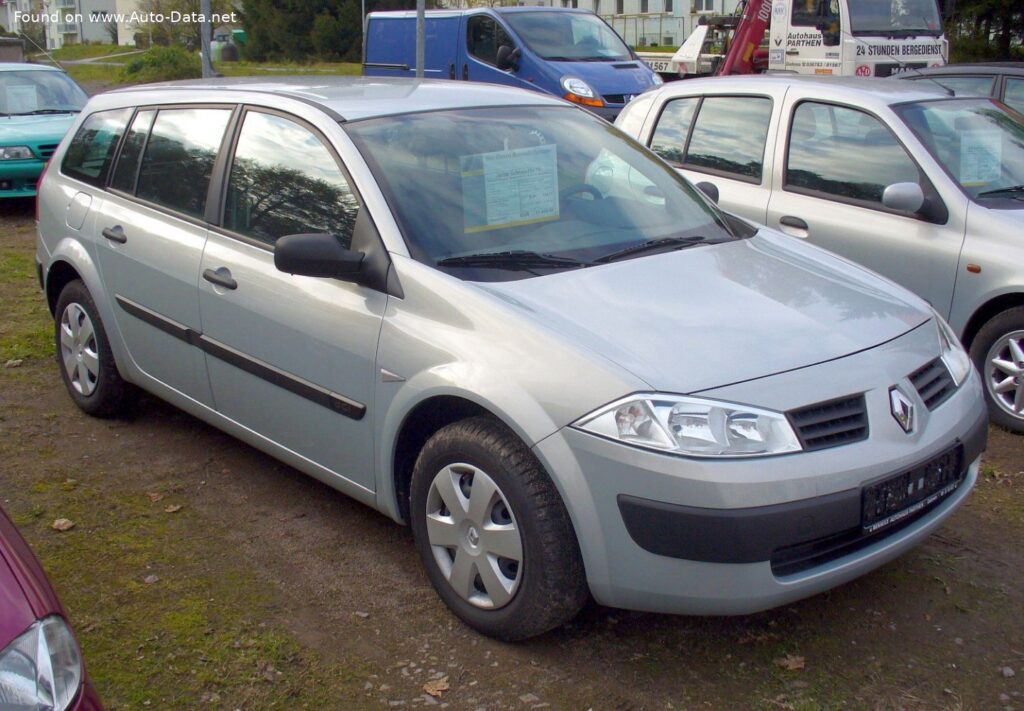
Renault Megane II Grandtour 1.9 dCi (120 Hp): An Overview of Renault’s European Compact Wagon
The Renault Megane II Grandtour 1.9 dCi (120 Hp) represents a significant chapter in the history of compact family vehicles in Europe. Produced between 2004 and 2005, this specific variant of the second-generation Megane was a popular choice for European families and businesses seeking a blend of practicality, fuel efficiency, and a distinctive design. As a model never officially sold in the United States, its impact and legacy are firmly rooted in the competitive European C-segment, where it vied for market share against a host of established rivals. The Megane II, launched in 2002, was renowned for its avant-garde styling, particularly its “bustle-back” rear on the hatchback variants, which extended to a more conventional yet equally stylish station wagon (or estate, as it’s known in Europe) form factor with the Grandtour. This 1.9 dCi diesel iteration, with its 120 horsepower engine, offered a compelling package of performance and economy, making it a workhorse for many across the continent.
Engine and Performance of the Renault Megane II Grandtour 1.9 dCi (120 Hp)
At the heart of the Renault Megane II Grandtour 1.9 dCi (120 Hp) was a robust and efficient 1.9-liter (1870 cm3 or 114.11 cu. in.) F9Q inline-four diesel engine. This powertrain was a testament to Renault’s expertise in diesel technology, featuring a common-rail fuel injection system and boosted by a turbocharger with an intercooler. The engine was configured with an OHC valvetrain and two valves per cylinder, contributing to its strong low-end torque delivery.
This 1.9 dCi unit generated a healthy 120 horsepower at 4000 rpm, which was a respectable output for a compact family car of its era. More importantly for real-world driving, especially in a station wagon designed for hauling, was its substantial torque figure: 300 Nm (221.27 lb-ft) available at a low 2000 rpm. This ample torque ensured responsive acceleration and effortless cruising, even when the vehicle was fully loaded.
Power was delivered to the front wheels via a slick-shifting 6-speed manual transmission, a feature that further enhanced both performance and fuel economy. The Megane II Grandtour 1.9 dCi could accelerate from 0 to 60 mph in a brisk 10.3 seconds, reaching a maximum speed of 120.55 mph (194 km/h). These figures positioned it as a capable performer within its segment, offering enough zip for highway merges and comfortable cruising speeds.
Fuel efficiency was a key selling point for this diesel Grandtour. It boasted impressive figures, with an urban consumption of 33.1 US mpg (7.1 l/100 km), an extra-urban economy of 53.5 US mpg (4.4 l/100 km), and a combined rating of 43.6 US mpg (5.4 l/100 km). With CO2 emissions of 141 g/km and adherence to Euro 3 emission standards, it was considered an environmentally conscious choice for the time, balancing performance with a reduced carbon footprint.
Design and Features
The Renault Megane II Grandtour carried over the distinctive design language of the second-generation Megane, which was a radical departure from its predecessor. While the hatchback’s rear styling drew the most attention, the Grandtour successfully translated this modern aesthetic into a practical station wagon form. Its elongated roofline and well-integrated tailgate provided a sleek, aerodynamic profile that was both visually appealing and highly functional. The overall length of 177.17 inches (4500 mm) and a wheelbase of 105.75 inches (2686 mm) contributed to a stable ride and generous interior volume.
Inside, the Megane II Grandtour was designed with passenger comfort and cargo versatility in mind. It offered seating for five adults, with a focus on ergonomic design and quality materials for its class. The primary appeal of the Grandtour, however, was its expansive cargo capacity. With the rear seats in place, it offered a substantial 18.36 cu. ft. (520 liters) of trunk space. Folding the rear seats down dramatically increased this to a cavernous 56.5 cu. ft. (1600 liters), making it exceptionally practical for carrying luggage, sports equipment, or larger items.
Features for the 2004-2005 model year included a focus on safety and convenience. The vehicle came equipped with a robust safety cage, multiple airbags, and an Anti-lock Braking System (ABS) as standard. The drivetrain architecture featured front-wheel drive, a common and efficient layout for compact cars. Steering was managed by a rack-and-pinion system with electric power steering, offering light and precise control. Suspension comprised an independent McPherson strut setup at the front and a torsion beam at the rear, a configuration chosen for its balance of comfort and handling. Braking power was provided by ventilated discs at the front and solid discs at the rear, ensuring confident stopping performance. The vehicle rode on 205/50 R17 tires mounted on 6.5J x 17-inch wheel rims, providing a good balance of grip and ride comfort.
Technical Specifications: Renault Megane II Grandtour 1.9 dCi (120 Hp)
| Category | Specification | US Equivalent |
|---|---|---|
| General Information | ||
| Brand | Renault | |
| Model | Megane | |
| Generation | Megane II Grandtour | |
| Type (Engine) | 1.9 dCi (120 Hp) | |
| Start of Production | 2004 | |
| End of Production | 2005 | |
| Powertrain Architecture | Internal Combustion engine | |
| Body type | Station wagon (estate) | |
| Seats | 5 | |
| Doors | 5 | |
| Performance Specs | ||
| Fuel consumption (economy) – urban | 7.1 l/100 km | 33.1 US mpg |
| Fuel consumption (economy) – extra urban | 4.4 l/100 km | 53.5 US mpg |
| Fuel consumption (economy) – combined | 5.4 l/100 km | 43.6 US mpg |
| CO2 emissions | 141 g/km | |
| Fuel Type | Diesel | |
| Acceleration 0 – 60 mph | 10.3 sec | |
| Maximum speed | 194 km/h | 120.55 mph |
| Emission standard | Euro 3 | |
| Weight-to-power ratio | 10.9 kg/Hp | |
| Weight-to-torque ratio | 4.4 kg/Nm | |
| Engine Specs | ||
| Power | 120 Hp @ 4000 rpm | |
| Power per liter | 64.2 Hp/l | |
| Torque | 300 Nm @ 2000 rpm | 221.27 lb-ft @ 2000 rpm |
| Engine layout | Front, Transverse | |
| Engine Model/Code | F9Q | |
| Engine displacement | 1870 cm3 | 1.9 liters (114.11 cu. in.) |
| Number of cylinders | 4 | |
| Engine configuration | Inline | |
| Cylinder Bore | 80 mm | 3.15 in. |
| Piston Stroke | 93 mm | 3.66 in. |
| Compression ratio | 19:1 | |
| Number of valves per cylinder | 2 | |
| Fuel injection system | Diesel Commonrail | |
| Engine aspiration | Turbocharger, Intercooler | |
| Valvetrain | OHC | |
| Engine oil capacity | 4.6 l | 4.86 US qt |
| Coolant | 7.2 l | 7.61 US qt |
| Space, Volume and Weights | ||
| Kerb Weight | 1310 kg | 2888.06 lbs |
| Max. weight | 1890 kg | 4166.74 lbs |
| Max load | 580 kg | 1278.68 lbs |
| Trunk (boot) space – minimum | 520 l | 18.36 cu. ft. |
| Trunk (boot) space – maximum | 1600 l | 56.5 cu. ft. |
| Fuel tank capacity | 60 l | 15.85 US gal |
| Max. roof load | 80 kg | 176.37 lbs |
| Permitted trailer load with brakes (12%) | 1350 kg | 2976.24 lbs |
| Permitted trailer load without brakes | 650 kg | 1433 lbs |
| Permitted towbar download | 75 kg | 165.35 lbs |
| Dimensions | ||
| Length | 4500 mm | 177.17 in. |
| Width | 1777 mm | 69.96 in. |
| Width including mirrors | 2026 mm | 79.76 in. |
| Height | 1467 mm | 57.76 in. |
| Wheelbase | 2686 mm | 105.75 in. |
| Front track | 1518 mm | 59.76 in. |
| Rear (Back) track | 1514 mm | 59.61 in. |
| Front overhang | 842 mm | 33.15 in. |
| Rear overhang | 972 mm | 38.27 in. |
| Minimum turning circle (turning diameter) | 11 m | 36.09 ft. |
| Drivetrain, Brakes and Suspension Specs | ||
| Drivetrain Architecture | The Internal combustion engine (ICE) drives the front wheels of the vehicle. | |
| Drive wheel | Front wheel drive | |
| Number of gears and type of gearbox | 6 gears, manual transmission | |
| Front suspension | Independent type McPherson | |
| Rear suspension | Torsion | |
| Front brakes | Ventilated discs | |
| Rear brakes | Disc | |
| Assisting systems | ABS (Anti-lock braking system) | |
| Steering type | Steering rack and pinion | |
| Power steering | Electric Steering | |
| Tires size | 205/50 R17 | |
| Wheel rims size | 6.5J x 17 | |
Legacy and Market Impact of the Renault Megane II Grandtour
The Renault Megane II Grandtour, particularly with the 1.9 dCi engine, carved out a significant niche in the highly competitive European compact segment during its production run from 2004 to 2005. While the Megane nameplate is largely unknown to American consumers, in Europe, it was a household name, representing a practical and stylish alternative to traditional sedans. The Grandtour variant was specifically tailored to meet the demands of European families and individuals who valued cargo capacity and versatility without sacrificing fuel economy or driving dynamics.
Its primary competitors included other popular European compact wagons such as the Ford Focus Wagon, Opel Astra Caravan (Vauxhall Astra Estate in the UK), Volkswagen Golf Variant (Jetta SportWagen in some markets), and Peugeot 307 SW. Against these rivals, the Megane II Grandtour stood out with its distinctive, almost avant-garde styling, which was a bold move by Renault and helped it differentiate itself in a crowded market. The comfortable ride quality, often praised for its ability to soak up road imperfections, combined with a well-appointed interior for its class, made it a pleasant long-distance cruiser.
The 1.9 dCi engine was a particularly strong asset, reflecting the European preference for diesel powertrains due to their superior fuel economy and torque characteristics. This engine provided a compelling balance of performance for daily commuting and longer journeys, alongside impressive efficiency figures that directly translated into lower running costs for owners. Its 6-speed manual transmission was also a key factor, offering drivers more control and contributing to the car’s overall efficiency.
Renault also heavily emphasized safety with the Megane II range, and the Grandtour benefited from this focus. The Megane II was one of the first cars in its class to achieve a 5-star Euro NCAP safety rating, a significant achievement that bolstered its reputation as a secure family vehicle. Features like ABS, multiple airbags, and a robust chassis design contributed to this strong safety performance.
In conclusion, the Renault Megane II Grandtour 1.9 dCi (120 Hp) was more than just a family car; it was a reflection of European automotive trends of its time. It showcased a commitment to innovative design, practical utility, and the increasing importance of diesel efficiency. Though it never graced American roads, its legacy as a popular, capable, and distinctive compact wagon in its home market remains a testament to Renault’s engineering and design prowess in the early 2000s. It successfully blended the everyday practicality demanded by families with a touch of French flair and technological advancement, leaving a lasting mark on the European automotive landscape.