The Renault Megane II Grandtour (Phase II, 2006) 1.4 16V (98 Hp): A European Workhorse
The
Renault Megane II Grandtour (Phase II, 2006)
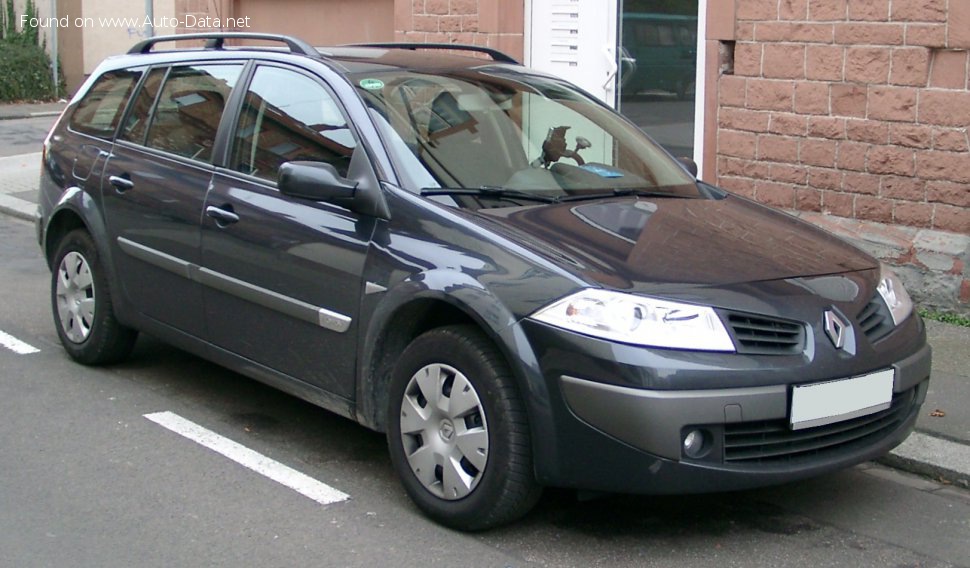
represents a significant chapter in the history of the French automaker’s compact car lineage. Positioned firmly within the highly competitive European C-segment, the Megane II, launched in 2002, quickly distinguished itself with its unconventional styling and a strong emphasis on safety and technology. The “Grandtour” designation refers to the station wagon (or estate) body style, offering enhanced practicality and cargo capacity compared to its hatchback and sedan siblings. The Phase II update, introduced in 2006, brought subtle styling revisions, updated interior materials, and minor mechanical refinements to keep the model fresh against a wave of new competitors. This particular variant, powered by a 1.4-liter 16-valve engine delivering 98 horsepower, served as a practical and economical choice for families and individuals in its primary European market, where it was never officially sold in the United States.
Engine and Performance of the Renault Megane II Grandtour
Under the hood of the
Renault Megane II Grandtour (Phase II, 2006)
1.4 16V lies Renault’s robust K4J engine, a naturally aspirated inline four-cylinder unit. With a displacement of 1390 cubic centimeters (84.82 cu. in.), this powerplant was designed for a balance of efficiency and adequate performance for daily driving in European conditions. The 16-valve (DOHC) valvetrain configuration allowed for better breathing and efficiency, contributing to its respectable power output for its size. It produced 98 horsepower at 6000 rpm and a peak torque of 93.67 lb.-ft. (127 Nm) at 3750 rpm.
Mated to a 5-speed manual transmission, the engine delivered power to the front wheels, a typical and efficient setup for a vehicle in this class. While not a performance leader, the 1.4 16V Megane II Grandtour offered a competent driving experience. It could accelerate from 0 to 60 mph in a calculated 12.4 seconds (0-100 km/h in 13.1 seconds) and reach a maximum speed of 112.47 mph (181 km/h). Fuel economy was a strong suit, with a combined rating of 33.6 US mpg (7 liters per 100 km), making it an economical choice for long-distance travel and urban commutes alike. Its Euro 4 emission standard compliance further underscored its relative environmental friendliness for its era, emitting 166 grams of CO2 per kilometer.
Design and Features: The Practicality of the Renault Megane II Grandtour
The
Renault Megane II Grandtour
retained the distinctive, somewhat polarizing design language of the second-generation Megane, albeit adapted for its station wagon form. While the hatchback famously featured a prominent “bustle-back” rear, the Grandtour opted for a more conventional, yet still stylish, elongated roofline that seamlessly integrated with the car’s overall aesthetic. Its five-door, five-seat configuration made it a highly practical family vehicle, emphasizing utility without sacrificing modern European styling.
Dimensionally, the Grandtour stretched 177.17 inches (4500 mm) in length, with a width of 69.96 inches (1777 mm) and a height of 57.76 inches (1467 mm). A generous wheelbase of 105.75 inches (2686 mm) contributed to a comfortable ride and ample interior space for both passengers and cargo. The standout feature of the Grandtour was its impressive cargo capacity, offering a minimum of 18.36 cubic feet (520 liters) with all seats in place, expandable to a cavernous 56.5 cubic feet (1600 liters) when the rear seats were folded down. This made it a versatile choice for everything from grocery runs to family vacations.
Standard features for the Megane II Grandtour included an independent MacPherson strut front suspension and a torsion beam rear suspension, providing a comfortable and predictable ride. Braking was handled by ventilated discs at the front and solid discs at the rear, complemented by an Anti-lock Braking System (ABS) for enhanced safety. The car also featured electric power steering, offering light and precise control, particularly beneficial in urban environments. Tire options ranged from 195/65 R15 to 205/50 R17, mounted on 15, 16, or 17-inch wheels, providing a balance of grip and ride comfort.
Technical Specifications for the Renault Megane II Grandtour (Phase II, 2006) 1.4 16V (98 Hp)
| Category | Specification |
|---|---|
| General Information | |
| Brand | Renault |
| Model | Megane |
| Generation | Megane II Grandtour (Phase II, 2006) |
| Engine Type | 1.4 16V (98 Hp) |
| Production Start | 2006 |
| Production End | 2008 |
| Powertrain Architecture | Internal Combustion Engine |
| Body Type | Station Wagon (Estate) |
| Seats | 5 |
| Doors | 5 |
| Performance Specs | |
| Fuel Consumption – Urban | 9.5 l/100 km (24.8 US mpg) |
| Fuel Consumption – Extra Urban | 5.5 l/100 km (42.8 US mpg) |
| Fuel Consumption – Combined | 7 l/100 km (33.6 US mpg) |
| CO2 Emissions | 166 g/km |
| Fuel Type | Petrol (Gasoline) |
| Acceleration 0 – 60 mph | 12.4 seconds |
| Acceleration 0 – 100 km/h | 13.1 seconds |
| Maximum Speed | 181 km/h (112.47 mph) |
| Emission Standard | Euro 4 |
| Weight-to-Power Ratio | 12.3 kg/Hp (81 Hp/tonne) |
| Weight-to-Torque Ratio | 9.5 kg/Nm (105 Nm/tonne) |
| Engine Specs | |
| Power | 98 Hp @ 6000 rpm |
| Power per Liter | 70.5 Hp/l |
| Torque | 127 Nm (93.67 lb.-ft.) @ 3750 rpm |
| Engine Layout | Front, Transverse |
| Engine Model/Code | K4J |
| Engine Displacement | 1390 cm3 (84.82 cu. in.) |
| Number of Cylinders | 4 |
| Engine Configuration | Inline |
| Cylinder Bore | 79.5 mm (3.13 in.) |
| Piston Stroke | 70 mm (2.76 in.) |
| Compression Ratio | 10:1 |
| Valves per Cylinder | 4 |
| Fuel Injection System | Multi-port manifold injection |
| Engine Aspiration | Naturally Aspirated |
| Valvetrain | DOHC |
| Engine Oil Capacity | 4.8 l (5.07 US qt) |
| Coolant Capacity | 6 l (6.34 US qt) |
| Space, Volume and Weights | |
| Kerb Weight | 1210 kg (2667.59 lbs.) |
| Max. Weight | 1790 kg (3946.27 lbs.) |
| Max Load | 580 kg (1278.68 lbs.) |
| Trunk (Boot) Space – Minimum | 520 l (18.36 cu. ft.) |
| Trunk (Boot) Space – Maximum | 1600 l (56.5 cu. ft.) |
| Fuel Tank Capacity | 60 l (15.85 US gal) |
| Max. Roof Load | 80 kg (176.37 lbs.) |
| Permitted Trailer Load with Brakes (12%) | 1300 kg (2866.01 lbs.) |
| Permitted Trailer Load without Brakes | 650 kg (1433 lbs.) |
| Permitted Towbar Download | 75 kg (165.35 lbs.) |
| Dimensions | |
| Length | 4500 mm (177.17 in.) |
| Width | 1777 mm (69.96 in.) |
| Width Including Mirrors | 2026 mm (79.76 in.) |
| Height | 1467 mm (57.76 in.) |
| Wheelbase | 2686 mm (105.75 in.) |
| Front Track | 1518 mm (59.76 in.) |
| Rear (Back) Track | 1514 mm (59.61 in.) |
| Front Overhang | 842 mm (33.15 in.) |
| Rear Overhang | 972 mm (38.27 in.) |
| Ride Height (Ground Clearance) | 120 mm (4.72 in.) |
| Minimum Turning Circle | 11 m (36.09 ft.) |
| Drivetrain, Brakes and Suspension Specs | |
| Drivetrain Architecture | Front-wheel drive, Internal Combustion Engine |
| Drive Wheel | Front-wheel drive |
| Number of Gears / Gearbox Type | 5 gears, Manual Transmission |
| Front Suspension | Independent type McPherson |
| Rear Suspension | Torsion Beam |
| Front Brakes | Ventilated Discs |
| Rear Brakes | Disc |
| Assisting Systems | ABS (Anti-lock Braking System) |
| Steering Type | Steering rack and pinion |
| Power Steering | Electric Steering |
| Tires Size | 195/65 R15; 195/55 R16; 205/50 R17 |
| Wheel Rims Size | 6.5J x 15; 6.5J x 16; 6.5J x 17 |
Legacy and Market Impact of the Renault Megane II Grandtour
The
Renault Megane II Grandtour
, particularly in its Phase II iteration from 2006, played a vital role in Renault’s strategy to capture a significant share of the European compact car market. Its primary competitors included established players like the Volkswagen Golf Variant, Opel Astra Estate, Ford Focus Wagon, and Peugeot 307 SW. Against these rivals, the Megane II Grandtour distinguished itself with its bold styling, competitive pricing, and a strong emphasis on passenger safety, having achieved a groundbreaking 5-star Euro NCAP safety rating for the hatchback version.
The 1.4 16V variant, while not the most powerful in the lineup, was crucial for offering an accessible entry point into the Megane Grandtour range, appealing to budget-conscious buyers and those prioritizing fuel efficiency over outright speed. Its robust construction and comfortable ride contributed to Renault’s reputation for building practical and family-friendly vehicles. The Grandtour’s generous cargo space and versatile interior made it a popular choice for young families and those requiring extra utility for hobbies or work.
The Megane II generation, including the Grandtour, is remembered for pushing design boundaries in the mainstream compact segment and for its pioneering adoption of features like keyless entry and start (Renault Card) across its range, which was quite advanced for its time. While never sold in the United States, its impact in Europe was substantial, helping Renault maintain its position as a dominant force in the compact car segment and laying the groundwork for future generations of the Megane line. Its legacy is one of innovation, practicality, and a distinctive French flair in a highly competitive global market. The
Renault Megane II Grandtour (Phase II, 2006)
remains a testament to European automotive engineering focused on real-world usability and efficiency.