The Renault Megane II Grandtour (Phase II, 2006): A Practical European Workhorse
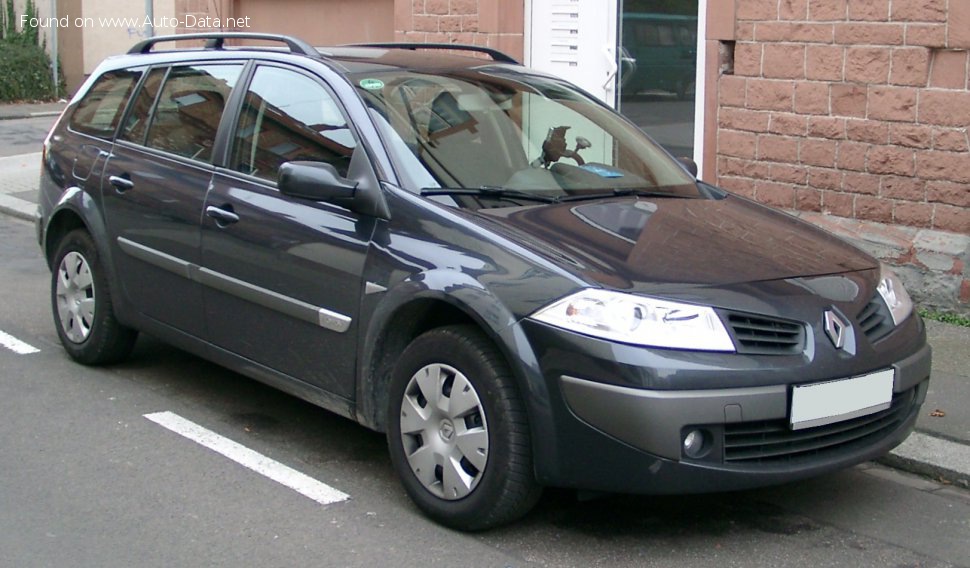
The Renault Megane II Grandtour (Phase II, 2006) represents a significant offering from the French automotive giant Renault within the highly competitive European C-segment. Launched as part of the refreshed second-generation Megane lineup, the Grandtour, or station wagon, variant was specifically designed to cater to families and individuals requiring substantial cargo capacity without compromising on fuel efficiency or a compact footprint. Produced from 2006 to 2008, this particular iteration, powered by the 1.5 dCi (86 Hp) turbodiesel engine, was a testament to Renault’s commitment to delivering practical, economical, and comfortable transportation solutions in its primary markets across Europe, where diesel powertrains held a dominant position.
The Megane II generation was renowned for its distinctive styling, particularly its controversial “bustle-back” sedan and hatchback designs. However, the Grandtour adopted a more conventional, yet still characterful, wagon silhouette that prioritized utility. The Phase II facelift, introduced in 2006, brought subtle enhancements to the exterior and interior, refining its aesthetics and updating its feature set to keep it competitive against a growing array of rivals. This specific model, with its 1.5-liter dCi engine, was positioned as an entry-level diesel option, balancing affordability with commendable running costs, making it a popular choice for budget-conscious buyers and fleet operators throughout the continent.
Engine and Performance of the Renault Megane II Grandtour (Phase II, 2006)
At the heart of this particular Renault Megane II Grandtour (Phase II, 2006) lies the venerable K9K Turbo 1.5 dCi engine, a powerplant that has seen widespread use across the Renault-Nissan Alliance. This inline four-cylinder turbodiesel unit, with an engine displacement of 1461 cm3 (89.16 cubic inches), was engineered for optimal fuel economy and respectable torque delivery in everyday driving conditions. It produces a modest but adequate 86 horsepower at 3750 revolutions per minute, making it suitable for urban commuting and relaxed highway cruising.
More importantly for a diesel engine, its torque output is a robust 147.51 lb.-ft. (200 Nm) available at a low 1900 rpm. This characteristic low-end torque provides a responsive feel from a standstill and aids in managing the vehicle’s weight, especially when loaded with passengers and cargo. The engine utilizes a Commonrail diesel fuel injection system, which contributes to its efficiency and relatively smooth operation for its class. Coupled with a turbocharger and intercooler, the engine benefits from improved combustion and power delivery, while adhering to Euro 4 emission standards, which were critical for its market at the time.
Performance figures for the 1.5 dCi Grandtour reflect its focus on economy rather than outright speed. It accelerates from 0 to 60 mph in a calculated 12.4 seconds, with a top speed of 108.12 mph (174 km/h). While not exhilarating, these figures were perfectly acceptable for a family station wagon in its segment. Where this powertrain truly shined was in its fuel consumption. The combined fuel economy was rated at an impressive 50 US mpg (4.7 liters per 100 km), with extra-urban figures reaching 56 US mpg (4.2 liters per 100 km). These numbers made it an incredibly attractive proposition for drivers looking to minimize their running costs, a key selling point in the European market.
Design and Features
The design of the Renault Megane II Grandtour (Phase II, 2006) is characterized by its functional elegance and practicality. As a 5-door station wagon, it offered superior versatility compared to its hatchback and sedan siblings. The exterior styling, refined during the Phase II update, featured updated headlights, taillights, and bumpers, giving it a slightly fresher and more modern appearance. Its dimensions – a length of 177.17 inches, a width of 69.96 inches (79.76 inches including mirrors), and a height of 57.76 inches – provided a substantial road presence without being overly cumbersome, making it suitable for both city driving and longer journeys.
Inside, the Grandtour was designed with passenger comfort and cargo flexibility in mind. It offered seating for five adults, with a focus on ergonomic design and quality materials for its class. The true strength of the Grandtour lay in its cargo capacity. With the rear seats in place, it boasted a generous trunk space of 18.36 cubic feet (520 liters), which could be expanded to a cavernous 56.5 cubic feet (1600 liters) when the rear seats were folded down. This made it an ideal vehicle for hauling luggage, sports equipment, or even small furniture, a crucial attribute for its target demographic.
Key features for the era included a 5-speed manual transmission, which was standard for this engine variant, transmitting power efficiently to the front wheels. The vehicle was equipped with an independent McPherson front suspension and a torsion beam rear suspension, providing a comfortable and stable ride. Safety was a significant consideration for Renault, and the Megane II Grandtour came with an Anti-lock Braking System (ABS) as standard, along with ventilated disc brakes at the front and disc brakes at the rear. Electric power steering offered ease of maneuverability, particularly in urban environments. The car rode on 205/50 R17 tires mounted on 6.5J x 17 wheel rims, providing a good balance of grip and ride comfort.
Technical Specifications
| Renault Megane II Grandtour (Phase II, 2006) 1.5 dCi (86 Hp) | |
|---|---|
| General Information | |
| Brand | Renault |
| Model | Megane |
| Generation | Megane II Grandtour (Phase II, 2006) |
| Engine Type | 1.5 dCi (86 Hp) |
| Start of Production | 2006 year |
| End of Production | 2008 year |
| Powertrain Architecture | Internal Combustion engine |
| Body type | Station wagon (estate) |
| Seats | 5 |
| Doors | 5 |
| Performance Specifications | |
| Fuel consumption (economy) – urban | 5.7 l/100 km (41.3 US mpg, 49.6 UK mpg) |
| Fuel consumption (economy) – extra urban | 4.2 l/100 km (56 US mpg, 67.3 UK mpg) |
| Fuel consumption (economy) – combined | 4.7 l/100 km (50 US mpg, 60.1 UK mpg) |
| CO2 emissions | 125 g/km |
| Fuel Type | Diesel |
| Acceleration 0 – 60 mph | 12.4 sec |
| Acceleration 0 – 100 km/h | 13.1 sec |
| Maximum speed | 108.12 mph (174 km/h) |
| Emission standard | Euro 4 |
| Weight-to-power ratio | 14.4 kg/Hp, 69.6 Hp/tonne |
| Weight-to-torque ratio | 6.2 kg/Nm, 161.9 Nm/tonne |
| Engine Specifications | |
| Power | 86 Hp @ 3750 rpm |
| Power per liter | 58.9 Hp/l |
| Torque | 147.51 lb.-ft. (200 Nm) @ 1900 rpm |
| Engine layout | Front, Transverse |
| Engine Model/Code | K9K Turbo |
| Engine displacement | 1461 cm3 (89.16 cu. in.) |
| Number of cylinders | 4 |
| Engine configuration | Inline |
| Cylinder Bore | 2.99 in. (76 mm) |
| Piston Stroke | 3.17 in. (80.5 mm) |
| Compression ratio | 18.8:1 |
| Number of valves per cylinder | 2 |
| Fuel injection system | Diesel Commonrail |
| Engine aspiration | Turbocharger, Intercooler |
| Engine oil capacity | 4.5 l (4.76 US qt) |
| Coolant | 5.3 l (5.6 US qt) |
| Space, Volume and Weights | |
| Kerb Weight | 2722.71 lbs. (1235 kg) |
| Max. weight | 4001.39 lbs. (1815 kg) |
| Max load | 1278.68 lbs. (580 kg) |
| Trunk (boot) space – minimum | 18.36 cu. ft. (520 l) |
| Trunk (boot) space – maximum | 56.5 cu. ft. (1600 l) |
| Fuel tank capacity | 15.85 US gal (60 l) |
| Max. roof load | 176.37 lbs. (80 kg) |
| Permitted trailer load with brakes (12%) | 2866.01 lbs. (1300 kg) |
| Permitted trailer load without brakes | 1433 lbs. (650 kg) |
| Permitted towbar download | 165.35 lbs. (75 kg) |
| Dimensions | |
| Length | 177.17 in. (4500 mm) |
| Width | 69.96 in. (1777 mm) |
| Width including mirrors | 79.76 in. (2026 mm) |
| Height | 57.76 in. (1467 mm) |
| Wheelbase | 105.75 in. (2686 mm) |
| Front track | 59.76 in. (1518 mm) |
| Rear (Back) track | 59.61 in. (1514 mm) |
| Front overhang | 33.15 in. (842 mm) |
| Rear overhang | 38.27 in. (972 mm) |
| Ride height (ground clearance) | 4.72 in. (120 mm) |
| Minimum turning circle (turning diameter) | 36.09 ft. (11 m) |
| Drivetrain, Brakes and Suspension Specifications | |
| Drivetrain Architecture | The Internal combustion engine (ICE) drives the front wheels of the vehicle. |
| Drive wheel | Front wheel drive |
| Number of gears and type of gearbox | 5 gears, manual transmission |
| Front suspension | Independent type McPherson |
| Rear suspension | Torsion |
| Front brakes | Ventilated discs |
| Rear brakes | Disc |
| Assisting systems | ABS (Anti-lock braking system) |
| Steering type | Steering rack and pinion |
| Power steering | Electric Steering |
| Tires size | 205/50 R17 |
| Wheel rims size | 6.5J x 17 |
Legacy and Market Impact
The Renault Megane II Grandtour (Phase II, 2006) 1.5 dCi (86 Hp) played a crucial role in Renault’s strategy for the European compact segment. While the Megane II generation as a whole garnered attention for its distinctive, often polarizing, styling, the Grandtour variant carved out a niche for itself as a highly practical and economical family car. Its primary market impact stemmed from its ability to offer a compelling blend of spaciousness, fuel efficiency, and affordability, which resonated strongly with European consumers.
In a segment dominated by strong competitors, the Megane II Grandtour held its own. Its rivals included established players like the Volkswagen Golf Variant, Ford Focus Estate, Opel Astra Estate, and Peugeot 307 SW. What set the Megane apart was often its strong emphasis on comfort, innovative features for its time (such as keyless entry and ignition on higher trims, though not explicitly detailed for this base model), and Renault’s consistent push for safety, often achieving high marks in Euro NCAP crash tests. The 1.5 dCi engine, in particular, solidified its reputation as a cost-effective choice, offering some of the best fuel economy figures in its class, which translated to lower running costs and reduced environmental impact compared to gasoline alternatives.
The legacy of the Megane II Grandtour, especially with this efficient diesel engine, is one of quiet competence. It wasn’t a performance icon, nor was it a luxury statement. Instead, it was a reliable, spacious, and extremely economical family hauler that served its purpose admirably. It helped reinforce Renault’s image as a producer of practical, family-oriented vehicles that prioritized usability and low ownership costs. For many European families and businesses, the Megane II Grandtour represented a smart and sensible choice, embodying the pragmatic spirit of a well-engineered compact station wagon designed for real-world demands. Its enduring presence on European roads years after its production ceased is a testament to its robust engineering and the enduring appeal of its core attributes.