Introduction to the Renault Megane II Grandtour (Phase II, 2006) 1.6 16V (112 Hp)
The Renault Megane II Grandtour (Phase II, 2006) 1.6 16V (112 Hp) represents a significant offering from the French automaker in the highly competitive European C-segment (compact car) market. Launched as part of the second generation of the Megane lineup, the Grandtour variant specifically catered to families and individuals requiring greater cargo capacity and versatility than the standard hatchback. The “Phase II” designation indicates a mid-cycle refresh, introduced in 2006, which brought subtle styling updates and technological enhancements to keep the model competitive until the introduction of the third generation.
While the Renault Megane was never officially sold in the United States, it was a cornerstone of Renault’s sales strategy across Europe, Asia, and other international markets. The 1.6 16V engine, a widely utilized and well-regarded powertrain within the Renault-Nissan Alliance, offered a balance of fuel efficiency, adequate performance for daily driving, and robust reliability. This particular configuration, producing 112 horsepower, was a popular choice for its blend of running costs and capability, making the Megane II Grandtour a quintessential European family station wagon during its production run from 2006 to 2008. Its design, features, and mechanical underpinnings reflect Renault’s approach to mass-market appeal, focusing on comfort, safety, and practicality.
Engine and Performance: The Heart of the Renault Megane II Grandtour (Phase II, 2006) 1.6 16V (112 Hp)
Under the hood of the Renault Megane II Grandtour (Phase II, 2006) 1.6 16V (112 Hp) lies the venerable K4M engine, a 1.6-liter (1598 cm³ or 97.52 cu. in.) naturally aspirated inline-four gasoline unit. This powerplant is characterized by its 16-valve (four valves per cylinder) DOHC (Double Overhead Camshaft) valvetrain, a configuration known for its efficiency and smooth operation. It generates a respectable 112 horsepower at 6000 rpm, which translates to a power-to-liter ratio of 70.1 horsepower per liter, quite competitive for its era and segment. Torque output stands at 152 Nm (112.11 lb.-ft.) delivered at 4200 rpm, providing sufficient pulling power for a vehicle of its size and intended use.
Power is sent to the front wheels via a five-speed manual transmission, a common and reliable setup for European compact cars. This drivetrain architecture, combined with the engine’s characteristics, allows the Megane II Grandtour to accelerate from 0 to 60 mph in a reasonable 10.7 seconds (0-100 km/h in 11.3 seconds). The top speed is rated at 190 km/h (118.06 mph), making it capable of comfortable highway cruising on European autobahns and motorways.
Fuel economy for the 1.6 16V engine was a strong selling point. According to combined European testing cycles, it achieves approximately 7 liters per 100 kilometers, which equates to an impressive 33.6 US miles per gallon. Urban driving sees consumption at 9.3 l/100 km (25.3 US mpg), while extra-urban (highway) figures drop to 5.7 l/100 km (41.3 US mpg). These figures highlight the engine’s efficiency, especially when considering its Euro 4 emission standard compliance, which was the prevailing benchmark for environmental performance at the time. The 60-liter (15.85 US gallon) fuel tank provided a substantial cruising range, a desirable trait for family road trips.
Design and Features
Body Type and Exterior Styling
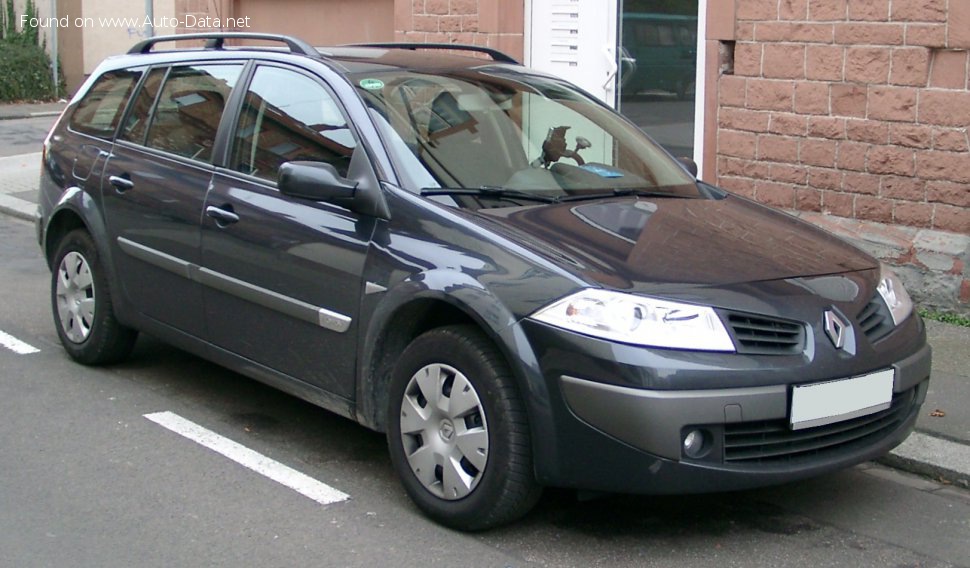
The Renault Megane II Grandtour (Phase II, 2006) adopts a conventional five-door station wagon (often referred to as an “estate” in Europe) body style, offering a practical and elongated silhouette compared to its hatchback sibling. Measuring 4500 mm (177.17 inches) in length, 1777 mm (69.96 inches) in width (2026 mm or 79.76 inches including mirrors), and 1467 mm (57.76 inches) in height, it presented a substantial footprint for a compact vehicle. The Phase II facelift introduced subtle refinements, including revised front and rear fascias, updated lighting signatures, and new wheel designs, giving it a slightly more modern and cohesive look than the initial Megane II. Its distinctive rear-end styling, with prominent vertical taillights, remained a signature element. The 2686 mm (105.75 inches) wheelbase contributed to a stable ride and generous interior space.
Interior and Practicality
Designed to accommodate five occupants, the Megane II Grandtour prioritized interior comfort and functionality. The cabin, characteristic of Renaults from this era, featured soft-touch materials in key areas and a generally ergonomic layout. A standout feature for the Grandtour was its exceptional cargo capacity. With the rear seats in place, it offered a substantial 520 liters (18.36 cu. ft.) of trunk space. When the rear seats were folded down, this expanded dramatically to a cavernous 1600 liters (56.5 cu. ft.), making it highly competitive in its segment for hauling luggage, groceries, or sports equipment. This versatility was a major draw for European families.
Safety and Technology
Safety was a paramount concern for Renault, and the Megane II Grandtour benefited from this focus. It featured standard safety systems such as ABS (Anti-lock Braking System) and often came with multiple airbags, depending on the trim level and market. The Megane II platform, in general, achieved high ratings in Euro NCAP crash tests for its time, underscoring its robust construction. Other features common in the Phase II models included electric power steering, which provided ease of maneuverability, and a range of convenience options such as climate control, power windows, and an integrated audio system. The 195/65 R15 or 205/55 R16 tire sizes, mounted on 6.5J x 15 or 6.5J x 16 wheels, provided a comfortable ride and stable handling characteristics, complemented by an independent McPherson front suspension and a torsion beam rear suspension.
Technical Specifications
| Category | Specification |
|---|---|
| Brand | Renault |
| Model | Megane II Grandtour (Phase II, 2006) |
| Engine Type | 1.6 16V (112 Hp) |
| Production Start | 2006 |
| Production End | 2008 |
| Body Type | Station wagon (estate) |
| Seats | 5 |
| Doors | 5 |
| Fuel Type | Petrol (Gasoline) |
| Engine Displacement | 1598 cm³ (97.52 cu. in.) |
| Number of Cylinders | 4, Inline |
| Valvetrain | DOHC, 4 valves per cylinder |
| Engine Aspiration | Naturally aspirated |
| Compression Ratio | 10:1 |
| Power | 112 Hp @ 6000 rpm |
| Torque | 152 Nm (112.11 lb.-ft.) @ 4200 rpm |
| Drivetrain | Front-wheel drive |
| Transmission | 5-speed manual |
| Acceleration 0-60 mph | 10.7 seconds |
| Maximum Speed | 190 km/h (118.06 mph) |
| Fuel Consumption (Combined) | 7 l/100 km (33.6 US mpg) |
| Fuel Consumption (Urban) | 9.3 l/100 km (25.3 US mpg) |
| Fuel Consumption (Extra Urban) | 5.7 l/100 km (41.3 US mpg) |
| CO2 Emissions | 166 g/km |
| Emission Standard | Euro 4 |
| Kerb Weight | 1220 kg (2689.64 lbs.) |
| Max. Weight | 1795 kg (3957.3 lbs.) |
| Max. Load | 575 kg (1267.66 lbs.) |
| Trunk Space (Minimum) | 520 l (18.36 cu. ft.) |
| Trunk Space (Maximum) | 1600 l (56.5 cu. ft.) |
| Fuel Tank Capacity | 60 l (15.85 US gal) |
| Length | 4500 mm (177.17 in.) |
| Width | 1777 mm (69.96 in.) |
| Height | 1467 mm (57.76 in.) |
| Wheelbase | 2686 mm (105.75 in.) |
| Ground Clearance | 120 mm (4.72 in.) |
| Turning Circle | 11 m (36.09 ft.) |
| Front Suspension | Independent McPherson |
| Rear Suspension | Torsion beam |
| Front Brakes | Ventilated discs |
| Rear Brakes | Disc |
| Assisting Systems | ABS |
| Steering Type | Electric rack and pinion |
| Tire Sizes | 195/65 R15; 205/55 R16 |
Legacy and Market Impact
The Renault Megane II Grandtour, particularly in its Phase II iteration with the 1.6 16V engine, carved out a strong niche for itself in the European compact family car market. Its primary competitors included established players like the Volkswagen Golf Variant (Jetta SportWagen in some markets), Ford Focus Estate, Opel Astra Caravan, and Peugeot 307 SW. What set the Megane II Grandtour apart was often its distinctive styling, particularly the bold rear design that, while polarizing for some, stood out in a segment often characterized by conservative aesthetics.
Its reputation was built on a foundation of practicality, comfort, and safety. For European families, the generous cargo space, combined with a comfortable ride and a generally well-appointed interior, made it an attractive proposition. The 1.6 16V engine, while not a powerhouse, was lauded for its reliability and decent fuel economy, contributing to lower running costs, a crucial factor for budget-conscious buyers. The Megane II generation also received acclaim for its safety features, often achieving high scores in independent crash tests, which further bolstered its appeal as a family vehicle.
The Megane II Grandtour’s impact was significant in reinforcing Renault’s position as a leader in innovative design and practical family transportation in Europe. It demonstrated Renault’s ability to combine distinctive styling with everyday usability, offering a compelling alternative to its German and other European rivals. While never making its way to North American showrooms, the Megane II Grandtour remains a testament to European automotive engineering and design philosophy, emphasizing versatility and efficiency within the compact segment. Its legacy is one of a well-rounded, practical, and safe family wagon that capably served its intended market, leaving a lasting impression on the European automotive landscape during the mid-2000s.