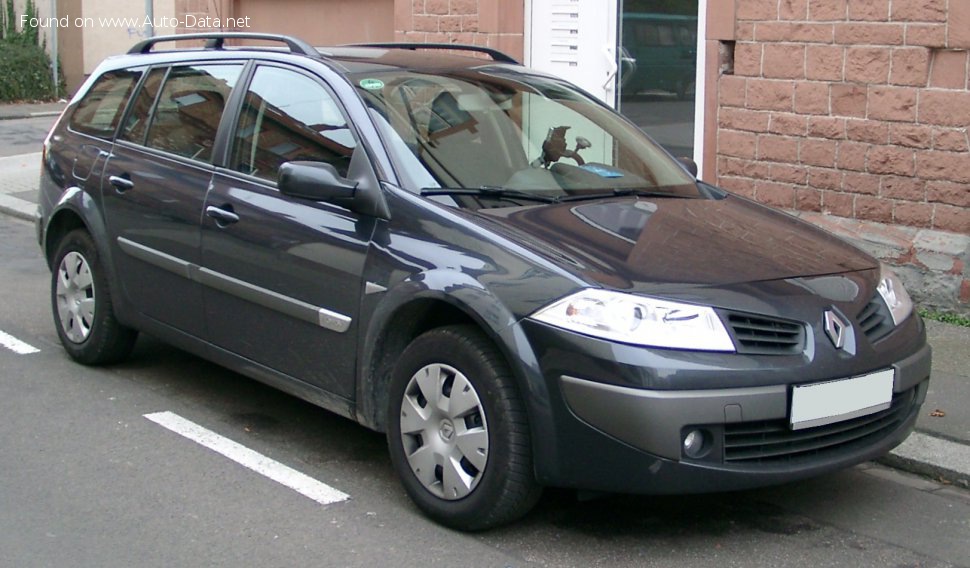
The Renault Megane II Grandtour (Phase II, 2006) represents a significant iteration in Renault’s popular compact car lineup, specifically catering to the European market’s demand for versatile and practical family vehicles. Launched as part of the Megane’s second generation, the Grandtour, or station wagon variant, was introduced to offer enhanced cargo capacity and utilitarian appeal without sacrificing the distinctive styling and comfortable ride characteristic of the Megane II series. The Phase II designation indicates a mid-cycle refresh, bringing updated aesthetics and minor mechanical refinements to the model from 2006 through its production end in 2008. This particular variant, equipped with the 1.6 16V engine and an automatic transmission, aimed to provide a balance of everyday usability, reasonable performance, and convenience for its target audience across Europe.
The Renault Megane II Grandtour (Phase II, 2006): A European Workhorse
The Renault Megane II, first unveiled in 2002, quickly became a sales success in Europe, praised for its groundbreaking design and innovative features. The Grandtour body style extended this appeal by offering a more spacious and flexible interior, crucial for families and those requiring extra cargo volume. The Phase II update for the 2006 model year brought subtle but impactful changes, including revised front and rear fascias, updated interior trim, and improved equipment levels, ensuring the Megane remained competitive in a crowded segment dominated by rivals such as the Volkswagen Golf Variant, Opel Astra Caravan, and Ford Focus Estate. The Megane II Grandtour (Phase II, 2006) was a testament to Renault’s commitment to providing well-rounded vehicles that blended practicality with French flair.
Engine & Performance
Under the hood, the Renault Megane II Grandtour (Phase II, 2006) 1.6 16V Automatic variant featured Renault’s widely utilized K4M engine. This inline four-cylinder, naturally aspirated gasoline (petrol) unit boasted a displacement of 1.6 liters (1598 cm³ or 97.52 cu. in.) and incorporated a Double Overhead Camshaft (DOHC) valvetrain with four valves per cylinder, totaling 16 valves. This setup contributed to its smooth operation and respectable power output for its class. The engine delivered 112 horsepower at 6000 rpm, translating to a power-per-liter ratio of 70.1 Hp/l, making it a capable performer for daily driving.
Peak torque was rated at 152 Nm (112.11 lb.-ft.) at 4200 rpm, providing adequate pulling power for city traffic and highway cruising. Power was sent to the front wheels via a 4-speed automatic transmission, prioritizing ease of driving and comfort, particularly in urban environments. While not designed for outright speed, the Megane II Grandtour 1.6 16V Automatic could accelerate from 0 to 60 mph in a calculated 12.5 seconds (0-100 km/h in 13.2 seconds) and reach a maximum speed of 111.85 mph (180 km/h). Fuel efficiency was a practical consideration, with a combined fuel consumption figure of 7.7 liters per 100 kilometers, or approximately 30.5 US mpg, an acceptable figure for a compact automatic station wagon of its era. It complied with the Euro 4 emission standard, reflecting the environmental considerations of the mid-2000s European market.
Design & Features
The design of the Megane II Grandtour (Phase II, 2006) was a continuation of the second-generation Megane’s distinctive styling, which broke away from conventional compact car aesthetics. Its bold, angular lines, particularly the unique “bustle back” rear design of the hatchback, were softened in the Grandtour variant to accommodate a more traditional, yet still stylish, station wagon profile. The Phase II refresh brought subtle exterior tweaks, including redesigned headlights and taillights, and refreshed bumper designs, giving it a more contemporary look. The body type was a 5-door station wagon (estate), offering seating for five occupants.
Practicality was paramount for the Grandtour. Its generous dimensions, with a length of 177.17 inches (4500 mm) and a width of 69.96 inches (1777 mm), contributed to a spacious interior. The wheelbase of 105.75 inches (2686 mm) ensured a comfortable ride and ample legroom for rear passengers. The true highlight for a station wagon was its cargo capacity: a minimum trunk space of 18.36 cu. ft. (520 liters) expanded to an impressive 56.5 cu. ft. (1600 liters) with the rear seats folded, making it highly versatile for carrying luggage, groceries, or larger items. Standard features for the era included power steering (electric), and essential safety systems like ABS (Anti-lock Braking System), contributing to driver confidence and passenger safety.
Technical Specifications
| Category | Specification |
|---|---|
| Brand | Renault |
| Model | Megane |
| Generation | Megane II Grandtour (Phase II, 2006) |
| Type (Engine) | 1.6 16V (112 Hp) Automatic |
| Start of Production | 2006 year |
| End of Production | 2008 year |
| Powertrain Architecture | Internal Combustion engine |
| Body type | Station wagon (estate) |
| Seats | 5 |
| Doors | 5 |
| Performance Specs | |
| Fuel Consumption (Urban) | 10.7 l/100 km (22 US mpg) |
| Fuel Consumption (Extra Urban) | 6 l/100 km (39.2 US mpg) |
| Fuel Consumption (Combined) | 7.7 l/100 km (30.5 US mpg) |
| CO2 Emissions | 184 g/km |
| Fuel Type | Petrol (Gasoline) |
| Acceleration 0 – 60 mph | 12.5 sec |
| Acceleration 0 – 100 km/h | 13.2 sec |
| Maximum Speed | 180 km/h (111.85 mph) |
| Emission Standard | Euro 4 |
| Weight-to-Power Ratio | 11.3 kg/Hp, 88.9 Hp/tonne |
| Weight-to-Torque Ratio | 8.3 kg/Nm, 120.6 Nm/tonne |
| Engine Specs | |
| Power | 112 Hp @ 6000 rpm |
| Power per Liter | 70.1 Hp/l |
| Torque | 152 Nm @ 4200 rpm (112.11 lb.-ft. @ 4200 rpm) |
| Engine Layout | Front, Transverse |
| Engine Model/Code | K4M |
| Engine Displacement | 1598 cm³ (1.6 Liters, 97.52 cu. in.) |
| Number of Cylinders | 4 |
| Engine Configuration | Inline |
| Cylinder Bore | 79.5 mm (3.13 in.) |
| Piston Stroke | 80.5 mm (3.17 in.) |
| Compression Ratio | 10:1 |
| Number of Valves per Cylinder | 4 |
| Fuel Injection System | Multi-port manifold injection |
| Engine Aspiration | Naturally aspirated engine |
| Valvetrain | DOHC |
| Engine Oil Capacity | 4.8 l (5.07 US qt) |
| Engine Oil Specification | Not provided |
| Coolant Capacity | 6.5 l (6.87 US qt) |
| Space, Volume and Weights | |
| Kerb Weight | 1260 kg (2777.82 lbs.) |
| Max. Weight | 1840 kg (4056.51 lbs.) |
| Max Load | 580 kg (1278.68 lbs.) |
| Trunk (boot) space – minimum | 520 l (18.36 cu. ft.) |
| Trunk (boot) space – maximum | 1600 l (56.5 cu. ft.) |
| Fuel Tank Capacity | 60 l (15.85 US gal) |
| Max. Roof Load | 80 kg (176.37 lbs.) |
| Permitted Trailer Load with Brakes (12%) | 1350 kg (2976.24 lbs.) |
| Permitted Trailer Load without Brakes | 650 kg (1433 lbs.) |
| Permitted Towbar Download | 75 kg (165.35 lbs.) |
| Dimensions | |
| Length | 4500 mm (177.17 in.) |
| Width | 1777 mm (69.96 in.) |
| Width including mirrors | 2026 mm (79.76 in.) |
| Height | 1467 mm (57.76 in.) |
| Wheelbase | 2686 mm (105.75 in.) |
| Front Track | 1518 mm (59.76 in.) |
| Rear (Back) Track | 1514 mm (59.61 in.) |
| Front Overhang | 842 mm (33.15 in.) |
| Rear Overhang | 972 mm (38.27 in.) |
| Ride Height (Ground Clearance) | 120 mm (4.72 in.) |
| Minimum Turning Circle (Turning Diameter) | 11 m (36.09 ft.) |
| Drivetrain, Brakes and Suspension Specs | |
| Drivetrain Architecture | The Internal combustion engine (ICE) drives the front wheels of the vehicle. |
| Drive Wheel | Front wheel drive |
| Number of Gears and Type of Gearbox | 4 gears, automatic transmission |
| Front Suspension | Independent type McPherson |
| Rear Suspension | Torsion |
| Front Brakes | Ventilated discs |
| Rear Brakes | Disc |
| Assisting Systems | ABS (Anti-lock braking system) |
| Steering Type | Steering rack and pinion |
| Power Steering | Electric Steering |
| Tires Size | 195/65 R15; 205/55 R16 |
| Wheel Rims Size | 6.5J x 15; 6.5J x 16 |
Legacy & Market Impact of the Renault Megane II Grandtour (Phase II, 2006)
The Renault Megane II Grandtour (Phase II, 2006) played a crucial role in Renault’s strategy to capture a significant share of the European compact family car market. While not sold in the United States, its impact across the Atlantic was substantial. The Megane II series, including the Grandtour, was critically acclaimed for its bold design, which stood out in a segment often characterized by conservative styling. This design philosophy, combined with a focus on passenger comfort, safety, and practicality, resonated well with European consumers.
In its primary markets, the Megane II Grandtour faced stiff competition from well-established rivals like the Volkswagen Golf Variant, which offered Teutonic build quality and refinement, and the Opel Astra Caravan (known as the Vauxhall Astra Estate in the UK), another strong contender for practicality. Ford’s Focus Estate also presented a formidable challenge with its engaging driving dynamics. Despite this fierce competition, the Megane II Grandtour carved out its niche by offering a distinct blend of French comfort, innovative features for its time (such as keyless entry and start on higher trims), and a practical, spacious interior wrapped in an aesthetically pleasing package.
The 1.6 16V Automatic variant, specifically, was popular among drivers seeking convenience and ease of use, particularly in congested European cities. Its combination of a willing engine, smooth automatic transmission, and generous cargo space made it an ideal choice for families and individuals who needed a versatile daily driver. The Phase II refresh ensured the model remained current and appealing, extending its competitive life cycle. The Megane II Grandtour’s legacy lies in its contribution to popularizing the compact station wagon segment in Europe, demonstrating that practicality could indeed coexist with distinctive design and a comfortable driving experience. It solidified Renault’s reputation for producing innovative and user-friendly vehicles, paving the way for future generations of the Megane and reinforcing its position as a key player in the European automotive landscape.