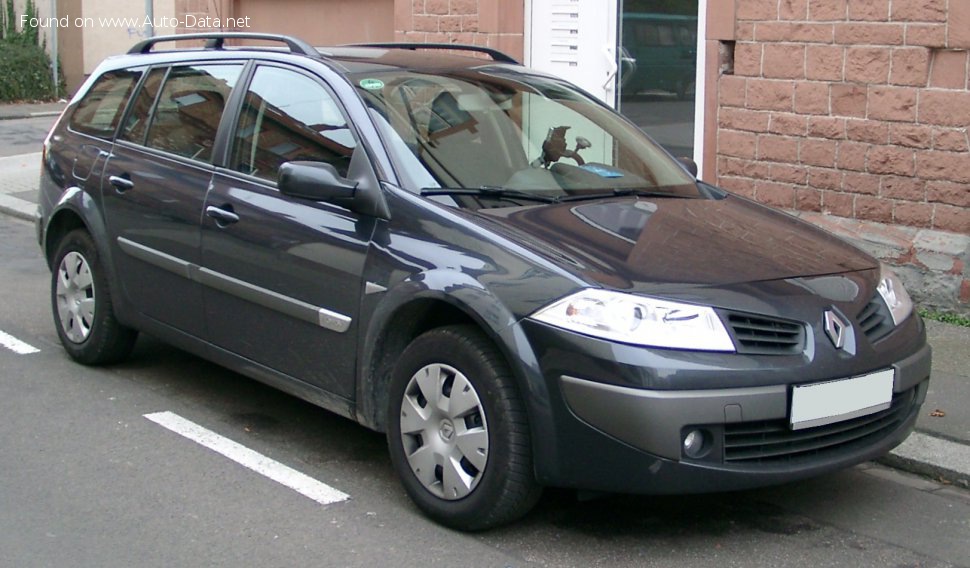
The Renault Megane II Grandtour (Phase II, 2006) 1.9 dCi (110 Hp) FAP: A European Family Workhorse
The Renault Megane II Grandtour (Phase II, 2006) 1.9 dCi (110 Hp) FAP represents a significant iteration of Renault’s popular compact family car, specifically tailored for the European market. Launched in 2006 as part of the Phase II refresh for the second-generation Megane, this particular model combined the practicality of a station wagon (known as an “estate” in Europe) with the efficiency and torque of a modern diesel engine. The Megane II, introduced in 2002, was celebrated for its distinctive styling, particularly its avant-garde rear end on the hatchback variants, and its focus on safety and comfort. The Grandtour body style extended this appeal by offering increased cargo capacity, making it a highly competitive choice in the C-segment for families and individuals prioritizing utility.
As a vehicle primarily designed and sold in Europe, the Renault Megane II Grandtour was never officially imported to the United States. However, its engineering principles, design philosophy, and market impact are relevant to understanding global automotive trends. It exemplifies the European preference for diesel engines, especially in larger vehicles or those intended for long-distance travel, due to their superior fuel economy and robust torque delivery. The inclusion of a Diesel Particulate Filter (FAP) in this 2006 model also highlights Renault’s commitment to meeting evolving emission standards like Euro 4, a crucial consideration for environmental regulations in its primary markets.
Engine and Performance of the Renault Megane II Grandtour (Phase II, 2006) 1.9 dCi (110 Hp) FAP
At the heart of this particular Megane II Grandtour was the F9Q Turbo 1.9-liter dCi (direct Common-rail injection) diesel engine, a powerplant renowned for its balance of power, efficiency, and durability. Producing 110 horsepower at 4000 rpm, the engine delivered ample motivation for the station wagon’s daily duties. More importantly for a vehicle of its type, it generated a substantial 191.77 lb.-ft. of torque at a low 2000 rpm. This strong low-end torque was instrumental in providing brisk acceleration from a standstill, confident overtaking capabilities, and excellent towing performance, making it well-suited for its role as a versatile family car.
The 1.9-liter inline-four engine, with its 80mm bore and 93mm piston stroke, featured a high 19:1 compression ratio, typical of diesel engines, to maximize combustion efficiency. Fuel was delivered via a sophisticated Commonrail injection system, ensuring precise fuel atomization and combustion. A turbocharger with an intercooler further enhanced performance by forcing more air into the cylinders, leading to increased power output and improved throttle response across the rev range. The valvetrain utilized an OHC (Overhead Camshaft) configuration, a common and reliable design.
Power was channeled to the front wheels through a 6-speed manual transmission, a choice that underscored the vehicle’s driver-centric approach to efficiency and engagement. This gearbox allowed drivers to keep the engine in its optimal torque band, contributing to the impressive fuel economy figures: an estimated 31.8 US mpg in urban driving, a remarkable 48 US mpg on the highway, and a combined average of 40.6 US mpg. These figures were highly competitive for its segment and era. Performance-wise, the Grandtour could accelerate from 0 to 60 mph in a respectable 10.4 seconds and reach a top speed of 116.82 mph, making it perfectly capable for extended highway cruises and daily commuting.
A key environmental feature of this 2006 model was the Diesel Particulate Filter (FAP). This system was designed to trap and periodically burn off soot particles from the exhaust gases, significantly reducing particulate matter emissions and helping the vehicle meet the stringent Euro 4 emission standard. This technology was a crucial step in making diesel engines cleaner and more acceptable in urban environments.
Design and Features
The Renault Megane II Grandtour, while sharing the distinctive front-end styling of the Megane II hatchback, adopted a more conventional and practical design from the B-pillar rearward. The Phase II refresh in 2006 brought subtle updates to the exterior, including revised headlamps, grille, and bumper designs, giving it a slightly more modern and refined appearance. The station wagon body type, with its five doors and seating for five occupants, was engineered for maximum utility. Its length of 177.17 inches (4500 mm) and width of 69.96 inches (1777 mm) positioned it firmly within the compact segment, yet it offered an impressive interior volume.
The Grandtour’s primary appeal lay in its cargo capacity. With the rear seats in place, it provided a generous 18.36 cubic feet (520 liters) of trunk space, which could be expanded to a cavernous 56.5 cubic feet (1600 liters) with the rear seats folded down. This flexibility made it ideal for carrying luggage, sports equipment, or even large household items, a critical attribute for European families. The interior design of the Megane II was known for its ergonomic layout and innovative features for its time, such as a digital instrument cluster and a “keycard” system for starting the car, which was a novelty at its introduction.
Safety was a paramount concern for Renault, and the Megane II was designed with a strong emphasis on occupant protection. It famously achieved a five-star Euro NCAP crash test rating, a benchmark for safety in its class. Standard safety features for the 2006 model included an Anti-lock Braking System (ABS) with electronic brake-force distribution, and multiple airbags. The braking system comprised ventilated discs at the front and solid discs at the rear, providing confident stopping power. The suspension setup featured an independent MacPherson strut design at the front and a torsion beam axle at the rear, a common configuration balancing ride comfort with predictable handling. Electric power steering offered light and precise control, aiding maneuverability in urban settings. The vehicle rode on 205/55 R16 tires mounted on 6.5J x 16-inch wheel rims.
Technical Specifications
| Category | Specification | US Equivalent (where applicable) |
|---|---|---|
| General Information | ||
| Brand | Renault | |
| Model | Megane II Grandtour (Phase II, 2006) | |
| Type (Engine) | 1.9 dCi (110 Hp) FAP | |
| Production Year | 2006 | |
| Body Type | Station wagon (estate) | |
| Seats | 5 | |
| Doors | 5 | |
| Performance Specs | ||
| Fuel Consumption (Urban) | 7.4 l/100 km | 31.8 US mpg |
| Fuel Consumption (Extra Urban) | 4.9 l/100 km | 48 US mpg |
| Fuel Consumption (Combined) | 5.8 l/100 km | 40.6 US mpg |
| CO2 Emissions | 154 g/km | |
| Fuel Type | Diesel | |
| Acceleration 0 – 60 mph | 10.4 sec | |
| Maximum Speed | 188 km/h | 116.82 mph |
| Emission Standard | Euro 4 | |
| Weight-to-Power Ratio | 11.9 kg/Hp | 26.24 lbs/Hp |
| Engine Specs | ||
| Power | 110 Hp @ 4000 rpm | |
| Power per liter | 58.8 Hp/l | |
| Torque | 260 Nm @ 2000 rpm | 191.77 lb.-ft. @ 2000 rpm |
| Engine Layout | Front, Transverse | |
| Engine Model/Code | F9Q Turbo | |
| Engine Displacement | 1870 cm3 | 114.11 cu. in. |
| Number of Cylinders | 4 | |
| Engine Configuration | Inline | |
| Cylinder Bore | 80 mm | 3.15 in. |
| Piston Stroke | 93 mm | 3.66 in. |
| Compression Ratio | 19:1 | |
| Valves per Cylinder | 2 | |
| Fuel Injection System | Diesel Commonrail | |
| Engine Aspiration | Turbocharger, Intercooler | |
| Valvetrain | OHC | |
| Engine Oil Capacity | 4.5 l | 4.76 US qt |
| Coolant Capacity | 7.9 l | 8.35 US qt |
| Engine Systems | Particulate filter (FAP) | |
| Space, Volume and Weights | ||
| Kerb Weight | 1310 kg | 2888.06 lbs. |
| Max. Weight (GVWR) | 1890 kg | 4166.74 lbs. |
| Max Load | 580 kg | 1278.68 lbs. |
| Trunk Space (Min) | 520 l | 18.36 cu. ft. |
| Trunk Space (Max) | 1600 l | 56.5 cu. ft. |
| Fuel Tank Capacity | 60 l | 15.85 US gal |
| Max. Roof Load | 80 kg | 176.37 lbs. |
| Permitted Trailer Load (with brakes) | 1350 kg | 2976.24 lbs. |
| Permitted Trailer Load (without brakes) | 650 kg | 1433 lbs. |
| Permitted Towbar Download | 75 kg | 165.35 lbs. |
| Dimensions | ||
| Length | 4500 mm | 177.17 in. |
| Width | 1777 mm | 69.96 in. |
| Width (incl. mirrors) | 2026 mm | 79.76 in. |
| Height | 1467 mm | 57.76 in. |
| Wheelbase | 2686 mm | 105.75 in. |
| Front Track | 1518 mm | 59.76 in. |
| Rear Track | 1514 mm | 59.61 in. |
| Front Overhang | 842 mm | 33.15 in. |
| Rear Overhang | 972 mm | 38.27 in. |
| Minimum Turning Circle | 10.7 m | 35.1 ft. |
| Drivetrain, Brakes and Suspension Specs | ||
| Drivetrain Architecture | Front-wheel drive | |
| Drive Wheel | Front wheel drive | |
| Gearbox | 6 gears, manual transmission | |
| Front Suspension | Independent type McPherson | |
| Rear Suspension | Torsion beam | |
| Front Brakes | Ventilated discs | |
| Rear Brakes | Disc | |
| Assisting Systems | ABS (Anti-lock braking system) | |
| Steering Type | Steering rack and pinion | |
| Power Steering | Electric Steering | |
| Tire Size | 205/55 R16 | |
| Wheel Rims Size | 6.5J x 16 | |
Legacy and Market Impact
The Renault Megane II Grandtour (Phase II, 2006) 1.9 dCi (110 Hp) FAP played a crucial role in Renault’s strategy for the highly competitive European C-segment. In a market where practicality, fuel efficiency, and low running costs are paramount, the Grandtour offered a compelling package. Its combination of a spacious interior, large cargo volume, and the frugal yet potent 1.9-liter dCi engine made it a favorite among families and business users alike.
Competitors in its class included well-established rivals such as the Volkswagen Golf Variant (Estate), Ford Focus Estate, Opel Astra Sports Tourer, and Peugeot 307 SW. The Megane II Grandtour distinguished itself with its distinctive styling, a strong emphasis on passive safety (evidenced by its Euro NCAP rating), and a reputation for comfort. The advanced diesel technology, including the FAP system, kept it competitive in terms of environmental performance and tax implications in many European countries, where diesel cars enjoyed favorable treatment due to their lower CO2 emissions per kilometer compared to equivalent gasoline engines.
Historically, the Megane II generation, including the Grandtour, is remembered for bringing a fresh design language to the compact segment and pioneering certain features like the keycard system and advanced safety technologies. The 1.9 dCi engine, in particular, solidified Renault’s reputation for producing competent and economical diesel powertrains. While the Megane II Grandtour may not have achieved the iconic status of some of its hatchback counterparts, its practicality and efficiency ensured its success and cemented its position as a reliable and versatile family car in its primary markets. Its enduring presence on European roads years after its production ceased is a testament to its robust engineering and sensible design, offering a compelling blend of utility, comfort, and economy for its target audience.