Introduction to the Renault Megane II Grandtour (Phase II, 2006)
The Renault Megane II Grandtour (Phase II, 2006) represents a significant chapter in the history of compact family vehicles within the European market. Launched in 2002, the second generation Megane quickly distinguished itself with its unconventional, avant-garde styling, which included a distinctive “bustle-back” rear on the hatchback models and a more conventional yet still modern aesthetic for the Grandtour (station wagon) variant. The Phase II, introduced in 2006, marked a mid-cycle refresh, bringing subtle cosmetic updates, revised interior materials, and minor mechanical refinements to keep the model competitive in its highly contested segment.
Specifically, the Renault Megane II Grandtour (Phase II, 2006) with the 2.0 16V (135 Hp) engine was positioned as a practical, comfortable, and reasonably spirited option for families and individuals prioritizing cargo space and everyday usability. While never officially sold in the United States, the Megane II Grandtour was a ubiquitous sight on European roads, embodying Renault’s reputation for innovative design, strong safety credentials, and a focus on passenger comfort. This particular iteration, produced between 2006 and 2008, offered a compelling blend of performance, efficiency, and utility, making it a popular choice across various European countries.
Engine and Performance of the Renault Megane II Grandtour (Phase II, 2006)
Under the hood, the Renault Megane II Grandtour (Phase II, 2006) 2.0 16V variant featured Renault’s venerable F4R engine, a naturally aspirated inline-four gasoline (petrol) unit. With a displacement of 1,998 cubic centimeters (approximately 121.9 cubic inches), this engine was engineered for a balance of smooth power delivery and reasonable fuel economy. It produced a healthy 135 horsepower at 5,500 rpm, which was a competitive figure for a mainstream compact station wagon of its era. Torque output stood at 191 Newton-meters (approximately 140.87 lb.-ft.) at 3,750 rpm, providing ample pulling power for daily driving and highway cruising, even when the vehicle was loaded.
Power was sent to the front wheels via a precise and engaging 6-speed manual transmission, a desirable feature for both driver engagement and optimizing fuel efficiency across a range of speeds. This powertrain configuration allowed the Megane II Grandtour to accelerate from 0 to 60 mph in a respectable 9.8 seconds, with a top speed reaching 123.03 mph (198 km/h).
Despite its performance capabilities, Renault also focused on practical economy. The combined fuel consumption for the 2.0 16V model was rated at 8 liters per 100 kilometers, translating to an estimated 29.4 US miles per gallon. Urban driving yielded about 21.6 US mpg, while extra-urban conditions could see figures as high as 36.8 US mpg. These figures, coupled with its Euro 4 emission standard compliance and CO2 emissions of 191 g/km, highlighted its relatively environmentally conscious design for the mid-2000s. The engine’s DOHC valvetrain and multi-port manifold injection system were standard for a modern gasoline engine, ensuring efficient combustion and reliable operation.
Design and Features
Exterior and Body Type
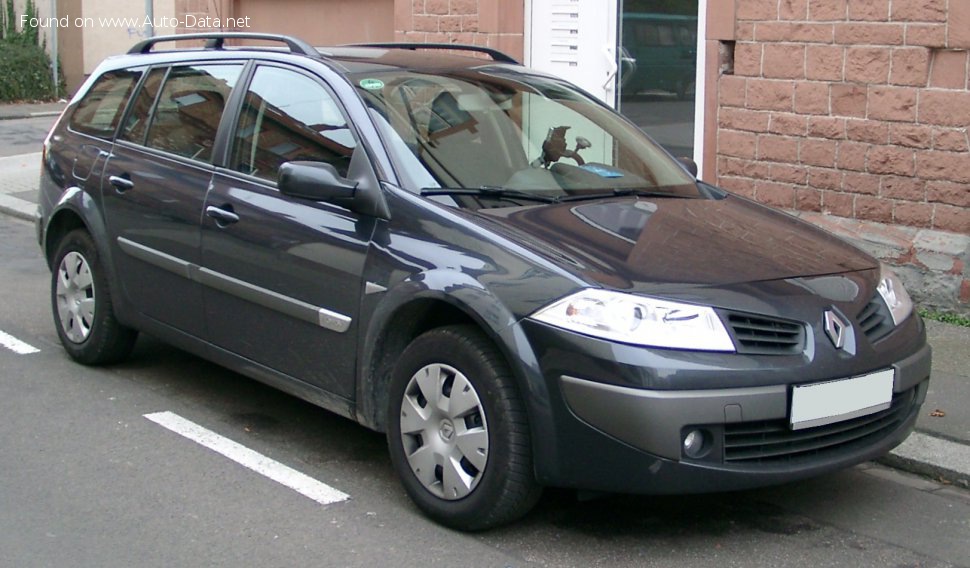
The Megane II Grandtour (Phase II) retained the distinctive styling cues of the second-generation Megane, albeit in a more conservative wagon form factor compared to its hatchback sibling. Its design, characterized by smooth lines and a robust stance, aimed at both aesthetics and practicality. As a 5-door station wagon (often referred to as an “estate car” in Europe), it offered a significantly expanded cargo capacity over the hatchback, making it ideal for families, outdoor enthusiasts, or those requiring extra utility. With an overall length of 177.17 inches (4500 mm) and a width of 69.96 inches (1777 mm), it struck a good balance between maneuverability in urban environments and stability on the open road. The 105.75-inch (2686 mm) wheelbase contributed to a comfortable ride and generous interior space.
Interior and Practicality
Inside, the Renault Megane II Grandtour (Phase II, 2006) was designed with passenger comfort and versatility in mind. It comfortably seated five occupants, offering ample headroom and legroom for its class. The true strength of the Grandtour lay in its cargo capabilities. With the rear seats in place, it boasted a substantial minimum trunk space of 520 liters (18.36 cubic feet). When the rear seats were folded down, this expanded dramatically to an impressive 1,600 liters (56.5 cubic feet), rivaling vehicles from larger segments. This flexibility, combined with a maximum payload of 1,278.68 lbs. (580 kg) and a permitted trailer load with brakes of 2,976.24 lbs. (1350 kg), underscored its utility as a workhorse and a family hauler.
Safety and Technology
Renault placed a strong emphasis on safety, and the Megane II Grandtour benefited from this focus. Key safety features for the time included an Anti-lock Braking System (ABS) as standard, ensuring stable braking performance. The car also featured front ventilated disc brakes and rear disc brakes, providing confident stopping power. Its independent MacPherson strut front suspension and torsion beam rear suspension, combined with electric power steering, contributed to predictable handling and a comfortable ride quality that was characteristic of Renault vehicles. The choice of 195/65 R15 or 205/55 R16 tires offered a balance of grip and ride comfort.
Technical Specifications
| Category | Specification | Value (US Units) |
|---|---|---|
| General Information | ||
| Brand | Renault | |
| Model | Megane II Grandtour (Phase II, 2006) | |
| Type (Engine) | 2.0 16V (135 Hp) | |
| Production Years | 2006 – 2008 | |
| Body Type | Station wagon (estate) | |
| Seats / Doors | 5 / 5 | |
| Performance Specs | ||
| Fuel Consumption (Urban) | 10.9 l/100 km | 21.6 US mpg |
| Fuel Consumption (Extra Urban) | 6.4 l/100 km | 36.8 US mpg |
| Fuel Consumption (Combined) | 8 l/100 km | 29.4 US mpg |
| CO2 Emissions | 191 g/km | |
| Fuel Type | Petrol (Gasoline) | |
| Acceleration 0-60 mph | 9.8 sec | |
| Maximum Speed | 198 km/h | 123.03 mph |
| Emission Standard | Euro 4 | |
| Weight-to-power ratio | 9.6 kg/Hp | 104.7 Hp/tonne |
| Engine Specs | ||
| Power | 135 Hp @ 5500 rpm | |
| Power per liter | 67.6 Hp/l | |
| Torque | 191 Nm @ 3750 rpm | 140.87 lb.-ft. @ 3750 rpm |
| Engine Layout | Front, Transverse | |
| Engine Model/Code | F4R | |
| Engine Displacement | 1998 cm3 | 121.93 cu. in. |
| Number of Cylinders | 4, Inline | |
| Cylinder Bore | 82.7 mm | 3.26 in. |
| Piston Stroke | 93 mm | 3.66 in. |
| Compression Ratio | 9.8:1 | |
| Valves per Cylinder | 4 | |
| Fuel Injection System | Multi-port manifold injection | |
| Engine Aspiration | Naturally aspirated | |
| Valvetrain | DOHC | |
| Engine Oil Capacity | 5.4 l | 5.71 US qt |
| Coolant Capacity | 6.5 l | 6.87 US qt |
| Space, Volume and Weights | ||
| Kerb Weight | 1290 kg | 2843.96 lbs. |
| Max. Weight | 1870 kg | 4122.64 lbs. |
| Max Load | 580 kg | 1278.68 lbs. |
| Trunk Space (Min/Max) | 520 – 1600 l | 18.36 – 56.5 cu. ft. |
| Fuel Tank Capacity | 60 l | 15.85 US gal |
| Max. Roof Load | 80 kg | 176.37 lbs. |
| Permitted Trailer Load (with brakes) | 1350 kg | 2976.24 lbs. |
| Permitted Trailer Load (without brakes) | 650 kg | 1433 lbs. |
| Dimensions | ||
| Length | 4500 mm | 177.17 in. |
| Width | 1777 mm | 69.96 in. |
| Width (incl. mirrors) | 2026 mm | 79.76 in. |
| Height | 1467 mm | 57.76 in. |
| Wheelbase | 2686 mm | 105.75 in. |
| Front Track | 1518 mm | 59.76 in. |
| Rear Track | 1514 mm | 59.61 in. |
| Ground Clearance | 120 mm | 4.72 in. |
| Minimum Turning Circle | 11 m | 36.09 ft. |
| Drivetrain, Brakes and Suspension | ||
| Drivetrain Architecture | Front-wheel drive (ICE drives front wheels) | |
| Drive Wheel | Front-wheel drive | |
| Gearbox | 6 gears, manual transmission | |
| Front Suspension | Independent type McPherson | |
| Rear Suspension | Torsion beam | |
| Front Brakes | Ventilated discs | |
| Rear Brakes | Disc | |
| Assisting Systems | ABS (Anti-lock braking system) | |
| Steering Type | Steering rack and pinion | |
| Power Steering | Electric Steering | |
| Tire Sizes | 195/65 R15; 205/55 R16 | |
| Wheel Rim Sizes | 6.5J x 15; 6.5J x 16 | |
Legacy and Market Impact of the Renault Megane II Grandtour
The Renault Megane II, including its Grandtour variant, left an indelible mark on the European compact car segment. Its launch was met with widespread attention due to its radical styling, which, while polarizing for some, ultimately cemented its place as a design icon of the early 2000s. The Grandtour, in particular, offered a more universally appealing aesthetic combined with superior practicality, making it a strong contender in the fiercely competitive European C-segment.
In its primary European market, the Megane II Grandtour competed against formidable rivals such as the Volkswagen Golf Variant (Jetta SportWagen in some markets), Ford Focus Estate, Opel Astra Sports Tourer, Peugeot 307 SW, and the Citroën C4 Estate. What set the Megane II Grandtour apart was its emphasis on comfort, safety, and a distinct French flair. Renault consistently achieved high marks in Euro NCAP crash tests for the Megane II, reinforcing its reputation as one of the safest cars in its class. This commitment to safety was a significant selling point for families.
The 2.0 16V (135 Hp) engine variant was particularly well-regarded for offering a good balance of performance for highway travel and everyday commuting without incurring excessive running costs. The 6-speed manual transmission was praised for its smooth shifts and helped maximize the engine’s potential. The vehicle’s ride quality was often highlighted as being supple and comfortable, making it well-suited for long journeys across varied European road networks.
While its unconventional design might have limited its appeal in certain markets, in Europe, the Megane II Grandtour was a commercial success, contributing significantly to Renault’s market share in the compact segment. Its legacy is one of innovation, practicality, and a bold design statement. It demonstrated that a family-oriented station wagon could still offer character and distinctive style, rather than merely being a utilitarian box on wheels. The Megane II series, including the Grandtour, played a crucial role in shaping the expectations for compact cars in Europe, pushing boundaries in design, safety, and comfort, ensuring its place as a memorable and impactful vehicle of its generation.