The Renault Megane II Grandtour (Phase II, 2006): A European Compact Workhorse
The Renault Megane II Grandtour (Phase II, 2006) 2.0 dCi (150 Hp) represents a significant chapter in the history of compact family cars in Europe. As an international automotive expert, it’s crucial to understand that while Renault models like the Megane were not widely sold in the United States, they played a pivotal role in shaping the European automotive landscape. The Megane II, launched in 2002, was renowned for its distinctive, avant-garde styling and a strong emphasis on safety and technology for its segment. The “Grandtour” designation refers to its station wagon (or estate) body style, offering enhanced practicality and cargo capacity compared to its hatchback and sedan siblings. The “Phase II” update, introduced in 2006, brought subtle but meaningful refinements to the car’s aesthetics, interior quality, and mechanical packages, keeping it competitive in the fiercely contested European C-segment. This particular variant, powered by the robust 2.0 dCi (150 Hp) turbodiesel engine, stood out for its blend of performance and exceptional fuel economy, making it a popular choice for families and fleet buyers across the continent.
Engine & Performance: The Robust 2.0 dCi Powertrain
At the heart of the Renault Megane II Grandtour (Phase II, 2006) 2.0 dCi (150 Hp) lies Renault’s M9R series diesel engine, a sophisticated 2.0-liter (1995 cm³ or 121.74 cu. in.) inline-four powerplant. This engine was a testament to the advancements in diesel technology of its era, featuring common rail direct fuel injection, a turbocharger, and an intercooler to optimize performance and efficiency. It delivered a respectable 150 horsepower at 4000 rpm, a substantial output for a compact family car in 2006, especially for a diesel. More impressive, however, was its torque output: a commanding 250.77 lb.-ft. (340 Nm) available at a low 2000 rpm. This characteristic torque delivery provided excellent mid-range acceleration and made the Megane feel effortless in everyday driving, whether navigating city streets or cruising on the Autobahn.
Performance figures for the 2.0 dCi Grandtour were quite competitive. It could accelerate from 0 to 60 mph in a brisk 8.4 seconds (0-100 km/h in 8.8 seconds) and reach a top speed of 129.87 mph (209 km/h). These figures underscored its capability as a versatile family vehicle that didn’t compromise on dynamic ability. Power was sent to the front wheels via a smooth-shifting 6-speed manual transmission, a common and preferred choice in the European market for its driver engagement and efficiency.
Fuel economy was a major selling point for this diesel variant. The Megane II Grandtour 2.0 dCi achieved an impressive combined fuel economy of 43.6 US mpg (5.4 l/100 km). Urban driving yielded around 34.1 US mpg (6.9 l/100 km), while extra-urban (highway) figures soared to an outstanding 51.1 US mpg (4.6 l/100 km). These numbers were highly attractive to European consumers facing higher fuel prices and a greater emphasis on efficiency. Furthermore, the engine complied with the Euro 4 emission standard, reflecting its relatively clean operation for its time, with CO2 emissions rated at 144 g/km.
Design & Features: Practicality Meets Distinctive Style
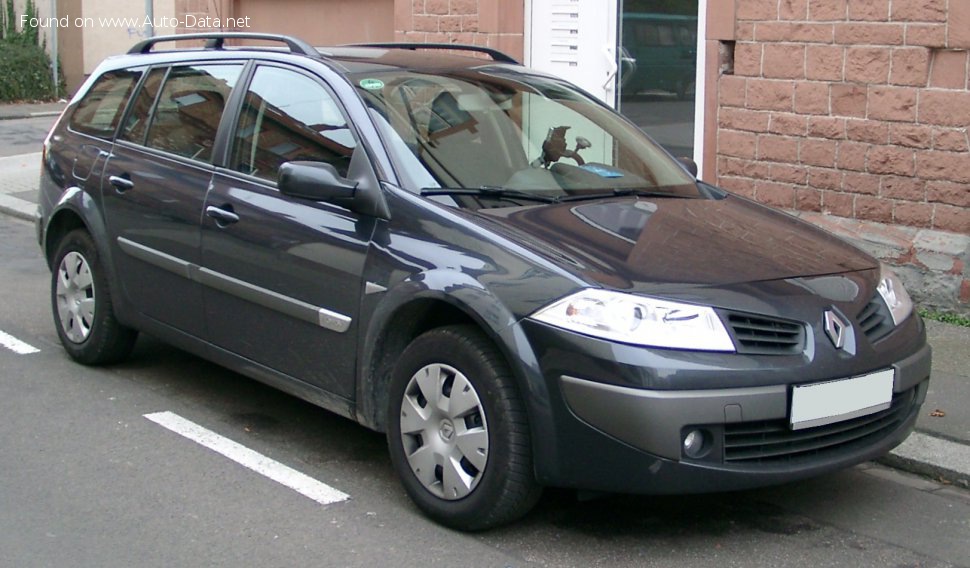
The Renault Megane II Grandtour retained the distinctive, somewhat controversial styling that defined the second-generation Megane. Its bold rear styling, characterized by a prominent “bustle” trunk lid and vertically oriented taillights, was a radical departure from conventional designs. The Phase II update introduced subtle refinements, including revised bumpers, grilles, and headlights, giving it a slightly more modern and cohesive appearance. As a station wagon, the Grandtour extended the Megane’s wheelbase and rear overhang to maximize cargo space, making it a highly practical choice for families.
Dimensions for the Grandtour were substantial for a compact car, emphasizing its family-friendly mission. It measured 177.17 inches in length, 69.96 inches in width (79.76 inches including mirrors), and 57.76 inches in height. The generous 105.75-inch wheelbase contributed to a stable ride and ample interior room. Inside, the Megane II Grandtour offered seating for five adults, with a focus on comfort and ergonomics. The interior design, while less radical than the exterior, was modern and functional.
One of the Grandtour’s strongest attributes was its cargo capacity. With the rear seats in place, it offered a substantial 18.36 cu. ft. (520 liters) of trunk space. Folding down the rear seats expanded this volume to a cavernous 56.5 cu. ft. (1600 liters), allowing it to swallow large items with ease. This flexibility, combined with a maximum payload of 1267.66 lbs. (575 kg) and a permitted trailer load with brakes of 2976.24 lbs. (1350 kg), underscored its versatility.
In terms of chassis and safety, the Megane II was well-equipped. It featured an independent McPherson strut front suspension and a torsion beam rear suspension, providing a comfortable yet composed ride. Braking was handled by ventilated discs at the front and disc brakes at the rear, complemented by an Anti-lock Braking System (ABS) as standard. Steering was an electric power-assisted rack and pinion system, offering ease of maneuverability. The car rode on 205/55 R16 tires mounted on 6.5J x 16-inch wheel rims. Renault also placed a strong emphasis on passive safety, with the Megane II having achieved a groundbreaking 5-star Euro NCAP safety rating for occupant protection at its launch, a benchmark for its segment.
Technical Specifications
| Renault Megane II Grandtour (Phase II, 2006) 2.0 dCi (150 Hp) | |
|---|---|
| General Information | |
| Brand | Renault |
| Model | Megane |
| Generation | Megane II Grandtour (Phase II, 2006) |
| Engine Type | 2.0 dCi (150 Hp) |
| Production Start | 2006 |
| Production End | 2008 |
| Powertrain Architecture | Internal Combustion Engine |
| Body Type | Station wagon (estate) |
| Seats | 5 |
| Doors | 5 |
| Performance Specs | |
| Fuel Consumption (Urban) | 6.9 l/100 km (34.1 US mpg) |
| Fuel Consumption (Extra Urban) | 4.6 l/100 km (51.1 US mpg) |
| Fuel Consumption (Combined) | 5.4 l/100 km (43.6 US mpg) |
| CO2 Emissions | 144 g/km |
| Fuel Type | Diesel |
| Acceleration 0-60 mph | 8.4 sec |
| Acceleration 0-62 mph (0-100 km/h) | 8.8 sec |
| Maximum Speed | 129.87 mph (209 km/h) |
| Emission Standard | Euro 4 |
| Weight-to-Power Ratio | 8.8 kg/Hp (114.1 Hp/tonne) |
| Weight-to-Torque Ratio | 3.9 kg/Nm (258.6 Nm/tonne) |
| Engine Specs | |
| Power | 150 Hp @ 4000 rpm |
| Power per liter | 75.2 Hp/l |
| Torque | 250.77 lb.-ft. (340 Nm) @ 2000 rpm |
| Engine Layout | Front, Transverse |
| Engine Model/Code | M9R Turbo |
| Engine Displacement | 1995 cm³ (121.74 cu. in.) |
| Number of Cylinders | 4 |
| Engine Configuration | Inline |
| Cylinder Bore | 3.31 in. (84 mm) |
| Piston Stroke | 3.54 in. (90 mm) |
| Compression Ratio | 16:1 |
| Valves per Cylinder | 4 |
| Fuel Injection System | Diesel Commonrail |
| Engine Aspiration | Turbocharger, Intercooler |
| Engine Oil Capacity | 6.6 l (6.97 US qt) |
| Coolant Capacity | 7.5 l (7.93 US qt) |
| Space, Volume & Weights | |
| Kerb Weight | 2899.08 lbs. (1315 kg) |
| Max. Weight | 4166.74 lbs. (1890 kg) |
| Max Load | 1267.66 lbs. (575 kg) |
| Trunk (Boot) Space – Minimum | 18.36 cu. ft. (520 l) |
| Trunk (Boot) Space – Maximum | 56.5 cu. ft. (1600 l) |
| Fuel Tank Capacity | 15.85 US gal (60 l) |
| Max. Roof Load | 176.37 lbs. (80 kg) |
| Permitted Trailer Load with Brakes (12%) | 2976.24 lbs. (1350 kg) |
| Permitted Trailer Load without Brakes | 1433 lbs. (650 kg) |
| Permitted Towbar Download | 165.35 lbs. (75 kg) |
| Dimensions | |
| Length | 177.17 in. (4500 mm) |
| Width | 69.96 in. (1777 mm) |
| Width Including Mirrors | 79.76 in. (2026 mm) |
| Height | 57.76 in. (1467 mm) |
| Wheelbase | 105.75 in. (2686 mm) |
| Front Track | 59.76 in. (1518 mm) |
| Rear (Back) Track | 59.61 in. (1514 mm) |
| Front Overhang | 33.15 in. (842 mm) |
| Rear Overhang | 38.27 in. (972 mm) |
| Minimum Turning Circle | 35.1 ft. (10.7 m) |
| Drivetrain, Brakes & Suspension | |
| Drivetrain Architecture | Front-wheel drive, Internal Combustion Engine |
| Drive Wheel | Front-wheel drive |
| Number of Gears & Gearbox Type | 6 gears, manual transmission |
| Front Suspension | Independent type McPherson |
| Rear Suspension | Torsion |
| Front Brakes | Ventilated discs |
| Rear Brakes | Disc |
| Assisting Systems | ABS (Anti-lock braking system) |
| Steering Type | Steering rack and pinion |
| Power Steering | Electric Steering |
| Tire Size | 205/55 R16 |
| Wheel Rims Size | 6.5J x 16 |
Legacy & Market Impact of the Renault Megane II Grandtour
The Renault Megane II Grandtour (Phase II, 2006) 2.0 dCi (150 Hp) carved out a strong niche for itself in the highly competitive European compact segment. Its distinctive styling, initially polarizing, eventually became a hallmark of the Megane II’s identity and helped it stand out from its more conservatively styled rivals. The Grandtour variant, in particular, was praised for its exceptional practicality and cargo-carrying capabilities, making it a compelling choice for families and those requiring more space than a hatchback could offer.
In its primary European market, the Megane II Grandtour competed against formidable opponents such as the Ford Focus Estate, Opel Astra Caravan (Vauxhall Astra Estate in the UK), Peugeot 307 SW, and the Volkswagen Golf Variant. While some rivals might have offered a slightly sharper driving experience or a more premium badge, the Megane consistently delivered on comfort, safety, and value. Its 5-star Euro NCAP safety rating was a significant selling point, reassuring safety-conscious buyers. The 2.0 dCi engine, with its strong performance and outstanding fuel efficiency, further cemented its reputation as a smart, economical choice.
The Megane II Grandtour, especially in its Phase II iteration, represented a mature and refined product from Renault. It showcased the brand’s commitment to innovation in design and technology, while also adhering to the practical demands of the European family car market. While its bold design might not have translated well to the American market’s preferences at the time, its impact on European automotive design and its success in providing efficient, safe, and versatile transportation for millions of families is undeniable. The 2.0 dCi (150 Hp) variant, in particular, stands as a testament to the era when diesel engines were at their peak in Europe, offering an attractive blend of power, economy, and low running costs for everyday use. Its legacy is one of a practical, stylish, and highly competent compact station wagon that played a crucial role in its segment.