Introduction to the Renault Megane II GT 1.9 dCi (110 Hp) FAP
The Renault Megane II, launched in 2002, represented a bold departure from its predecessor, showcasing a distinctive and often polarizing design philosophy that defined Renault’s aesthetic direction in the early 2000s. As a prominent player in the highly competitive European C-segment (compact family car market), the Megane II quickly garnered attention for its unconventional styling, particularly the dramatic “bustle-back” rear end of its hatchback variants. The specific model under review, the Renault Megane II GT 1.9 dCi (110 Hp) FAP, produced solely in 2005, embodies a particular blend of performance, efficiency, and environmental consciousness that was increasingly important in the European automotive landscape. This variant, with its advanced turbodiesel engine and particulate filter, was not offered in the United States, making it a quintessential European market vehicle tailored to the continent’s preferences for diesel power and stringent emissions standards. It aimed to provide a dynamic driving experience while maintaining the practicality and fuel economy expected of a family hatchback.
Engine and Performance: The Heart of the Renault Megane II GT 1.9 dCi (110 Hp) FAP
At the core of the Renault Megane II GT 1.9 dCi (110 Hp) FAP lies a sophisticated 1.9-liter (1870 cm3 or 114.11 cu. in.) F9Q inline-four turbodiesel engine. This powertrain was a testament to Renault’s expertise in common-rail direct injection diesel technology, offering a compelling blend of torque and fuel efficiency. The engine delivers a respectable 110 horsepower at 4000 rpm, which for a compact family car in 2005, provided ample motivation. More significantly for a diesel, it produced a robust 191.77 lb.-ft. (260 Nm) of torque, available at a low 2000 rpm. This characteristic low-end torque made the Megane II GT feel responsive and capable in everyday driving, particularly in urban environments and during highway overtakes, without needing to rev the engine excessively.
Performance figures for this variant were competitive for its class and powertrain type. The Megane II GT 1.9 dCi could accelerate from 0 to 60 mph in a calculated 10.1 seconds (0-100 km/h in 10.6 seconds) and reach a top speed of 116.82 mph (188 km/h). These numbers positioned it as a capable, rather than overtly sporty, performer, aligning with its role as a GT – a grand tourer for everyday use, emphasizing comfortable cruising and efficient travel.
A key feature of this specific model name is “FAP,” which stands for “Filtre à Particules” or Particulate Filter. This technology was crucial for meeting the Euro 4 emission standard, which became mandatory for new car types in 2005. The FAP system significantly reduced particulate matter emissions, making the Megane II GT 1.9 dCi a more environmentally friendly option compared to earlier diesels. This focus on emissions control, combined with impressive fuel economy, was a major selling point in Europe. The combined fuel consumption was rated at an excellent 42 US mpg (5.6 l/100 km), with even better figures on the extra-urban cycle at 49 US mpg (4.8 l/100 km), making it a cost-effective choice for long-distance travel. The powertrain architecture featured a front, transverse engine layout driving the front wheels through a precise 6-speed manual transmission, offering driver engagement and optimized gear ratios for both acceleration and highway cruising.
Design and Features
Distinctive Styling and Practicality
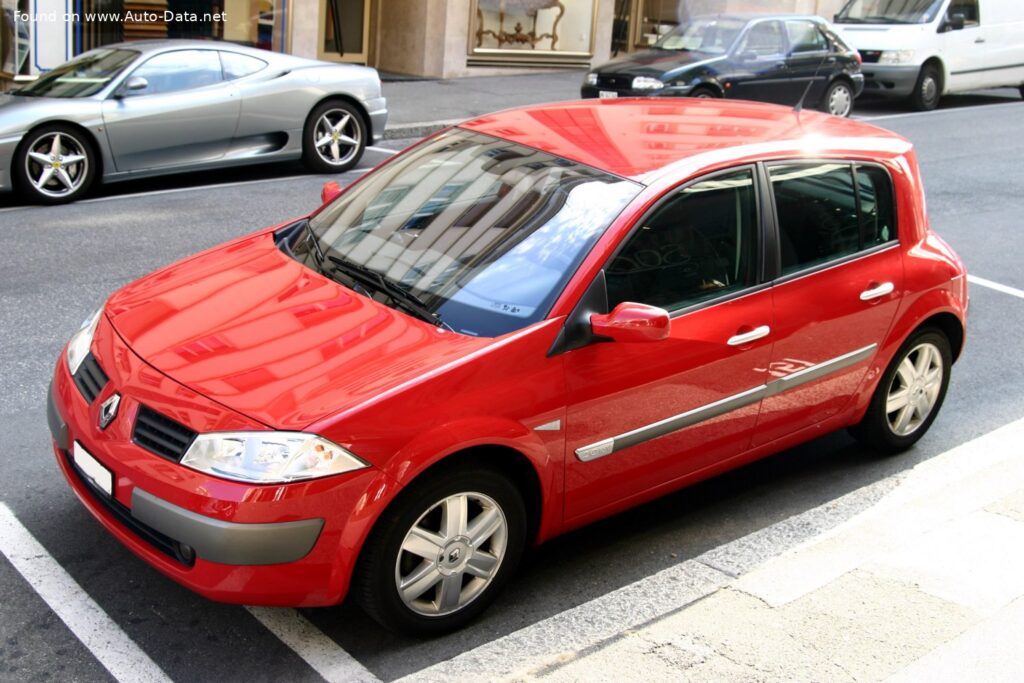
The Renault Megane II’s design was its most defining characteristic. The 5-door hatchback body type, with its unconventional “bustle-back” rear, was a bold statement that set it apart from more conservatively styled competitors. This design choice, while polarizing, contributed to a distinctive road presence and surprisingly good aerodynamics. The car’s dimensions, with a length of 165.71 inches (4209 mm), width of 69.96 inches (1777 mm), and height of 57.4 inches (1458 mm), provided a compact footprint suitable for European city driving, yet offered a spacious interior for five occupants. The 103.35-inch (2625 mm) wheelbase contributed to a stable ride and generous cabin space.
Inside, the Megane II prioritized comfort and functionality. While specific interior features for the GT trim aren’t fully detailed in the provided data, a 2005 GT variant would typically include upgraded upholstery, perhaps sportier trim accents, and a comprehensive set of convenience features. The car offered a practical interior with 5 seats, and a flexible cargo area, ranging from 11.65 cu. ft. (330 liters) with the rear seats up to a substantial 42.02 cu. ft. (1190 liters) with the seats folded down, making it highly versatile for families and individuals alike.
Safety and Chassis Engineering
Safety was a paramount concern for Renault with the Megane II. It was one of the first cars in its segment to achieve a full 5-star rating in the Euro NCAP crash tests, a significant achievement at the time. Beyond passive safety, the car featured active safety systems like ABS (Anti-lock Braking System) as standard, enhancing control during emergency braking. The braking system comprised ventilated discs at the front and solid discs at the rear, providing confident stopping power.
The chassis of the Megane II GT was engineered for a balanced ride. It utilized an independent McPherson strut setup for the front suspension, a proven design offering good handling and ride comfort. The rear featured a torsion beam suspension, a compact and cost-effective solution commonly found in front-wheel-drive compact cars, providing a good compromise between space efficiency and dynamic capability. The electric power steering system offered light and precise steering, making it agile in urban environments and stable at higher speeds. The car rode on 195/65 R15 tires mounted on 6.5J x 15-inch wheel rims, a sensible setup balancing grip, comfort, and rolling resistance for fuel efficiency.
Technical Specifications
| Category | Specification |
|---|---|
| General Information | |
| Brand | Renault |
| Model | Megane |
| Generation | Megane II |
| Type (Engine) | GT 1.9 dCi (110 Hp) FAP |
| Start of Production | 2005 year |
| End of Production | 2005 year |
| Powertrain Architecture | Internal Combustion engine |
| Body type | Hatchback |
| Seats | 5 |
| Doors | 5 |
| Performance Specs | |
| Fuel consumption (economy) – urban | 7.1 l/100 km (33.1 US mpg) |
| Fuel consumption (economy) – extra urban | 4.8 l/100 km (49 US mpg) |
| Fuel consumption (economy) – combined | 5.6 l/100 km (42 US mpg) |
| CO2 emissions | 148 g/km |
| Fuel Type | Diesel |
| Acceleration 0 – 60 mph | 10.1 sec |
| Maximum speed | 116.82 mph (188 km/h) |
| Emission standard | Euro 4 |
| Weight-to-power ratio | 11.5 kg/Hp (86.6 Hp/tonne) |
| Weight-to-torque ratio | 4.9 kg/Nm (204.7 Nm/tonne) |
| Engine Specs | |
| Power | 110 Hp @ 4000 rpm |
| Power per liter | 58.8 Hp/l |
| Torque | 191.77 lb.-ft. (260 Nm) @ 2000 rpm |
| Engine layout | Front, Transverse |
| Engine Model/Code | F9Q |
| Engine displacement | 1.9 liters (1870 cm3, 114.11 cu. in.) |
| Number of cylinders | 4 |
| Engine configuration | Inline |
| Cylinder Bore | 3.15 in. (80 mm) |
| Piston Stroke | 3.66 in. (93 mm) |
| Compression ratio | 19:1 |
| Number of valves per cylinder | 2 |
| Fuel injection system | Diesel Commonrail |
| Engine aspiration | Turbocharger, Intercooler |
| Valvetrain | OHC |
| Engine oil capacity | 4.76 US qt (4.5 l) |
| Coolant | 8.03 US qt (7.6 l) |
| Engine systems | Particulate filter |
| Space, Volume and Weights | |
| Kerb Weight | 2799.87 lbs. (1270 kg) |
| Max. weight | 4012.41 lbs. (1820 kg) |
| Max load | 1212.54 lbs. (550 kg) |
| Trunk (boot) space – minimum | 11.65 cu. ft. (330 l) |
| Trunk (boot) space – maximum | 42.02 cu. ft. (1190 l) |
| Fuel tank capacity | 15.85 US gal (60 l) |
| Max. roof load | 176.37 lbs. (80 kg) |
| Permitted trailer load with brakes (12%) | 2866.01 lbs. (1300 kg) |
| Permitted trailer load without brakes | 1433 lbs. (650 kg) |
| Permitted towbar download | 165.35 lbs. (75 kg) |
| Dimensions | |
| Length | 165.71 in. (4209 mm) |
| Width | 69.96 in. (1777 mm) |
| Height | 57.4 in. (1458 mm) |
| Wheelbase | 103.35 in. (2625 mm) |
| Front track | 59.76 in. (1518 mm) |
| Rear (Back) track | 59.61 in. (1514 mm) |
| Front overhang | 33.15 in. (842 mm) |
| Rear overhang | 29.21 in. (742 mm) |
| Minimum turning circle (turning diameter) | 34.45 ft. (10.5 m) |
| Drivetrain, Brakes and Suspension Specs | |
| Drivetrain Architecture | The Internal combustion engine (ICE) drives the front wheels of the vehicle. |
| Drive wheel | Front wheel drive |
| Number of gears and type of gearbox | 6 gears, manual transmission |
| Front suspension | Independent type McPherson |
| Rear suspension | Torsion |
| Front brakes | Ventilated discs |
| Rear brakes | Disc |
| Assisting systems | ABS (Anti-lock braking system) |
| Steering type | Steering rack and pinion |
| Power steering | Electric Steering |
| Tires size | 195/65 R15 |
| Wheel rims size | 6.5J x 15 |
Legacy and Market Impact
The Renault Megane II, including the GT 1.9 dCi (110 Hp) FAP variant, left a significant mark on the European automotive landscape. Its most immediate impact was through its bold and unconventional styling, which sparked considerable debate but ultimately helped Renault stand out in a crowded market. This design language, spearheaded by Patrick Le Quément, aimed to inject emotion and distinctiveness into a segment often characterized by conservative aesthetics. While not universally loved, it certainly achieved its goal of being noticed.
Beyond aesthetics, the Megane II’s legacy is strongly tied to its pioneering safety features. Being one of the first compact cars to achieve a 5-star Euro NCAP rating, it raised the bar for safety in its class, influencing competitors to enhance their own safety offerings. This commitment to passenger protection was a major selling point and contributed to the car’s strong reputation among safety-conscious buyers.
In the highly competitive European C-segment, the Megane II faced formidable rivals such as the Volkswagen Golf, Ford Focus, Opel Astra, and Peugeot 307. Each offered its own blend of styling, dynamics, and practicality. The Megane II distinguished itself with its unique design, innovative features (such as the “Renault Card” keyless entry and start system, which was quite novel at the time), and a strong emphasis on comfort and refinement. The 1.9 dCi engine, in particular, was a cornerstone of its success, catering to the strong European demand for fuel-efficient and torque-rich diesel powertrains. The inclusion of the FAP system in models like the GT 1.9 dCi further cemented Renault’s position as a leader in environmentally conscious diesel technology, helping to meet evolving emissions regulations.
The GT 1.9 dCi (110 Hp) FAP variant, though produced for only a single year in 2005, represented a sweet spot in the Megane II lineup. It offered a compelling combination of the Megane’s distinctive character with a potent yet economical diesel engine, positioned for drivers seeking a blend of everyday usability, spirited performance, and low running costs. Its 6-speed manual transmission reinforced the driver-focused appeal, while the FAP system underscored its modern credentials. The Megane II generation, while eventually succeeded by the Megane III in 2008, remains a memorable chapter in Renault’s history, celebrated for its courage in design, its advancements in safety, and its strong presence in the European compact car market. Its impact continues to be felt in the design cues and technological aspirations of subsequent Renault models.