The Renault Megane II (Phase II, 2006) 1.5 dCi (103 Hp) FAP: A European Compact Diesel Powerhouse
The Renault Megane II (Phase II, 2006) 1.5 dCi (103 Hp) FAP represents a significant iteration of Renault’s popular compact family car, the Megane. Launched as a facelifted version of the second-generation Megane, the Phase II models were produced from 2007 to 2008, solidifying its position in the highly competitive European C-segment. While never officially sold in the United States, the Megane II was a cornerstone of Renault’s lineup across Europe and other international markets, celebrated for its distinctive styling, practical packaging, and, particularly in this diesel variant, its remarkable fuel efficiency and robust performance. This specific model, equipped with the 1.5-liter dCi engine and a Diesel Particulate Filter (FAP), was a prime example of Renault’s commitment to offering economical yet capable vehicles designed for the demands of European drivers.
Engine and Performance of the Renault Megane II (Phase II, 2006) 1.5 dCi (103 Hp) FAP
At the heart of the Renault Megane II (Phase II, 2006) 1.5 dCi (103 Hp) FAP lies a transversely mounted, front-wheel-drive 1.5-liter (1461 cubic centimeters or 89.16 cubic inches) inline-four turbo-diesel engine, designated by Renault as the K9K Turbo. This powerplant was a critical component of Renault’s strategy to provide efficient and environmentally conscious options within its model range. It produced a respectable 103 horsepower at 4000 revolutions per minute, delivering ample power for daily driving and highway cruising.
More impressive than its horsepower, especially for a diesel, was its torque output. The engine generated 240 Newton-meters (177.01 lb.-ft.) of torque at a low 2000 rpm. This characteristic low-end torque made the Megane feel responsive and capable, particularly in urban environments or when hauling passengers and cargo. The engine’s advanced common-rail fuel injection system and turbocharger with intercooler ensured efficient combustion and optimal power delivery across the rev range. With a compression ratio of 18.8:1 and two valves per cylinder, the engine was designed for durability and efficiency.
Mated to a precise 6-speed manual transmission, this Megane variant offered a balanced blend of performance and economy. It could accelerate from 0 to 60 miles per hour in a swift 10.5 seconds, reaching a top speed of 114.95 mph. Crucially, its fuel economy was a major selling point. The urban fuel consumption was rated at 6 liters per 100 km (39.2 US mpg), while extra-urban driving yielded an impressive 4.3 liters per 100 km (54.7 US mpg). The combined fuel economy figure stood at an outstanding 4.8 liters per 100 km (49 US mpg), making it an extremely economical choice for commuters and families alike.
Environmental considerations were also paramount, with the engine meeting Euro 4 emission standards. The inclusion of a Diesel Particulate Filter (FAP) was vital for reducing harmful particulate matter emissions, a key step towards cleaner diesel technology in the mid-2000s. The engine oil capacity was 4.5 liters (4.76 US quarts), and the cooling system held 6.8 liters (7.19 US quarts), indicating a robust design for sustained performance.
Design and Features
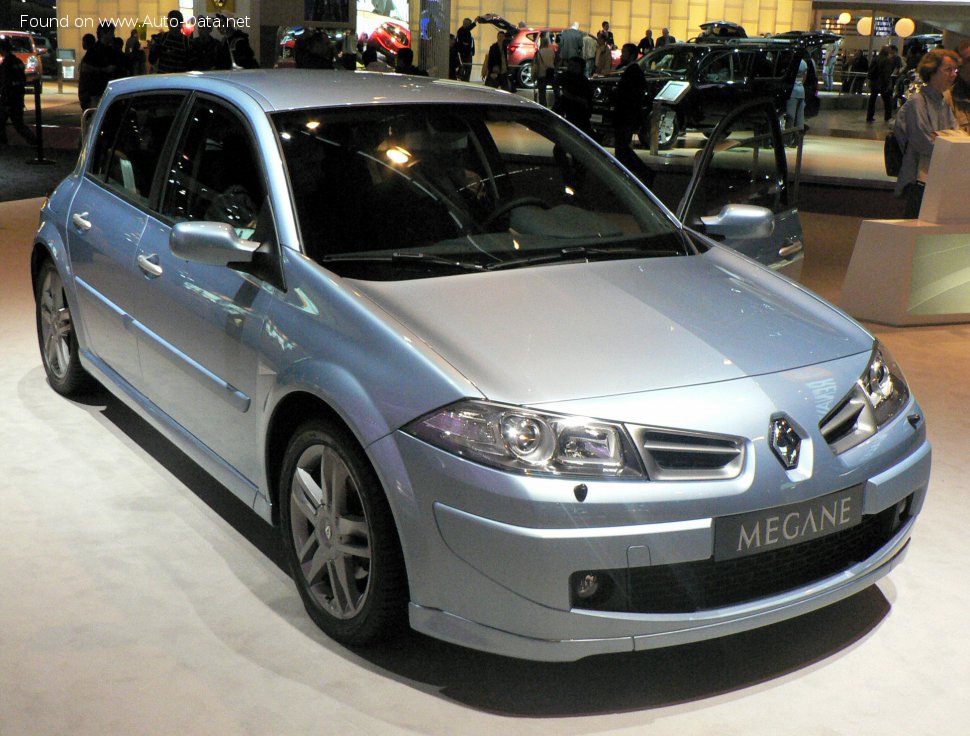
The Renault Megane II, particularly in its Phase II iteration, retained the distinctive and somewhat polarizing design language introduced with the second generation. This specific model, a 5-door hatchback, offered a blend of unique aesthetics and practical functionality. Its bold, angular lines and distinctive “bustle-back” rear design set it apart from its more conventionally styled competitors. The Phase II refresh brought subtle enhancements, including revised headlights, taillights, and interior trim, refining its contemporary appearance.
Measuring 165.71 inches in length, 69.96 inches in width (79.76 inches including mirrors), and 57.4 inches in height, the Megane II hatchback provided a compact footprint ideal for navigating crowded European city streets, while still offering a spacious and comfortable interior. The 103.35-inch wheelbase contributed to a stable ride and generous cabin room for five occupants.
Inside, the Megane II focused on user-friendliness and comfort. The dashboard design was modern for its time, with clear instrumentation and accessible controls. Seating for five adults was standard, and the 5-door hatchback configuration ensured easy access to both front and rear seats. Cargo versatility was a strong suit, with a minimum trunk space of 330 liters (11.65 cubic feet), expandable to a substantial 1190 liters (42.02 cubic feet) with the rear seats folded down, making it suitable for varying family needs.
Safety and driving dynamics were also key considerations. The vehicle featured front-wheel drive, a standard configuration for this segment, providing predictable handling. The suspension system comprised independent McPherson struts at the front and a torsion beam axle at the rear, a common and effective setup for balancing ride comfort and handling. Braking was handled by ventilated discs at the front and solid discs at the rear, augmented by an Anti-lock Braking System (ABS) for enhanced stopping power and control. The electric power steering system offered light and precise steering, aiding maneuverability in urban areas and parking. Standard tire size was 195/65 R15 on 6J x 15-inch wheel rims.
Technical Specifications
| Category | Specification | US/Imperial Conversion |
|---|---|---|
General Information |
||
| Brand | Renault | |
| Model | Megane II (Phase II, 2006) | |
| Type (Engine) | 1.5 dCi (103 Hp) FAP | |
| Start of Production | 2007 | |
| End of Production | 2008 | |
| Powertrain Architecture | Internal Combustion Engine | |
| Body Type | Hatchback | |
| Seats | 5 | |
| Doors | 5 | |
Performance Specs |
||
| Fuel Consumption (Urban) | 6 l/100 km | 39.2 US mpg / 47.1 UK mpg |
| Fuel Consumption (Extra Urban) | 4.3 l/100 km | 54.7 US mpg / 65.7 UK mpg |
| Fuel Consumption (Combined) | 4.8 l/100 km | 49 US mpg / 58.9 UK mpg |
| CO2 Emissions | 128 g/km | |
| Fuel Type | Diesel | |
| Acceleration 0 – 60 mph | 10.5 sec | |
| Acceleration 0 – 100 km/h | 11.1 sec | |
| Maximum Speed | 185 km/h | 114.95 mph |
| Emission Standard | Euro 4 | |
| Weight-to-Power Ratio | 12 kg/Hp | 83.4 Hp/tonne |
| Weight-to-Torque Ratio | 5.1 kg/Nm | 194.3 Nm/tonne |
Engine Specs |
||
| Power | 103 Hp @ 4000 rpm | |
| Power per Liter | 70.5 Hp/l | |
| Torque | 240 Nm @ 2000 rpm | 177.01 lb.-ft. @ 2000 rpm |
| Engine Layout | Front, Transverse | |
| Engine Model/Code | K9K Turbo | |
| Engine Displacement | 1461 cm³ | 1.5 liters / 89.16 cu. in. |
| Number of Cylinders | 4 | |
| Engine Configuration | Inline | |
| Cylinder Bore | 76 mm | 2.99 in. |
| Piston Stroke | 80.5 mm | 3.17 in. |
| Compression Ratio | 18.8:1 | |
| Number of Valves per Cylinder | 2 | |
| Fuel Injection System | Diesel Commonrail | |
| Engine Aspiration | Turbocharger, Intercooler | |
| Engine Oil Capacity | 4.5 l | 4.76 US qt / 3.96 UK qt |
| Coolant Capacity | 6.8 l | 7.19 US qt / 5.98 UK qt |
| Engine Systems | Particulate filter (FAP) | |
Space, Volume and Weights |
||
| Kerb Weight | 1235 kg | 2722.71 lbs. |
| Max. Weight (GVWR) | 1790 kg | 3946.27 lbs. |
| Max Load | 555 kg | 1223.57 lbs. |
| Trunk (Boot) Space – Minimum | 330 l | 11.65 cu. ft. |
| Trunk (Boot) Space – Maximum | 1190 l | 42.02 cu. ft. |
| Fuel Tank Capacity | 60 l | 15.85 US gal / 13.2 UK gal |
| Max. Roof Load | 80 kg | 176.37 lbs. |
| Permitted Trailer Load with Brakes (12%) | 1300 kg | 2866.01 lbs. |
| Permitted Trailer Load without Brakes | 650 kg | 1433 lbs. |
| Permitted Towbar Download | 75 kg | 165.35 lbs. |
Dimensions |
||
| Length | 4209 mm | 165.71 in. |
| Width | 1777 mm | 69.96 in. |
| Width Including Mirrors | 2026 mm | 79.76 in. |
| Height | 1458 mm | 57.4 in. |
| Wheelbase | 2625 mm | 103.35 in. |
| Front Track | 1518 mm | 59.76 in. |
| Rear (Back) Track | 1514 mm | 59.61 in. |
| Front Overhang | 842 mm | 33.15 in. |
| Rear Overhang | 742 mm | 29.21 in. |
| Minimum Turning Circle (Turning Diameter) | 10.5 m | 34.45 ft. |
Drivetrain, Brakes and Suspension Specs |
||
| Drivetrain Architecture | The Internal Combustion Engine (ICE) drives the front wheels of the vehicle. | |
| Drive Wheel | Front Wheel Drive | |
| Number of Gears and Type of Gearbox | 6 gears, Manual Transmission | |
| Front Suspension | Independent type McPherson | |
| Rear Suspension | Torsion | |
| Front Brakes | Ventilated Discs | |
| Rear Brakes | Disc | |
| Assisting Systems | ABS (Anti-lock braking system) | |
| Steering Type | Steering rack and pinion | |
| Power Steering | Electric Steering | |
| Tires Size | 195/65 R15 | |
| Wheel Rims Size | 6J x 15 | |
Legacy and Market Impact
The Renault Megane II, particularly in its Phase II iteration and with the efficient 1.5 dCi engine, carved out a substantial legacy in the European compact car market. Its distinct design, which was initially met with mixed reactions, eventually became a recognizable hallmark, influencing subsequent Renault models and contributing to a period of bold design for the French automaker. The Megane II was a direct competitor to established segment leaders such as the Volkswagen Golf, Ford Focus, Opel Astra (Vauxhall Astra in the UK), and Peugeot 307. In this highly competitive environment, the Megane stood out not only for its styling but also for its strong emphasis on comfort, safety, and, crucially, fuel economy, especially with its diesel offerings.
The 1.5 dCi (103 Hp) FAP variant was particularly significant for its ability to deliver an appealing balance of usable performance and exceptional running costs. For European consumers, where diesel fuel was often cheaper and diesel engines were taxed more favorably, and where long-distance driving was common, the Megane’s impressive fuel efficiency (up to 49 US mpg combined) and low CO2 emissions (128 g/km, meeting Euro 4 standards) made it a highly attractive proposition. The inclusion of the Diesel Particulate Filter (FAP) was a forward-thinking move, demonstrating Renault’s commitment to cleaner diesel technology well before it became a widespread regulatory requirement.
The Megane II also garnered praise for its driving dynamics, offering a comfortable and composed ride suitable for both city driving and extended highway journeys. Its practical hatchback body style, generous interior space, and versatile cargo capacity solidified its reputation as a capable family car. The 6-speed manual transmission, a common feature in European compacts, provided engaging control and further contributed to the car’s efficiency.
In terms of historical significance, the Megane II’s design represented a departure from conservative styling, signaling Renault’s intent to innovate and differentiate. Its success helped reinforce Renault’s position as a major player in the European automotive landscape. While the specific 1.5 dCi FAP model had a relatively short production run of two years (2007-2008) before the introduction of the third-generation Megane, it was a finely tuned and environmentally conscious offering that perfectly met the needs of its target market during its time. Its combination of distinctive design, practical features, and a highly efficient diesel powertrain left a lasting impression on the compact segment and remains a testament to Renault’s engineering capabilities.