The Renault Megane II (Phase II, 2006): A European Compact with Distinctive Flair
The Renault Megane II (Phase II, 2006) represents a significant chapter in the history of the French automaker’s compact car lineup. Launched in 2002, the second-generation Megane quickly garnered attention for its unconventional design, particularly its distinctive “bustle-back” rear end on the hatchback models, a bold departure from the typically conservative C-segment. The Phase II, introduced in 2006, served as a mid-cycle refresh, refining the aesthetics and mechanicals to keep it competitive in the fiercely contested European market until its discontinuation in 2008.
While the Renault Megane was not officially sold in the United States, it was a cornerstone of Renault’s offerings across Europe, Asia, and other international markets. It competed directly with stalwarts like the Volkswagen Golf, Ford Focus, and Opel Astra, aiming to differentiate itself through innovative design, a strong emphasis on safety, and a comfortable, user-friendly driving experience. The specific variant under review, the 2.0 16V (135 Hp) Automatic, offered a blend of decent performance and the convenience of an automatic transmission, catering to a broad segment of drivers seeking a capable daily driver.
Engine & Performance: The 2.0 16V Powertrain in the Renault Megane II (Phase II, 2006)
At the heart of this particular Renault Megane II (Phase II, 2006) variant is Renault’s F4R engine, a naturally aspirated 2.0-liter (1998 cm³ or 121.93 cu. in.) inline-four cylinder unit. This engine, known for its robust design and widespread use across various Renault and Nissan models, features a DOHC (Double Overhead Camshaft) valvetrain with four valves per cylinder, totaling 16 valves. It delivers a respectable 135 horsepower (Hp) at 5500 rpm and generates 140.87 lb-ft (191 Nm) of torque at 3750 rpm. With a compression ratio of 9.8:1 and multi-port manifold injection, the engine was designed for a balance of efficiency and responsiveness in everyday driving conditions.
Power is directed to the front wheels via a 4-speed automatic transmission. While a 4-speed automatic might seem modest by today’s standards, it was a common and reliable choice for compact cars in the mid-2000s, prioritizing smooth shifts and ease of use over outright performance or cutting-edge efficiency. This powertrain configuration allowed the Megane II to accelerate from 0 to 60 mph in a reasonable 10.4 seconds, with a top speed of 120.55 mph (194 km/h). Fuel economy figures were competitive for its era: 19.9 US mpg (11.8 l/100 km) in urban driving, 36.2 US mpg (6.5 l/100 km) on the highway, and a combined average of 28 US mpg (8.4 l/100 km). The vehicle met Euro 4 emission standards, with CO2 emissions rated at 201 g/km.
Design & Features: A Bold Statement in the Compact Segment
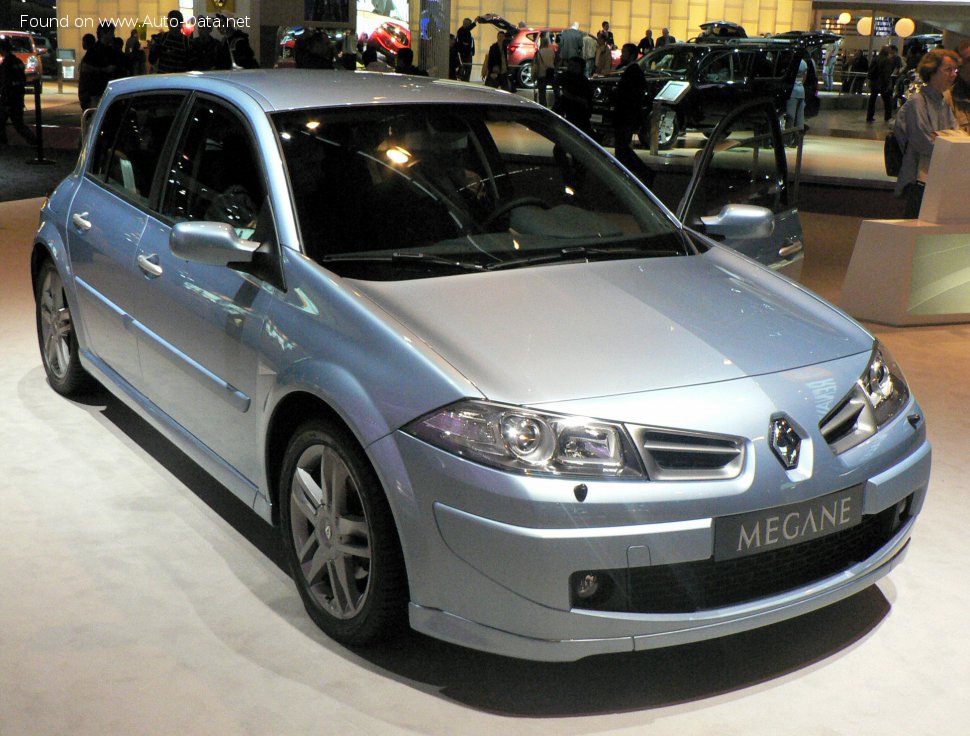
The Renault Megane II (Phase II, 2006) hatchback retained the distinctive styling that made the second generation a standout. Its design, characterized by sharp lines, a prominent grille, and the aforementioned “bustle-back” rear, was a product of Renault’s ambitious design philosophy under Patrick le Quément. The five-door hatchback body type offered practical access for five occupants, making it a versatile choice for families and individuals alike. With a length of 165.71 inches (4209 mm), a width of 69.96 inches (1777 mm), and a height of 57.4 inches (1458 mm), it occupied a typical footprint for its segment.
Inside, the Megane II was known for its comfortable cabin, often featuring soft-touch materials and a driver-centric layout. While specific trim levels varied by market, common features for the Phase II included electric power steering, which contributed to an agile turning circle of 34.45 feet (10.5 m), and a suite of safety technologies. Renault had made safety a cornerstone of its brand identity, and the Megane II was no exception, achieving high ratings in European crash tests. Standard safety equipment typically included ABS (Anti-lock Braking System), and depending on the market and trim, could extend to multiple airbags and electronic stability control (ESC). The car rode on 205/55 R16 tires wrapped around 6.5J x 16-inch wheel rims, providing a comfortable and stable ride. Practicality was further enhanced by a generous trunk space ranging from 11.65 cu. ft. (330 liters) to a maximum of 42.02 cu. ft. (1190 liters) with the rear seats folded, catering to varying cargo needs.
Technical Specifications for the Renault Megane II (Phase II, 2006) 2.0 16V (135 Hp) Automatic
| Category | Specification | US Equivalent (where applicable) |
|---|---|---|
| General Information | ||
| Brand | Renault | |
| Model | Megane | |
| Generation | Megane II (Phase II, 2006) | |
| Type (Engine) | 2.0 16V (135 Hp) Automatic | |
| Start of production | 2006 year | |
| End of production | 2008 year | |
| Powertrain Architecture | Internal Combustion engine | |
| Body type | Hatchback | |
| Seats | 5 | |
| Doors | 5 | |
| Performance Specs | ||
| Fuel consumption (economy) – urban | 11.8 l/100 km | 19.9 US mpg |
| Fuel consumption (economy) – extra urban | 6.5 l/100 km | 36.2 US mpg |
| Fuel consumption (economy) – combined | 8.4 l/100 km | 28 US mpg |
| CO2 emissions | 201 g/km | |
| Fuel Type | Petrol (Gasoline) | |
| Acceleration 0 – 60 mph | 10.4 sec | |
| Acceleration 0 – 100 km/h | 10.9 sec | |
| Maximum speed | 194 km/h | 120.55 mph |
| Emission standard | Euro 4 | |
| Weight-to-power ratio | 9.4 kg/Hp | 106.7 Hp/tonne |
| Weight-to-torque ratio | 6.6 kg/Nm | 151 Nm/tonne |
| Engine Specs | ||
| Power | 135 Hp @ 5500 rpm | |
| Power per liter | 67.6 Hp/l | |
| Torque | 191 Nm @ 3750 rpm | 140.87 lb.-ft. @ 3750 rpm |
| Engine layout | Front, Transverse | |
| Engine Model/Code | F4R | |
| Engine displacement | 1998 cm³ | 121.93 cu. in. |
| Number of cylinders | 4 | |
| Engine configuration | Inline | |
| Cylinder Bore | 82.7 mm | 3.26 in. |
| Piston Stroke | 93 mm | 3.66 in. |
| Compression ratio | 9.8:1 | |
| Number of valves per cylinder | 4 | |
| Fuel injection system | Multi-port manifold injection | |
| Engine aspiration | Naturally aspirated engine | |
| Valvetrain | DOHC | |
| Engine oil capacity | 5.4 l | 5.71 US qt |
| Coolant | 6.5 l | 6.87 US qt |
| Space, Volume and Weights | ||
| Kerb Weight | 1265 kg | 2788.85 lbs. |
| Max. weight | 1805 kg | 3979.34 lbs. |
| Max load | 540 kg | 1190.5 lbs. |
| Trunk (boot) space – minimum | 330 l | 11.65 cu. ft. |
| Trunk (boot) space – maximum | 1190 l | 42.02 cu. ft. |
| Fuel tank capacity | 60 l | 15.85 US gal |
| Max. roof load | 80 kg | 176.37 lbs. |
| Permitted trailer load with brakes (12%) | 1300 kg | 2866.01 lbs. |
| Permitted trailer load without brakes | 650 kg | 1433 lbs. |
| Permitted towbar download | 75 kg | 165.35 lbs. |
| Dimensions | ||
| Length | 4209 mm | 165.71 in. |
| Width | 1777 mm | 69.96 in. |
| Width including mirrors | 2026 mm | 79.76 in. |
| Height | 1458 mm | 57.4 in. |
| Wheelbase | 2625 mm | 103.35 in. |
| Front track | 1518 mm | 59.76 in. |
| Rear (Back) track | 1514 mm | 59.61 in. |
| Front overhang | 842 mm | 33.15 in. |
| Rear overhang | 742 mm | 29.21 in. |
| Minimum turning circle (turning diameter) | 10.5 m | 34.45 ft. |
| Drivetrain, Brakes and Suspension Specs | ||
| Drivetrain Architecture | The Internal combustion engine (ICE) drives the front wheels of the vehicle. | |
| Drive wheel | Front wheel drive | |
| Number of gears and type of gearbox | 4 gears, automatic transmission | |
| Front suspension | Independent type McPherson | |
| Rear suspension | Torsion | |
| Front brakes | Ventilated discs | |
| Rear brakes | Disc | |
| Assisting systems | ABS (Anti-lock braking system) | |
| Steering type | Steering rack and pinion | |
| Power steering | Electric Steering | |
| Tires size | 205/55 R16 | |
| Wheel rims size | 6.5J x 16 | |
Legacy & Market Impact: The Renault Megane II’s Place in Automotive History
The Renault Megane II, including the Phase II update from 2006, left a significant mark on the European compact car segment. Its audacious design, particularly the distinctive rear styling, was initially polarizing but ultimately helped the Megane stand out in a crowded market. This bold aesthetic choice underscored Renault’s commitment to design innovation, a characteristic that became synonymous with the brand during this era. The Megane II’s success was not solely based on looks; it also built a strong reputation for safety, consistently achieving top ratings in Euro NCAP crash tests, which was a major selling point for European consumers.
In its primary markets, the Renault Megane II (Phase II, 2006) competed fiercely against established rivals. The Volkswagen Golf, with its conservative but universally appealing design and strong build quality, represented a benchmark. The Ford Focus offered dynamic handling and a more conventional aesthetic. Opel (Vauxhall in the UK) Astra was another direct competitor, offering a solid all-rounder package. Against these formidable opponents, the Megane II carved out its niche by offering a compelling blend of avant-garde styling, a comfortable and well-appointed interior, and a strong emphasis on passive and active safety features.
The 2.0 16V Automatic variant, while not the sportiest in the lineup, provided a smooth and effortless driving experience, appealing to those who prioritized comfort and convenience in city traffic and on longer journeys. Its naturally aspirated engine, paired with a reliable automatic transmission, delivered predictable power delivery and adequate performance for most daily driving scenarios. The Megane II’s overall package contributed to Renault’s strong market share in Europe during its production run, solidifying its position as a key player in the C-segment. Even after its replacement by the Megane III in 2008, the second-generation model is remembered for its distinctive character and its contribution to pushing design boundaries in mainstream automotive manufacturing.