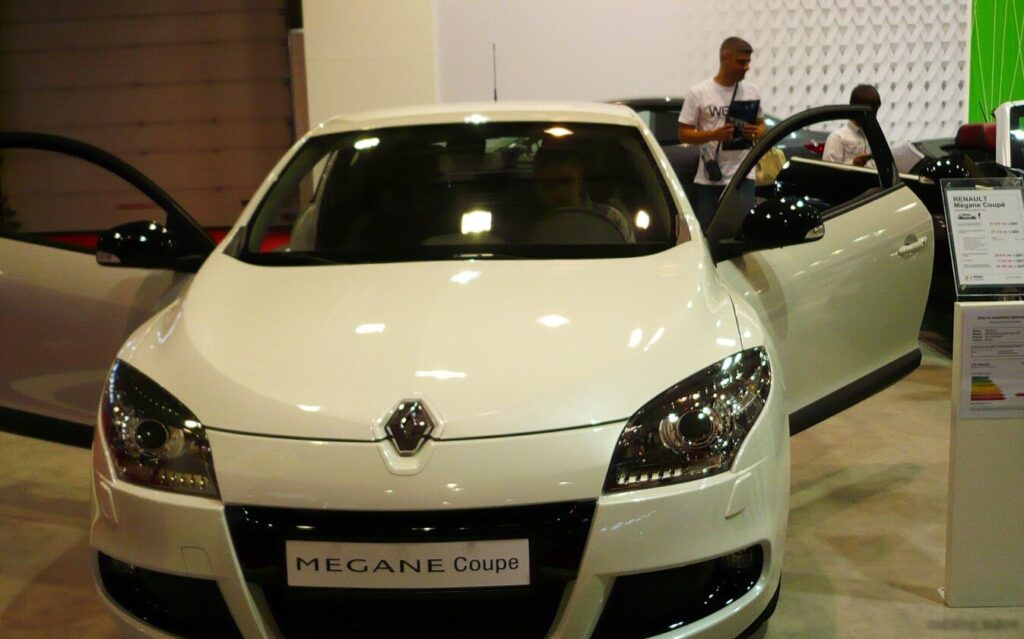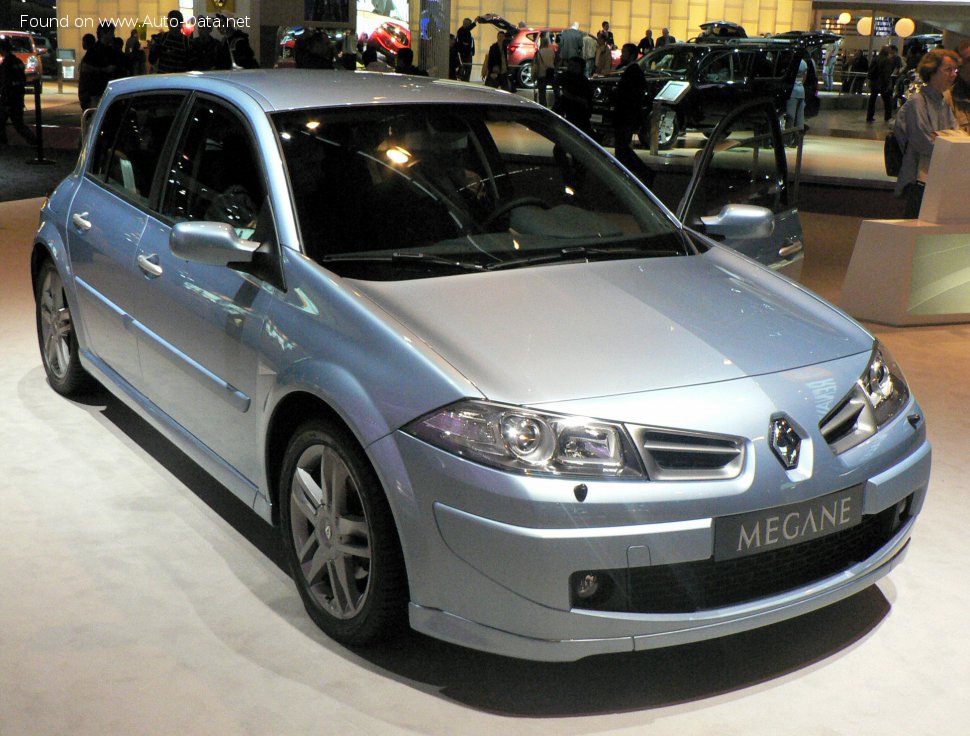
The Renault Megane II Phase II RS 2.0 dCi (173 Hp) FAP is a performance-oriented hatchback produced by the French automaker Renault between 2007 and 2008. This model, while not officially sold in the United States, represented a significant offering in the European compact car market, blending diesel efficiency with sporty characteristics. It was positioned as a competitor to models like the Volkswagen Golf GTD and Ford Focus ST, appealing to drivers seeking a balance between fuel economy and engaging driving dynamics. The “RS” designation signifies Renault Sport, the company’s performance division, indicating enhancements to the standard Megane II.
Renault Megane II RS 2.0 dCi: Overview
The Megane II, launched in 2003, was a crucial model for Renault, representing a step up in quality and design compared to its predecessor. The Phase II update in 2006 brought styling revisions and technological improvements. The RS 2.0 dCi variant, introduced shortly after, aimed to capitalize on the growing demand for diesel-powered performance cars in Europe. The inclusion of a Diesel Particulate Filter (FAP) demonstrated Renault’s commitment to meeting increasingly stringent emissions regulations. This vehicle offered a unique proposition – a relatively economical diesel engine delivering respectable power and torque in a practical, five-door hatchback body style.
Engine & Performance
The heart of the Megane II RS 2.0 dCi is a 2.0-liter inline-four cylinder diesel engine, designated M9R Turbo. This engine produces 173 horsepower at 3750 rpm and a substantial 360 Nm (265.52 lb.-ft.) of torque at 2000 rpm. The engine utilizes a diesel commonrail fuel injection system and a turbocharger with an intercooler to maximize power and efficiency. This configuration allows for strong acceleration, with a 0-100 km/h (0-62 mph) time of 8.5 seconds and a 0-60 mph time of 8.1 seconds. The engine’s relatively high compression ratio of 16:1 contributes to its efficiency. The powertrain is coupled with a six-speed manual transmission, providing drivers with precise control over gear selection. The front-wheel-drive layout, while common for this class of vehicle, is managed effectively by the chassis tuning to minimize torque steer.
Design & Features
The Renault Megane II RS 2.0 dCi is a five-door hatchback, offering a practical and versatile body style. Its design, while not overtly aggressive, incorporates subtle sporty cues, such as a slightly lower ride height and unique alloy wheel options (17 or 18-inch). Inside, the cabin features a functional layout with seating for five passengers. The focus is on practicality and usability, with a trunk space ranging from 330 liters (11.65 cu. ft.) with the rear seats up to 1190 liters (42.02 cu. ft.) with them folded down. Safety features for the era included ABS (Anti-lock Braking System) and a robust chassis design. The car’s dimensions are 4228 mm (166.46 in) in length, 1777 mm (69.96 in) in width, and 1436 mm (56.54 in) in height. The electric power steering provides a responsive and precise driving experience.
Technical Specifications
| Brand | Renault |
| Model | Megane |
| Generation | Megane II (Phase II, 2006) |
| Type (Engine) | RS 2.0 dCi (173 Hp) FAP |
| Start of production | 2007 |
| End of production | 2008 |
| Powertrain Architecture | Internal Combustion engine |
| Body type | Hatchback |
| Seats | 5 |
| Doors | 5 |
| Fuel consumption (urban) | 8.2 l/100 km (28.7 US mpg, 34.4 UK mpg, 12.2 km/l) |
| Fuel consumption (extra urban) | 5.6 l/100 km (42 US mpg, 50.4 UK mpg, 17.9 km/l) |
| Fuel consumption (combined) | 6.5 l/100 km (36.2 US mpg, 43.5 UK mpg, 15.4 km/l) |
| CO2 emissions | 172 g/km |
| Fuel Type | Diesel |
| Acceleration 0 – 100 km/h | 8.5 sec |
| Acceleration 0 – 62 mph | 8.5 sec |
| Acceleration 0 – 60 mph | 8.1 sec |
| Maximum speed | 220 km/h (136.7 mph) |
| Emission standard | Euro 4 |
| Weight-to-power ratio | 8.4 kg/Hp, 119.3 Hp/tonne |
| Weight-to-torque ratio | 4 kg/Nm, 248.3 Nm/tonne |
| Power | 173 Hp @ 3750 rpm |
| Power per litre | 86.7 Hp/l |
| Torque | 360 Nm @ 2000 rpm (265.52 lb.-ft. @ 2000 rpm) |
| Engine layout | Front, Transverse |
| Engine Model/Code | M9R Turbo |
| Engine displacement | 1995 cm3 (121.74 cu. in.) |
| Number of cylinders | 4 |
| Engine configuration | Inline |
| Cylinder Bore | 84 mm (3.31 in.) |
| Piston Stroke | 90 mm (3.54 in.) |
| Compression ratio | 16:1 |
| Number of valves per cylinder | 4 |
| Fuel injection system | Diesel Commonrail |
| Engine aspiration | Turbocharger, Intercooler |
| Engine oil capacity | 6.6 l (6.97 US qt | 5.81 UK qt) |
| Coolant | 7.5 l (7.93 US qt | 6.6 UK qt) |
| Kerb Weight | 1450 kg (3196.7 lbs.) |
| Max. weight | 1895 kg (4177.76 lbs.) |
| Max load | 445 kg (981.06 lbs.) |
| Trunk (boot) space – minimum | 330 l (11.65 cu. ft.) |
| Trunk (boot) space – maximum | 1190 l (42.02 cu. ft.) |
| Fuel tank capacity | 60 l (15.85 US gal | 13.2 UK gal) |
| Max. roof load | 80 kg (176.37 lbs.) |
| Permitted trailer load with brakes (12%) | 1000 kg (2204.62 lbs.) |
| Permitted trailer load without brakes | 650 kg (1433 lbs.) |
| Permitted towbar download | 75 kg (165.35 lbs.) |
| Length | 4228 mm (166.46 in.) |
| Width | 1777 mm (69.96 in.) |
| Width including mirrors | 2026 mm (79.76 in.) |
| Height | 1436 mm (56.54 in.) |
| Wheelbase | 2617 mm (103.03 in.) |
| Front track | 1517 mm (59.72 in.) |
| Rear (Back) track | 1521 mm (59.88 in.) |
| Front overhang | 857 mm (33.74 in.) |
| Rear overhang | 754 mm (29.69 in.) |
| Drivetrain Architecture | Front wheel drive |
| Number of gears and type of gearbox | 6 gears, manual transmission |
| Front suspension | Independent type McPherson, Transverse stabilizer |
| Rear suspension | Torsion |
| Front brakes | Ventilated discs, 312 mm |
| Rear brakes | Disc, 300 mm |
| Tires size | 225/45 R17; 225/40 R18 |
| Wheel rims size | 17; 18 |
The Renault Megane II RS 2.0 dCi (173 Hp) FAP, while a relatively short-lived model, offered a compelling package for European drivers seeking a blend of performance, efficiency, and practicality. It showcased Renault’s ability to deliver engaging driving experiences even within the constraints of diesel technology and emissions regulations.