Introduction to the Renault Megane III 1.4 TCe (130 Hp)
The Renault Megane III, launched in 2008, represented the third generation of Renault’s popular compact car, a cornerstone model for the French automaker in the highly competitive European C-segment. Produced from 2009 to 2012 in its specific 1.4 TCe (130 Hp) iteration, this model aimed to build on the success of its predecessors by offering a blend of modern design, enhanced technology, and improved driving dynamics. While the Megane line has never been officially sold in the United States, it has consistently been a top seller across Europe and other international markets, competing fiercely with established rivals like the Volkswagen Golf, Ford Focus, and Opel Astra. The Renault Megane III 1.4 TCe (130 Hp), specifically, was a key offering, providing a compelling balance of performance and fuel efficiency for the average European consumer seeking a versatile and practical five-door hatchback.
This generation of the Megane marked a departure from the more polarizing styling of the Megane II, adopting a more conventional yet sophisticated aesthetic. Renault focused on refining the driving experience, interior quality, and overall perceived value. The 1.4 TCe (Turbo Control efficiency) engine variant was particularly significant as it introduced downsized, turbocharged gasoline technology to the Megane lineup, a trend that would become pervasive across the automotive industry. This engine allowed for smaller displacement while still delivering robust power and torque figures, catering to both urban commuters and those requiring sufficient highway performance.
Engine and Performance of the Renault Megane III 1.4 TCe (130 Hp)
At the heart of the Renault Megane III 1.4 TCe (130 Hp) lies the H4J 700 engine, a modern 1.4-liter (1397 cm³, or 85.25 cubic inches) inline four-cylinder gasoline unit. This engine was a testament to the growing trend of engine downsizing, utilizing a turbocharger and intercooler to punch above its weight class. It produced a respectable 130 horsepower at 5500 rpm, translating to a power-per-liter output of 93.1 horsepower per liter, an impressive figure for its time. More critically for everyday driving, the engine delivered a strong 140.14 lb-ft (190 Nm) of torque, peaking at a relatively low 2250 rpm. This broad torque band ensured responsive acceleration and reduced the need for frequent gear changes, enhancing the driving experience in varied conditions.
Power was routed to the front wheels via a smooth-shifting 6-speed manual transmission, offering drivers precise control over the engine’s output. This powertrain combination allowed the Megane III 1.4 TCe to accelerate from 0 to 60 mph in a brisk 9.1 seconds (0-100 km/h in 9.6 seconds), with a top speed of 124.27 mph (200 km/h). These performance figures positioned it competitively within its segment, offering a sporty feel without sacrificing practicality.
Fuel efficiency was another strong suit for this engine. The combined fuel consumption was rated at 37.3 US mpg (6.3 l/100 km), with urban consumption at 28 US mpg (8.4 l/100 km) and extra-urban at 46.1 US mpg (5.1 l/100 km). These figures, alongside CO2 emissions of 145 g/km, allowed the vehicle to meet Euro 5 emission standards, reflecting Renault’s commitment to environmental responsibility during its production run. The engine’s architecture featured a DOHC (Double Overhead Camshaft) valvetrain with four valves per cylinder and a multi-port manifold injection system, all contributing to its efficiency and performance.
Design and Features
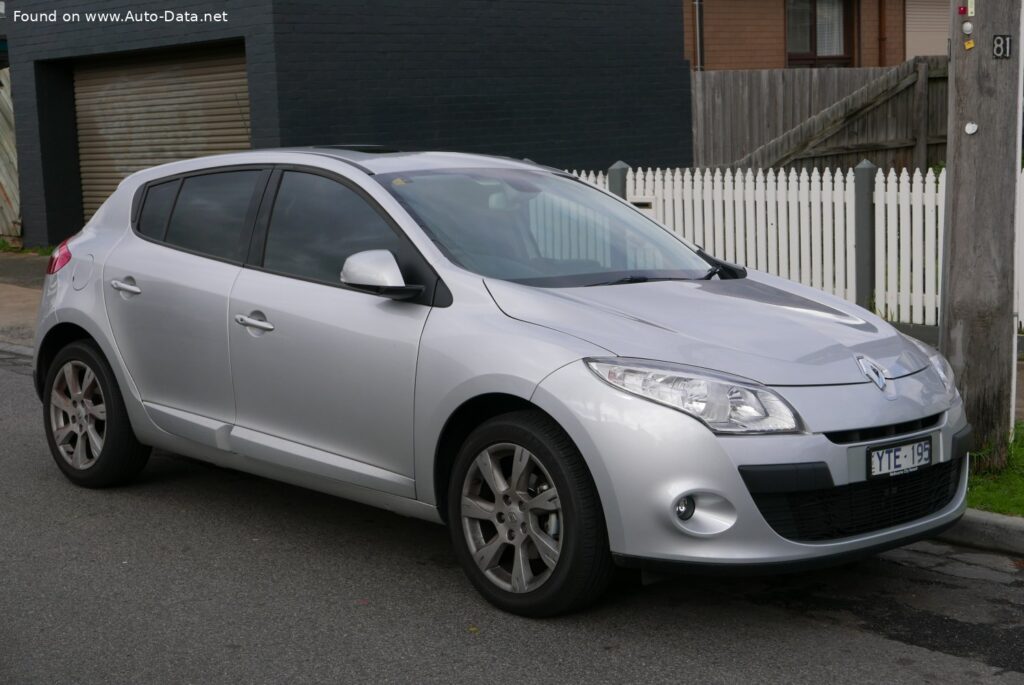
The Renault Megane III hatchback, produced from 2009 to 2012, showcased a more refined and universally appealing design compared to its predecessor. Its five-door hatchback body type offered a practical and aesthetically pleasing solution for European families and individuals. Measuring 169.09 inches (4295 mm) in length, 71.18 inches (1808 mm) in width (80.2 inches or 2037 mm including mirrors), and 57.91 inches (1471 mm) in height, the Megane III struck a balanced stance on the road. The 103.98-inch (2641 mm) wheelbase contributed to stable handling and a comfortable ride.
Inside, the Megane III was designed to be spacious and user-friendly, accommodating five occupants comfortably. The trunk space was generous for its class, offering 14.3 cubic feet (405 liters) with the rear seats up, expandable to an impressive 41.04 cubic feet (1162 liters) when the rear seats were folded down. This flexibility made it highly suitable for diverse needs, from daily commuting to weekend trips. The interior materials and finish were generally considered an improvement over previous generations, reflecting a push towards a more premium feel within the compact segment.
Key features for the era included power steering, an electric steering system for ease of maneuverability, and a robust braking system comprising ventilated discs at the front and disc brakes at the rear, complemented by an Anti-lock Braking System (ABS) for enhanced safety. The suspension setup featured an independent McPherson type at the front and a torsion beam at the rear, a common and effective configuration for front-wheel-drive compact cars, offering a good balance between comfort and handling. Standard tires were sized 195/65 R15 on 6.5J x 15 wheel rims, providing a comfortable ride and adequate grip.
Technical Specifications
| Category | Specification | Value (US/Imperial) |
|---|---|---|
General Information |
||
| Brand | Renault | – |
| Model | Megane | – |
| Generation | Megane III | – |
| Type (Engine) | 1.4 TCe (130 Hp) | – |
| Start of Production | 2009 | – |
| End of Production | 2012 | – |
| Powertrain Architecture | Internal Combustion Engine | – |
| Body Type | Hatchback | – |
| Seats | 5 | – |
| Doors | 5 | – |
Performance Specs |
||
| Fuel Consumption (Urban) | 8.4 l/100 km | 28 US mpg |
| Fuel Consumption (Extra Urban) | 5.1 l/100 km | 46.1 US mpg |
| Fuel Consumption (Combined) | 6.3 l/100 km | 37.3 US mpg |
| CO2 Emissions | 145 g/km | – |
| Fuel Type | Petrol (Gasoline) | – |
| Acceleration 0 – 60 mph | 9.1 sec | – |
| Maximum Speed | 200 km/h | 124.27 mph |
| Emission Standard | Euro 5 | – |
| Weight-to-Power Ratio | 9.3 kg/Hp | 107.9 Hp/tonne |
| Weight-to-Torque Ratio | 6.3 kg/Nm | 157.7 Nm/tonne |
Engine Specs |
||
| Power | 130 Hp @ 5500 rpm | – |
| Power per Liter | 93.1 Hp/l | – |
| Torque | 190 Nm @ 2250 rpm | 140.14 lb-ft @ 2250 rpm |
| Engine Layout | Front, Transverse | – |
| Engine Model/Code | H4J 700 | – |
| Engine Displacement | 1397 cm³ | 1.4 Liters / 85.25 cu. in. |
| Number of Cylinders | 4 | – |
| Engine Configuration | Inline | – |
| Cylinder Bore | 78 mm | 3.07 in. |
| Piston Stroke | 73.1 mm | 2.88 in. |
| Compression Ratio | 9.1:1 | – |
| Valves per Cylinder | 4 | – |
| Fuel Injection System | Multi-port manifold injection | – |
| Engine Aspiration | Turbocharger, Intercooler | – |
| Valvetrain | DOHC | – |
| Engine Oil Capacity | 4.5 l | 4.76 US qt |
| Coolant Capacity | 6.5 l | 6.87 US qt |
Space, Volume and Weights |
||
| Kerb Weight | 1205 kg | 2656.57 lbs. |
| Max. Weight | 1781 kg | 3926.43 lbs. |
| Max Load | 576 kg | 1269.86 lbs. |
| Trunk Space (Min) | 405 l | 14.3 cu. ft. |
| Trunk Space (Max) | 1162 l | 41.04 cu. ft. |
| Fuel Tank Capacity | 60 l | 15.85 US gal |
| Permitted Trailer Load (with brakes) | 1300 kg | 2866.01 lbs. |
| Permitted Trailer Load (without brakes) | 635 kg | 1399.94 lbs. |
Dimensions |
||
| Length | 4295 mm | 169.09 in. |
| Width | 1808 mm | 71.18 in. |
| Width (incl. mirrors) | 2037 mm | 80.2 in. |
| Height | 1471 mm | 57.91 in. |
| Wheelbase | 2641 mm | 103.98 in. |
| Front Track | 1546 mm | 60.87 in. |
| Rear Track | 1547 mm | 60.91 in. |
| Front Overhang | 862 mm | 33.94 in. |
| Rear Overhang | 792 mm | 31.18 in. |
| Ride Height (Ground Clearance) | 120 mm | 4.72 in. |
| Minimum Turning Circle | 10.95 m | 35.93 ft. |
Drivetrain, Brakes and Suspension Specs |
||
| Drivetrain Architecture | Internal combustion engine drives front wheels | – |
| Drive Wheel | Front wheel drive | – |
| Number of Gears | 6 | – |
| Type of Gearbox | Manual transmission | – |
| Front Suspension | Independent type McPherson | – |
| Rear Suspension | Torsion | – |
| Front Brakes | Ventilated discs | – |
| Rear Brakes | Disc | – |
| Assisting Systems | ABS (Anti-lock braking system) | – |
| Steering Type | Steering rack and pinion | – |
| Power Steering | Electric Steering | – |
| Tires Size | 195/65 R15 | – |
| Wheel Rims Size | 6.5J x 15 | – |
Legacy and Market Impact
The Renault Megane III, particularly the 1.4 TCe (130 Hp) variant, played a crucial role in Renault’s strategy for the highly competitive European compact segment. Its production run from 2009 to 2012 saw it go head-to-head with formidable competitors such as the perennial best-seller Volkswagen Golf, the dynamic Ford Focus, the stylish Peugeot 308, and the robust Opel Astra. In this crowded market, the Megane III carved out its niche by offering a compelling combination of comfort, practicality, and a distinctive French flair. While perhaps not as overtly sporty as some rivals, it was widely praised for its compliant ride quality and comfortable interior, making it an excellent choice for long-distance cruising and daily commuting alike.
The introduction of the 1.4 TCe engine was a forward-thinking move by Renault, anticipating the industry’s shift towards smaller, more efficient turbocharged gasoline engines. This engine offered a significant performance boost over naturally aspirated alternatives of similar displacement while maintaining competitive fuel economy, a crucial factor for European consumers facing high fuel prices and stringent emissions regulations. Its Euro 5 compliance highlighted Renault’s commitment to environmental standards, further enhancing its appeal.
Over its lifespan, the Megane III garnered a reputation for reliability and solid build quality, improving upon some of the perceived shortcomings of earlier Renault models. Its conservative yet elegant design, spacious interior, and practical hatchback configuration ensured its enduring popularity. Although never officially imported into the United States, the Megane III series, including the 1.4 TCe (130 Hp) model, was a significant success story for Renault globally, demonstrating the brand’s ability to produce a well-rounded and competitive compact car. Its legacy is one of a sensible, comfortable, and technologically relevant vehicle that successfully navigated the demands of its era and market.