Renault Megane III 1.5 dCi (110 Hp) FAP: A European Compact Standard
The Renault Megane III, launched in 2008, represented a significant evolution for the French automaker’s compact car offering. Following the somewhat polarizing design of its predecessor, the Megane III adopted a more conventional yet sophisticated aesthetic, aiming for broader appeal in the fiercely competitive European C-segment. This generation, produced until 2012, was a cornerstone of Renault’s lineup, providing a practical, efficient, and comfortable option for families and commuters alike. The specific variant, the Renault Megane III 1.5 dCi (110 Hp) FAP, embodied the era’s strong emphasis on diesel efficiency and lower emissions, a critical factor in the European automotive landscape. As a model primarily sold in Europe and other international markets, it showcased Renault’s engineering prowess in creating a well-rounded vehicle tailored to regional demands, prioritizing fuel economy and compliance with stringent environmental regulations.
Engine & Performance: The Efficient Diesel Heart of the Megane III 1.5 dCi (110 Hp) FAP
At the core of the Renault Megane III 1.5 dCi (110 Hp) FAP lies Renault’s venerable K9K 836 engine, a 1.5-liter (1461 cm3 or 89.16 cu. in.) inline four-cylinder diesel unit. This powertrain was engineered for a blend of usable power and exceptional fuel efficiency, a hallmark of diesel engines in the European market. It delivers a respectable 110 horsepower at 4000 rpm, providing ample thrust for daily driving and highway cruising. More importantly for a diesel, the engine produces a robust 240 Nm (177.01 lb.-ft.) of torque, available from a low 1750 rpm. This low-end torque is crucial for responsive acceleration and effortless overtaking, particularly when the car is loaded or climbing inclines.
The engine’s architecture features a front, transverse layout and utilizes a Diesel Commonrail fuel injection system, ensuring precise fuel delivery for optimal combustion. Further enhancing its performance and efficiency is a turbocharger coupled with an intercooler, which significantly boosts power output and response across the rev range. With a compression ratio of 15.2:1 and two valves per cylinder, this engine was designed for durability and efficiency. Power is channeled to the front wheels via a smooth-shifting 6-speed manual transmission, offering drivers direct control and aiding in maximizing fuel economy.
Performance figures underscore its practical orientation: the Megane III 1.5 dCi accelerates from 0 to 60 mph in a calculated 11.7 seconds (0-100 km/h in 12.3 seconds) and can reach a top speed of 118.06 mph (190 km/h). However, its true strength lies in its fuel economy. The combined cycle consumption is an impressive 4.1 liters per 100 kilometers, translating to approximately 57.4 US mpg. In extra-urban driving, this figure climbs to an astounding 3.5 l/100 km (67.2 US mpg), while urban driving still yields a respectable 4.9 l/100 km (48 US mpg). Coupled with a 60-liter (15.85 US gallon) fuel tank, the Megane III 1.5 dCi offers an excellent driving range, a significant advantage for long-distance European travel. The inclusion of a Diesel Particulate Filter (FAP) and compliance with Euro 5 emission standards, with CO2 emissions of just 106 g/km, highlighted Renault’s commitment to environmental responsibility during its production run.
Design & Features: Practicality Meets Refinement
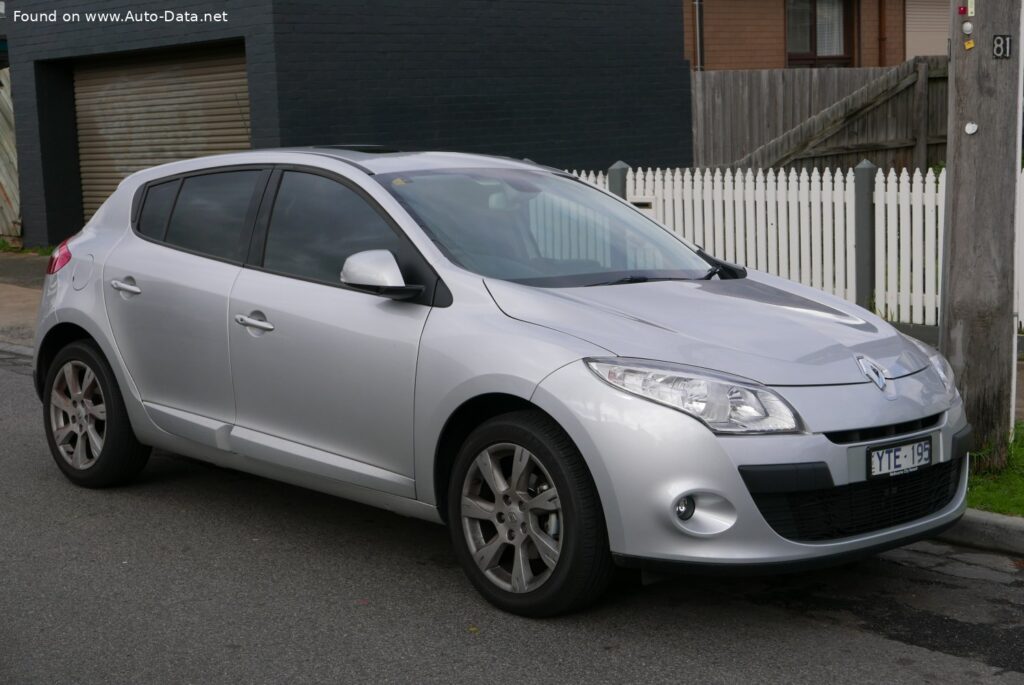
The Renault Megane III adopted a design language that moved away from the distinctive, often controversial styling of its predecessor, opting for a more universally appealing and fluid aesthetic. As a 5-door hatchback, it offered a practical and versatile body type, perfectly suited for the demands of European families and urban dwellers. Its dimensions—169.09 inches (4295 mm) in length, 71.18 inches (1808 mm) in width (80.2 inches or 2037 mm including mirrors), and 57.91 inches (1471 mm) in height—positioned it squarely within the compact segment, making it maneuverable in city environments while providing a comfortable cabin.
The interior of the Megane III was designed with ergonomics and comfort in mind, offering seating for five occupants. The trunk (boot) space was generous for its class, ranging from 14.3 cu. ft. (405 liters) with the rear seats up, expanding to a substantial 41.04 cu. ft. (1162 liters) when the rear seats were folded down, providing ample cargo capacity for groceries, luggage, or larger items. The design also featured a thoughtful approach to storage and passenger comfort, essential for a family-oriented vehicle.
Underneath its skin, the Megane III featured a robust chassis designed for a balanced ride and handling. The front suspension utilized an independent McPherson type setup, known for its ability to provide a comfortable ride and precise steering. At the rear, a torsion beam suspension offered a good compromise between packaging efficiency, cost-effectiveness, and dynamic stability. The steering system was a power-assisted electric rack and pinion, contributing to lighter steering effort at low speeds and improved feedback at higher velocities. Safety features for the era included an Anti-lock Braking System (ABS) as standard, complementing the ventilated disc brakes at the front and solid disc brakes at the rear, ensuring confident stopping power. The vehicle typically rode on 205/60 R16 92H or 205/55 R17 91H tires, mounted on 6.5J x 16 or 6.5J x 17 wheel rims, respectively, providing a good balance of grip and ride comfort.
Technical Specifications: Renault Megane III 1.5 dCi (110 Hp) FAP
| Category | Specification | Value (Metric) | Value (US/Imperial) |
|---|---|---|---|
| General Information | |||
| Brand | Renault | ||
| Model | Megane | ||
| Generation | Megane III | ||
| Type (Engine) | 1.5 dCi (110 Hp) FAP | ||
| Production Start | 2008 | ||
| Production End | 2012 | ||
| Powertrain Architecture | Internal Combustion Engine | ||
| Body type | Hatchback | ||
| Seats | 5 | ||
| Doors | 5 | ||
| Performance Specifications | |||
| Fuel consumption (urban) | 4.9 l/100 km | 48 US mpg | |
| Fuel consumption (extra urban) | 3.5 l/100 km | 67.2 US mpg | |
| Fuel consumption (combined) | 4.1 l/100 km | 57.4 US mpg | |
| CO2 emissions | 106 g/km | ||
| Fuel Type | Diesel | ||
| Acceleration 0-60 mph | 11.7 sec | ||
| Acceleration 0-100 km/h | 12.3 sec | ||
| Maximum speed | 190 km/h | 118.06 mph | |
| Emission standard | Euro 5 | ||
| Weight-to-power ratio | 11 kg/Hp | 90.5 Hp/tonne | |
| Weight-to-torque ratio | 5.1 kg/Nm | 197.5 Nm/tonne | |
| Engine Specifications | |||
| Power | 110 Hp @ 4000 rpm | ||
| Power per liter | 75.3 Hp/l | ||
| Torque | 240 Nm @ 1750 rpm | 177.01 lb.-ft. @ 1750 rpm | |
| Engine layout | Front, Transverse | ||
| Engine Model/Code | K9K 836 | ||
| Engine displacement | 1461 cm3 | 89.16 cu. in. | |
| Number of cylinders | 4 | ||
| Engine configuration | Inline | ||
| Cylinder Bore | 76 mm | 2.99 in. | |
| Piston Stroke | 80.5 mm | 3.17 in. | |
| Compression ratio | 15.2:1 | ||
| Number of valves per cylinder | 2 | ||
| Fuel injection system | Diesel Commonrail | ||
| Engine aspiration | Turbocharger, Intercooler | ||
| Engine oil capacity | 4.5 l | 4.76 US qt | |
| Coolant capacity | 6.5 l | 6.87 US qt | |
| Engine systems | Particulate filter | ||
| Space, Volume and Weights | |||
| Kerb Weight | 1215 kg | 2678.62 lbs. | |
| Max. weight | 1797 kg | 3961.71 lbs. | |
| Max load | 582 kg | 1283.09 lbs. | |
| Trunk (boot) space – minimum | 405 l | 14.3 cu. ft. | |
| Trunk (boot) space – maximum | 1162 l | 41.04 cu. ft. | |
| Fuel tank capacity | 60 l | 15.85 US gal | |
| Permitted trailer load with brakes (12%) | 1300 kg | 2866.01 lbs. | |
| Permitted trailer load without brakes | 640 kg | 1410.96 lbs. | |
| Dimensions | |||
| Length | 4295 mm | 169.09 in. | |
| Width | 1808 mm | 71.18 in. | |
| Width including mirrors | 2037 mm | 80.2 in. | |
| Height | 1471 mm | 57.91 in. | |
| Wheelbase | 2641 mm | 103.98 in. | |
| Front track | 1546 mm | 60.87 in. | |
| Rear (Back) track | 1547 mm | 60.91 in. | |
| Front overhang | 862 mm | 33.94 in. | |
| Rear overhang | 792 mm | 31.18 in. | |
| Ride height (ground clearance) | 120 mm | 4.72 in. | |
| Minimum turning circle (turning diameter) | 10.95 m | 35.93 ft. | |
| Drivetrain, Brakes and Suspension | |||
| Drivetrain Architecture | Front-wheel drive, Internal Combustion Engine | ||
| Drive wheel | Front wheel drive | ||
| Number of gears and type of gearbox | 6 gears, manual transmission | ||
| Front suspension | Independent type McPherson | ||
| Rear suspension | Torsion | ||
| Front brakes | Ventilated discs | ||
| Rear brakes | Disc | ||
| Assisting systems | ABS (Anti-lock braking system) | ||
| Steering type | Steering rack and pinion | ||
| Power steering | Electric Steering | ||
| Tires size | 205/60 R16 92H; 205/55 R17 91H | ||
| Wheel rims size | 6.5J x 16; 6.5J x 17 | ||
Legacy & Market Impact: A Strong Contender in Europe’s Compact Landscape
The Renault Megane III, and particularly its efficient 1.5 dCi (110 Hp) FAP variant, played a crucial role in Renault’s strategy within the European market. It faced stiff competition from well-established rivals such as the Volkswagen Golf, Ford Focus, Opel Astra, and Peugeot 308. Despite this formidable lineup, the Megane III carved out a significant niche for itself, largely due to its compelling combination of comfort, practicality, and, critically, outstanding fuel economy.
Its reputation was built on being a sensible, reliable, and cost-effective choice for European consumers. The dCi engines, in particular, were lauded for their refinement and impressive real-world fuel efficiency, making them a favorite among those looking to minimize running costs in a region with high fuel prices. The 1.5 dCi (110 Hp) FAP variant perfectly exemplified this, offering a strong balance of performance for daily driving without sacrificing economy, all while adhering to the increasingly strict Euro 5 emissions standards of its time. This compliance, coupled with the inclusion of a Diesel Particulate Filter, was a testament to Renault’s focus on environmental responsibility and future-proofing its vehicles in a regulatory-heavy market.
The Megane III’s more conservative design compared to its predecessor helped it appeal to a broader demographic, contributing to its strong sales performance across various European countries. It solidified Renault’s position as a leader in the compact segment, showcasing its ability to produce a vehicle that was not only practical and efficient but also comfortable and pleasant to drive. Its legacy is one of a dependable workhorse and a family-friendly hatchback that successfully navigated the demands of a highly competitive and environmentally conscious market, leaving a lasting impression as a well-engineered and highly relevant vehicle of its era.