The Renault Megane III CC 1.4 Energy TCe (132 Hp) Start&Stop: A European Open-Air Performer
The Renault Megane III CC, specifically the 1.4 Energy TCe (132 Hp) Start&Stop variant, represents a significant offering within the European compact coupe-cabriolet segment during its production run from 2013 to 2014. As part of the third generation of the popular Megane lineup, the Coupe-Cabriolet (CC) model emphasized a blend of stylish design, open-air driving pleasure, and modern powertrain efficiency. While Renault is not a prevalent brand in the United States market, the Megane III CC played a crucial role in its home continent, showcasing the brand’s commitment to diverse body styles and innovative engine technology. This particular iteration, featuring the advanced Energy TCe engine and Start&Stop system, aimed to deliver a compelling balance of performance and fuel economy, catering to consumers seeking both driving enjoyment and reduced running costs in a sophisticated package.
Engine and Performance of the Renault Megane III CC
At the heart of this specific Megane III CC lies a compact yet potent powertrain: the 1.4 Energy TCe. While badged as a “1.4,” the technical specifications reveal an actual engine displacement of 1,198 cubic centimeters (approximately 1.2 liters). This practice of rounding up or using an equivalent performance designation is common in the automotive industry, indicating that the turbocharged 1.2L unit delivers performance comparable to a larger, naturally aspirated 1.4-liter engine. Codenamed H4J, this inline four-cylinder engine is a testament to modern downsizing trends, combining a turbocharger and intercooler to produce impressive output for its size.
The engine generates a respectable 132 horsepower at 5,500 revolutions per minute, accompanied by a robust 151.2 pound-feet of torque available at a low 2,000 rpm. This broad torque band ensures responsive acceleration and flexible driving characteristics, whether navigating urban environments or cruising on the highway. Power is delivered to the front wheels via a precise 6-speed manual transmission, offering engaging control for the driver. In terms of outright speed, the Megane III CC 1.4 Energy TCe is capable of reaching a maximum speed of 118.06 miles per hour. Acceleration from 0 to 60 mph is achieved in a respectable 10.6 seconds, making it agile enough for daily driving and occasional spirited excursions.
A key technological highlight is the “Energy TCe” designation, signifying Renault’s focus on fuel efficiency and reduced emissions. This is further bolstered by the standard Start&Stop system, which automatically shuts off the engine when the vehicle is stationary and restarts it seamlessly when the driver intends to move. This feature contributes significantly to the vehicle’s urban fuel economy, rated at 30.2 US miles per gallon. On the highway, the efficiency improves to an impressive 42.8 US mpg, culminating in a combined average of 36.8 US mpg. With CO2 emissions of 145 grams per kilometer, the vehicle met the stringent Euro 5 emission standard, reflecting its environmentally conscious design for its era.
Design and Features: The Megane III CC’s Distinctive Appeal
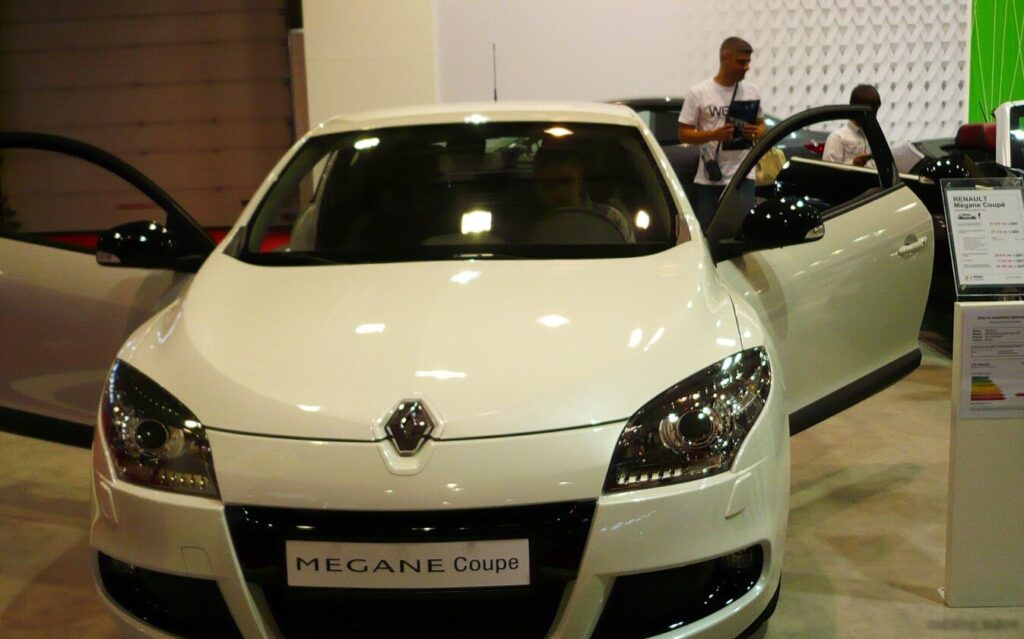
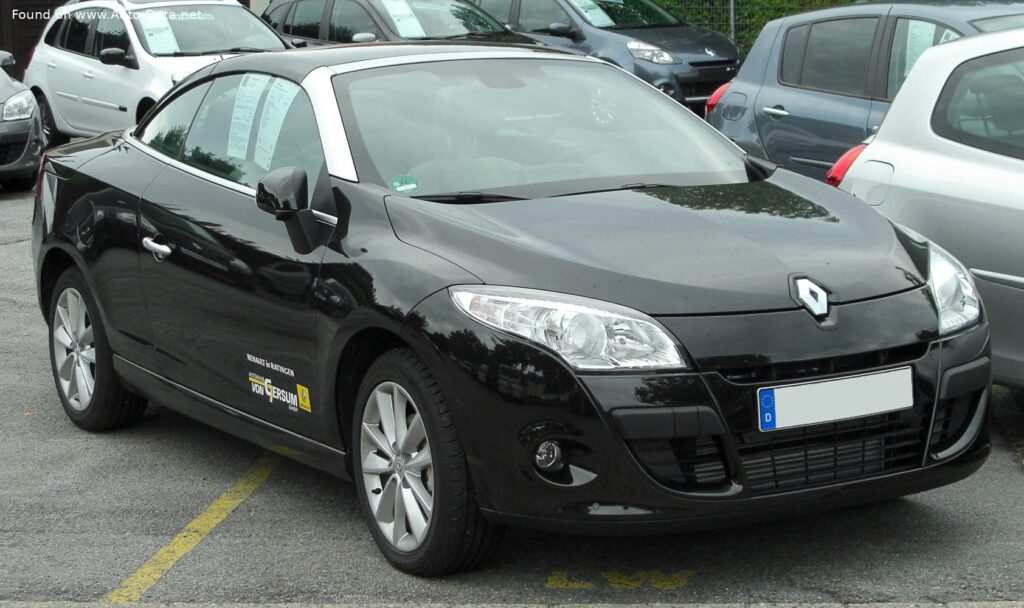
The Renault Megane III CC is defined by its elegant coupe-cabriolet body style, offering the versatility of a fixed-roof coupe and the exhilaration of an open-top convertible in one package. Its design language is sleek and contemporary, characterized by smooth lines and a balanced profile, whether the retractable hardtop is up or down. The two-door configuration emphasizes its sporty character, while the four-seat interior provides practical accommodation for passengers, albeit with reduced rear legroom typical of this segment.
When the hardtop is deployed, the Megane III CC presents a refined coupe silhouette, offering enhanced security and weather protection compared to traditional soft-top convertibles. The transformation to an open-air cruiser is executed with a sophisticated electro-hydraulic mechanism, neatly stowing the roof into the trunk. This clever engineering, however, impacts cargo capacity; trunk space ranges from a minimum of 7.45 cubic feet with the roof stowed to a more generous 14.73 cubic feet when the roof is closed.
Inside, the cabin of the Megane III CC prioritizes comfort and ergonomics. While specific infotainment details are not provided, a 2013-era Renault would typically feature a user-friendly dashboard layout, quality materials, and a range of convenience features such as climate control, power windows, and an audio system. Safety was also a key consideration, with standard equipment including an Anti-lock Braking System (ABS), ensuring stable stopping power. The braking system comprises ventilated discs at the front and solid discs at the rear. The vehicle’s handling is managed by an independent McPherson strut front suspension and a torsion beam rear suspension, a common and effective setup for front-wheel-drive compact cars, providing a comfortable ride and predictable dynamics. Electric power steering enhances maneuverability, especially in tight urban spaces, with a minimum turning circle of 35.93 feet. Standard 205/50 R17H tires on 17-inch wheel rims complete the athletic stance.
Technical Specifications
| Category | Specification | Value |
|---|---|---|
| General Information | ||
| Brand | Renault | |
| Model | Megane | |
| Generation | Megane III CC | |
| Type (Engine) | 1.4 Energy TCe (132 Hp) Start&Stop | |
| Production Start | 2013 year | |
| Production End | 2014 year | |
| Powertrain Architecture | Internal Combustion engine | |
| Body Type | Coupe – Cabriolet | |
| Seats | 4 | |
| Doors | 2 | |
| Performance Specifications | ||
| Fuel Consumption (Urban) | 7.8 l/100 km | 30.2 US mpg |
| Fuel Consumption (Extra Urban) | 5.5 l/100 km | 42.8 US mpg |
| Fuel Consumption (Combined) | 6.4 l/100 km | 36.8 US mpg |
| CO2 Emissions | 145 g/km | |
| Fuel Type | Petrol (Gasoline) | |
| Acceleration 0 – 60 mph | 10.6 sec | |
| Maximum Speed | 190 km/h | 118.06 mph |
| Emission Standard | Euro 5 | |
| Weight-to-Power Ratio | 11.4 kg/Hp | 88 Hp/tonne |
| Weight-to-Torque Ratio | 7.3 kg/Nm | 136.7 Nm/tonne |
| Engine Specifications | ||
| Power | 132 Hp @ 5500 rpm | |
| Power per liter | 110.2 Hp/l | |
| Torque | 205 Nm @ 2000 rpm | 151.2 lb.-ft. @ 2000 rpm |
| Engine Layout | Front, Transverse | |
| Engine Model/Code | H4J | |
| Engine Displacement | 1198 cm3 | 73.11 cu. in. |
| Number of Cylinders | 4 | |
| Engine Configuration | Inline | |
| Cylinder Bore | 72.2 mm | 2.84 in. |
| Piston Stroke | 73.2 mm | 2.88 in. |
| Compression Ratio | 10:1 | |
| Valves per Cylinder | 4 | |
| Fuel Injection System | Multi-port manifold injection | |
| Engine Aspiration | Turbocharger, Intercooler | |
| Engine Oil Capacity | 4.5 l | 4.76 US qt |
| Coolant Capacity | 6.8 l | 7.19 US qt |
| Engine Systems | Start & Stop System | |
| Space, Volume, and Weights | ||
| Kerb Weight | 1500 kg | 3306.93 lbs. |
| Max. Weight | 1864 kg | 4109.42 lbs. |
| Max Load | 364 kg | 802.48 lbs. |
| Trunk Space (Min) | 211 l | 7.45 cu. ft. |
| Trunk Space (Max) | 417 l | 14.73 cu. ft. |
| Fuel Tank Capacity | 60 l | 15.85 US gal |
| Permitted Trailer Load (with brakes) | 750 kg | 1653.47 lbs. |
| Permitted Trailer Load (without brakes) | 750 kg | 1653.47 lbs. |
| Dimensions | ||
| Length | 4485 mm | 176.57 in. |
| Width | 1811 mm | 71.3 in. |
| Width (incl. mirrors) | 2072 mm | 81.57 in. |
| Height | 1434 mm | 56.46 in. |
| Wheelbase | 2609 mm | 102.72 in. |
| Front Track | 1546 mm | 60.87 in. |
| Rear Track | 1547 mm | 60.91 in. |
| Front Overhang | 862 mm | 33.94 in. |
| Rear Overhang | 1014 mm | 39.92 in. |
| Ride Height (Ground Clearance) | 120 mm | 4.72 in. |
| Minimum Turning Circle | 10.95 m | 35.93 ft. |
| Drivetrain, Brakes, and Suspension | ||
| Drivetrain Architecture | The Internal combustion engine (ICE) drives the front wheels of the vehicle. | |
| Drive Wheel | Front-wheel drive | |
| Gearbox | 6 gears, manual transmission | |
| Front Suspension | Independent type McPherson | |
| Rear Suspension | Torsion | |
| Front Brakes | Ventilated discs | |
| Rear Brakes | Disc | |
| Assisting Systems | ABS (Anti-lock braking system) | |
| Steering Type | Steering rack and pinion | |
| Power Steering | Electric Steering | |
| Tire Size | 205/50 R17H | |
| Wheel Rim Size | 17 inches | |
Legacy and Market Impact
The Renault Megane III CC, particularly its 1.4 Energy TCe variant, carved out a niche for itself in the highly competitive European compact car market. It stood as a direct competitor to other popular coupe-cabriolets of its time, such as the Peugeot 308 CC, Volkswagen Eos, and Opel Astra TwinTop. What set the Megane III CC apart was its distinctive styling, refined interior, and the innovative “Energy TCe” powertrains that offered a compelling blend of performance and efficiency, a growing priority for European consumers.
The introduction of the 1.4 Energy TCe (1.2L displacement) engine with Start&Stop technology was a strategic move by Renault to meet evolving environmental regulations and consumer demand for lower running costs. This focus on fuel economy and reduced CO2 emissions helped solidify Renault’s reputation as a leader in powertrain innovation within the mainstream segment. The car’s weight-to-power ratio of 11.4 kg/Hp (88 Hp/tonne) was competitive for a compact convertible, which inherently carries more weight due to the reinforced chassis and retractable roof mechanism.
The Megane III CC was well-regarded for offering a genuine open-top driving experience without compromising too heavily on the practicality expected from a compact car. Its retractable hardtop provided year-round usability, offering the quietness and security of a coupe during colder months and the exhilaration of a convertible in warmer weather. While never officially sold in the United States, due to Renault’s minimal presence in the North American market since the late 1980s and the declining demand for compact convertibles, its impact was significant in Europe. It contributed to Renault’s brand image as a producer of stylish, technologically advanced, and segment-diverse vehicles.
Ultimately, the Renault Megane III CC, with its 1.4 Energy TCe (132 Hp) Start&Stop engine, represents a thoughtful engineering effort to combine leisure and practicality. It encapsulates an era where European manufacturers were pushing boundaries in engine downsizing and efficiency, all while maintaining a strong emphasis on design and the emotional appeal of open-air motoring. Its legacy lies in its contribution to Renault’s diverse Megane lineup and its role in offering a sophisticated yet accessible convertible experience to a broad European audience.