Renault Megane III CC 1.5 dCi (110 Hp) EDC: A Detailed Overview
The Renault Megane III CC 1.5 dCi (110 Hp) EDC represents a significant offering within the European compact convertible segment during its production run from 2010 to 2014. As part of the third generation of the popular Megane lineup, this specific variant combined the practicality of a retractable hardtop coupe-cabriolet with the renowned efficiency of Renault’s 1.5-liter dCi diesel engine, paired with an advanced EDC (Efficient Dual Clutch) automatic transmission. While never officially sold in the United States, the Megane III CC played a crucial role in the European market, catering to consumers seeking a stylish, open-air driving experience without sacrificing fuel economy or everyday usability. Its design and engineering reflected Renault’s commitment to innovation and accessibility in a competitive segment dominated by other European manufacturers.
Engine and Performance of the Renault Megane III CC
At the heart of the Renault Megane III CC 1.5 dCi (110 Hp) EDC lies the K9K 837 engine, a 1.5-liter (1461 cm³ or 89.16 cu. in.) inline four-cylinder turbodiesel unit, which was a cornerstone of Renault’s powertrain strategy for efficiency across many models. This engine delivered a respectable 110 horsepower at 4000 rpm, providing a lively yet economical driving experience. Torque output was a robust 240 Nm (177.01 lb.-ft.) available at a low 1750 rpm, ensuring strong pulling power and effortless cruising, particularly beneficial for a car of its weight. The engine featured a common rail direct fuel injection system and was equipped with a turbocharger and intercooler, optimizing performance and fuel combustion. Furthermore, it included a particulate filter, demonstrating its compliance with Euro 5 emission standards, a critical factor for its European market acceptance.
Power was delivered to the front wheels via Renault’s EDC (Efficient Dual Clutch) automatic transmission, a sophisticated system designed to offer the convenience of an automatic with the efficiency and responsiveness typically associated with manual gearboxes. This combination contributed to the vehicle’s impressive fuel economy figures: an estimated 49 US mpg (4.8 l/100 km) combined, rising to 56 US mpg (4.2 l/100 km) on the highway. While not designed as a performance powerhouse, the Megane III CC 1.5 dCi could accelerate from 0 to 60 mph in a calculated 12.5 seconds (0-100 km/h in 13.2 seconds) and reach a top speed of 118 mph (190 km/h), making it perfectly adequate for daily commutes and extended road trips across Europe. Its weight-to-power ratio stood at 14 kg/Hp, indicating a balanced approach to performance and efficiency.
Design and Features: The Megane III CC’s Distinctive Appeal
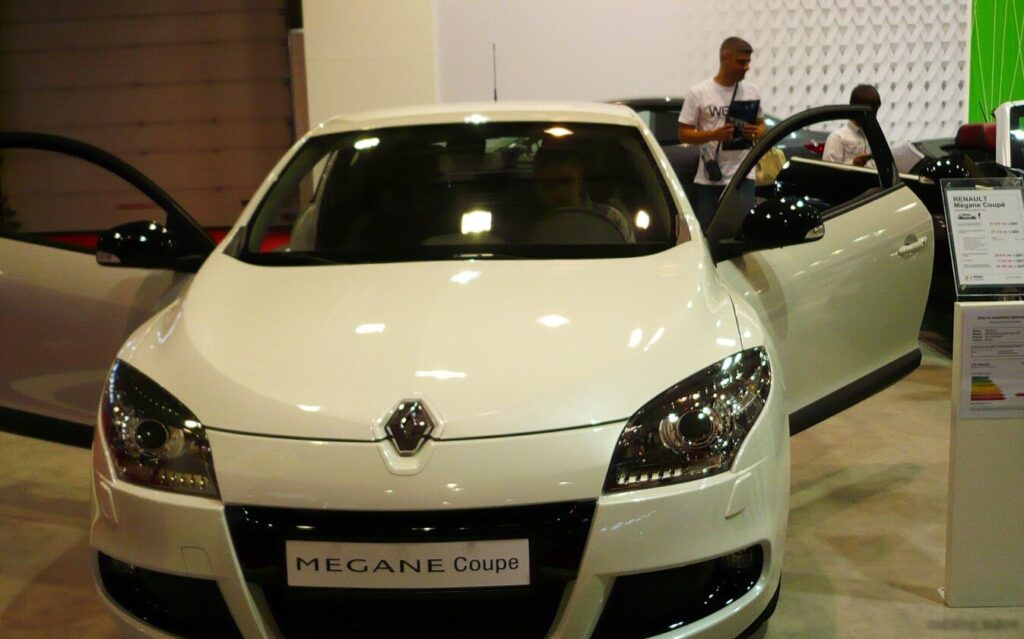
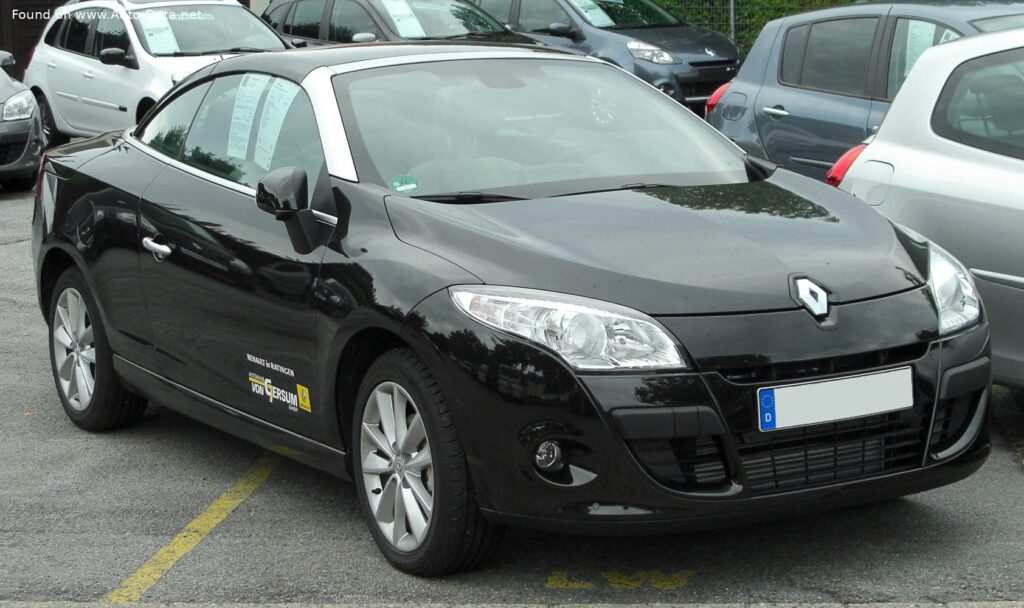
The Renault Megane III CC was characterized by its elegant coupe-cabriolet body style, featuring a distinctive two-door, four-seat configuration. The highlight of its design was the fully automatic retractable hardtop, which transformed the car from a sleek coupe to an open-air convertible with the push of a button. This system offered enhanced security and refinement compared to traditional soft-top convertibles, providing better insulation from noise and weather when the roof was up. The design language was typical of Renault’s aesthetic at the time, featuring smooth lines, a prominent front grille, and swept-back headlights that gave it a contemporary and sophisticated appearance.
Measuring 176.57 inches (4485 mm) in length, 71.3 inches (1811 mm) in width (81.57 inches or 2072 mm including mirrors), and 56.46 inches (1434 mm) in height, the Megane III CC maintained a compact footprint suitable for European city driving and parking. The wheelbase of 102.72 inches (2609 mm) provided a stable ride, while the minimum turning circle of 35.93 feet (10.95 m) ensured good maneuverability. Inside, the cabin was designed for comfort and practicality, offering seating for four adults, though the rear seats were more suited for shorter journeys or children, especially with the roof down. Trunk space was a notable feature for a convertible, ranging from 7.45 cu. ft. (211 liters) with the roof stowed to a generous 14.73 cu. ft. (417 liters) with the roof up, making it surprisingly versatile for luggage. Standard safety features included ABS (Anti-lock Braking System), and the vehicle utilized ventilated discs at the front and disc brakes at the rear for confident stopping power. The electric power steering system offered light and precise control, enhancing the driving experience.
Technical Specifications
| Category | Specification |
|---|---|
| General Information | |
| Brand | Renault |
| Model | Megane III CC |
| Type (Engine) | 1.5 dCi (110 Hp) EDC |
| Production Years | 2010 – 2014 |
| Body Type | Coupe – Cabriolet |
| Seats | 4 |
| Doors | 2 |
| Performance Specs | |
| Fuel Consumption (Urban) | 5.8 l/100 km (40.6 US mpg) |
| Fuel Consumption (Extra Urban) | 4.2 l/100 km (56 US mpg) |
| Fuel Consumption (Combined) | 4.8 l/100 km (49 US mpg) |
| CO2 Emissions | 124 g/km |
| Fuel Type | Diesel |
| Acceleration 0 – 62 mph (0-100 km/h) | 13.2 sec |
| Acceleration 0 – 60 mph (Calculated) | 12.5 sec |
| Maximum Speed | 118.06 mph (190 km/h) |
| Emission Standard | Euro 5 |
| Weight-to-Power Ratio | 14 kg/Hp |
| Weight-to-Torque Ratio | 6.4 kg/Nm |
| Engine Specs | |
| Power | 110 Hp @ 4000 rpm |
| Power per liter | 75.3 Hp/l |
| Torque | 240 Nm (177.01 lb.-ft.) @ 1750 rpm |
| Engine Layout | Front, Transverse |
| Engine Model/Code | K9K 837 |
| Engine Displacement | 1461 cm³ (89.16 cu. in.) |
| Number of Cylinders | 4 |
| Engine Configuration | Inline |
| Cylinder Bore | 76 mm (2.99 in.) |
| Piston Stroke | 80.5 mm (3.17 in.) |
| Compression Ratio | 15.2:1 |
| Valves per Cylinder | 4 |
| Fuel Injection System | Diesel Commonrail |
| Engine Aspiration | Turbocharger, Intercooler |
| Engine Oil Capacity | 4.5 l (4.76 US qt) |
| Coolant Capacity | 6.8 l (7.19 US qt) |
| Engine Systems | Particulate filter |
| Dimensions, Volume & Weights | |
| Kerb Weight | 1535 kg (3384.1 lbs) |
| Max. Weight | 1899 kg (4186.58 lbs) |
| Max Load | 364 kg (802.48 lbs) |
| Trunk Space (Minimum) | 211 l (7.45 cu. ft.) |
| Trunk Space (Maximum) | 417 l (14.73 cu. ft.) |
| Fuel Tank Capacity | 60 l (15.85 US gal) |
| Length | 4485 mm (176.57 in.) |
| Width | 1811 mm (71.3 in.) |
| Width (incl. mirrors) | 2072 mm (81.57 in.) |
| Height | 1434 mm (56.46 in.) |
| Wheelbase | 2609 mm (102.72 in.) |
| Front Track | 1546 mm (60.87 in.) |
| Rear Track | 1547 mm (60.91 in.) |
| Front Overhang | 862 mm (33.94 in.) |
| Rear Overhang | 1014 mm (39.92 in.) |
| Ride Height (Ground Clearance) | 120 mm (4.72 in.) |
| Minimum Turning Circle | 10.95 m (35.93 ft.) |
| Drivetrain, Brakes & Suspension | |
| Drivetrain Architecture | Front-wheel drive, Internal Combustion Engine |
| Drive Wheel | Front Wheel Drive |
| Gearbox Type | Automatic (EDC) |
| Front Suspension | Independent type McPherson |
| Rear Suspension | Torsion Beam |
| Front Brakes | Ventilated Discs |
| Rear Brakes | Disc |
| Assisting Systems | ABS (Anti-lock Braking System) |
| Steering Type | Steering rack and pinion |
| Power Steering | Electric Steering |
| Tires Size | 205/50 R17H |
| Wheel Rims Size | 17 inches |
Legacy and Market Impact of the Renault Megane III CC
The Renault Megane III CC, particularly the 1.5 dCi (110 Hp) EDC variant, carved out a distinct niche for itself in the European automotive landscape. In a market where fuel efficiency and practicality are often prioritized alongside style, this model offered a compelling blend. Its primary competitors included other compact coupe-cabriolets such as the Peugeot 308 CC, the Volkswagen Eos, and to some extent, the Opel Astra TwinTop. What set the Megane III CC apart was its strong emphasis on diesel economy combined with the convenience of an automatic transmission, making it an attractive option for daily commuters and those who appreciated lower running costs.
The retractable hardtop design, a trend that gained significant traction in Europe during the 2000s and early 2010s, provided the best of both worlds: the security and refinement of a fixed-roof coupe and the exhilaration of an open-top convertible. This versatility contributed to its appeal in varied European climates. Renault’s decision to offer a diesel engine in a convertible body style underscored the European market’s preference for diesel powertrains due to their superior fuel economy and lower CO2 emissions, especially before the widespread shift towards electrification. The EDC transmission further enhanced its marketability by offering smooth shifts and improved efficiency over traditional torque converter automatics.
While the Megane III CC, like many compact hardtop convertibles, eventually saw its segment shrink due to evolving consumer preferences and the rising popularity of SUVs, its legacy is one of a well-engineered and practical convertible. It demonstrated Renault’s ability to combine stylish design with sensible engineering and efficient powertrains. For many European buyers, it represented an accessible entry into the convertible lifestyle, offering a blend of French flair, modern technology, and economic operation that resonated strongly within its target demographic. Its continued presence on European roads today attests to its durability and the lasting appeal of its unique proposition.