The Renault Megane III CC: A European Open-Top Experience
The Renault Megane III CC, specifically the 1.6 16V (110 Hp) variant, represents a significant offering within the European C-segment for coupe-cabriolets. Produced by the French automaker Renault from 2010 to 2013, this generation of the Megane CC continued the brand’s tradition of offering stylish, open-top motoring with the practicality of a retractable hardtop. While never officially sold in the United States, the Megane III CC played a crucial role in Renault’s European lineup, catering to consumers seeking a versatile vehicle capable of transforming from a comfortable coupe into an exhilarating convertible at the touch of a button. It embodied a blend of French design sensibilities, everyday usability, and a focus on providing an accessible open-air driving experience.
Engine and Performance of the Renault Megane III CC
Powering the Renault Megane III CC 1.6 16V variant is a naturally aspirated 1.6-liter (1598 cm³ or 97.52 cu. in.) inline four-cylinder engine, designated by the engine code K4M 858. This powerplant, featuring 16 valves (four per cylinder) and a multi-port manifold injection system, delivers a respectable 110 horsepower at 6000 rpm. Torque output stands at 151 Nm, or approximately 111.37 lb.-ft., available at 4250 rpm. This configuration, with its front, transverse engine layout, drives the front wheels through a 6-speed manual transmission.
While not designed as a performance powerhouse, the powertrain provides adequate motivation for the Megane III CC, especially for its intended use as a stylish cruiser. The vehicle achieves a 0 to 60 mph acceleration in an estimated 11.6 seconds, with a top speed of 118 mph (190 km/h). Given its curb weight of 3152.61 lbs (1430 kg), the engine’s output translates to a weight-to-power ratio of 13 kg/Hp (76.9 Hp/tonne), indicating a balanced approach rather than outright sportiness.
Fuel efficiency for the 1.6 16V model is rated at a combined 7.6 liters per 100 kilometers, which translates to approximately 30.9 US mpg. Urban consumption stands at 10.2 l/100 km (23.1 US mpg), while extra-urban driving yields 6.1 l/100 km (38.6 US mpg). These figures, combined with CO2 emissions of 175 g/km and adherence to Euro 5 emission standards, positioned the Megane III CC as a reasonably efficient option within its class for its era. The fuel tank capacity of 15.85 US gallons (60 liters) ensured a practical range for touring.
Design and Features of the Renault Megane III CC
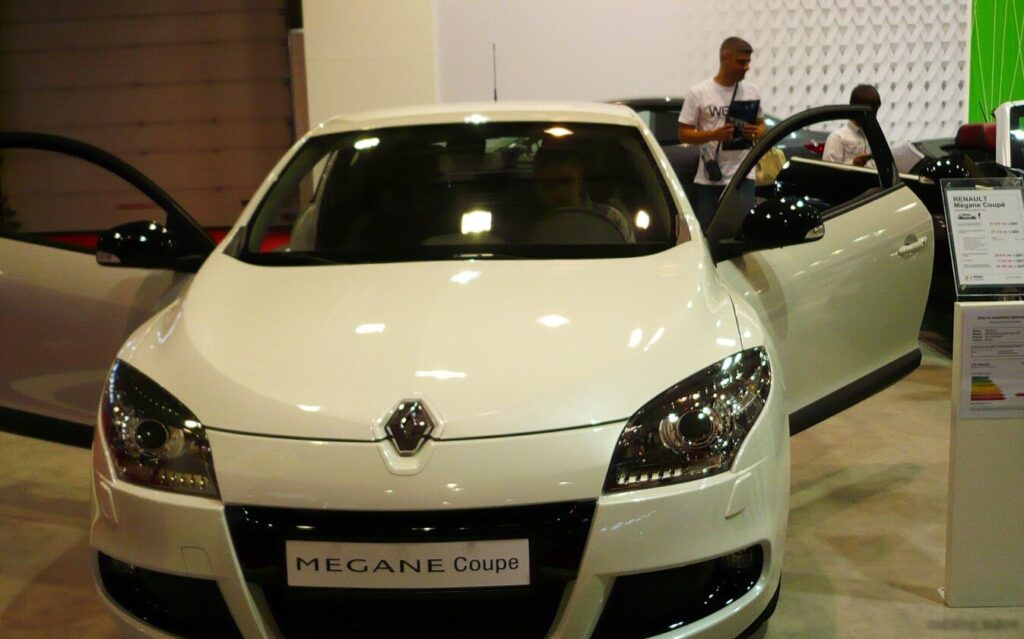
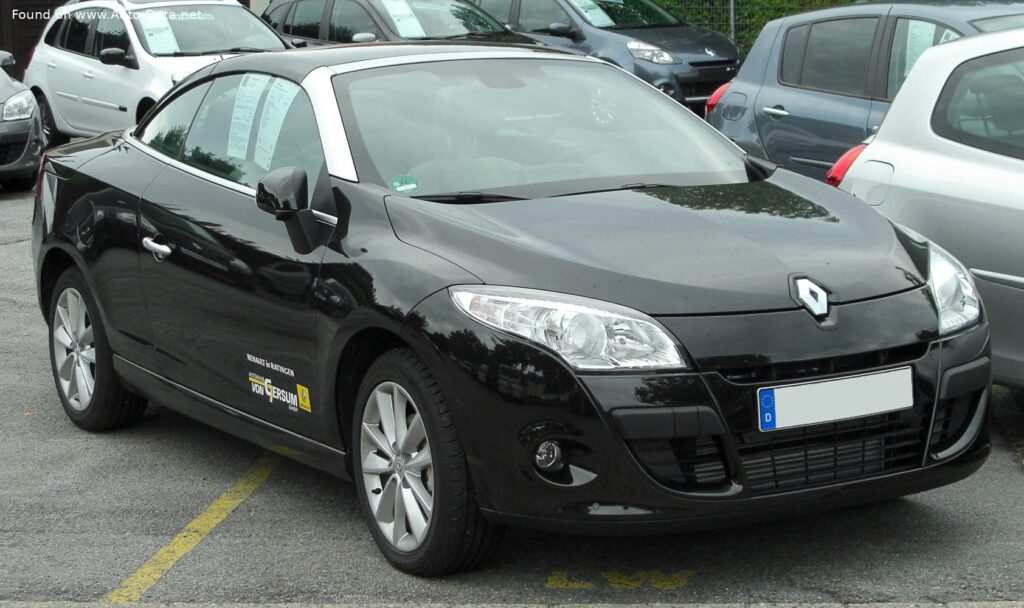
The Renault Megane III CC distinguished itself with its elegant coupe-cabriolet body style, featuring two doors and seating for four occupants. The defining characteristic was its sophisticated electrically operated retractable hardtop, a feature that offered the best of both worlds: the security and refinement of a coupe when closed, and the exhilarating open-air freedom of a convertible when stowed. The hardtop mechanism was designed for smooth operation, transforming the car’s character in a relatively short period.
Dimensionally, the Megane III CC measured 176.57 inches (4485 mm) in length, 71.3 inches (1811 mm) in width (81.57 inches or 2072 mm including mirrors), and 56.46 inches (1434 mm) in height. Its wheelbase of 102.72 inches (2609 mm) contributed to a stable ride. The design language was distinctly Renault, featuring smooth lines and a cohesive aesthetic that aimed for a premium feel.
Inside, the four-seat configuration offered a more practical solution than some two-seater roadsters, though rear passenger space, typical for this segment, was more suited for shorter journeys or children. Trunk space was a notable feature, varying significantly depending on the roof’s position. With the hardtop up, the trunk offered a generous 14.73 cu. ft. (417 liters) of cargo volume. However, when the roof was stowed, this space was reduced to 7.45 cu. ft. (211 liters) to accommodate the folding panels.
Key features included a robust chassis with independent McPherson front suspension and a torsion beam rear suspension, providing a comfortable and predictable ride. The braking system comprised ventilated discs at the front and solid discs at the rear, complemented by an Anti-lock Braking System (ABS) for enhanced safety. Steering was a rack and pinion type with electric power assistance, contributing to ease of maneuvering. The car rode on 205/55 R16 tires mounted on 16-inch wheel rims, a common size for balanced handling and ride comfort in its class.
Technical Specifications
| Category | Specification |
|---|---|
| General Information | |
| Brand | Renault |
| Model | Megane III CC |
| Type (Engine) | 1.6 16V (110 Hp) |
| Production Start / End | 2010 – 2013 |
| Powertrain Architecture | Internal Combustion Engine |
| Body type | Coupe – Cabriolet |
| Seats | 4 |
| Doors | 2 |
| Performance Specs | |
| Fuel consumption (urban) | 10.2 l/100 km (23.1 US mpg) |
| Fuel consumption (extra urban) | 6.1 l/100 km (38.6 US mpg) |
| Fuel consumption (combined) | 7.6 l/100 km (30.9 US mpg) |
| CO2 emissions | 175 g/km |
| Fuel Type | Petrol (Gasoline) |
| Acceleration 0-60 mph | 11.6 seconds |
| Acceleration 0-100 km/h | 12.2 seconds |
| Maximum speed | 118.06 mph (190 km/h) |
| Emission standard | Euro 5 |
| Weight-to-power ratio | 13 kg/Hp (76.9 Hp/tonne) |
| Weight-to-torque ratio | 9.5 kg/Nm (105.6 Nm/tonne) |
| Engine Specs | |
| Power | 110 Hp @ 6000 rpm |
| Power per liter | 68.8 Hp/l |
| Torque | 151 Nm @ 4250 rpm (111.37 lb.-ft. @ 4250 rpm) |
| Engine layout | Front, Transverse |
| Engine Model/Code | K4M 858 |
| Engine displacement | 1598 cm³ (97.52 cu. in.) |
| Number of cylinders | 4 |
| Engine configuration | Inline |
| Cylinder Bore | 79.5 mm (3.13 in.) |
| Piston Stroke | 80.5 mm (3.17 in.) |
| Compression ratio | 9.7:1 |
| Number of valves per cylinder | 4 |
| Fuel injection system | Multi-port manifold injection |
| Engine aspiration | Naturally aspirated |
| Engine oil capacity | 4.8 l (5.07 US qt) |
| Coolant capacity | 5.3 l (5.6 US qt) |
| Space, Volume and Weights | |
| Kerb Weight | 1430 kg (3152.61 lbs) |
| Max. weight | 1839 kg (4054.3 lbs) |
| Max load | 409 kg (901.69 lbs) |
| Trunk (boot) space – minimum | 211 l (7.45 cu. ft.) |
| Trunk (boot) space – maximum | 417 l (14.73 cu. ft.) |
| Fuel tank capacity | 60 l (15.85 US gal) |
| Permitted trailer load with brakes (12%) | 750 kg (1653.47 lbs) |
| Permitted trailer load without brakes | 750 kg (1653.47 lbs) |
| Dimensions | |
| Length | 4485 mm (176.57 in.) |
| Width | 1811 mm (71.3 in.) |
| Width including mirrors | 2072 mm (81.57 in.) |
| Height | 1434 mm (56.46 in.) |
| Wheelbase | 2609 mm (102.72 in.) |
| Front track | 1546 mm (60.87 in.) |
| Rear (Back) track | 1547 mm (60.91 in.) |
| Front overhang | 862 mm (33.94 in.) |
| Rear overhang | 1014 mm (39.92 in.) |
| Ride height (ground clearance) | 120 mm (4.72 in.) |
| Minimum turning circle | 10.95 m (35.93 ft.) |
| Drivetrain, Brakes and Suspension Specs | |
| Drivetrain Architecture | Front-wheel drive, Internal Combustion Engine |
| Drive wheel | Front wheel drive |
| Number of gears and type of gearbox | 6 gears, manual transmission |
| Front suspension | Independent type McPherson |
| Rear suspension | Torsion |
| Front brakes | Ventilated discs |
| Rear brakes | Disc |
| Assisting systems | ABS (Anti-lock braking system) |
| Steering type | Steering rack and pinion |
| Power steering | Electric Steering |
| Tires size | 205/55 R16 |
| Wheel rims size | 16 inches |
Legacy and Market Impact
The Renault Megane III CC carved out a niche for itself in the highly competitive European compact segment, specifically among convertible offerings. It competed directly with other popular coupe-cabriolets of the era, such as the Peugeot 308 CC, Volkswagen Eos, and Opel Astra TwinTop. Its primary appeal lay in its combination of fashionable styling, the versatility of a retractable hardtop, and a relatively accessible price point compared to premium convertibles.
Renault positioned the Megane III CC as a lifestyle vehicle, emphasizing open-air enjoyment and practicality for everyday use. While the 1.6 16V engine offered a sensible balance of performance and fuel economy, it was the car’s aesthetic appeal and the sophistication of its folding roof that truly defined its market presence. It wasn’t about setting lap records but about providing a comfortable, stylish, and engaging driving experience, whether cruising along coastal roads or navigating urban environments.
The Megane III CC contributed to Renault’s reputation for producing innovative and design-led vehicles for the European mass market. Its presence ensured that Renault remained a strong contender in the niche but popular coupe-cabriolet segment during its production run. Although this specific model never crossed the Atlantic to the North American market, its design language and engineering principles reflected broader automotive trends of the early 2010s, where manufacturers sought to offer diverse body styles and cater to evolving consumer preferences for versatility and style. The Megane III CC remains a recognizable and fondly remembered model for its distinctive European charm and its ability to seamlessly switch between two distinct driving personalities.