The Renault Megane III CC 1.6 Energy dCi (130 Hp) Start&Stop: A European Convertible for the Modern Era
The Renault Megane III CC 1.6 Energy dCi (130 Hp) Start&Stop represents a compelling blend of style, efficiency, and practicality within the European compact convertible segment. Launched in 2012 as part of the third generation Megane lineup, the “CC” designation signifies its Coupe-Cabriolet body style, featuring an innovative retractable hardtop roof. This specific variant, powered by Renault’s advanced 1.6-liter Energy dCi diesel engine, was positioned as an economical yet engaging choice for consumers seeking the versatility of an open-air vehicle combined with the fuel efficiency of a modern diesel powertrain. While never officially sold in the United States, the Megane III CC played a significant role in the European market, offering a sophisticated alternative to traditional soft-top convertibles and solidifying Renault’s presence in a competitive niche.
The Megane III CC was designed to appeal to a broad audience, from young couples to empty nesters, offering a four-seat configuration that, while snug in the rear, provided more utility than a pure two-seater roadster. Its production run from 2012 to 2014 saw it benefit from Renault’s ongoing commitment to powertrain refinement and technological integration, particularly with the inclusion of the Start&Stop system, which aimed to reduce fuel consumption and CO2 emissions in urban driving conditions. This model underscored a growing trend in Europe for practical, all-season convertibles that didn’t compromise on everyday usability.
Engine & Performance: The Efficient Heart of the Renault Megane III CC
At the core of the Renault Megane III CC 1.6 Energy dCi (130 Hp) Start&Stop is its highly regarded R9M 414 engine, a 1.6-liter (1598 cm3 or 97.52 cu. in.) inline four-cylinder diesel unit. This powertrain was a testament to Renault’s engineering prowess, focusing on delivering a balance of robust performance and exceptional fuel economy. Equipped with a turbocharger and intercooler, along with a sophisticated Diesel Common Rail fuel injection system, the engine produced a respectable 130 horsepower at 4000 rpm. More impressively for a diesel, it generated a substantial 236.02 lb.-ft. (320 Nm) of torque available at a low 2000 rpm, providing strong pulling power and effortless cruising capabilities.
The power delivery of this front-transverse mounted engine, driving the front wheels through a precise 6-speed manual transmission, allowed the Megane III CC to achieve a 0-60 mph acceleration in a competitive 10.3 seconds (0-100 km/h in 10.8 seconds). Its top speed was rated at 130.49 mph (210 km/h), making it perfectly capable for extended highway journeys across Europe. A key efficiency feature was the Start&Stop system, which automatically shut off the engine when the vehicle was stationary and restarted it when the driver engaged the clutch, significantly contributing to its impressive combined fuel economy of 53.5 US mpg (4.4 l/100 km). Urban consumption was rated at 44.4 US mpg (5.3 l/100 km), while extra-urban driving could yield up to 60.3 US mpg (3.9 l/100 km). These figures, combined with CO2 emissions of just 115 g/km, ensured the vehicle met strict Euro 5 emission standards and offered compelling running costs for European buyers.
Design & Features: Style Meets Versatility
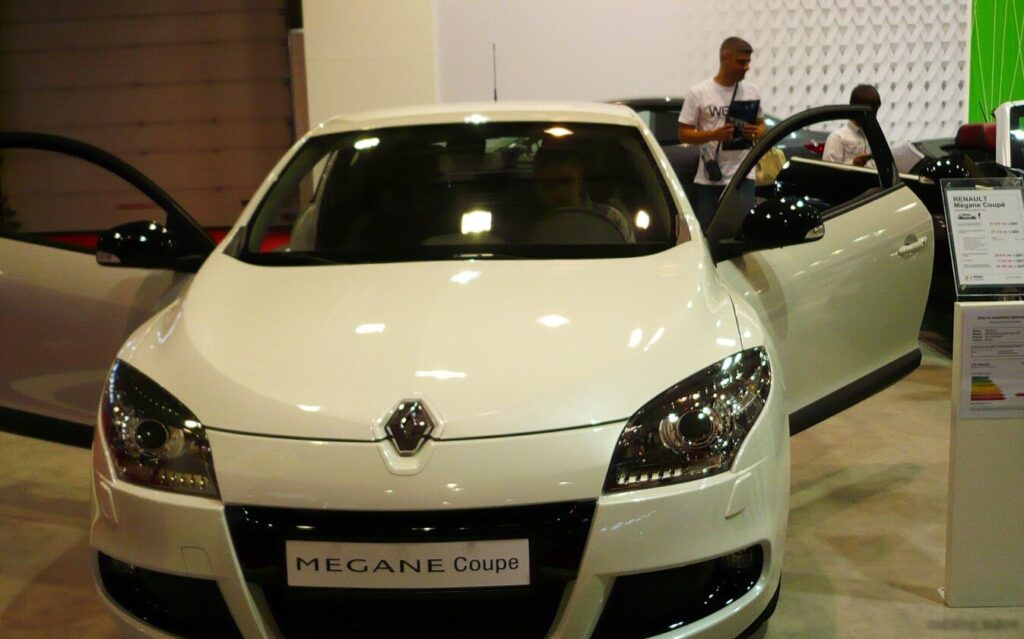
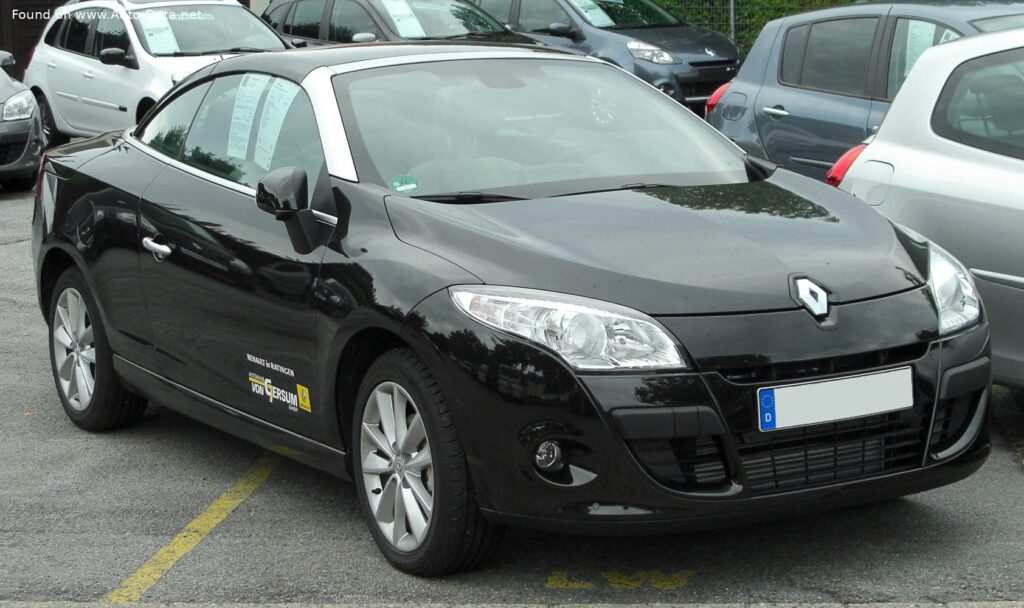
The Renault Megane III CC adopted a sleek and modern design language, characteristic of Renault’s aesthetic during the early 2010s. Its primary defining feature was the electrically operated retractable hardtop roof, a sophisticated piece of engineering that transformed the car from a stylish coupe into an open-air cabriolet in a matter of seconds. This hardtop provided superior insulation and security compared to traditional soft-tops, making the Megane III CC a true all-weather vehicle.
Measuring 176.57 inches (4485 mm) in length, 71.3 inches (1811 mm) in width (81.57 inches or 2072 mm with mirrors), and 56.46 inches (1434 mm) in height, the Megane III CC presented a well-proportioned stance. Its 102.72-inch (2609 mm) wheelbase contributed to a stable ride, while the 4.72-inch (120 mm) ground clearance was typical for a passenger car of its class. The vehicle rode on 17-inch wheel rims fitted with 205/50 R17H tires, providing a good balance of grip and ride comfort. Inside, the cabin offered seating for four, though rear passenger space was naturally compromised when the roof was stowed. The trunk space varied significantly depending on the roof’s position: 14.73 cu. ft. (417 liters) with the roof up, shrinking to 7.45 cu. ft. (211 liters) with the roof down.
Key features included a robust drivetrain architecture with front-wheel drive, independent McPherson front suspension, and a torsion beam rear suspension for a comfortable ride. Safety was enhanced by ventilated disc brakes at the front, disc brakes at the rear, and standard ABS (Anti-lock Braking System). The electric power steering system provided light and responsive handling, making urban maneuvers and parking straightforward, with a minimum turning circle of 35.93 ft. (10.95 m). Beyond the mechanicals, the inclusion of a particulate filter was another nod to environmental responsibility, ensuring cleaner emissions.
Technical Specifications
| Renault Megane III CC 1.6 Energy dCi (130 Hp) Start&Stop (2012 – 2014) | |
|---|---|
| General Information | |
| Brand | Renault |
| Model | Megane |
| Generation | Megane III CC |
| Type (Engine) | 1.6 Energy dCi (130 Hp) Start&Stop |
| Production Start | 2012 year |
| Production End | 2014 year |
| Powertrain Architecture | Internal Combustion Engine |
| Body type | Coupe – Cabriolet |
| Seats | 4 |
| Doors | 2 |
| Performance Specs | |
| Fuel consumption (urban) | 5.3 l/100 km (44.4 US mpg) |
| Fuel consumption (extra urban) | 3.9 l/100 km (60.3 US mpg) |
| Fuel consumption (combined) | 4.4 l/100 km (53.5 US mpg) |
| CO2 emissions | 115 g/km |
| Fuel Type | Diesel |
| Acceleration 0-60 mph | 10.3 sec |
| Acceleration 0-100 km/h | 10.8 sec |
| Maximum speed | 130.49 mph (210 km/h) |
| Emission standard | Euro 5 |
| Weight-to-power ratio | 11.8 kg/Hp (84.6 Hp/tonne) |
| Weight-to-torque ratio | 4.8 kg/Nm (208.3 Nm/tonne) |
| Engine Specs | |
| Power | 130 Hp @ 4000 rpm |
| Power per liter | 81.4 Hp/l |
| Torque | 236.02 lb.-ft. (320 Nm) @ 2000 rpm |
| Engine layout | Front, Transverse |
| Engine Model/Code | R9M 414 |
| Engine displacement | 1.6 liters (1598 cm3 / 97.52 cu. in.) |
| Number of cylinders | 4 |
| Engine configuration | Inline |
| Cylinder Bore | 3.15 in. (80 mm) |
| Piston Stroke | 3.13 in. (79.5 mm) |
| Compression ratio | 15.4:1 |
| Valves per cylinder | 4 |
| Fuel injection system | Diesel Commonrail |
| Engine aspiration | Turbocharger, Intercooler |
| Engine oil capacity | 5.81 US qt (5.5 l) |
| Coolant capacity | 7.08 US qt (6.7 l) |
| Engine systems | Start & Stop System, Particulate filter |
| Space, Volume & Weights | |
| Kerb Weight | 3386.3 lbs. (1536 kg) |
| Max. weight | 4446.72 lbs. (2017 kg) |
| Max load | 1060.42 lbs. (481 kg) |
| Trunk (boot) space – minimum | 7.45 cu. ft. (211 l) |
| Trunk (boot) space – maximum | 14.73 cu. ft. (417 l) |
| Fuel tank capacity | 15.85 US gal (60 l) |
| Permitted trailer load with brakes (12%) | 1653.47 lbs. (750 kg) |
| Permitted trailer load without brakes | 1653.47 lbs. (750 kg) |
| Dimensions | |
| Length | 176.57 in. (4485 mm) |
| Width | 71.3 in. (1811 mm) |
| Width including mirrors | 81.57 in. (2072 mm) |
| Height | 56.46 in. (1434 mm) |
| Wheelbase | 102.72 in. (2609 mm) |
| Front track | 60.87 in. (1546 mm) |
| Rear (Back) track | 60.91 in. (1547 mm) |
| Front overhang | 33.94 in. (862 mm) |
| Rear overhang | 39.92 in. (1014 mm) |
| Ride height (ground clearance) | 4.72 in. (120 mm) |
| Minimum turning circle (turning diameter) | 35.93 ft. (10.95 m) |
| Drivetrain, Brakes & Suspension | |
| Drivetrain Architecture | Front-wheel drive, Internal Combustion Engine |
| Drive wheel | Front wheel drive |
| Number of gears and type of gearbox | 6 gears, manual transmission |
| Front suspension | Independent type McPherson |
| Rear suspension | Torsion |
| Front brakes | Ventilated discs |
| Rear brakes | Disc |
| Assisting systems | ABS (Anti-lock braking system) |
| Steering type | Steering rack and pinion |
| Power steering | Electric Steering |
| Tires size | 205/50 R17H |
| Wheel rims size | 17 inches |
Legacy & Market Impact in Europe
The Renault Megane III CC, particularly with the 1.6 Energy dCi (130 Hp) Start&Stop engine, carved out a significant niche for itself in the European automotive landscape. Its primary competitors included other compact coupe-cabriolets such as the Peugeot 308 CC and the Volkswagen Eos, both of which also offered the versatility of a retractable hardtop. The Megane III CC distinguished itself with its distinctive Renault styling, robust diesel engine efficiency, and a comfortable, well-appointed interior for its class.
Its reputation was built on offering a practical solution for those who desired the exhilaration of open-top driving without the compromises often associated with soft-top convertibles, such as reduced security, poorer insulation, and less refined aesthetics. The diesel engine, a staple in the European market, further enhanced its appeal by providing impressive fuel economy and lower running costs, making it an attractive proposition for daily commuting and longer journeys alike. The Start&Stop system, a relatively modern feature for its time, underscored Renault’s commitment to environmental responsibility and efficiency, aligning with evolving consumer demands for greener vehicles.
While the compact coupe-cabriolet segment eventually saw a decline in popularity, leading to fewer new models, the Renault Megane III CC remains a notable example of the era when manufacturers experimented with bringing convertible practicality to the mainstream. Its blend of French design flair, innovative engineering, and economical performance ensured its place as a respected and well-regarded option among European car buyers during its production years. Today, it stands as a testament to Renault’s ingenuity in adapting to market trends and delivering vehicles that balanced lifestyle aspirations with sensible economics, particularly for a market that embraced diesel technology.