The Renault Megane III CC 1.9 dCi (130 Hp) FAP: A European Open-Air Experience
The Renault Megane III CC 1.9 dCi (130 Hp) FAP represents a distinctive segment in the European automotive landscape: the compact hardtop convertible. Introduced in 2010 as part of the third-generation Megane lineup, this particular variant combined the versatility of a coupe with the exhilaration of open-top motoring, all powered by an efficient diesel engine. While never officially sold in the United States, the Megane III CC played a significant role in the European market, offering a blend of style, practicality, and fuel economy tailored to regional preferences. Its retractable glass roof, a signature feature, allowed owners to transform the vehicle from a sleek coupe to an open-air cruiser at the touch of a button, embodying Renault’s commitment to diverse and innovative body styles.
Engineering and Performance of the Renault Megane III CC
At the heart of this particular Megane III CC was a robust and fuel-efficient 1.9-liter dCi (Direct Common-rail Injection) diesel engine, bearing the internal code F9Q 870. This inline four-cylinder powerplant was transversely mounted, driving the front wheels through a standard six-speed manual transmission. Producing a respectable 130 horsepower at 3750 rpm, the engine delivered its power smoothly and efficiently. However, the true strength of this diesel unit lay in its torque output: a substantial 221.27 lb.-ft. (300 Nm) available from a low 1750 rpm. This characteristic torque delivery made for effortless cruising and responsive acceleration, particularly in urban and highway driving scenarios.
Performance figures for the Megane III CC 1.9 dCi were competitive for its class. It could accelerate from 0 to 60 mph in a brisk 10.1 seconds, with a top speed reaching 127.38 mph (205 km/h). Given its additional weight due to the retractable hardtop mechanism and structural reinforcements, these figures demonstrated the engine’s capability. A key environmental feature of this powertrain was the inclusion of a Diesel Particulate Filter (FAP – Filtre à Particules), which was crucial for meeting the stringent Euro 5 emission standards prevalent in Europe at the time. This system significantly reduced particulate matter emissions, making the diesel engine a cleaner option.
Fuel economy was a major selling point for the 1.9 dCi engine. The combined cycle consumption was rated at an impressive 46.1 US mpg (5.1 l/100 km), with extra-urban driving potentially yielding up to 52.3 US mpg (4.5 l/100 km). Urban consumption stood at 37.9 US mpg (6.2 l/100 km). These figures, coupled with CO2 emissions of 149 g/km, highlighted the vehicle’s efficiency and lower running costs, a significant advantage in markets with high fuel prices. The 15.85 US gallon fuel tank also provided a generous cruising range between fill-ups.
Design and Features of the Renault Megane III CC
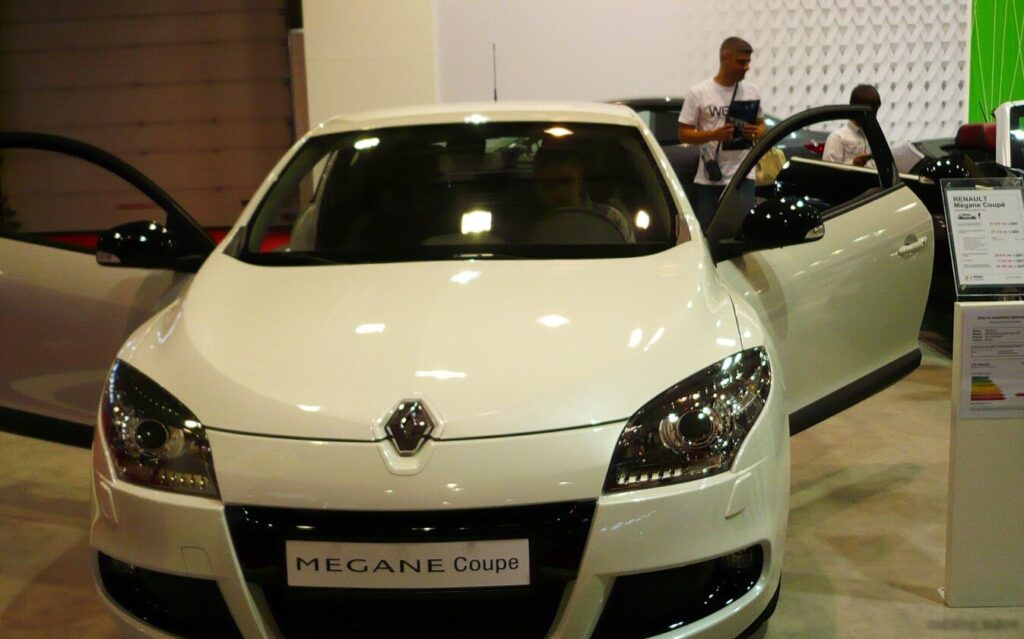
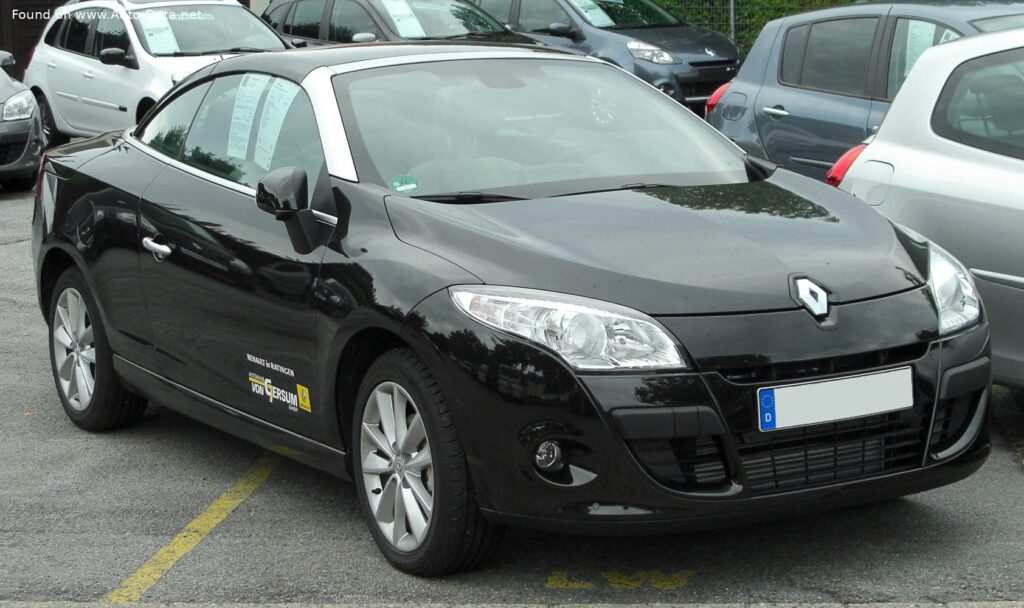
The Renault Megane III CC distinguished itself with its elegant Coupe-Cabriolet body type, featuring a two-door, four-seat configuration. The most striking element of its design was the fully automatic, two-piece retractable glass roof. This innovative feature, a hallmark of the Megane CC line, allowed for an airy cabin even with the roof up, while offering the full open-air experience when stowed. The transformation from coupe to convertible took approximately 21 seconds, neatly tucking the roof into the trunk.
Aesthetically, the Megane III CC followed the design language of the broader Megane III range, characterized by smoother lines and a more conventional, yet still distinctive, appearance compared to its predecessor. Its dimensions—176.57 inches in length, 71.3 inches in width (81.57 inches with mirrors), and 56.46 inches in height—gave it a substantial road presence for a compact car. The 102.72-inch wheelbase provided a stable ride and adequate interior space.
Inside, the Megane III CC offered seating for four, though the rear seats, as is common with convertibles, were best suited for shorter journeys or children. When the roof was up, the trunk provided a generous 14.73 cubic feet (417 liters) of cargo space, which was commendable for its class. With the roof retracted, however, cargo capacity was reduced to 7.45 cubic feet (211 liters), a typical compromise for hardtop convertibles. Standard features for the era included power windows, climate control, and an infotainment system, varying by trim level. Safety was addressed with standard ABS (Anti-lock Braking System), airbags, and a reinforced structure to compensate for the lack of a fixed roof. The vehicle also featured electric power steering for easy maneuverability and a comfortable ride, supported by an independent McPherson front suspension and a torsion beam rear suspension.
Technical Specifications: Renault Megane III CC 1.9 dCi (130 Hp) FAP
| Category | Specification |
|---|---|
| Brand | Renault |
| Model | Megane III CC |
| Type (Engine) | 1.9 dCi (130 Hp) FAP |
| Production Start | 2010 |
| Production End | 2013 |
| Body Type | Coupe – Cabriolet |
| Seats | 4 |
| Doors | 2 |
| Performance Specs | |
| Fuel Consumption (Urban) | 6.2 l/100 km (37.9 US mpg) |
| Fuel Consumption (Extra Urban) | 4.5 l/100 km (52.3 US mpg) |
| Fuel Consumption (Combined) | 5.1 l/100 km (46.1 US mpg) |
| CO2 Emissions | 149 g/km |
| Fuel Type | Diesel |
| Acceleration 0-60 mph | 10.1 sec |
| Maximum Speed | 127.38 mph (205 km/h) |
| Emission Standard | Euro 5 |
| Engine Specs | |
| Power | 130 Hp @ 3750 rpm |
| Torque | 221.27 lb.-ft. (300 Nm) @ 1750 rpm |
| Engine Layout | Front, Transverse |
| Engine Model/Code | F9Q 870 |
| Engine Displacement | 1870 cm3 (1.9 L / 114.11 cu. in.) |
| Number of Cylinders | 4, Inline |
| Cylinder Bore | 80 mm (3.15 in.) |
| Piston Stroke | 93 mm (3.66 in.) |
| Compression Ratio | 17:1 |
| Valves per Cylinder | 4 |
| Fuel Injection System | Diesel Commonrail |
| Engine Aspiration | Turbocharger, Intercooler |
| Engine Oil Capacity | 5.1 l (5.39 US qt) |
| Coolant Capacity | 6.3 l (6.66 US qt) |
| Engine Systems | Particulate filter |
| Space, Volume and Weights | |
| Kerb Weight | 3395.12 lbs (1540 kg) |
| Max. Weight | 4257.13 lbs (1931 kg) |
| Max Load | 862.01 lbs (391 kg) |
| Trunk Space (Minimum) | 7.45 cu. ft. (211 l) |
| Trunk Space (Maximum) | 14.73 cu. ft. (417 l) |
| Fuel Tank Capacity | 15.85 US gal (60 l) |
| Dimensions | |
| Length | 176.57 in. (4485 mm) |
| Width | 71.3 in. (1811 mm) |
| Width (incl. mirrors) | 81.57 in. (2072 mm) |
| Height | 56.46 in. (1434 mm) |
| Wheelbase | 102.72 in. (2609 mm) |
| Front Track | 60.87 in. (1546 mm) |
| Rear Track | 60.91 in. (1547 mm) |
| Ground Clearance | 4.72 in. (120 mm) |
| Minimum Turning Circle | 35.93 ft. (10.95 m) |
| Drivetrain, Brakes and Suspension | |
| Drivetrain Architecture | Front-wheel drive |
| Gearbox | 6-speed manual transmission |
| Front Suspension | Independent McPherson |
| Rear Suspension | Torsion beam |
| Front Brakes | Ventilated discs |
| Rear Brakes | Discs |
| Assisting Systems | ABS (Anti-lock braking system) |
| Steering Type | Rack and pinion with Electric Power Steering |
| Tire Size | 205/50 R17H |
| Wheel Rims Size | 17 inches |
Legacy and Market Impact of the Renault Megane III CC
The Renault Megane III CC, particularly with the 1.9 dCi engine, carved out a distinct niche in the European market for compact convertibles. It competed against rivals like the Peugeot 308 CC, Volkswagen Eos, and Ford Focus CC, all of which also offered the popular hardtop convertible format. Renault had a long history with convertibles, and the Megane CC line continued this tradition by offering a relatively affordable and stylish open-top experience.
Its appeal stemmed from several factors. Firstly, the retractable hardtop offered enhanced security and refinement over traditional soft-top convertibles, providing better insulation from noise and weather when closed. Secondly, the diesel engine variant addressed the strong European demand for fuel-efficient vehicles, making open-air motoring more accessible and economical for daily use. The combination of decent performance, excellent fuel economy, and a versatile body style made it a practical choice for individuals or small families seeking a car that could serve multiple purposes, from a sensible commuter to a weekend pleasure vehicle.
Despite its merits, the era of the compact hardtop convertible eventually waned. Production of the Megane III CC concluded in 2013, with the segment slowly being phased out by manufacturers in favor of more SUV-focused offerings or traditional soft-top convertibles. However, the Megane III CC, and particularly the 1.9 dCi FAP model, remains a testament to Renault’s ingenuity in providing a diverse range of vehicles tailored to European consumer tastes. It showcased a period where open-top motoring could be combined with diesel efficiency and everyday usability, leaving a legacy as a stylish and practical option for those who desired a touch of open-air freedom without sacrificing practicality or economy.