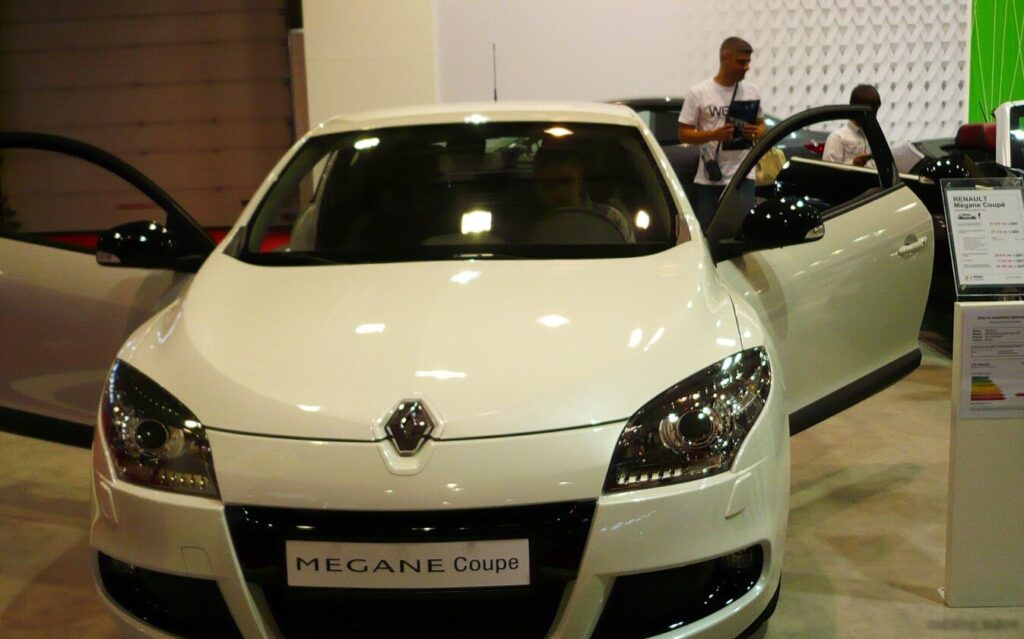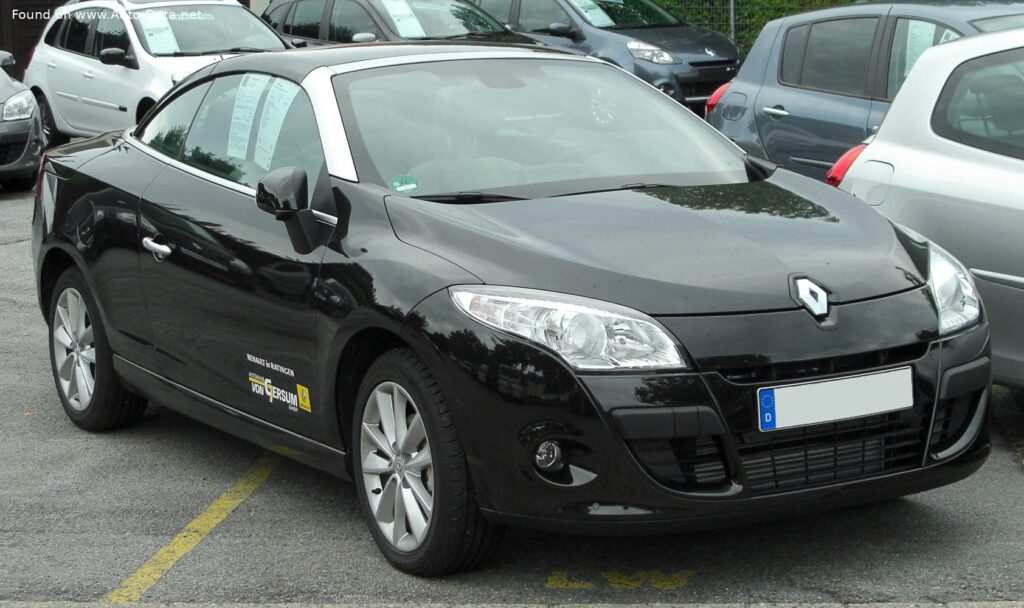
Introduction to the Renault Megane III CC
The Renault Megane III CC represents a distinctive chapter in the third generation of Renault’s popular compact car, the Megane. Launched in 2010 and produced until 2014, this particular variant, the Megane III CC (Coupé-Cabriolet) with its 2.0 16V (140 Hp) CVT powertrain, carved out a niche in the highly competitive European C-segment. As a vehicle primarily marketed and sold in Europe and other international markets, it was not officially imported into the United States. However, its design philosophy and technical specifications offer a fascinating insight into European automotive trends of the early 2010s, particularly the enduring appeal of retractable hardtop convertibles.
The Megane III CC was designed to offer the best of both worlds: the security and refinement of a coupe with the exhilaration of open-air motoring. Its sleek, four-seat body style, combined with Renault’s commitment to comfort and practicality, made it a popular choice for consumers seeking a versatile and stylish daily driver. This specific model, equipped with a naturally aspirated 2.0-liter gasoline engine paired with a Continuously Variable Transmission (CVT), prioritized smooth power delivery and ease of driving, reflecting a focus on relaxed cruising rather than outright performance.
Engine and Performance of the Renault Megane III CC
Under the hood of the Renault Megane III CC 2.0 16V CVT lay Renault’s M4R 711 engine, a robust and well-proven 2.0-liter (1997 cm3 or 121.86 cubic inches) inline four-cylinder gasoline unit. This engine featured a 16-valve configuration, with four valves per cylinder, and relied on a multi-port manifold injection system for fuel delivery. As a naturally aspirated engine, it delivered a linear power curve, producing 140 horsepower at 6000 rpm. Torque output peaked at 143.82 lb.-ft. (195 Nm) at a relatively accessible 3750 rpm, providing adequate thrust for daily driving and highway cruising.
The powertrain architecture saw the internal combustion engine positioned transversely at the front, driving the front wheels. A key characteristic of this particular model was its transmission: a 6-speed automatic Continuously Variable Transmission (CVT). While CVTs are often lauded for their seamless power delivery and potential for improved fuel economy, they can sometimes temper the raw acceleration feel. In the Megane III CC, this setup resulted in a 0-60 mph acceleration time of 11.1 seconds (0-100 km/h in 11.7 seconds) and a top speed of 121.17 mph (195 km/h). These figures positioned the car as a comfortable cruiser rather than a sporty performer, aligning with its coupe-cabriolet market segment.
Fuel efficiency was a notable aspect for a car of its type and era. The Megane III CC 2.0 16V CVT achieved a combined fuel consumption of 29.4 US mpg (8.0 l/100 km). In urban driving, it returned 21.6 US mpg (10.9 l/100 km), while extra-urban conditions saw figures rise to 37.3 US mpg (6.3 l/100 km). With CO2 emissions of 184 g/km, the vehicle complied with the Euro 5 emission standard, reflecting Renault’s efforts to balance performance with environmental considerations in the European market. The 15.85 US gallon (60 liter) fuel tank provided a decent cruising range.
Design and Features
Body Type and Exterior Design
The defining characteristic of the Renault Megane III CC was its Coupe-Cabriolet body style, featuring a sophisticated retractable hardtop. This design offered the best of both worlds: the structural rigidity, noise insulation, and theft deterrence of a fixed-roof coupe when closed, and the exhilarating open-air experience of a convertible at the touch of a button. The transformation from coupe to cabriolet was a key selling point, allowing drivers to adapt the car to varying weather conditions and preferences.
Measuring 176.57 inches (4485 mm) in length, 71.3 inches (1811 mm) in width (81.57 inches including mirrors), and 56.46 inches (1434 mm) in height, the Megane III CC possessed balanced proportions. Its wheelbase of 102.72 inches (2609 mm) contributed to a stable ride, while the front and rear tracks of 60.87 inches (1546 mm) and 60.91 inches (1547 mm), respectively, ensured a confident stance. The design language was consistent with the broader Megane III lineup, featuring a clean, modern aesthetic with distinctive headlamps and a prominent Renault emblem. The rear design, in particular, was carefully sculpted to accommodate the folding roof mechanism without appearing overly bulky, a common challenge for retractable hardtop vehicles.
Interior and Cabin Features
The cabin of the Megane III CC was designed for four occupants, offering two front seats and two rear seats. While the rear seating, typical for a compact convertible, might have been more suitable for shorter journeys or children, it provided added versatility compared to a pure two-seater. The trunk space was significantly impacted by the convertible roof mechanism. With the roof up, it offered a respectable 14.73 cubic feet (417 liters) of cargo volume. However, when the roof was stowed, this space reduced to 7.45 cubic feet (211 liters), a common compromise in the coupe-cabriolet segment.
Key features included electric power steering, providing ease of maneuverability, particularly in urban environments with a minimum turning circle of 35.93 feet (10.95 meters). The car rode on 205/55 R16 tires mounted on 16-inch wheel rims. For safety, the Megane III CC was equipped with an Anti-lock Braking System (ABS) as standard, complementing its ventilated disc brakes at the front and disc brakes at the rear. The suspension system featured an independent MacPherson strut setup at the front and a torsion beam axle at the rear, a common and cost-effective arrangement for front-wheel-drive compact cars, balancing ride comfort with handling capabilities.
Technical Specifications
| Category | Specification |
|---|---|
| General Information | |
| Brand | Renault |
| Model | Megane III CC |
| Type (Engine) | 2.0 16V (140 Hp) CVT |
| Production Years | 2010 – 2014 |
| Body Type | Coupe – Cabriolet |
| Seats | 4 |
| Doors | 2 |
| Performance Specs | |
| Power | 140 Hp @ 6000 rpm |
| Torque | 143.82 lb.-ft. (195 Nm) @ 3750 rpm |
| Acceleration 0-60 mph | 11.1 seconds |
| Maximum Speed | 121.17 mph (195 km/h) |
| Fuel Consumption (Combined) | 29.4 US mpg (8.0 l/100 km) |
| Fuel Consumption (Urban) | 21.6 US mpg (10.9 l/100 km) |
| Fuel Consumption (Extra Urban) | 37.3 US mpg (6.3 l/100 km) |
| CO2 Emissions | 184 g/km |
| Emission Standard | Euro 5 |
| Fuel Type | Petrol (Gasoline) |
| Engine Specs | |
| Engine Model/Code | M4R 711 |
| Engine Layout | Front, Transverse |
| Engine Displacement | 2.0 liters (1997 cm3 / 121.86 cu. in.) |
| Number of Cylinders | 4, Inline |
| Number of Valves per Cylinder | 4 |
| Bore x Stroke | 3.31 in (84 mm) x 3.55 in (90.1 mm) |
| Compression Ratio | 10.2:1 |
| Fuel Injection System | Multi-port manifold injection |
| Engine Aspiration | Naturally aspirated |
| Engine Oil Capacity | 3.7 US qt (3.5 l) |
| Coolant Capacity | 7.19 US qt (6.8 l) |
| Dimensions, Volume & Weights | |
| Length | 176.57 in (4485 mm) |
| Width | 71.3 in (1811 mm) |
| Width (incl. mirrors) | 81.57 in (2072 mm) |
| Height | 56.46 in (1434 mm) |
| Wheelbase | 102.72 in (2609 mm) |
| Front Track | 60.87 in (1546 mm) |
| Rear Track | 60.91 in (1547 mm) |
| Front Overhang | 33.94 in (862 mm) |
| Rear Overhang | 39.92 in (1014 mm) |
| Ground Clearance | 4.72 in (120 mm) |
| Minimum Turning Circle | 35.93 ft (10.95 m) |
| Kerb Weight | 3395.12 lbs (1540 kg) |
| Maximum Weight | 4197.6 lbs (1904 kg) |
| Maximum Load | 802.48 lbs (364 kg) |
| Trunk Space (Minimum) | 7.45 cu. ft. (211 l) |
| Trunk Space (Maximum) | 14.73 cu. ft. (417 l) |
| Fuel Tank Capacity | 15.85 US gal (60 l) |
| Permitted Trailer Load (with brakes) | 1653.47 lbs (750 kg) |
| Permitted Trailer Load (without brakes) | 1653.47 lbs (750 kg) |
| Drivetrain, Brakes & Suspension | |
| Drivetrain Architecture | Front-wheel drive |
| Gearbox Type | Automatic, CVT (6 gears) |
| Front Suspension | Independent type McPherson |
| Rear Suspension | Torsion beam |
| Front Brakes | Ventilated discs |
| Rear Brakes | Disc |
| Assisting Systems | ABS (Anti-lock braking system) |
| Steering Type | Steering rack and pinion |
| Power Steering | Electric Steering |
| Tire Size | 205/55 R16 |
| Wheel Rims Size | 16 inches |
Legacy and Market Impact
The Renault Megane III CC, particularly the 2.0 16V (140 Hp) CVT variant, played a significant role in the European compact convertible market during its production run from 2010 to 2014. While the retractable hardtop convertible segment itself was a niche, it was a highly competitive one, with several key players vying for consumer attention. The Megane III CC faced direct competition from contemporaries such as the Peugeot 308 CC, Volkswagen Eos, Opel Astra TwinTop, and even the Ford Focus CC. Each offered its own interpretation of the coupe-cabriolet concept, but the Megane stood out with its distinctive Renault styling, emphasis on comfort, and the smooth operation of its CVT transmission.
Its reputation was built on offering a stylish, practical, and relatively affordable entry into open-top motoring. The ability to transform from a secure coupe to an airy convertible provided a versatility that traditional soft-top convertibles couldn’t match in terms of all-weather usability and perceived security. The 2.0-liter engine, while not delivering blistering performance, offered sufficient power for highway cruising and comfortable daily commutes, aligning with the car’s relaxed character. The CVT further enhanced this by providing a smooth, unruffled driving experience, well-suited to the car’s intended demographic.
The Megane III CC was appreciated for its comfortable ride, decent interior quality for its class, and the advanced technology of its folding hardtop. Its appeal was primarily to those who valued style, comfort, and the unique flexibility of a coupe-cabriolet over outright sporty handling or blistering acceleration. As the market for compact convertibles, particularly those with complex hardtop mechanisms, began to wane in the mid-2010s due to rising costs and changing consumer preferences towards SUVs, the Megane III CC represents one of the later examples of this segment’s heyday.
Though never officially sold in the United States, the Renault Megane III CC exemplified European design and engineering philosophies for a specific market segment. It showcased Renault’s ability to innovate within the compact car class, offering a premium feature like a retractable hardtop in a mainstream package. Its legacy lies in its contribution to making open-top motoring accessible and practical for a broader audience in Europe, solidifying its place as a memorable and stylish option within the diverse Megane family.