The Renault Megane III CC GT 2.0 TCe (180 Hp): A European Open-Top Performer
The Renault Megane III CC GT 2.0 TCe (180 Hp) represents a compelling chapter in the French automaker’s history of offering stylish and accessible open-top motoring. Part of the third generation of the Megane lineup, the “CC” designation stands for Coupe-Cabriolet, highlighting its dual nature as both a fixed-roof coupe and a retractable hardtop convertible. Produced between 2010 and 2014, this particular GT variant was positioned as a sportier, more performance-oriented option within the Megane CC range, appealing to European buyers seeking a blend of driving excitement, practicality, and the unmistakable allure of open-air cruising. While not officially sold in the United States, the Megane III CC GT 2.0 TCe (180 Hp) played a significant role in its primary European markets, competing in the popular compact convertible segment by offering distinctive French design, a refined powertrain, and a well-appointed interior.
Renault, a brand synonymous with innovation and design flair, aimed to deliver a sophisticated yet engaging driving experience with the Megane III CC. The GT 2.0 TCe (180 Hp) variant specifically catered to enthusiasts desiring more power and a sharper response than the standard models, without venturing into the extreme performance territory of the full-blown Megane RS. Its blend of a potent turbocharged engine, a precise manual transmission, and a four-seat configuration made it a versatile choice for daily commutes and weekend getaways alike.
Engine and Performance: The Heart of the Renault Megane III CC GT 2.0 TCe (180 Hp)
At the core of the Megane III CC GT 2.0 TCe (180 Hp) lies a robust and responsive 2.0-liter (1998 cm3 or 121.93 cu. in.) F4R 872 inline-four gasoline engine. This powerplant features a turbocharger and intercooler, enhancing its power delivery and efficiency. It produces a healthy 180 horsepower at 5500 rpm, which, for a vehicle of its class and era, provided a spirited performance. The engine’s torque output is equally impressive, delivering 221.27 lb.-ft. at a relatively low 2250 rpm. This broad torque band ensures strong acceleration from a standstill and flexible in-gear performance, making it enjoyable in various driving conditions, from city traffic to winding country roads.
Power is channeled to the front wheels through a precise and engaging 6-speed manual transmission, a choice that further underscores the GT variant’s driver-focused ethos. This powertrain combination allows the Megane III CC GT to accelerate from 0 to 60 mph in a swift 8.1 seconds, with 0 to 100 km/h achieved in 8.5 seconds. The car’s top speed is rated at 139.81 mph (225 km/h), demonstrating its capability on European highways.
Despite its performance credentials, Renault engineered the 2.0 TCe engine to meet Euro 5 emission standards, reflecting a commitment to environmental responsibility. Fuel economy figures, while not groundbreaking for a compact car, were respectable for a turbocharged convertible of its weight. The combined cycle fuel consumption is rated at 29 US mpg (8.1 l/100 km), with urban consumption at 21 US mpg (11.2 l/100 km) and extra-urban figures reaching 37.3 US mpg (6.3 l/100 km). CO2 emissions stand at 188 g/km, reflecting a balance between performance and efficiency. The engine’s architecture is a front, transverse layout, utilizing multi-port manifold injection and a 9.3:1 compression ratio, with four valves per cylinder for optimal breathing.
Design and Features: Form Meets Function in the Coupe-Cabriolet
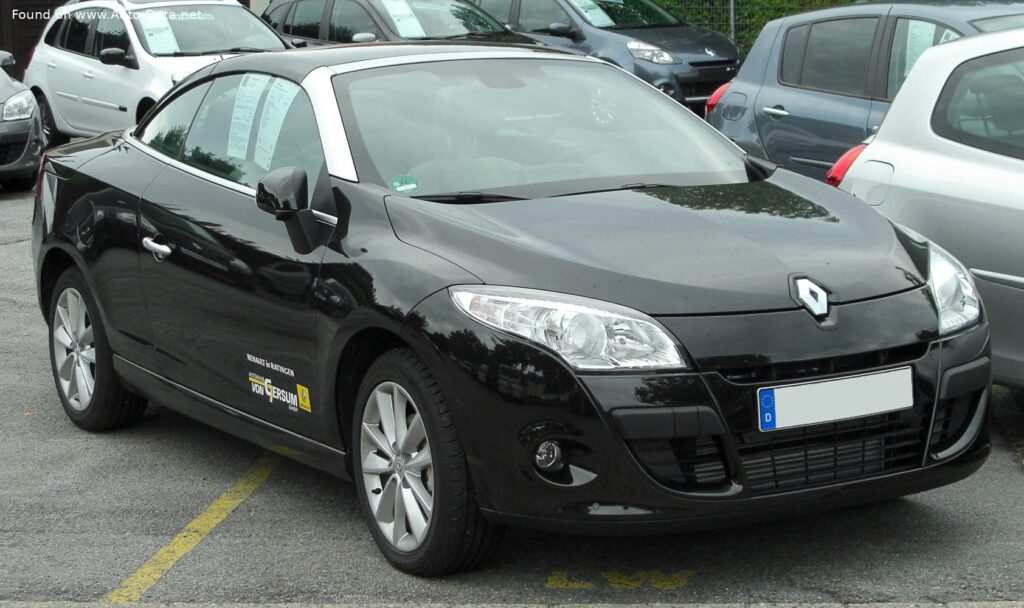
The Megane III CC GT 2.0 TCe (180 Hp) stands out with its elegant coupe-cabriolet body type, featuring a sophisticated retractable hardtop. This design offered the best of both worlds: the security, refinement, and weather protection of a fixed-roof coupe, combined with the exhilarating open-air experience of a convertible. The transformation from coupe to cabriolet was a key selling point, executed with a smooth, automated mechanism.
Aesthetically, the Megane III CC adopted the distinctive styling cues of the third-generation Megane, characterized by its sleek lines, prominent front grille, and sculpted rear. The GT trim likely added specific styling enhancements, such as unique alloy wheels (18-inch rims with 225/40 R18 tires are specified), sportier bumpers, and interior accents to differentiate it from lesser models. With a length of 176.57 inches (4485 mm) and a width of 71.3 inches (1811 mm), the car had a substantial road presence for its class.
Inside, the Megane III CC was designed to accommodate four occupants, offering a relatively spacious cabin for a convertible. While the rear seats might have been more suitable for shorter journeys or children, they added a layer of practicality not always found in two-seater roadsters. Standard features for a GT model of this era would typically include automatic climate control, a sophisticated infotainment system (for its time), and premium upholstery. Safety was also a priority, with the car featuring an Anti-lock Braking System (ABS) as standard, along with a comprehensive array of airbags and structural reinforcements designed to protect occupants in the event of a rollover or collision. The steering system was an electric power-assisted rack and pinion unit, providing a comfortable and responsive driving feel.
One of the practical advantages of the hardtop convertible design was the variable trunk space. With the roof up, the trunk offered a generous 14.73 cu. ft. (417 liters) of cargo capacity, comparable to many compact sedans. However, when the roof was stowed, this capacity was reduced to 7.45 cu. ft. (211 liters), a common compromise for such vehicles. The 15.85 US gallon (60-liter) fuel tank provided a decent cruising range.
Technical Specifications for the Renault Megane III CC GT 2.0 TCe (180 Hp)
| Specification | Value |
|---|---|
| Brand | Renault |
| Model | Megane |
| Generation | Megane III CC |
| Type (Engine) | GT 2.0 TCe (180 Hp) |
| Start of Production | 2010 year |
| End of Production | 2014 year |
| Powertrain Architecture | Internal Combustion engine |
| Body Type | Coupe – Cabriolet |
| Seats | 4 |
| Doors | 2 |
| Performance Specs | |
| Fuel Consumption (Economy) – Urban | 21 US mpg (11.2 l/100 km) |
| Fuel Consumption (Economy) – Extra Urban | 37.3 US mpg (6.3 l/100 km) |
| Fuel Consumption (Economy) – Combined | 29 US mpg (8.1 l/100 km) |
| CO2 Emissions | 188 g/km |
| Fuel Type | Petrol (Gasoline) |
| Acceleration 0 – 60 mph | 8.1 sec |
| Acceleration 0 – 100 km/h | 8.5 sec |
| Maximum Speed | 139.81 mph (225 km/h) |
| Emission Standard | Euro 5 |
| Weight-to-Power Ratio | 8.6 kg/Hp (116.9 Hp/tonne) |
| Weight-to-Torque Ratio | 5.1 kg/Nm (194.8 Nm/tonne) |
| Engine Specs | |
| Power | 180 Hp @ 5500 rpm |
| Power Per Liter | 90.1 Hp/l |
| Torque | 221.27 lb.-ft. @ 2250 rpm (300 Nm @ 2250 rpm) |
| Engine Layout | Front, Transverse |
| Engine Model/Code | F4R 872 |
| Engine Displacement | 121.93 cu. in. (1998 cm3) |
| Number of Cylinders | 4 |
| Engine Configuration | Inline |
| Cylinder Bore | 3.26 in. (82.7 mm) |
| Piston Stroke | 3.66 in. (93 mm) |
| Compression Ratio | 9.3:1 |
| Number of Valves per Cylinder | 4 |
| Fuel Injection System | Multi-port manifold injection |
| Engine Aspiration | Turbocharger, Intercooler |
| Engine Oil Capacity | 5.71 US qt (5.4 l) |
| Engine Oil Specification | Not specified |
| Coolant Capacity | 6.87 US qt (6.5 l) |
| Space, Volume and Weights | |
| Kerb Weight | 3395.12 lbs (1540 kg) |
| Max. Weight | 4246.1 lbs (1926 kg) |
| Max Load | 850.98 lbs (386 kg) |
| Trunk (Boot) Space – Minimum | 7.45 cu. ft. (211 l) |
| Trunk (Boot) Space – Maximum | 14.73 cu. ft. (417 l) |
| Fuel Tank Capacity | 15.85 US gal (60 l) |
| Permitted Trailer Load with Brakes (12%) | 1653.47 lbs (750 kg) |
| Permitted Trailer Load without Brakes | 1653.47 lbs (750 kg) |
| Dimensions | |
| Length | 176.57 in. (4485 mm) |
| Width | 71.3 in. (1811 mm) |
| Width Including Mirrors | 81.57 in. (2072 mm) |
| Height | 56.46 in. (1434 mm) |
| Wheelbase | 102.72 in. (2609 mm) |
| Front Track | 60.87 in. (1546 mm) |
| Rear (Back) Track | 60.91 in. (1547 mm) |
| Front Overhang | 33.94 in. (862 mm) |
| Rear Overhang | 39.92 in. (1014 mm) |
| Ride Height (Ground Clearance) | 4.72 in. (120 mm) |
| Minimum Turning Circle (Turning Diameter) | 35.93 ft. (10.95 m) |
| Drivetrain, Brakes and Suspension Specs | |
| Drivetrain Architecture | Front wheel drive; Internal combustion engine drives the front wheels. |
| Drive Wheel | Front wheel drive |
| Number of Gears and Type of Gearbox | 6 gears, manual transmission |
| Front Suspension | Independent type McPherson |
| Rear Suspension | Torsion beam |
| Front Brakes | Ventilated discs |
| Rear Brakes | Disc |
| Assisting Systems | ABS (Anti-lock braking system) |
| Steering Type | Steering rack and pinion |
| Power Steering | Electric Steering |
| Tires Size | 225/40 R18 |
| Wheel Rims Size | 18 inches |
Legacy and Market Impact
The Renault Megane III CC GT 2.0 TCe (180 Hp) carved out a niche for itself in the highly competitive European compact convertible market. Its primary rivals included other popular hardtop convertibles of the era, such as the Peugeot 308 CC, Volkswagen Eos, and Opel Astra TwinTop. The Megane CC distinguished itself with its distinctive French styling, comfortable ride, and the perceived security and refinement of its retractable glass roof, a feature that was quite advanced for its time.
The GT 2.0 TCe (180 Hp) variant, in particular, enhanced the Megane CC’s appeal by offering a more engaging driving experience than its naturally aspirated counterparts. It provided a compelling option for buyers who desired open-top motoring but didn’t want to sacrifice performance or the practicality of a four-seater. Its strong torque delivery made it well-suited for both urban commutes and longer road trips, while the 6-speed manual transmission appealed to driving enthusiasts.
While the Megane III CC, like many hardtop convertibles, faced challenges with its increased weight and complexity compared to fixed-roof coupes or traditional soft-top convertibles, it nonetheless contributed positively to Renault’s image. It showcased the brand’s ability to combine innovative design with practical engineering and a touch of sporting flair. The Megane CC series, including this GT variant, helped solidify Renault’s presence in a lifestyle segment that valued both aesthetic appeal and functional versatility.
In terms of historical significance, the Megane III CC represented a continuation of Renault’s commitment to offering diverse body styles within its best-selling Megane family. It demonstrated the evolution of convertible technology, moving towards more refined and secure hardtop solutions. Though it was eventually succeeded by other models and the hardtop convertible trend waned, the Megane III CC GT 2.0 TCe (180 Hp) remains a testament to a period when automakers strived to offer accessible, stylish, and enjoyable open-top cars to a broad audience in Europe. Its legacy is one of a well-rounded, distinctive, and surprisingly capable compact convertible that delivered on its promise of a versatile and spirited driving experience.