Introduction to the Renault Megane III Coupe 1.5 dCi (110 Hp) FAP EDC
The Renault Megane III Coupe 1.5 dCi (110 Hp) FAP EDC represents a significant offering from the French automaker in the highly competitive European C-segment. Produced between 2008 and 2012, this particular variant of the third-generation Megane Coupe showcased Renault’s commitment to combining distinctive styling with practical efficiency and modern powertrain technology. While the Renault Megane was never officially sold in the United States market, it played a crucial role in Europe, appealing to buyers looking for a stylish, compact vehicle that offered a sportier aesthetic than its hatchback counterpart, without sacrificing everyday usability.
This specific model, with its 1.5-liter dCi diesel engine, 110 horsepower output, FAP (Diesel Particulate Filter) for reduced emissions, and EDC (Efficient Dual Clutch) automatic transmission, was engineered to deliver an optimal balance of fuel economy, environmental performance, and comfortable driving dynamics. It carved out a niche for itself by offering a three-door coupe body style that was both elegant and surprisingly accommodating for a car of its class, making it a compelling choice for European consumers seeking a blend of flair and fiscal responsibility.
Powertrain and Performance of the Renault Megane III Coupe 1.5 dCi (110 Hp) FAP EDC
At the heart of the Renault Megane III Coupe 1.5 dCi (110 Hp) FAP EDC lies a highly efficient 1.5-liter (1461 cm3 or 89.16 cu. in.) inline four-cylinder diesel engine, designated with the internal code K9K 837. This powerplant, a cornerstone of Renault’s compact and subcompact offerings across Europe, is renowned for its impressive fuel economy and robust torque delivery. It employs a common rail direct injection system, coupled with a turbocharger and intercooler, to produce a respectable 110 horsepower at 4000 rpm. More notably for a diesel, it generates 177.01 lb.-ft. (240 Nm) of torque at a low 1750 rpm, providing strong pulling power from early in the rev range.
The engine’s configuration, with two valves per cylinder and a compression ratio of 15.2:1, is optimized for diesel efficiency. The inclusion of a Diesel Particulate Filter (FAP) was critical in meeting the stringent Euro 5 emission standards prevalent during its production years, highlighting Renault’s focus on environmental compliance.
Power is transmitted to the front wheels through a sophisticated 6-speed EDC (Efficient Dual Clutch) automatic transmission. This gearbox, known for its smooth and rapid shifts, contributes significantly to both the car’s performance and its remarkable fuel efficiency. The combination allows the Megane Coupe to accelerate from 0 to 60 mph in a competitive 11.1 seconds, with a top speed of 118 mph (190 km/h).
Fuel economy was a major selling point for this variant. The combined cycle fuel consumption is an impressive 56 US mpg (4.2 l/100 km), while extra-urban driving could yield up to 63.6 US mpg (3.7 l/100 km). Urban driving figures were also commendable at 46.1 US mpg (5.1 l/100 km). These figures, combined with CO2 emissions of just 109 g/km, underscored the Megane Coupe 1.5 dCi’s credentials as an environmentally conscious and economically viable daily driver in its market.
Design, Features, and Ergonomics
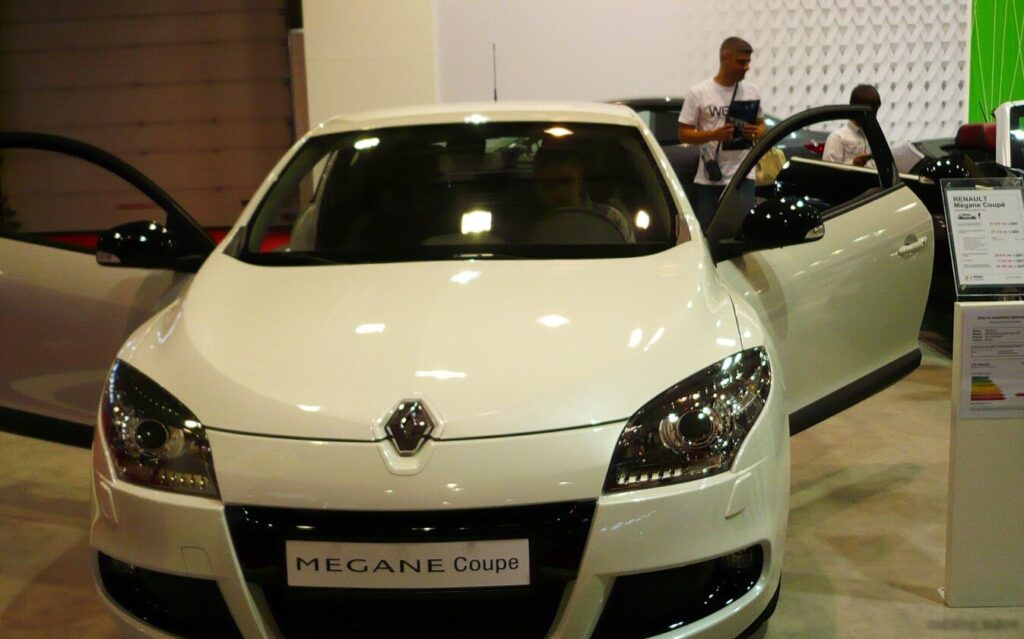
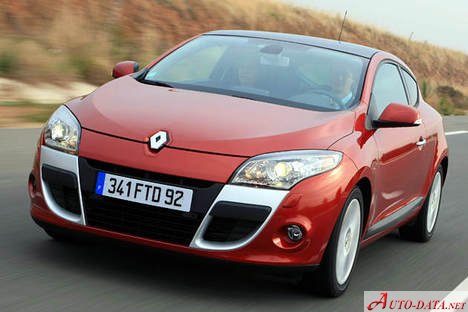
The Renault Megane III Coupe stood out with its distinctive and dynamic design, a stark contrast to the more conventional styling of its hatchback sibling. With its sleek three-door coupe body, it exuded a sportier and more aggressive stance. Its dimensions – 169.25 inches (4299 mm) in length, 71.02 inches (1804 mm) in width (80.2 inches or 2037 mm including mirrors), and 56.02 inches (1423 mm) in height – gave it a low-slung, planted appearance. The wheelbase of 103.94 inches (2640 mm) contributed to both its visual balance and its stable ride.
Despite its coupe designation, the Megane III Coupe was designed to be practical, offering seating for five occupants. While access to the rear seats was naturally more restricted than in a five-door model, the interior was thoughtfully laid out. The trunk (boot) space ranged from 12.15 cubic feet (344 liters) to a maximum of 13.31 cubic feet (377 liters), which was quite generous for a coupe in its class, making it suitable for weekend trips or grocery runs.
Key features included a robust drivetrain architecture with front-wheel drive, utilizing an independent McPherson strut front suspension and a torsion beam rear suspension, a common and effective setup for compact vehicles, balancing ride comfort with agile handling. Braking was handled by ventilated discs at the front and solid discs at the rear, augmented by an Anti-lock Braking System (ABS) for enhanced safety. The electric power steering system provided light and precise control, making urban maneuvers and parking effortless. Standard tire sizes typically included 205/55 R16 or 205/50 R17, mounted on 6.5J x 16 or 6.5J x 17 wheel rims, respectively, contributing to both aesthetics and roadholding. The vehicle’s kerb weight of 2656.57 lbs (1205 kg) also contributed to its nimble feel.
Technical Specifications
| Renault Megane III Coupe 1.5 dCi (110 Hp) FAP EDC (2008-2012) | |
|---|---|
General Information |
|
| Brand | Renault |
| Model | Megane |
| Generation | Megane III Coupe |
| Type (Engine) | 1.5 dCi (110 Hp) FAP EDC |
| Production Start | 2008 year |
| Production End | 2012 year |
| Powertrain Architecture | Internal Combustion engine |
| Body Type | Coupe |
| Seats | 5 |
| Doors | 3 |
Performance Specifications |
|
| Fuel Consumption (Urban) | 46.1 US mpg (5.1 l/100 km) |
| Fuel Consumption (Extra Urban) | 63.6 US mpg (3.7 l/100 km) |
| Fuel Consumption (Combined) | 56 US mpg (4.2 l/100 km) |
| CO2 Emissions | 109 g/km |
| Fuel Type | Diesel |
| Acceleration 0-60 mph | 11.1 sec |
| Acceleration 0-100 km/h | 11.7 sec |
| Maximum Speed | 118.06 mph (190 km/h) |
| Emission Standard | Euro 5 |
| Weight-to-Power Ratio | 11 kg/Hp, 91.3 Hp/tonne |
| Weight-to-Torque Ratio | 5 kg/Nm, 199.2 Nm/tonne |
Engine Specifications |
|
| Power | 110 Hp @ 4000 rpm |
| Power per Liter | 75.3 Hp/l |
| Torque | 177.01 lb.-ft. (240 Nm) @ 1750 rpm |
| Engine Layout | Front, Transverse |
| Engine Model/Code | K9K 837 |
| Engine Displacement | 89.16 cu. in. (1461 cm3) |
| Number of Cylinders | 4 |
| Engine Configuration | Inline |
| Cylinder Bore | 2.99 in. (76 mm) |
| Piston Stroke | 3.17 in. (80.5 mm) |
| Compression Ratio | 15.2:1 |
| Number of Valves per Cylinder | 2 |
| Fuel Injection System | Diesel Commonrail |
| Engine Aspiration | Turbocharger, Intercooler |
| Engine Oil Capacity | 4.76 US qt (4.5 l) |
| Coolant Capacity | 6.87 US qt (6.5 l) |
| Engine Systems | Particulate filter |
Space, Volume and Weights |
|
| Kerb Weight | 2656.57 lbs (1205 kg) |
| Max. Weight | 3952.89 lbs (1793 kg) |
| Max Load | 1296.32 lbs (588 kg) |
| Trunk (Boot) Space – Minimum | 12.15 cu. ft. (344 l) |
| Trunk (Boot) Space – Maximum | 13.31 cu. ft. (377 l) |
| Fuel Tank Capacity | 15.85 US gal (60 l) |
| Max. Roof Load | 176.37 lbs (80 kg) |
| Permitted Trailer Load with Brakes (12%) | 2866.01 lbs (1300 kg) |
| Permitted Trailer Load without Brakes | 1410.96 lbs (640 kg) |
| Permitted Towbar Download | 165.35 lbs (75 kg) |
Dimensions |
|
| Length | 169.25 in. (4299 mm) |
| Width | 71.02 in. (1804 mm) |
| Width Including Mirrors | 80.2 in. (2037 mm) |
| Height | 56.02 in. (1423 mm) |
| Wheelbase | 103.94 in. (2640 mm) |
| Front Track | 60.87 in. (1546 mm) |
| Rear (Back) Track | 60.91 in. (1547 mm) |
| Front Overhang | 33.94 in. (862 mm) |
| Rear Overhang | 31.38 in. (797 mm) |
| Ride Height (Ground Clearance) | 4.72 in. (120 mm) |
| Minimum Turning Circle (Turning Diameter) | 35.93 ft. (10.95 m) |
Drivetrain, Brakes and Suspension Specifications |
|
| Drivetrain Architecture | The Internal combustion engine (ICE) drives the front wheels of the vehicle. |
| Drive Wheel | Front wheel drive |
| Number of Gears and Type of Gearbox | 6 gears, automatic transmission EDC |
| Front Suspension | Independent type McPherson |
| Rear Suspension | Torsion |
| Front Brakes | Ventilated discs |
| Rear Brakes | Disc |
| Assisting Systems | ABS (Anti-lock braking system) |
| Steering Type | Steering rack and pinion |
| Power Steering | Electric Steering |
| Tires Size | 205/55 R16; 205/50 R17 |
| Wheel Rims Size | 6.5J x 16; 6.5J x 17 |
Legacy and Market Impact
The Renault Megane III Coupe, particularly the 1.5 dCi (110 Hp) FAP EDC variant, carved out a distinct legacy in the European compact segment during its production run. It was positioned as a more emotionally appealing alternative to the ubiquitous compact hatchback, targeting buyers who desired a blend of style, efficiency, and modern technology. Its sleek, three-door profile distinguished it from competitors and contributed to Renault’s reputation for bold design.
In its primary European market, the Megane Coupe competed against a strong field of rivals. Key competitors included models like the Opel Astra GTC, the Volkswagen Scirocco, and the Peugeot 308 Coupe. What set the Megane apart was its ability to offer a compelling package of a distinctive design, excellent fuel economy from its refined dCi diesel engine, and the convenience of a modern dual-clutch automatic transmission. The 1.5 dCi engine, in particular, was lauded for its low running costs, making it a popular choice for both private buyers and fleet operators in countries where diesel fuel was prevalent and favored.
The car’s strong emphasis on efficiency, evidenced by its Euro 5 compliance and impressive fuel consumption figures, reflected the growing environmental consciousness and fuel price sensitivity in Europe during the late 2000s and early 2010s. The EDC transmission also played a crucial role, offering the smooth operation of an automatic with the efficiency typically associated with manual gearboxes, contributing to a more relaxed and enjoyable driving experience in urban environments and on longer journeys.
While the Renault Megane, in any of its forms, never officially made it to the North American market, its impact in Europe was considerable. It reinforced Renault’s position as a leader in compact car design and diesel engine technology. The Megane III Coupe helped to democratize stylish coupe ownership, making it accessible to a broader audience who might otherwise have opted for a more mundane hatchback. Its blend of French flair, practical considerations, and advanced powertrain technology ensured its relevance and desirability throughout its production cycle, leaving a mark as a well-rounded and visually appealing option in its segment.