The Renault Megane III Coupe (Phase II, 2012) 1.4 TCe (130 Hp): A European Compact Performer
The Renault Megane III Coupe (Phase II, 2012) 1.4 TCe (130 Hp) represents a compelling entry in the European compact car segment, specifically targeting buyers seeking a sportier aesthetic and driving experience than its more utilitarian hatchback sibling. Introduced in 2012 as part of the Megane’s mid-cycle refresh (Phase II), this particular variant showcased Renault’s commitment to offering efficient yet engaging powertrains. While the Megane line has been a stalwart in the European market for decades, it was not offered for sale in the United States, making it a relatively unknown entity to American consumers. In its primary European market, the Megane III Coupe carved out a niche as an accessible and stylish three-door option, blending practicality with a dynamic stance. This 2012 model, with its turbocharged 1.4-liter gasoline engine, aimed to deliver a balance of everyday usability, spirited performance, and competitive fuel economy, adhering to the Euro 5 emission standards prevalent at the time.
Engine and Performance
At the heart of the Renault Megane III Coupe (Phase II, 2012) 1.4 TCe (130 Hp) lies a sophisticated 1.4-liter (1395 cm³ or 85.13 cu. in.) turbocharged gasoline engine, designated by Renault as the H4J 700. This inline four-cylinder unit, featuring a multi-port manifold injection system and an intercooler, was engineered to deliver a strong blend of power and efficiency for its class. It produced a respectable 130 horsepower at 5500 rpm, translating to a power-per-liter output of 93.2 horsepower per liter, which was quite competitive for a non-performance-oriented engine of its size.
More impressively, the engine generated a robust 190 Nm (140.14 lb.-ft.) of torque at a relatively low 2250 rpm. This broad torque band was crucial for everyday drivability, providing strong acceleration from low engine speeds and reducing the need for frequent downshifts. Mated to a precise 6-speed manual transmission, this powertrain architecture drove the front wheels, offering a traditional and engaging driving experience.
In terms of performance, the 1.4 TCe (130 Hp) Megane Coupe was capable of accelerating from 0 to 60 mph in an estimated 9.2 seconds (0-100 km/h in 9.7 seconds), reaching a top speed of 124.27 mph (200 km/h). These figures positioned it as a brisk performer within the compact coupe segment, suitable for both urban commuting and longer highway journeys. Fuel economy was also a strong suit, with a combined rating of 6.3 liters per 100 km (37.3 US mpg), contributing to CO2 emissions of 145 g/km, allowing it to meet the Euro 5 emission standard. Its weight-to-power ratio stood at 9.3 kg/Hp (107.9 Hp/tonne), indicating efficient power utilization for its 2656.57 lbs (1205 kg) curb weight.
Design and Features
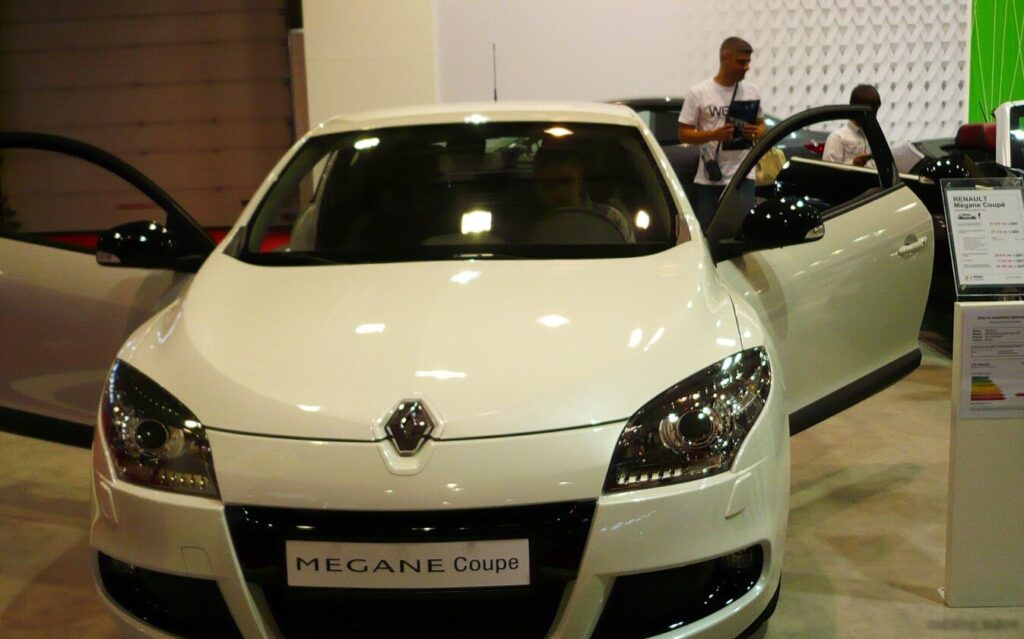
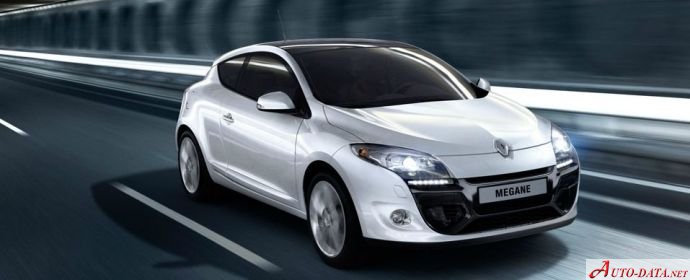
The Megane III Coupe, particularly in its Phase II iteration from 2012, boasted a distinctive and attractive design that set it apart from its hatchback and sedan counterparts. As a three-door coupe, it featured a sleeker, more dynamic profile with a lower roofline and a sportier stance. The Phase II refresh brought subtle but effective aesthetic enhancements, including revised front fascias, updated lighting signatures, and new wheel designs, further sharpening its appeal. Measuring 169.25 inches (4299 mm) in length, 70.28 inches (1785 mm) in width, and 56.02 inches (1423 mm) in height, the Megane Coupe maintained compact dimensions suitable for navigating crowded European city streets while offering a surprisingly spacious interior for its class.
Despite its coupe designation, the Megane III Coupe was designed with practical considerations. It offered seating for five occupants, a notable advantage over many 2+2 coupes, though rear passenger access and legroom were naturally more constrained than in the five-door hatchback. The trunk space was generous for a coupe, ranging from 13.31 cubic feet (377 liters) with all seats in place, expanding to a substantial 35 cubic feet (991 liters) with the rear seats folded down, making it quite versatile for luggage or larger items.
The vehicle’s chassis featured an independent McPherson strut front suspension and a torsion beam rear suspension, a common and effective setup for front-wheel-drive compact cars, balancing ride comfort with responsive handling. Stopping power was provided by ventilated disc brakes at the front and solid discs at the rear, augmented by an Anti-lock Braking System (ABS) for enhanced safety. Electric power steering, a rack and pinion system, offered light and precise control, aiding maneuverability in urban environments. The car rode on 205/55 R16 91H tires mounted on 6.5J x 16-inch wheel rims, providing a good balance of grip and ride quality.
Technical Specifications
| Category | Specification |
|---|---|
| General Information | |
| Brand | Renault |
| Model | Megane |
| Generation | Megane III Coupe (Phase II, 2012) |
| Engine Type | 1.4 TCe (130 Hp) |
| Production Start | 2012 year |
| Production End | 2013 year |
| Powertrain Architecture | Internal Combustion engine |
| Body Type | Coupe |
| Seats | 5 |
| Doors | 3 |
| Performance Specs | |
| Fuel Consumption (Urban) | 8.4 l/100 km (28 US mpg) |
| Fuel Consumption (Extra Urban) | 5.1 l/100 km (46.1 US mpg) |
| Fuel Consumption (Combined) | 6.3 l/100 km (37.3 US mpg) |
| CO2 Emissions | 145 g/km |
| Fuel Type | Petrol (Gasoline) |
| Acceleration 0-60 mph | 9.2 sec |
| Acceleration 0-100 km/h | 9.7 sec |
| Maximum Speed | 200 km/h (124.27 mph) |
| Emission Standard | Euro 5 |
| Weight-to-Power Ratio | 9.3 kg/Hp (107.9 Hp/tonne) |
| Weight-to-Torque Ratio | 6.3 kg/Nm (157.7 Nm/tonne) |
| Engine Specs | |
| Power | 130 Hp @ 5500 rpm |
| Power per Liter | 93.2 Hp/l |
| Torque | 190 Nm @ 2250 rpm (140.14 lb.-ft. @ 2250 rpm) |
| Engine Layout | Front, Transverse |
| Engine Model/Code | H4J 700 |
| Engine Displacement | 1395 cm³ (1.4 L / 85.13 cu. in.) |
| Number of Cylinders | 4 |
| Engine Configuration | Inline |
| Cylinder Bore | 78 mm (3.07 in.) |
| Piston Stroke | 73.1 mm (2.88 in.) |
| Compression Ratio | 9.1:1 |
| Valves per Cylinder | 4 |
| Fuel Injection System | Multi-port manifold injection |
| Engine Aspiration | Turbocharger, Intercooler |
| Engine Oil Capacity | 4.5 l (4.76 US qt) |
| Coolant Capacity | 6.5 l (6.87 US qt) |
| Space, Volume and Weights | |
| Kerb Weight | 1205 kg (2656.57 lbs.) |
| Max. Weight | 1772 kg (3906.59 lbs.) |
| Max Load | 567 kg (1250.02 lbs.) |
| Trunk Space (Min) | 377 l (13.31 cu. ft.) |
| Trunk Space (Max) | 991 l (35 cu. ft.) |
| Fuel Tank Capacity | 60 l (15.85 US gal) |
| Permitted Trailer Load with Brakes (12%) | 1300 kg (2866.01 lbs.) |
| Permitted Trailer Load without Brakes | 635 kg (1399.94 lbs.) |
| Dimensions | |
| Length | 4299 mm (169.25 in.) |
| Width | 1785 mm (70.28 in.) |
| Height | 1423 mm (56.02 in.) |
| Wheelbase | 2640 mm (103.94 in.) |
| Front Track | 1546 mm (60.87 in.) |
| Rear Track | 1547 mm (60.91 in.) |
| Front Overhang | 862 mm (33.94 in.) |
| Rear Overhang | 797 mm (31.38 in.) |
| Ride Height (Ground Clearance) | 120 mm (4.72 in.) |
| Minimum Turning Circle | 10.95 m (35.93 ft.) |
| Drivetrain, Brakes and Suspension Specs | |
| Drivetrain Architecture | Front-wheel drive, Internal Combustion engine |
| Drive Wheel | Front wheel drive |
| Gearbox Type | 6 gears, manual transmission |
| Front Suspension | Independent type McPherson |
| Rear Suspension | Torsion beam |
| Front Brakes | Ventilated discs |
| Rear Brakes | Disc |
| Assisting Systems | ABS (Anti-lock braking system) |
| Steering Type | Steering rack and pinion |
| Power Steering | Electric Steering |
| Tires Size | 205/55 R16 91H |
| Wheel Rims Size | 6.5J x 16 |
Legacy and Market Impact
The Renault Megane III Coupe (Phase II, 2012) 1.4 TCe (130 Hp) played a significant role in Renault’s strategy to offer a broad and versatile lineup in the highly competitive European compact segment. While the five-door hatchback and Wagon (Estate) variants typically accounted for the bulk of Megane sales due to their practicality, the Coupe provided an emotional appeal, attracting buyers who prioritized style and a more engaging driving posture. It stood as a testament to Renault’s design capabilities, offering a distinctive aesthetic that helped it stand out in a crowded market.
In its competitive landscape, the Megane III Coupe faced rivals such as the Volkswagen Scirocco, Opel Astra GTC, and to a lesser extent, sporty versions of compact hatchbacks like the Peugeot 308. While the Scirocco often commanded a premium for its VW badge and sportier chassis, the Megane Coupe typically offered a more accessible entry point into the compact coupe segment, often with a generous standard equipment list. Its 1.4 TCe engine, with its balance of performance and efficiency, was particularly well-suited for European tax structures and fuel prices, making it an economically sensible choice for many consumers.
The Megane III generation, and specifically the Coupe, helped solidify Renault’s reputation for producing vehicles with distinctive styling and a focus on comfort and safety. While not a groundbreaking technological marvel, the 2012 Phase II update brought incremental improvements in refinement and efficiency, keeping it relevant against newer competitors. Its legacy is one of a stylish, practical, and well-rounded compact coupe that offered a compelling alternative for European drivers seeking something beyond the conventional hatchback, successfully blending French design flair with pragmatic engineering. For the North American market, it remains an interesting example of the diverse automotive landscape that exists outside its borders, showcasing a different approach to compact vehicle design and powertrain philosophy.