The Renault Megane III Coupe (Phase II, 2012): A Stylish European Diesel Compact
The Renault Megane III Coupe (Phase II, 2012) represents a distinctive chapter in the third generation of Renault’s popular compact car series. Unveiled as part of the “Phase II” refresh for the Megane III lineup, this particular variant, equipped with the 1.5 dCi (110 Hp) FAP engine, carved out a niche in the highly competitive European compact segment from its production start in 2012 until its conclusion in 2013. While never officially sold in the United States, the Megane III Coupe was a significant player in markets like France, the UK, and Germany, offering a blend of attractive styling, practical compact dimensions, and impressive fuel efficiency, particularly with its advanced diesel powertrain.
The Megane III generation marked a departure from the somewhat controversial styling of its predecessor, adopting a more conventional yet undeniably elegant design language. The Coupe variant, in particular, emphasized sportiness and flair, appealing to buyers who prioritized aesthetics alongside daily usability. The Phase II update brought subtle refinements to the exterior and interior, keeping the model fresh against rivals. This specific 1.5 dCi model, with its 110 horsepower and Diesel Particulate Filter (FAP), was a testament to Renault’s commitment to producing economical and environmentally conscious vehicles for the European market, adhering to Euro 5 emission standards.
Engine and Performance of the Renault Megane III Coupe (Phase II, 2012) 1.5 dCi
At the heart of this particular Renault Megane III Coupe (Phase II, 2012) lies the acclaimed K9K 656 1.5-liter (1461 cm³ or 89.16 cu. in.) dCi inline-four diesel engine. This powertrain was a cornerstone of Renault’s smaller and mid-sized vehicle offerings across Europe, renowned for its balance of efficiency and usable torque. With a power output of 110 horsepower at 4000 rpm and a robust 240 Nm (177.01 lb.-ft.) of torque delivered at a low 1750 rpm, the engine provided ample motivation for the compact coupe.
The engine’s architecture, featuring a front, transverse layout, and a sophisticated Diesel Commonrail fuel injection system, was complemented by a turbocharger and intercooler. This setup ensured responsive power delivery and optimized combustion, contributing significantly to its fuel economy. Mated to a precise 6-speed manual transmission, the Megane Coupe could accelerate from 0 to 60 mph in a respectable 11.7 seconds (0-100 km/h in 12.3 seconds) and reach a top speed of 118.06 mph (190 km/h). While not a performance-oriented model, these figures made it a capable and enjoyable car for daily commuting and longer journeys on European highways.
Fuel efficiency was a major selling point for the 1.5 dCi engine. The combined fuel consumption was rated at an impressive 4.1 liters per 100 kilometers, translating to approximately 57.4 US miles per gallon. Urban driving yielded about 48 US mpg (4.9 l/100 km), while extra-urban cruising could achieve an outstanding 67.2 US mpg (3.5 l/100 km). These figures, coupled with CO2 emissions of just 106 g/km and Euro 5 compliance, underscored the vehicle’s commitment to environmental responsibility, a critical factor in the European automotive landscape.
Design and Features
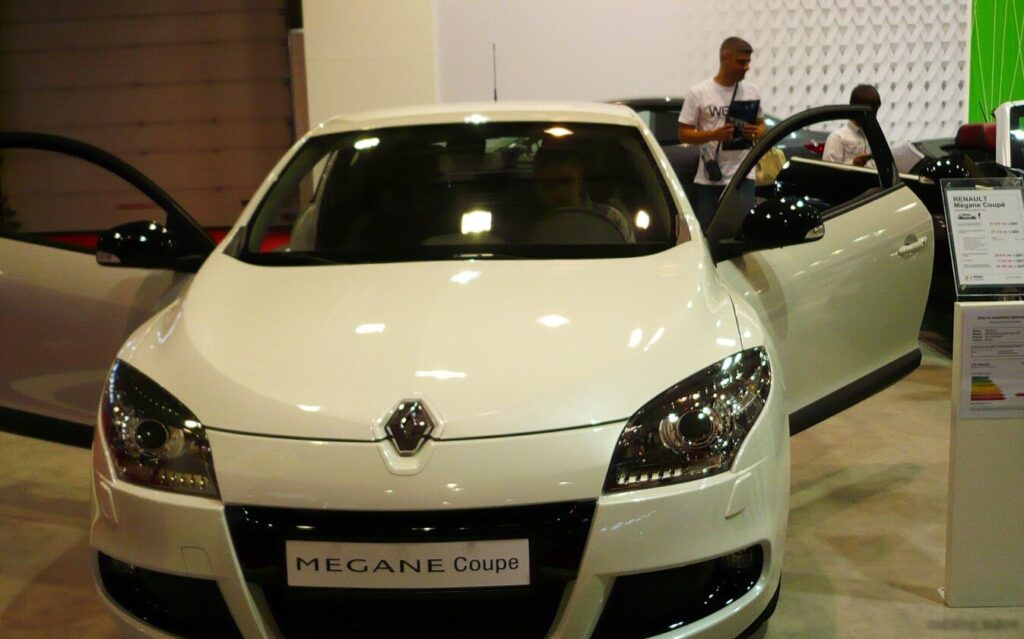
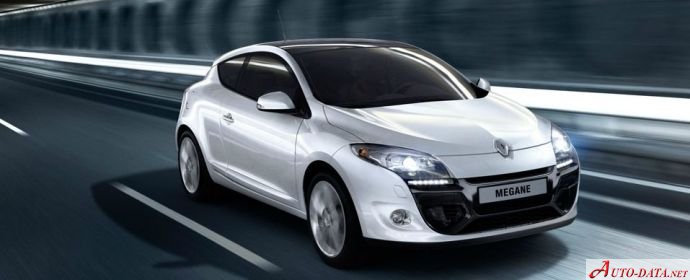
The Megane III Coupe, especially in its Phase II iteration, was a visually striking vehicle. It adopted a sleek, three-door coupe body type, distinguishing it from its more utilitarian hatchback and sedan siblings. Its design was characterized by smooth lines, a dynamic profile, and a more aggressive stance than the standard Megane. The Phase II refresh brought subtle updates, likely including revised headlight and taillight designs, grille elements, and possibly new wheel options, to maintain its contemporary appeal.
Inside, the Megane III Coupe offered a comfortable and well-appointed cabin, designed to accommodate five occupants, though the rear seats in a compact coupe would naturally be tighter than in a five-door model. Standard features for this era and segment typically included air conditioning, power windows and mirrors, a multi-function steering wheel, and a capable audio system. Safety was a paramount concern for Renault, and the Megane III Coupe incorporated essential features such as an Anti-lock Braking System (ABS), and a comprehensive airbag system. The inclusion of a Diesel Particulate Filter (FAP) was not just an emission control device but also a key technological feature, ensuring cleaner exhaust gases.
The car’s dimensions—a length of 169.25 inches, a width of 70.28 inches, and a height of 56.02 inches—contributed to its agile handling and ease of maneuverability in urban environments. A wheelbase of 103.94 inches provided a stable ride, while the independent McPherson front suspension and torsion beam rear suspension offered a comfortable yet engaging driving experience. Braking was handled by ventilated discs at the front and solid discs at the rear, providing confident stopping power. Electric power steering further enhanced the driving experience, offering ease of control at low speeds and improved feedback at higher velocities.
Technical Specifications
| Category | Specification |
|---|---|
| Brand | Renault |
| Model | Megane |
| Generation | Megane III Coupe (Phase II, 2012) |
| Type (Engine) | 1.5 dCi (110 Hp) FAP |
| Start of Production | 2012 year |
| End of Production | 2013 year |
| Powertrain Architecture | Internal Combustion engine |
| Body type | Coupe |
| Seats | 5 |
| Doors | 3 |
| Performance Specs | |
| Fuel Consumption (Urban) | 4.9 l/100 km (48 US mpg) |
| Fuel Consumption (Extra Urban) | 3.5 l/100 km (67.2 US mpg) |
| Fuel Consumption (Combined) | 4.1 l/100 km (57.4 US mpg) |
| CO2 Emissions | 106 g/km |
| Fuel Type | Diesel |
| Acceleration 0-60 mph | 11.7 sec |
| Maximum Speed | 190 km/h (118.06 mph) |
| Emission Standard | Euro 5 |
| Weight-to-Power Ratio | 11 kg/Hp, 91.3 Hp/tonne |
| Weight-to-Torque Ratio | 5 kg/Nm, 199.2 Nm/tonne |
| Engine Specs | |
| Power | 110 Hp @ 4000 rpm |
| Power per Liter | 75.3 Hp/l |
| Torque | 240 Nm @ 1750 rpm (177.01 lb.-ft. @ 1750 rpm) |
| Engine Layout | Front, Transverse |
| Engine Model/Code | K9K 656 |
| Engine Displacement | 1461 cm³ (89.16 cu. in.) |
| Number of Cylinders | 4 |
| Engine Configuration | Inline |
| Cylinder Bore | 76 mm (2.99 in.) |
| Piston Stroke | 80.5 mm (3.17 in.) |
| Compression Ratio | 15.2:1 |
| Number of Valves per Cylinder | 2 |
| Fuel Injection System | Diesel Commonrail |
| Engine Aspiration | Turbocharger, Intercooler |
| Engine Oil Capacity | 4.5 l (4.76 US qt) |
| Coolant Capacity | 6.5 l (6.87 US qt) |
| Engine Systems | Particulate filter |
| Space, Volume and Weights | |
| Kerb Weight | 1205 kg (2656.57 lbs) |
| Max. Weight | 1795 kg (3957.3 lbs) |
| Max Load | 590 kg (1300.73 lbs) |
| Trunk (boot) Space – Minimum | 377 l (13.31 cu. ft.) |
| Trunk (boot) Space – Maximum | 991 l (35 cu. ft.) |
| Fuel Tank Capacity | 60 l (15.85 US gal) |
| Permitted Trailer Load with Brakes (12%) | 1300 kg (2866.01 lbs) |
| Permitted Trailer Load without Brakes | 635 kg (1399.94 lbs) |
| Dimensions | |
| Length | 4299 mm (169.25 in.) |
| Width | 1785 mm (70.28 in.) |
| Height | 1423 mm (56.02 in.) |
| Wheelbase | 2640 mm (103.94 in.) |
| Front Track | 1546 mm (60.87 in.) |
| Rear (Back) Track | 1547 mm (60.91 in.) |
| Front Overhang | 862 mm (33.94 in.) |
| Rear Overhang | 797 mm (31.38 in.) |
| Ride Height (Ground Clearance) | 120 mm (4.72 in.) |
| Minimum Turning Circle (Turning Diameter) | 10.95 m (35.93 ft.) |
| Drivetrain, Brakes and Suspension Specs | |
| Drivetrain Architecture | Front-wheel drive with Internal Combustion Engine (ICE) |
| Drive Wheel | Front wheel drive |
| Number of Gears and Type of Gearbox | 6 gears, manual transmission |
| Front Suspension | Independent type McPherson |
| Rear Suspension | Torsion |
| Front Brakes | Ventilated discs |
| Rear Brakes | Disc |
| Assisting Systems | ABS (Anti-lock braking system) |
| Steering Type | Steering rack and pinion |
| Power Steering | Electric Steering |
| Tires Size | 195/65 R15 91H |
| Wheel Rims Size | 6.5J x 15 |
Legacy and Market Impact
The Renault Megane III Coupe (Phase II, 2012) played a significant role in solidifying Renault’s position in the European compact car segment, especially for those seeking a more emotionally charged design than the standard hatchback. It competed directly with other stylish compact coupes and three-door hatchbacks such as the Volkswagen Scirocco, Opel Astra GTC, and the Peugeot 308 Coupe. While the Scirocco might have offered a sportier image and the Astra GTC a bolder aesthetic, the Megane Coupe distinguished itself with its flowing, elegant lines and a strong emphasis on fuel economy, particularly with the 1.5 dCi engine.
Renault, as a brand, has a long-standing reputation for producing practical, comfortable, and innovative vehicles for the European mass market. The Megane III Coupe continued this tradition, offering a compelling package of style, efficiency, and everyday usability. Its diesel powertrain, a common choice in Europe due to favorable fuel pricing and tax structures, made it an economical option for many drivers, allowing for long-distance travel with fewer stops for refueling. The inclusion of a Diesel Particulate Filter (FAP) underscored Renault’s commitment to meeting stringent European emission standards, positioning the car as a responsible choice in an increasingly environmentally conscious market.
Although its production run as a Phase II model was relatively brief (2012-2013), the Megane III Coupe, and specifically the 1.5 dCi variant, contributed to the Megane’s overall success in Europe. It appealed to a demographic that desired the practicality of a compact car but with the added allure of a sportier, more distinctive body style. Its legacy is one of a well-rounded European compact that successfully blended appealing design with real-world efficiency and a comfortable driving experience, remaining a recognizable and respected model in its primary markets long after its production ceased.