Introduction to the Renault Megane III Coupe (Phase III, 2014)
The Renault Megane III Coupe (Phase III, 2014) represents a stylish and efficient iteration of Renault’s popular compact car, specifically tailored for the European market. Unveiled as part of the third-generation Megane’s mid-cycle refresh, this particular variant, equipped with the 1.5 dCi (95 Hp) FAP engine, offered a compelling blend of sporty aesthetics, practical five-seat accommodation, and exceptional fuel economy. While never officially imported to the United States, the Megane Coupe played a significant role in the highly competitive European C-segment, providing a more dynamic and visually distinct alternative to its hatchback and sedan siblings. Its design language, performance characteristics, and focus on diesel efficiency underscore the distinct preferences and regulatory landscape of its primary market during the mid-2010s.
The third generation of the Megane, initially launched in 2008, received its final significant update, known as “Phase III,” in 2014. This refresh brought subtle styling enhancements, updated technology, and refinements to its powertrain lineup. The Coupe body style, with its sleeker profile and three-door configuration, aimed to capture a younger, more design-conscious demographic seeking a compact car with a sportier edge. The inclusion of the 1.5 dCi diesel engine with a Diesel Particulate Filter (FAP) was a direct response to Europe’s strong demand for highly fuel-efficient and low-emission vehicles.
The Renault Megane III Coupe (Phase III, 2014): A European Compact Performer
Engine and Performance
At the heart of this particular Renault Megane III Coupe (Phase III, 2014) lies the venerable K9K 846 1.5-liter (1461 cm3 or 89.16 cubic inches) inline-four common-rail diesel engine. This unit, known for its robustness and efficiency across various Renault and Nissan models, delivers a respectable 95 horsepower at 4000 rpm. More critically for a diesel, it produces a robust 177.01 lb.-ft. (240 Nm) of torque, available from a low 1750 rpm. This ample low-end torque is characteristic of diesel engines and contributes significantly to the car’s tractable everyday driving feel and strong pulling power, even with a full load or when towing.
Power is sent to the front wheels via a smooth-shifting 6-speed manual transmission, a common and popular choice in European compacts for its driver engagement and efficiency. Performance figures for the 1.5 dCi Coupe are pragmatic rather than exhilarating, reflecting its focus on economy. The car accelerates from 0 to 60 mph in a calculated 11.7 seconds (0-100 km/h in 12.3 seconds) and reaches a top speed of 118.06 mph (190 km/h). While these numbers won’t set any records, they are perfectly adequate for highway cruising and city driving within European speed limits.
Where this powertrain truly shines is in its fuel economy and environmental credentials. The Megane III Coupe 1.5 dCi boasts an impressive combined fuel consumption of 57.4 US mpg (4.1 l/100 km). Urban driving yields 48 US mpg (4.9 l/100 km), while extra-urban (highway) driving can see figures as high as 67.2 US mpg (3.5 l/100 km). With CO2 emissions of just 106 g/km, the vehicle met the Euro 5 emission standard, a crucial factor for taxation and environmental regulations in its target markets. The inclusion of a Diesel Particulate Filter (FAP) was standard, ensuring compliance with stringent European emission norms by trapping harmful soot particles.
Design and Features
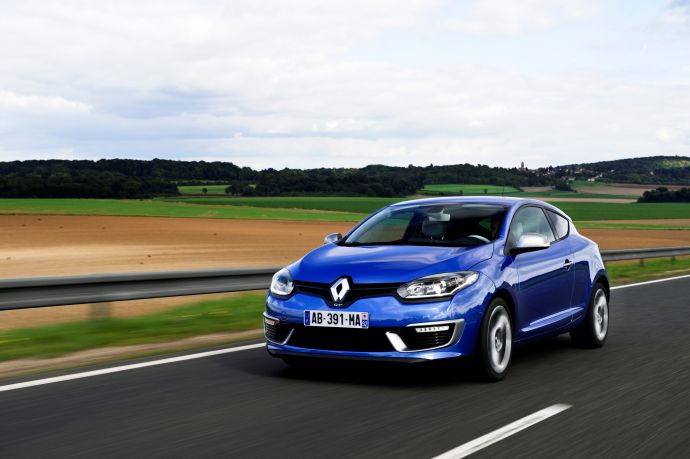
The Renault Megane III Coupe (Phase III, 2014) stood out in its segment with its distinctive and sporty design. Unlike the more conventional five-door hatchback, the Coupe featured a lower roofline, a more raked rear window, and a sleeker side profile, giving it a dynamic and athletic stance. The Phase III update introduced a new front fascia with a larger Renault badge set against a gloss black background, redesigned headlights with LED daytime running lights, and a refreshed bumper, aligning its aesthetics with Renault’s contemporary design language.
Measuring 169.25 inches (4299 mm) in length, 70.28 inches (1785 mm) in width, and 56.02 inches (1423 mm) in height, the Megane Coupe maintained a compact footprint suitable for European city streets while offering a surprisingly spacious interior. Despite being a coupe, it was configured with five seats, although rear passenger room was naturally more constrained than in the hatchback. The wheelbase of 103.94 inches (2640 mm) contributed to stable handling and a comfortable ride.
Practicality was not entirely sacrificed for style. The trunk space ranged from a decent 12.15 cubic feet (344 liters) with all seats in place, expanding to a generous 35 cubic feet (991 liters) with the rear seats folded down, making it capable of handling substantial cargo. The vehicle’s kerb weight was 2656.57 lbs (1205 kg), contributing to its agile handling and efficiency.
Key features included a robust front suspension utilizing an independent McPherson strut setup and a torsion beam rear suspension, a common and cost-effective solution for front-wheel-drive compacts that balances ride comfort with predictable handling. Braking was handled by ventilated discs at the front and solid discs at the rear, augmented by an Anti-lock Braking System (ABS) for enhanced safety. Electric power steering provided light and precise control, making urban maneuvers easier. The car offered various tire and wheel options, including 195/65 R15, 205/55 R16, and 205/50 R17, paired with 6.5J x 15, 6.5J x 16, or 6.5J x 17 wheel rims, respectively.
Technical Specifications
| Category | Specification |
|---|---|
| General Information | |
| Brand | Renault |
| Model | Megane |
| Generation | Megane III Coupe (Phase III, 2014) |
| Type (Engine) | 1.5 dCi (95 Hp) FAP |
| Production Start | 2014 |
| Production End | 2016 |
| Powertrain Architecture | Internal Combustion Engine |
| Body Type | Coupe |
| Seats | 5 |
| Doors | 3 |
| Performance Specs | |
| Fuel Consumption (Urban) | 4.9 l/100 km (48 US mpg) |
| Fuel Consumption (Extra Urban) | 3.5 l/100 km (67.2 US mpg) |
| Fuel Consumption (Combined) | 4.1 l/100 km (57.4 US mpg) |
| CO2 Emissions | 106 g/km |
| Fuel Type | Diesel |
| Acceleration 0-60 mph | 11.7 sec |
| Acceleration 0-100 km/h | 12.3 sec |
| Maximum Speed | 118.06 mph (190 km/h) |
| Emission Standard | Euro 5 |
| Weight-to-Power Ratio | 12.7 kg/Hp, 78.8 Hp/tonne |
| Weight-to-Torque Ratio | 5 kg/Nm, 199.2 Nm/tonne |
| Engine Specs | |
| Power | 95 Hp @ 4000 rpm |
| Power per liter | 65 Hp/l |
| Torque | 177.01 lb.-ft. (240 Nm) @ 1750 rpm |
| Engine Layout | Front, Transverse |
| Engine Model/Code | K9K 846 |
| Engine Displacement | 1.5 liters (1461 cm3 / 89.16 cu. in.) |
| Number of Cylinders | 4 |
| Engine Configuration | Inline |
| Cylinder Bore | 2.99 in. (76 mm) |
| Piston Stroke | 3.17 in. (80.5 mm) |
| Compression Ratio | 15.2:1 |
| Valves per Cylinder | 2 |
| Fuel Injection System | Diesel Commonrail |
| Engine Aspiration | Turbocharger, Intercooler |
| Engine Oil Capacity | 4.76 US qt (4.5 l) |
| Coolant Capacity | 6.87 US qt (6.5 l) |
| Engine Systems | Particulate filter |
| Space, Volume and Weights | |
| Kerb Weight | 2656.57 lbs (1205 kg) |
| Max. Weight (GVWR) | 3957.3 lbs (1795 kg) |
| Max Load | 1300.73 lbs (590 kg) |
| Trunk Space (Min) | 12.15 cu. ft. (344 l) |
| Trunk Space (Max) | 35 cu. ft. (991 l) |
| Fuel Tank Capacity | 15.85 US gal (60 l) |
| Max. Roof Load | 176.37 lbs (80 kg) |
| Permitted Trailer Load with Brakes (12%) | 2866.01 lbs (1300 kg) |
| Permitted Trailer Load without Brakes | 1399.94 lbs (635 kg) |
| Permitted Towbar Download | 165.35 lbs (75 kg) |
| Dimensions | |
| Length | 169.25 in. (4299 mm) |
| Width | 70.28 in. (1785 mm) |
| Height | 56.02 in. (1423 mm) |
| Wheelbase | 103.94 in. (2640 mm) |
| Front Track | 60.87 in. (1546 mm) |
| Rear Track | 60.91 in. (1547 mm) |
| Front Overhang | 33.94 in. (862 mm) |
| Rear Overhang | 31.38 in. (797 mm) |
| Ride Height (Ground Clearance) | 4.72 in. (120 mm) |
| Minimum Turning Circle | 35.93 ft. (10.95 m) |
| Drivetrain, Brakes and Suspension Specs | |
| Drivetrain Architecture | Front-wheel drive, Internal Combustion engine |
| Drive Wheel | Front wheel drive |
| Number of Gears and Type of Gearbox | 6 gears, manual transmission |
| Front Suspension | Independent type McPherson |
| Rear Suspension | Torsion beam |
| Front Brakes | Ventilated discs |
| Rear Brakes | Disc |
| Assisting Systems | ABS (Anti-lock braking system) |
| Steering Type | Steering rack and pinion |
| Power Steering | Electric Steering |
| Tire Sizes | 195/65 R15 91T; 205/55 R16 91H; 205/50 R17 89V |
| Wheel Rim Sizes | 6.5J x 15; 6.5J x 16; 6.5J x 17 |
Legacy and Market Impact
The Renault Megane III Coupe (Phase III, 2014), particularly with the 1.5 dCi engine, carved out a significant niche in the highly competitive European compact segment. While the segment was dominated by more utilitarian hatchbacks like the Volkswagen Golf, Ford Focus, Opel Astra, Peugeot 308, and Citroën C4, the Megane Coupe offered a compelling alternative for buyers seeking more style without sacrificing too much practicality or efficiency. Its primary competitors in the three-door coupe-like compact space included the VW Scirocco (though typically positioned slightly upmarket), the Opel Astra GTC, and to some extent, the MINI Cooper if considering premium smaller coupes.
Renault’s reputation for building comfortable, safe, and value-oriented vehicles was upheld by the Megane III. The 1.5 dCi engine, in particular, was lauded for its exceptional fuel economy, low running costs, and respectable refinement for a diesel of its size. This made it a popular choice for both private owners and fleet operators across Europe, where diesel powertrains traditionally held a strong market share due to their efficiency and favorable tax structures. The FAP system, a standard feature, underscored Renault’s commitment to meeting evolving emission standards and contributed to the car’s environmental appeal.
The Phase III refresh helped keep the Megane Coupe visually fresh and competitive against newer rivals during its production run from 2014 to 2016. While diesel passenger cars have faced increasing scrutiny in recent years, the Megane III 1.5 dCi stands as a testament to the era when compact, efficient diesel engines were considered a pinnacle of automotive engineering for the mass market in Europe. Its legacy is one of a practical yet stylish compact car that delivered on its promise of economical motoring and distinctive design in a crowded and demanding segment.