Introduction: The Renault Megane III Coupe (Phase III, 2014) 1.6 Energy dCi (130 Hp) Start&Stop
The Renault Megane III Coupe, particularly in its Phase III iteration from 2014, represents a distinctive offering within the highly competitive European C-segment. While the Renault brand, and specifically the Megane line, is not typically available in the United States market, it has long been a cornerstone of the French automaker’s presence across Europe and other international territories. The Megane III Coupe, produced from 2014 to 2016, carved out a niche for itself by combining the practicality of a compact car with the sporty aesthetics of a two-door coupe.
This particular variant, the Renault Megane III Coupe (Phase III, 2014) 1.6 Energy dCi (130 Hp) Start&Stop, highlights Renault’s commitment to efficiency and performance through its advanced diesel powertrain. It was designed to appeal to consumers seeking a stylish, economical, and engaging driving experience without compromising on everyday usability. The “Energy dCi” designation signifies a focus on fuel efficiency and reduced emissions, incorporating modern technologies like the Start&Stop system to enhance its environmental credentials and lower running costs, a crucial factor for European buyers.
Engine & Performance: The Efficient Heart of the Renault Megane III Coupe (Phase III, 2014)
At the core of this Megane III Coupe lies Renault’s acclaimed 1.6-liter (1598 cm³ or 97.52 cu. in.) Energy dCi (diesel Commonrail Injection) engine, designated R9M 414. This inline-four cylinder engine is a testament to modern diesel engineering, featuring 16 valves (four per cylinder) and a sophisticated fuel injection system. To boost power and efficiency, it is equipped with a turbocharger and an intercooler, ensuring optimal air-fuel mixture and performance across the rev range.
The powertrain delivers a robust 130 horsepower at 4000 rpm, which is a significant output for an engine of this displacement. More impressively, it generates a substantial 236.02 lb.-ft. (320 Nm) of torque at a low 1750 rpm. This characteristic low-end torque is a hallmark of modern diesel engines, providing strong acceleration and effortless cruising, particularly beneficial for highway driving and overtaking maneuvers.
Performance figures for the Renault Megane III Coupe (Phase III, 2014) 1.6 Energy dCi (130 Hp) Start&Stop are competitive for its segment. It accelerates from 0 to 60 mph in a respectable 9.3 seconds (0-100 km/h in 9.8 seconds) and can reach a maximum speed of 124 mph (200 km/h). Power is delivered to the front wheels via a smooth-shifting 6-speed manual transmission, offering drivers an engaging and controlled experience.
One of the most compelling aspects of this vehicle is its exceptional fuel economy. The Start&Stop system, which automatically shuts off the engine when the vehicle is stationary and restarts it upon clutch engagement, plays a crucial role in reducing fuel consumption and CO2 emissions. The combined fuel economy is rated at an impressive 58.8 US mpg (4 liters per 100 km), with urban consumption at 49 US mpg (4.8 l/100 km) and extra-urban at 65.3 US mpg (3.6 l/100 km). With CO2 emissions of just 104 g/km, the car meets the Euro 5 emission standard, highlighting its environmental responsibility. The inclusion of a particulate filter further underscores its clean diesel technology.
Design & Features: Sporty Aesthetics and Practicality
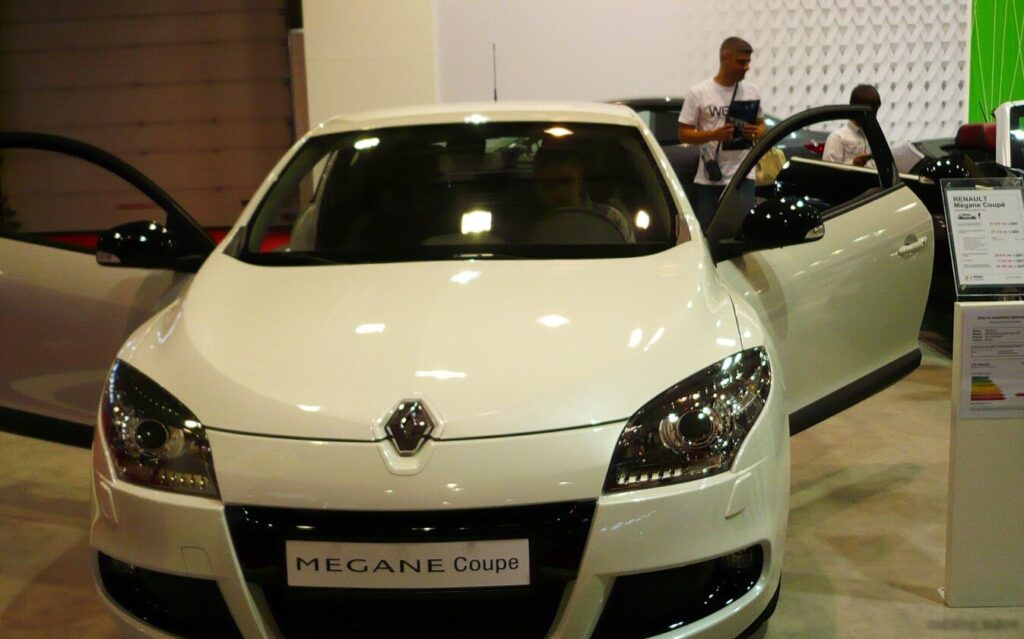
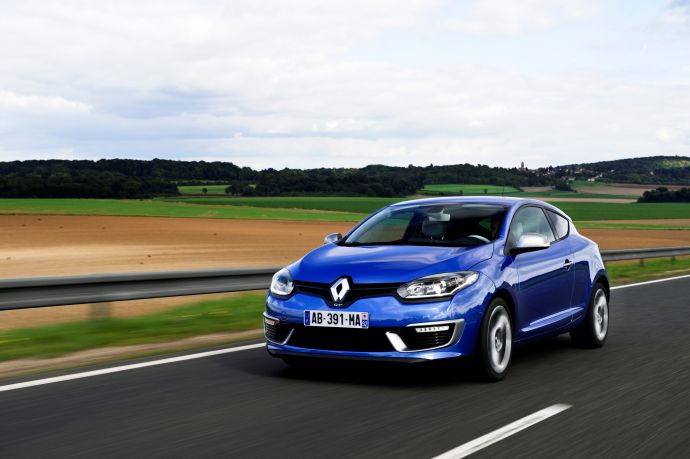
The Megane III Coupe distinguishes itself from its hatchback sibling with a more athletic and streamlined design. As a 3-door coupe, it features a lower roofline and a more raked rear window, contributing to its dynamic silhouette. Despite its sporty appearance, the car maintains a practical 5-seat configuration, making it suitable for small families or those needing occasional rear passenger capacity.
With a length of 169.25 inches (4299 mm), a width of 70.28 inches (1785 mm), and a height of 56.02 inches (1423 mm), the Megane III Coupe strikes a balance between compact dimensions for urban maneuverability and a stable footprint for highway cruising. The wheelbase measures 103.94 inches (2640 mm), contributing to a comfortable ride and stable handling. The minimum turning circle of 35.93 feet (10.95 m) ensures agility in tight city spaces.
Inside, the Megane III Coupe offers a practical cargo solution with a minimum trunk space of 12.15 cu. ft. (344 liters), which can expand significantly to 35 cu. ft. (991 liters) with the rear seats folded down. This flexibility allows for the transport of larger items, enhancing its versatility. The fuel tank capacity of 15.85 US gallons (60 liters) combined with its excellent fuel economy provides a substantial driving range.
Underneath, the vehicle utilizes an independent McPherson strut front suspension and a torsion beam rear suspension, a common and effective setup for front-wheel-drive compact cars, balancing ride comfort with responsive handling. Braking is handled by ventilated discs at the front and solid discs at the rear, complemented by an Anti-lock Braking System (ABS) for enhanced safety. The electric power steering system provides precise control and ease of maneuverability at low speeds. The car typically came with tire sizes ranging from 205/55 R16 to 225/40 R18, mounted on corresponding wheel rims, allowing for varying levels of grip and ride comfort.
Technical Specifications
| Category | Specification | Value |
|---|---|---|
General Information |
||
| Brand | Renault | |
| Model | Megane | |
| Generation | Megane III Coupe (Phase III, 2014) | |
| Type (Engine) | 1.6 Energy dCi (130 Hp) Start&Stop | |
| Start of Production | 2014 year | |
| End of Production | 2016 year | |
| Powertrain Architecture | Internal Combustion engine | |
| Body Type | Coupe | |
| Seats | 5 | |
| Doors | 3 | |
Performance Specs |
||
| Fuel Consumption (Economy) – Urban | 4.8 l/100 km | 49 US mpg |
| Fuel Consumption (Economy) – Extra Urban | 3.6 l/100 km | 65.3 US mpg |
| Fuel Consumption (Economy) – Combined | 4 l/100 km | 58.8 US mpg |
| CO2 Emissions | 104 g/km | |
| Fuel Type | Diesel | |
| Acceleration 0 – 62 mph (0-100 km/h) | 9.8 sec | |
| Acceleration 0 – 60 mph (Calculated) | 9.3 sec | |
| Maximum Speed | 200 km/h | 124.27 mph |
| Emission Standard | Euro 5 | |
| Weight-to-Power Ratio | 10.2 kg/Hp | 98.5 Hp/tonne |
| Weight-to-Torque Ratio | 4.1 kg/Nm | 242.4 Nm/tonne |
Engine Specs |
||
| Power | 130 Hp @ 4000 rpm | |
| Power per Liter | 81.4 Hp/l | |
| Torque | 320 Nm @ 1750 rpm | 236.02 lb.-ft. @ 1750 rpm |
| Engine Layout | Front, Transverse | |
| Engine Model/Code | R9M 414 | |
| Engine Displacement | 1598 cm³ | 97.52 cu. in. |
| Number of Cylinders | 4 | |
| Engine Configuration | Inline | |
| Cylinder Bore | 80 mm | 3.15 in. |
| Piston Stroke | 79.5 mm | 3.13 in. |
| Compression Ratio | 15.4:1 | |
| Number of Valves per Cylinder | 4 | |
| Fuel Injection System | Diesel Commonrail | |
| Engine Aspiration | Turbocharger, Intercooler | |
| Engine Oil Capacity | 5.5 l | 5.81 US qt |
| Engine Systems | Start & Stop System, Particulate filter | |
Space, Volume and Weights |
||
| Kerb Weight | 1320 kg | 2910.1 lbs. |
| Max. Weight | 1849 kg | 4076.35 lbs. |
| Max Load | 529 kg | 1166.25 lbs. |
| Trunk (Boot) Space – Minimum | 344 l | 12.15 cu. ft. |
| Trunk (Boot) Space – Maximum | 991 l | 35 cu. ft. |
| Fuel Tank Capacity | 60 l | 15.85 US gal |
| Max. Roof Load | 80 kg | 176.37 lbs. |
| Permitted Trailer Load with Brakes (12%) | 1300 kg | 2866.01 lbs. |
| Permitted Trailer Load without Brakes | 695 kg | 1532.21 lbs. |
Dimensions |
||
| Length | 4299 mm | 169.25 in. |
| Width | 1785 mm | 70.28 in. |
| Height | 1423 mm | 56.02 in. |
| Wheelbase | 2640 mm | 103.94 in. |
| Front Track | 1546 mm | 60.87 in. |
| Rear (Back) Track | 1547 mm | 60.91 in. |
| Front Overhang | 862 mm | 33.94 in. |
| Rear Overhang | 797 mm | 31.38 in. |
| Ride Height (Ground Clearance) | 120 mm | 4.72 in. |
| Minimum Turning Circle (Turning Diameter) | 10.95 m | 35.93 ft. |
Drivetrain, Brakes and Suspension Specs |
||
| Drivetrain Architecture | Internal combustion engine (ICE) drives the front wheels. | |
| Drive Wheel | Front wheel drive | |
| Number of Gears and Type of Gearbox | 6 gears, manual transmission | |
| Front Suspension | Independent type McPherson | |
| Rear Suspension | Torsion | |
| Front Brakes | Ventilated discs | |
| Rear Brakes | Disc | |
| Assisting Systems | ABS (Anti-lock braking system) | |
| Steering Type | Steering rack and pinion | |
| Power Steering | Electric Steering | |
| Tires Size | 205/55 R16 91H; 205/50 R17 89V; 225/40 R18 | |
| Wheel Rims Size | 6.5J x 16; 6.5J x 17; 6.5J x 18 | |
Legacy & Market Impact
The Renault Megane III Coupe, and specifically the 2014 Phase III 1.6 Energy dCi variant, held a significant position in the European compact car market. In a region where diesel powertrains are highly valued for their efficiency and torque characteristics, this model was a strong contender. It competed against other popular compact coupes and sporty hatchbacks such as the Volkswagen Scirocco, Opel Astra GTC, and to some extent, premium offerings like the Audi A3 and BMW 1 Series Coupe, albeit at a more accessible price point.
Its legacy is rooted in offering a compelling blend of style, economy, and practicality. While the Megane hatchback was the volume seller, the coupe variant provided a more emotional and design-driven choice for buyers. The 1.6 Energy dCi engine, in particular, solidified Renault’s reputation for developing highly efficient and refined diesel engines. The integration of Start&Stop technology and a particulate filter was forward-thinking for its time, aligning with increasingly stringent European emission regulations and consumer demand for greener vehicles.
The Megane III Coupe was praised for its distinctive styling, comfortable ride, and frugal fuel consumption, making it an ideal choice for both urban commuting and long-distance touring across Europe. Its robust build quality and comprehensive feature set, along with competitive pricing, ensured its relevance in a segment known for fierce competition. Although never officially sold in the United States, the Renault Megane III Coupe (Phase III, 2014) 1.6 Energy dCi (130 Hp) Start&Stop remains an excellent example of European automotive engineering, demonstrating how style, efficiency, and driving enjoyment can be harmoniously combined in a compact package. Its impact was primarily felt in its primary markets, where it contributed to Renault’s enduring success in the compact car segment.