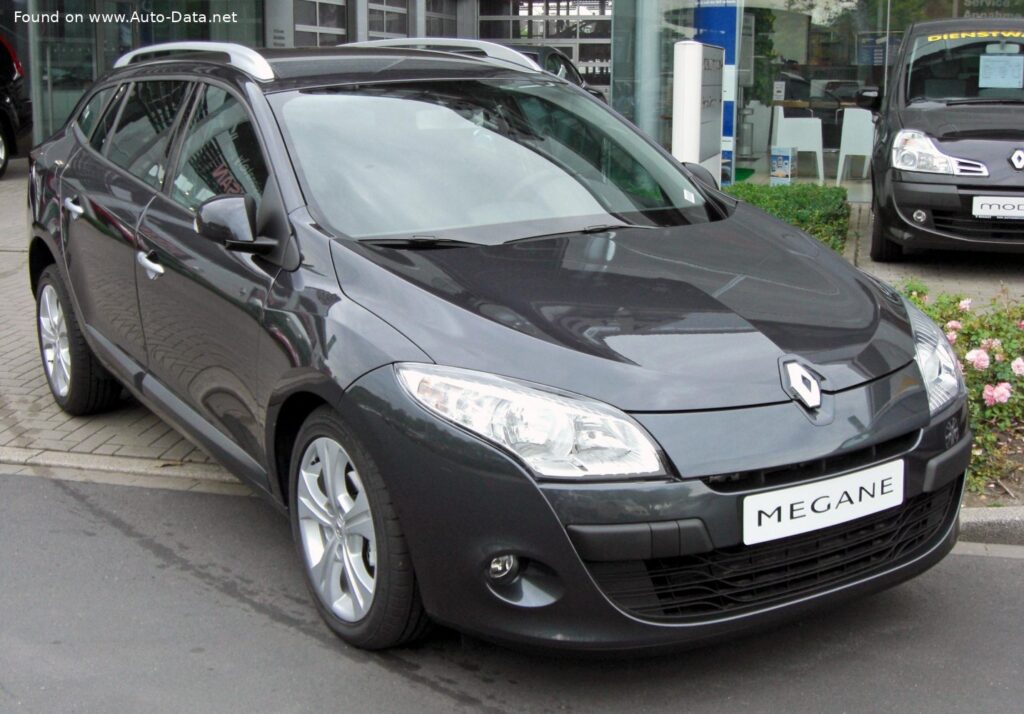
The Renault Megane III Grandtour 1.4 TCe (130 Hp): A European Workhorse
The Renault Megane III Grandtour 1.4 TCe (130 Hp) represents a significant offering in the highly competitive European C-segment, specifically targeting the practical and family-oriented station wagon market. Introduced in 2009 as part of the third-generation Megane lineup, this particular variant, known as the Grandtour, was designed to blend the compact dimensions and agile handling of the Megane hatchback with enhanced cargo capacity and versatility. Produced until 2012, this model was a cornerstone of Renault’s strategy to provide efficient, comfortable, and safe transportation solutions for European consumers, a role it capably fulfilled without ever officially reaching the shores of the United States market.
The Megane III Grandtour, with its 1.4 TCe engine, was engineered to strike a balance between spirited performance and fuel economy, a critical consideration in its primary markets. It showcased Renault’s commitment to downsizing engines while leveraging turbocharging technology to maintain respectable power output. As an international automotive expert, it’s clear that this vehicle was a prime example of European automotive design principles: efficiency, practicality, and a focus on diverse powertrain options tailored to regional needs.
Engine and Performance: The 1.4 TCe Heart of the Renault Megane III Grandtour 1.4 TCe (130 Hp)
At the core of the Renault Megane III Grandtour 1.4 TCe (130 Hp) lies a sophisticated 1.4-liter (1395 cm3 or 85.13 cu. in.) inline-four cylinder engine, designated by Renault as the H4J 700. This powertrain is a prime example of the “Turbo Control efficiency” (TCe) philosophy, a strategy adopted by many European manufacturers to deliver the performance of a larger naturally aspirated engine with the fuel economy and lower emissions of a smaller unit. The engine features a modern architecture with four valves per cylinder, totaling 16 valves, ensuring efficient gas flow. Fuel delivery is handled by a multi-port manifold injection system, precisely metering gasoline into the combustion chambers.
The key to this engine’s performance is its turbocharger, complemented by an intercooler. This setup allows the compact 1.4-liter unit to produce a robust 130 horsepower at 5500 rpm. More impressively for a vehicle designed for family duties and highway cruising, it generates a healthy 190 Nm (140.14 lb.-ft.) of torque available at a relatively low 2250 rpm. This broad torque band translates into excellent drivability and less need for frequent downshifts, making it well-suited for both city traffic and longer journeys with a full load.
Power is transmitted to the front wheels via a smooth-shifting 6-speed manual transmission, offering the driver precise control over the engine’s output. This combination enables the Megane III Grandtour 1.4 TCe to accelerate from 0 to 60 mph in a respectable 9.4 seconds (or 0-100 km/h in 9.9 seconds), before reaching a top speed of 124.27 mph (200 km/h). These figures demonstrate that despite its family-friendly wagon body, the car is far from sluggish.
Beyond performance, efficiency was a major design priority. The Megane III Grandtour 1.4 TCe boasts commendable fuel economy figures for its class: 35.6 US mpg (6.6 l/100 km) in combined driving, dropping to 26.7 US mpg (8.8 l/100 km) in urban settings, and rising to an impressive 44.4 US mpg (5.3 l/100 km) on the highway. With CO2 emissions rated at 153 g/km, it met the Euro 5 emission standard, reflecting its environmental consciousness at the time of its production.
Design and Features: Practicality Meets European Style
The Renault Megane III Grandtour adopted a sleek, contemporary design that departed from some of the more polarizing styling cues of its predecessor. As a 5-door station wagon (often referred to as an “estate” in Europe), its primary design objective was practicality and cargo versatility without sacrificing aesthetic appeal. The exterior dimensions of 179.49 inches in length, 69.53 inches in width, and 57.52 inches in height, coupled with a generous 106.42-inch wheelbase, provided a spacious interior for five occupants and substantial luggage capacity.
The Grandtour’s design emphasized a smooth, aerodynamic profile, contributing to its respectable drag coefficient (Cd) of 0.32. This not only enhanced fuel efficiency but also reduced wind noise at higher speeds, improving cabin comfort. The interior was designed with ergonomics and user-friendliness in mind, featuring a logical layout of controls and good material quality for its segment. Storage solutions were abundant, reflecting its family car ethos.
Cargo capacity was a standout feature. With the rear seats in place, the trunk offered a substantial 18.5 cubic feet (524 liters) of space. Folding down the rear seats expanded this to an impressive 56.33 cubic feet (1595 liters), allowing for the transportation of larger items, a key selling point for station wagon buyers. The maximum load capacity was 1212.54 lbs (550 kg), and it could tow a braked trailer up to 2866.01 lbs (1300 kg), further underscoring its utility.
Underneath, the Megane III Grandtour featured an independent McPherson strut front suspension, providing a good balance of comfort and handling precision. The rear utilized a torsion beam setup, a common and space-efficient design for compact cars, which allowed for the large trunk volume. Braking performance was assured by ventilated discs at the front and solid discs at the rear, supported by an Anti-lock Braking System (ABS) for enhanced safety. Electric power steering provided light and precise control, particularly beneficial in urban environments. The vehicle offered tire size options of 195/65 R15 or 205/55 R16, mounted on corresponding 15 or 16-inch wheel rims.
Technical Specifications
| Category | Specification |
|---|---|
| General Information | |
| Brand | Renault |
| Model | Megane III Grandtour |
| Engine Type | 1.4 TCe (130 Hp) |
| Production Start | 2009 |
| Production End | 2012 |
| Body Type | Station Wagon (Estate) |
| Seats | 5 |
| Doors | 5 |
| Performance Specs | |
| Fuel Consumption (Urban) | 8.8 l/100 km (26.7 US mpg) |
| Fuel Consumption (Extra Urban) | 5.3 l/100 km (44.4 US mpg) |
| Fuel Consumption (Combined) | 6.6 l/100 km (35.6 US mpg) |
| CO2 Emissions | 153 g/km |
| Fuel Type | Petrol (Gasoline) |
| Acceleration 0-60 mph | 9.4 sec |
| Acceleration 0-100 km/h | 9.9 sec |
| Maximum Speed | 200 km/h (124.27 mph) |
| Emission Standard | Euro 5 |
| Weight-to-Power Ratio | 9.5 kg/Hp (104.8 Hp/tonne) |
| Weight-to-Torque Ratio | 6.5 kg/Nm (153.2 Nm/tonne) |
| Engine Specs | |
| Power | 130 Hp @ 5500 rpm |
| Power per Liter | 93.2 Hp/l |
| Torque | 190 Nm (140.14 lb.-ft.) @ 2250 rpm |
| Engine Layout | Front, Transverse |
| Engine Model/Code | H4J 700 |
| Engine Displacement | 1395 cm3 (1.4 L / 85.13 cu. in.) |
| Number of Cylinders | 4 |
| Engine Configuration | Inline |
| Cylinder Bore | 78 mm (3.07 in) |
| Piston Stroke | 73.1 mm (2.88 in) |
| Compression Ratio | 9:1 |
| Valves per Cylinder | 4 |
| Fuel Injection System | Multi-port manifold injection |
| Engine Aspiration | Turbocharger, Intercooler |
| Engine Oil Capacity | 4.5 l (4.76 US qt) |
| Coolant Capacity | 6.5 l (6.87 US qt) |
| Space, Volume and Weights | |
| Kerb Weight | 1240 kg (2733.73 lbs) |
| Max. Weight | 1790 kg (3946.27 lbs) |
| Max Load | 550 kg (1212.54 lbs) |
| Trunk Space (Min) | 524 l (18.5 cu. ft.) |
| Trunk Space (Max) | 1595 l (56.33 cu. ft.) |
| Fuel Tank Capacity | 60 l (15.85 US gal) |
| Max. Roof Load | 80 kg (176.37 lbs) |
| Permitted Trailer Load with Brakes (12%) | 1300 kg (2866.01 lbs) |
| Permitted Trailer Load without Brakes | 680 kg (1499.14 lbs) |
| Permitted Towbar Download | 75 kg (165.35 lbs) |
| Dimensions | |
| Length | 4559 mm (179.49 in) |
| Width | 1766 mm (69.53 in) |
| Height | 1461 mm (57.52 in) |
| Wheelbase | 2703 mm (106.42 in) |
| Front Track | 1546 mm (60.87 in) |
| Rear Track | 1547 mm (60.91 in) |
| Front Overhang | 862 mm (33.94 in) |
| Rear Overhang | 994 mm (39.13 in) |
| Ride Height (Ground Clearance) | 120 mm (4.72 in) |
| Drag Coefficient (Cd) | 0.32 |
| Minimum Turning Circle | 11.05 m (36.25 ft) |
| Drivetrain, Brakes and Suspension Specs | |
| Drivetrain Architecture | Front-wheel drive, Internal Combustion Engine |
| Drive Wheel | Front-wheel drive |
| Number of Gears | 6 |
| Gearbox Type | Manual transmission |
| Front Suspension | Independent type McPherson |
| Rear Suspension | Torsion |
| Front Brakes | Ventilated discs |
| Rear Brakes | Disc |
| Assisting Systems | ABS (Anti-lock braking system) |
| Steering Type | Steering rack and pinion |
| Power Steering | Electric Steering |
| Tires Size | 195/65 R15; 205/55 R16 |
| Wheel Rims Size | 15; 16 |
Legacy and Market Impact
The Renault Megane III Grandtour, particularly the 1.4 TCe variant, carved out a strong reputation in its primary European markets for being a highly practical, comfortable, and safe family vehicle. It was consistently praised for its ample cargo space, smooth ride quality, and the refined nature of its turbocharged gasoline engine. The 1.4 TCe engine, in particular, was lauded for its impressive balance of power delivery and fuel efficiency, making it an economical choice for everyday use and longer trips.
In the fiercely competitive European C-segment, the Megane III Grandtour faced stiff competition from established rivals. Its main competitors included other popular compact station wagons such as the Volkswagen Golf Variant (SportWagen in some markets), the Ford Focus Estate, the Opel Astra Sports Tourer, the Peugeot 308 SW, and the Skoda Octavia Combi. Against these formidable contenders, the Megane distinguished itself with its distinctive French styling, often perceived as more elegant than some of its German counterparts, and a strong emphasis on passenger comfort and safety, frequently achieving high Euro NCAP safety ratings.
The historical significance of the Megane III Grandtour lies in its role as a volume seller that upheld Renault’s position as a major player in the European family car segment. It demonstrated Renault’s ability to evolve its core models to meet changing consumer demands, particularly the growing desire for smaller, more efficient engines that still offered satisfactory performance. While SUVs began their ascent in popularity during this period, traditional station wagons like the Grandtour remained a vital choice for many European families who valued driving dynamics, efficiency, and cargo capacity over a higher seating position.
As an expert looking from an American perspective, the Megane III Grandtour highlights a stark difference in market preferences. Station wagons, though experiencing a niche resurgence in the US, have largely been overshadowed by SUVs and crossovers. The Megane, with its compact dimensions and emphasis on fuel-efficient gasoline engines, was perfectly tailored for European roads and economic conditions, where fuel prices are higher and parking spaces are often tighter. Its absence from the American market reflects Renault’s strategic focus on its home continent and the distinct automotive cultures across the Atlantic. Nevertheless, the Renault Megane III Grandtour 1.4 TCe (130 Hp) remains an excellent example of a well-engineered and highly effective European family car of its era.