As an international automotive expert, I present a detailed analysis of the Renault Megane III Grandtour 2.0 16V (140 Hp) CVT, a key player in the European compact segment during its production run. This article utilizes American English terminology for clarity, acknowledging the vehicle’s primary market outside the United States.
Introduction: The Renault Megane III Grandtour 2.0 16V (140 Hp) CVT
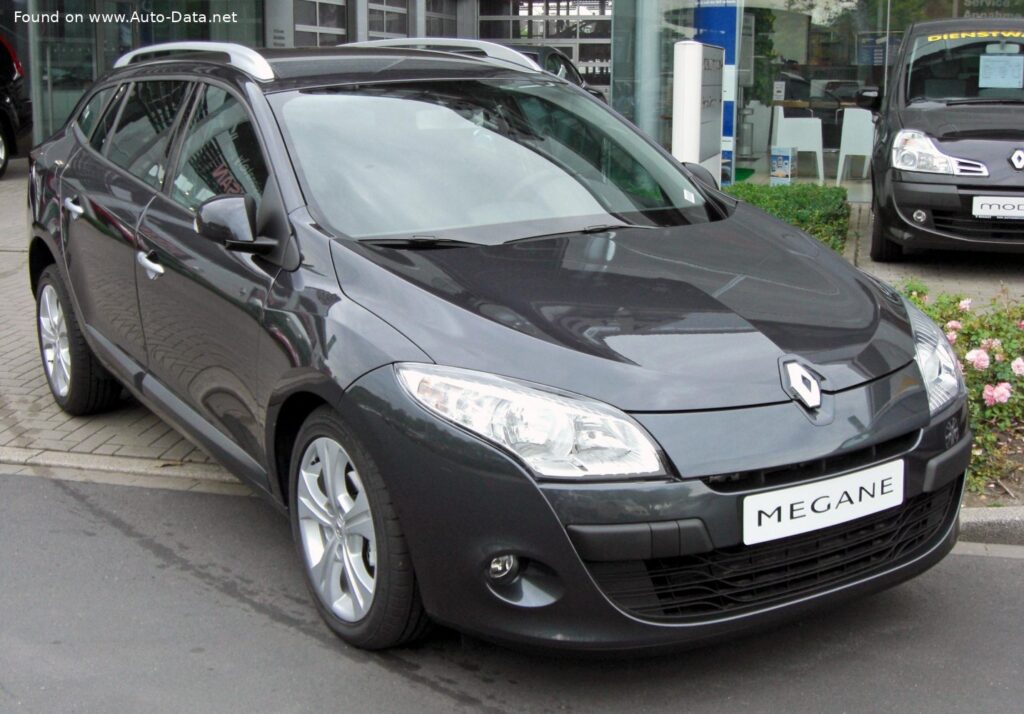
The Renault Megane III Grandtour 2.0 16V (140 Hp) CVT represents a significant iteration within the third generation of Renault’s popular compact car, the Megane. Produced between 2010 and 2012, this particular variant, known as an “estate” in Europe and a “station wagon” in the United States, was a cornerstone of Renault’s offerings in the highly competitive European C-segment. Designed with practicality, efficiency, and comfort in mind, the Megane III Grandtour served as a versatile family vehicle, offering a compelling blend of cargo capacity, passenger space, and a smooth driving experience, particularly with its Continuously Variable Transmission (CVT).
Unlike many of its contemporaries that saw global distribution, the Renault Megane III Grandtour was primarily aimed at European and select Asian markets, where compact station wagons are highly valued for their blend of maneuverability and utility. It never officially crossed the Atlantic to the North American market, making its specifications and market positioning unique from a US perspective. This article delves into the technical prowess, design philosophy, and market impact of this specific model, highlighting its role in its intended environment.
Engine and Performance: Powering the Renault Megane III Grandtour
At the heart of the Renault Megane III Grandtour 2.0 16V (140 Hp) CVT lies a robust 2.0-liter (1998 cm³) naturally aspirated inline-four gasoline engine, designated with the M4R 711 code. This powerplant was engineered to deliver a balance of usable power and respectable fuel economy for daily driving. It produced 140 horsepower at 6000 rpm, a healthy output for a compact station wagon of its era, providing sufficient thrust for both city commuting and longer highway journeys. Torque figures stood at 111.37 lb-ft (151 Nm) available at 4250 rpm, ensuring decent mid-range flexibility.
A distinctive feature of this particular Megane III Grandtour variant was its Continuously Variable Transmission (CVT). This automatic gearbox, utilizing a system of pulleys and a belt, offered seamless acceleration without the traditional stepped shifts of conventional automatics. While some enthusiasts might have preferred a manual transmission for engagement, the CVT was chosen for its ability to keep the engine within its optimal power band, contributing to both fuel efficiency and a smooth, relaxed driving experience. The transmission was effectively a 6-speed automatic in terms of its operational range, managed electronically to simulate gear ratios.
Performance figures for the 2.0 16V (140 Hp) CVT model were competitive for its class. It could accelerate from 0 to 60 mph in an estimated 10.3 seconds, with a top speed of 121.17 mph (195 km/h). Fuel economy was a strong point for a vehicle of its size and engine displacement, with a combined rating of 30.9 US mpg (7.6 l/100 km). Urban driving yielded 23.1 US mpg (10.2 l/100 km), while extra-urban (highway) cruising improved significantly to 38.6 US mpg (6.1 l/100 km). These figures, combined with CO2 emissions of 175 g/km, allowed the vehicle to meet the Euro 5 emission standard, a crucial factor in the European market.
The engine layout was a conventional front, transverse configuration, driving the front wheels. This setup, combined with a kerb weight of 2943.17 lbs (1335 kg), resulted in a weight-to-power ratio of 9.5 kg/Hp, indicating a well-matched powertrain for its intended purpose.
Design and Features: Practicality Meets European Style
The Renault Megane III Grandtour embodied a more refined and mature design language compared to its predecessors. Its exterior styling was characterized by smooth lines, a distinctive front fascia with prominent headlights, and a gracefully integrated roofline that flowed into the rear tailgate. As a station wagon, its primary design emphasis was on maximizing interior volume and accessibility without sacrificing aesthetic appeal. The five-door, five-seat configuration made it an ideal choice for families requiring ample passenger space and a generous cargo area.
Measuring 179.49 inches (4559 mm) in length, 69.53 inches (1766 mm) in width, and 57.52 inches (1461 mm) in height, the Grandtour offered a substantial footprint for its class. Its 106.42-inch (2703 mm) wheelbase contributed to a stable ride and allowed for impressive interior room, particularly for rear passengers. The design prioritized utility, evident in its cargo capacity: a minimum trunk space of 18.5 cu. ft. (524 liters) expanded to a cavernous 56.33 cu. ft. (1595 liters) with the rear seats folded down. This flexibility made it highly competitive against rivals in terms of load-carrying capability, accommodating everything from groceries to luggage for extended road trips.
Inside, the Megane III Grandtour featured an ergonomic cabin with a focus on driver comfort and intuitive controls. While specific trim levels varied by market, typical features for the era included air conditioning, power windows, and a comprehensive infotainment system, often with CD playback and auxiliary input. Safety was also a priority, with standard features like ABS (Anti-lock Braking System) ensuring controlled braking in emergency situations. The car utilized a steering rack and pinion system with electric power steering, providing light and precise maneuverability, particularly beneficial in urban environments and for parking. The suspension system, featuring an independent McPherson type at the front and a torsion beam at the rear, struck a balance between ride comfort and handling stability, a common and effective setup for front-wheel-drive compacts.
Technical Specifications
| Category | Specification | Value |
|---|---|---|
| General Information | ||
| Brand | Renault | |
| Model | Megane | |
| Generation | Megane III Grandtour | |
| Type (Engine) | 2.0 16V (140 Hp) CVT | |
| Start of Production | 2010 year | |
| End of Production | 2012 year | |
| Powertrain Architecture | Internal Combustion engine | |
| Body type | Station wagon (estate) | |
| Seats | 5 | |
| Doors | 5 | |
| Performance Specs | ||
| Fuel Consumption (economy) – urban | 10.2 l/100 km (23.1 US mpg) | |
| Fuel Consumption (economy) – extra urban | 6.1 l/100 km (38.6 US mpg) | |
| Fuel Consumption (economy) – combined | 7.6 l/100 km (30.9 US mpg) | |
| CO2 emissions | 175 g/km | |
| Fuel Type | Petrol (Gasoline) | |
| Acceleration 0 – 60 mph | 10.3 sec | |
| Maximum speed | 121.17 mph (195 km/h) | |
| Emission standard | Euro 5 | |
| Weight-to-power ratio | 9.5 kg/Hp (104.9 Hp/tonne) | |
| Weight-to-torque ratio | 8.8 kg/Nm (113.1 Nm/tonne) | |
| Engine Specs | ||
| Power | 140 Hp @ 6000 rpm | |
| Power per liter | 70.1 Hp/l | |
| Torque | 111.37 lb.-ft. (151 Nm) @ 4250 rpm | |
| Engine layout | Front, Transverse | |
| Engine Model/Code | M4R 711 | |
| Engine displacement | 121.93 cu. in. (1998 cm³) | |
| Number of cylinders | 4 | |
| Engine configuration | Inline | |
| Cylinder Bore | 3.31 in. (84 mm) | |
| Piston Stroke | 3.55 in. (90.1 mm) | |
| Compression ratio | 10.2:1 | |
| Number of valves per cylinder | 4 | |
| Fuel injection system | Multi-port manifold injection | |
| Engine aspiration | Naturally aspirated engine | |
| Engine oil capacity | 3.7 US qt (3.5 l) | |
| Coolant | 7.19 US qt (6.8 l) | |
| Space, Volume and Weights | ||
| Kerb Weight | 2943.17 lbs. (1335 kg) | |
| Max. weight | 4056.51 lbs. (1840 kg) | |
| Max load | 1113.33 lbs. (505 kg) | |
| Trunk (boot) space – minimum | 18.5 cu. ft. (524 l) | |
| Trunk (boot) space – maximum | 56.33 cu. ft. (1595 l) | |
| Fuel tank capacity | 15.85 US gal (60 l) | |
| Max. roof load | 176.37 lbs. (80 kg) | |
| Permitted trailer load with brakes (12%) | 2866.01 lbs. (1300 kg) | |
| Permitted trailer load without brakes | 1554.26 lbs. (705 kg) | |
| Permitted towbar download | 165.35 lbs. (75 kg) | |
| Dimensions | ||
| Length | 179.49 in. (4559 mm) | |
| Width | 69.53 in. (1766 mm) | |
| Height | 57.52 in. (1461 mm) | |
| Wheelbase | 106.42 in. (2703 mm) | |
| Front track | 60.87 in. (1546 mm) | |
| Rear (Back) track | 60.91 in. (1547 mm) | |
| Front overhang | 33.94 in. (862 mm) | |
| Rear overhang | 39.13 in. (994 mm) | |
| Ride height (ground clearance) | 4.72 in. (120 mm) | |
| Drag coefficient (Cd) | 0.32 | |
| Minimum turning circle (turning diameter) | 36.25 ft. (11.05 m) | |
| Drivetrain, Brakes and Suspension Specs | ||
| Drivetrain Architecture | The Internal combustion engine (ICE) drives the front wheels of the vehicle. | |
| Drive wheel | Front wheel drive | |
| Number of gears and type of gearbox | 6 gears, automatic transmission CVT | |
| Front suspension | Independent type McPherson | |
| Rear suspension | Torsion | |
| Front brakes | Ventilated discs | |
| Rear brakes | Disc | |
| Assisting systems | ABS (Anti-lock braking system) | |
| Steering type | Steering rack and pinion | |
| Power steering | Electric Steering | |
| Tires size | 205/50 R17 | |
| Wheel rims size | 17 | |
Legacy and Market Impact
The Renault Megane III Grandtour, particularly the 2.0 16V (140 Hp) CVT variant, played a crucial role in maintaining Renault’s strong presence in the European compact car segment. In markets where practicality and fuel efficiency are paramount, the station wagon body style has historically been a popular choice for families and businesses alike. The Megane Grandtour effectively competed against well-established rivals such as the Volkswagen Golf Variant, Ford Focus Estate, Opel Astra Sports Tourer, and Peugeot 308 SW.
Its reputation was built on several pillars: a comfortable ride, a spacious and versatile interior, and a generally reliable powertrain. While the CVT might not have appealed to all drivers, its smooth operation was a significant draw for those prioritizing ease of driving in congested urban environments or seeking a relaxed highway cruiser. The 2.0-liter engine provided a good balance of performance and economy, avoiding the feeling of being underpowered, which sometimes afflicted smaller-engined variants in a fully loaded station wagon.
The Megane III Grandtour’s design, while perhaps not groundbreaking, was contemporary and elegant, contributing to its broad appeal. It represented a period of refinement for Renault, moving towards higher quality interiors and more sophisticated driving dynamics. Its legacy is one of a dependable, practical, and family-friendly vehicle that offered genuine value in its segment. It helped solidify Renault’s image as a manufacturer capable of producing competitive and attractive compact cars that met the diverse needs of European consumers.
Even after its production ended in 2012, the Megane III Grandtour continued to be a common sight on European roads, a testament to its durability and practicality. It laid the groundwork for subsequent generations of the Megane, influencing design cues and engineering principles that would be carried forward. For many European families, it was an indispensable tool, a reliable partner for daily commutes, school runs, and holiday adventures, embodying the essence of a well-rounded compact station wagon.