The Renault Megane III Grandtour GT 2.0 dCi (160 Hp) FAP: A European Compact Wagon Powerhouse
The Renault Megane III Grandtour GT 2.0 dCi (160 Hp) FAP represents a significant offering from the French automaker Renault within the highly competitive European C-segment. Produced between 2010 and 2012, this particular model variant combined the practicality of a station wagon, known as an “estate” in many European markets, with the spirited performance of a GT trim and the renowned efficiency of Renault’s dCi diesel powertrain. While never officially imported for sale in the United States, the Megane III Grandtour was a staple of family transportation across Europe, embodying the continent’s preference for compact, versatile vehicles that deliver both driving enjoyment and economical operation.
As the third generation of the popular Megane lineup, the Grandtour (station wagon) body style was designed to maximize utility and comfort for families and individuals needing greater cargo capacity than the standard hatchback. The GT 2.0 dCi variant, in particular, carved out a niche for itself by offering a compelling blend of performance, fuel efficiency, and a touch of sportiness, making it a well-rounded contender in its class.
Engineering and Performance of the Renault Megane III Grandtour GT 2.0 dCi (160 Hp) FAP
Powertrain and Driving Dynamics
At the heart of the Renault Megane III Grandtour GT 2.0 dCi (160 Hp) FAP lies a robust and efficient 2.0-liter (1,995 cm3) inline-four diesel engine, designated by the M9R 610 code. This powerplant, a testament to Renault’s expertise in diesel technology, features a common rail fuel injection system and is boosted by a turbocharger with an intercooler. It delivers a respectable 160 horsepower at 3750 rpm, providing ample motivation for the compact wagon. More impressively, the engine generates a substantial 280.27 lb.-ft. of torque at a low 2000 rpm, a characteristic trait of modern diesel engines that translates into strong, accessible pulling power across the rev range, ideal for both city driving and highway cruising, especially when loaded or towing.
Power is directed to the front wheels via a slick-shifting 6-speed manual transmission, offering drivers an engaging and direct connection to the powertrain. This setup allows the Megane Grandtour GT to accelerate from 0 to 60 mph in a swift 8.3 seconds, a commendable figure for a family station wagon. The top speed is rated at 133.59 mph (215 km/h), demonstrating its capability for sustained high-speed travel on European autobahns.
Beyond its performance figures, the Megane III Grandtour GT also excelled in fuel economy, a critical factor for European consumers. It achieved an impressive combined fuel consumption of 39.9 US mpg (5.9 liters per 100 km). Urban driving saw figures around 31.4 US mpg (7.5 l/100 km), while extra-urban (highway) driving could yield up to 47 US mpg (5 l/100 km). These figures were competitive for its era, showcasing the efficiency of the dCi engine. Furthermore, the vehicle met Euro 5 emission standards, with CO2 emissions of 155 g/km, and was equipped with a Diesel Particulate Filter (FAP) to reduce harmful emissions.
Design and Features
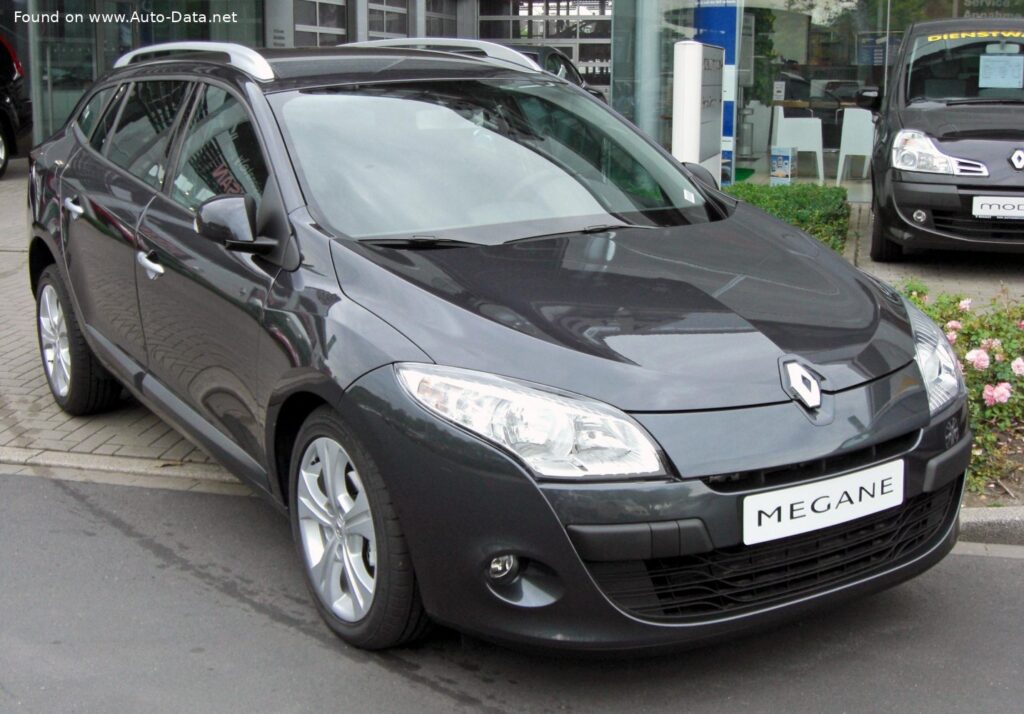
The Megane III Grandtour adopted a more mature and sophisticated design language compared to its predecessor, moving away from some of the more polarizing styling cues. The Grandtour body style, specifically, emphasized sleek lines and a well-integrated rear cargo area, avoiding the boxy appearance sometimes associated with station wagons. Its overall length of 179.49 inches (4559 mm) and a wheelbase of 106.42 inches (2703 mm) contributed to a stable ride and generous interior space.
As a 5-door, 5-seat station wagon, practicality was paramount. The trunk space offered a minimum of 18.5 cubic feet (524 liters) with the rear seats up, expanding significantly to a cavernous 56.33 cubic feet (1595 liters) when the rear seats were folded down. This flexibility made it an ideal choice for families, offering ample room for luggage, groceries, or sports equipment. The GT trim level further enhanced its appeal with a sportier aesthetic, likely including unique exterior styling elements, interior accents, and the striking 18-inch alloy wheels wrapped in 225/40 R18 tires, which not only improved handling but also added to its visual presence.
The chassis and suspension setup featured an independent McPherson strut arrangement at the front, a common and effective design for front-wheel-drive vehicles, providing good handling and ride comfort. The rear utilized a torsion beam setup, a space-efficient solution that allowed for a larger cargo area. Braking duties were handled by ventilated discs at the front and solid discs at the rear, complemented by an Anti-lock Braking System (ABS) for enhanced safety. Electric power steering, a modern feature for its time, ensured light and precise steering, making maneuvering in tight urban spaces easier.
Technical Specifications
| Category | Specification |
|---|---|
| Brand | Renault |
| Model | Megane |
| Generation | Megane III Grandtour |
| Type (Engine) | GT 2.0 dCi (160 Hp) FAP |
| Start of Production | 2010 year |
| End of Production | 2012 year |
| Powertrain Architecture | Internal Combustion engine |
| Body Type | Station wagon (estate) |
| Seats | 5 |
| Doors | 5 |
| Performance Specs | |
| Fuel Consumption (Economy) – Urban | 7.5 l/100 km (31.4 US mpg) |
| Fuel Consumption (Economy) – Extra Urban | 5 l/100 km (47 US mpg) |
| Fuel Consumption (Economy) – Combined | 5.9 l/100 km (39.9 US mpg) |
| CO2 Emissions | 155 g/km |
| Fuel Type | Diesel |
| Acceleration 0 – 60 mph | 8.3 sec |
| Maximum Speed | 215 km/h (133.59 mph) |
| Emission Standard | Euro 5 |
| Weight-to-power ratio | 8.9 kg/Hp (112.4 Hp/tonne) |
| Weight-to-torque ratio | 3.7 kg/Nm (266.9 Nm/tonne) |
| Engine Specs | |
| Power | 160 Hp @ 3750 rpm |
| Power per liter | 80.2 Hp/l |
| Torque | 380 Nm @ 2000 rpm (280.27 lb.-ft.) |
| Engine Layout | Front, Transverse |
| Engine Model/Code | M9R 610 |
| Engine Displacement | 1995 cm3 (2.0 liters / 121.74 cu. in.) |
| Number of Cylinders | 4 |
| Engine Configuration | Inline |
| Cylinder Bore | 84 mm (3.31 in.) |
| Piston Stroke | 90 mm (3.54 in.) |
| Compression Ratio | 15:1 |
| Number of Valves per Cylinder | 2 |
| Fuel Injection System | Diesel Commonrail |
| Engine Aspiration | Turbocharger, Intercooler |
| Engine Oil Capacity | 7.4 l (7.82 US qt) |
| Coolant Capacity | 7.2 l (7.61 US qt) |
| Engine Systems | Particulate filter |
| Space, Volume and Weights | |
| Kerb Weight | 1424 kg (3139.38 lbs.) |
| Max. Weight | 1914 kg (4219.65 lbs.) |
| Max Load | 490 kg (1080.27 lbs.) |
| Trunk (boot) Space – Minimum | 524 l (18.5 cu. ft.) |
| Trunk (boot) Space – Maximum | 1595 l (56.33 cu. ft.) |
| Fuel Tank Capacity | 60 l (15.85 US gal) |
| Max. Roof Load | 80 kg (176.37 lbs.) |
| Permitted Trailer Load with Brakes (12%) | 1300 kg (2866.01 lbs.) |
| Permitted Trailer Load without Brakes | 745 kg (1642.44 lbs.) |
| Permitted Towbar Download | 75 kg (165.35 lbs.) |
| Dimensions | |
| Length | 4559 mm (179.49 in.) |
| Width | 1766 mm (69.53 in.) |
| Height | 1461 mm (57.52 in.) |
| Wheelbase | 2703 mm (106.42 in.) |
| Front Track | 1546 mm (60.87 in.) |
| Rear (Back) Track | 1547 mm (60.91 in.) |
| Front Overhang | 862 mm (33.94 in.) |
| Rear Overhang | 994 mm (39.13 in.) |
| Ride Height (Ground Clearance) | 120 mm (4.72 in.) |
| Drag Coefficient (Cd) | 0.32 |
| Minimum Turning Circle (Turning Diameter) | 11.05 m (36.25 ft.) |
| Drivetrain, Brakes and Suspension Specs | |
| Drivetrain Architecture | Front-wheel drive, Internal Combustion engine |
| Drive Wheel | Front wheel drive |
| Number of Gears and Type of Gearbox | 6 gears, manual transmission |
| Front Suspension | Independent type McPherson |
| Rear Suspension | Torsion |
| Front Brakes | Ventilated discs |
| Rear Brakes | Disc |
| Assisting Systems | ABS (Anti-lock braking system) |
| Steering Type | Steering rack and pinion |
| Power Steering | Electric Steering |
| Tires Size | 225/40 R18 |
| Wheel Rims Size | 18 |
Legacy and Market Impact
The Renault Megane III Grandtour GT 2.0 dCi (160 Hp) FAP played a significant role in Renault’s strategy for the European market during its production run. It stood as a strong competitor in the fiercely contested compact station wagon segment, facing off against well-established rivals such as the Volkswagen Golf Variant, Ford Focus Wagon, Opel Astra Sports Tourer, and Peugeot 308 SW. Its combination of stylish design, spacious interior, efficient diesel powertrain, and the sporty GT trim allowed it to carve out a distinct identity.
Renault, a brand renowned for its distinctive design and comfort-oriented vehicles, found particular success with its dCi diesel engines across Europe. The 2.0 dCi engine in the GT variant was praised for its robust performance, excellent fuel economy, and refined operation, making it a popular choice for long-distance drivers and those seeking a practical yet engaging family car. The GT trim added a layer of desirability, appealing to buyers who desired a more dynamic driving experience without sacrificing the inherent utility of a station wagon.
While the Megane nameplate, and indeed Renault passenger cars, largely exited the North American market years prior, the Megane III Grandtour GT exemplifies the trends and preferences that dominated the European automotive landscape in the early 2010s. It highlighted the continued demand for compact, fuel-efficient vehicles, the enduring popularity of diesel engines, and the versatility of the station wagon body style. Its legacy is one of a well-executed, practical, and surprisingly spirited family vehicle that contributed to Renault’s strong market presence in its home continent, showcasing the brand’s ability to balance performance, efficiency, and everyday usability.