The Renault Megane III Grandtour (Phase II, 2012) 1.4 TCe (130 Hp): A European Workhorse
The Renault Megane III Grandtour (Phase II, 2012) 1.4 TCe (130 Hp) represents a significant offering in the European compact segment, specifically targeting families and individuals seeking practicality, efficiency, and comfort in a versatile package. Launched as part of the Megane’s third generation, this particular variant, produced from 2012 to 2013, showcased Renault’s commitment to modern powertrain technology and ergonomic design within the highly competitive C-segment. While never officially sold in the United States, the Megane Grandtour played a crucial role in Renault’s European lineup, serving as a direct competitor to popular station wagons (known as estates in Europe) from brands like Volkswagen, Ford, and Opel. This Phase II update brought subtle refinements in styling and technology, ensuring the Megane remained a compelling option for its target demographic, emphasizing its blend of performance and fuel economy.
Powertrain and Performance of the Renault Megane III Grandtour (Phase II, 2012)
Under the hood, the Renault Megane III Grandtour (Phase II, 2012) 1.4 TCe (130 Hp) featured a modern, transversely mounted 1.4-liter (1395 cm3 or 85.13 cu. in.) inline-four gasoline engine, designated with the H4J 700 code. This engine was a prime example of Renault’s “TCe” (Turbo Control efficiency) philosophy, incorporating a turbocharger and intercooler to deliver a robust output despite its relatively small displacement. It produced a healthy 130 horsepower at 5500 rpm, translating to a power-per-liter figure of 93.2 Hp/l, which was quite respectable for its time. More importantly for daily driving, the engine generated 140.14 lb.-ft. (190 Nm) of torque at a relatively low 2250 rpm. This low-end torque ensured responsive acceleration and reduced the need for frequent downshifts, enhancing the driving experience, especially in urban environments or when carrying a full load.
Power was sent to the front wheels via a precise 6-speed manual transmission, a common and favored setup in European markets for its engaging feel and efficiency. This combination allowed the Megane Grandtour to accelerate from 0 to 60 mph in approximately 9.5 seconds (0-100 km/h in 10 seconds) and reach a top speed of 124.27 mph (200 km/h). These figures positioned it as a capable performer within its class, offering enough grunt for highway cruising and confident overtakes.
Fuel efficiency was a key selling point for the 1.4 TCe engine, aligning with European market demands for economical vehicles. The combined fuel consumption was rated at 37.3 US mpg (6.3 l/100 km), with urban consumption at 28 US mpg (8.4 l/100 km) and extra-urban at an impressive 46.1 US mpg (5.1 l/100 km). With CO2 emissions of 145 g/km, the vehicle met the Euro 5 emission standard, reflecting its relatively clean operation for the era. The 15.85 US gallon (60 l) fuel tank provided a substantial cruising range, making it suitable for long-distance travel.
Design and Features
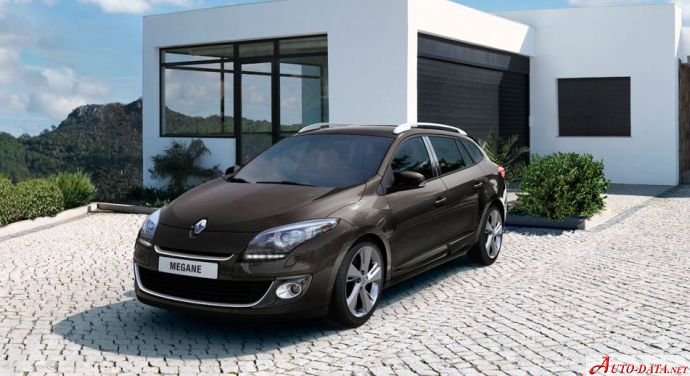
The Renault Megane III Grandtour (Phase II, 2012) retained the elegant and aerodynamic styling that characterized the third-generation Megane. As a 5-door station wagon (estate), its design prioritized practicality without sacrificing aesthetic appeal. Measuring 179.49 inches (4559 mm) in length, 69.53 inches (1766 mm) in width, and 57.52 inches (1461 mm) in height, it offered a substantial footprint for a compact vehicle. The long wheelbase of 106.42 inches (2703 mm) was instrumental in providing generous interior space, particularly for rear passengers, and contributed to a stable ride.
One of the Grandtour’s most compelling features was its cargo capacity. With all five seats in place, the trunk offered 18.5 cu. ft. (524 liters) of space, which could expand to a cavernous 56.33 cu. ft. (1595 liters) with the rear seats folded down. This made it an ideal choice for families, tradespeople, or anyone needing significant hauling capability. The maximum payload was 1236.79 lbs. (561 kg), and it could tow a braked trailer up to 3306.93 lbs. (1500 kg), further underscoring its utility.
On the chassis front, the Megane Grandtour featured a robust and comfortable setup. The front suspension employed an independent McPherson strut system, known for its balance of ride comfort and handling precision. The rear utilized an elastic beam (torsion beam) setup, a cost-effective and space-efficient solution common in front-wheel-drive compact cars, which helped maximize cargo volume. Braking duties were handled by ventilated discs at the front and solid discs at the rear, complemented by an Anti-lock Braking System (ABS) for enhanced safety. The electric power steering system offered light and precise control, making urban maneuvers and parking effortless, with a minimum turning circle of 36.25 ft. (11.05 m). Standard tires were 195/65 R15 91H, mounted on 6.5J x 15-inch wheels.
Technical Specifications
| Category | Specification |
|---|---|
| General Information | |
| Brand | Renault |
| Model | Megane |
| Generation | Megane III Grandtour (Phase II, 2012) |
| Type (Engine) | 1.4 TCe (130 Hp) |
| Start of Production | 2012 year |
| End of Production | 2013 year |
| Powertrain Architecture | Internal Combustion Engine |
| Body Type | Station Wagon (Estate) |
| Seats | 5 |
| Doors | 5 |
| Performance Specifications | |
| Fuel Consumption (Urban) | 8.4 l/100 km (28 US mpg) |
| Fuel Consumption (Extra Urban) | 5.1 l/100 km (46.1 US mpg) |
| Fuel Consumption (Combined) | 6.3 l/100 km (37.3 US mpg) |
| CO2 Emissions | 145 g/km |
| Fuel Type | Petrol (Gasoline) |
| Acceleration 0-60 mph | 9.5 sec |
| Acceleration 0-100 km/h | 10 sec |
| Maximum Speed | 124.27 mph (200 km/h) |
| Emission Standard | Euro 5 |
| Weight-to-Power Ratio | 9.8 kg/Hp, 101.9 Hp/tonne |
| Weight-to-Torque Ratio | 6.7 kg/Nm, 148.9 Nm/tonne |
| Engine Specifications | |
| Power | 130 Hp @ 5500 rpm |
| Power per Liter | 93.2 Hp/l |
| Torque | 140.14 lb.-ft. (190 Nm) @ 2250 rpm |
| Engine Layout | Front, Transverse |
| Engine Model/Code | H4J 700 |
| Engine Displacement | 1395 cm3 (85.13 cu. in.) |
| Number of Cylinders | 4 |
| Engine Configuration | Inline |
| Cylinder Bore | 3.07 in. (78 mm) |
| Piston Stroke | 2.88 in. (73.1 mm) |
| Compression Ratio | 9.1:1 |
| Number of Valves per Cylinder | 4 |
| Fuel Injection System | Multi-port manifold injection |
| Engine Aspiration | Turbocharger, Intercooler |
| Engine Oil Capacity | 4.5 l (4.76 US qt) |
| Coolant Capacity | 6.5 l (6.87 US qt) |
| Dimensions, Volume, and Weights | |
| Kerb Weight | 2813.1 lbs. (1276 kg) |
| Max. Weight | 4049.89 lbs. (1837 kg) |
| Max Load | 1236.79 lbs. (561 kg) |
| Trunk (Boot) Space – Minimum | 18.5 cu. ft. (524 l) |
| Trunk (Boot) Space – Maximum | 56.33 cu. ft. (1595 l) |
| Fuel Tank Capacity | 15.85 US gal (60 l) |
| Max. Roof Load | 176.37 lbs. (80 kg) |
| Permitted Trailer Load with Brakes (12%) | 3306.93 lbs. (1500 kg) |
| Permitted Trailer Load without Brakes | 1488.12 lbs. (675 kg) |
| Permitted Towbar Download | 165.35 lbs. (75 kg) |
| Length | 179.49 in. (4559 mm) |
| Width | 69.53 in. (1766 mm) |
| Height | 57.52 in. (1461 mm) |
| Wheelbase | 106.42 in. (2703 mm) |
| Front Track | 60.87 in. (1546 mm) |
| Rear Track | 60.91 in. (1547 mm) |
| Front Overhang | 33.94 in. (862 mm) |
| Rear Overhang | 39.13 in. (994 mm) |
| Minimum Turning Circle (Diameter) | 36.25 ft. (11.05 m) |
| Drivetrain, Brakes, and Suspension Specifications | |
| Drivetrain Architecture | The Internal Combustion Engine (ICE) drives the front wheels of the vehicle. |
| Drive Wheel | Front-wheel drive |
| Number of Gears and Type of Gearbox | 6 gears, manual transmission |
| Front Suspension | Independent type McPherson |
| Rear Suspension | Elastic beam |
| Front Brakes | Ventilated discs |
| Rear Brakes | Disc |
| Assisting Systems | ABS (Anti-lock Braking System) |
| Steering Type | Steering rack and pinion |
| Power Steering | Electric Steering |
| Tires Size | 195/65 R15 91H |
| Wheel Rims Size | 6.5J x 15 |
Legacy and Market Impact in Europe
The Renault Megane III Grandtour (Phase II, 2012) 1.4 TCe (130 Hp) was a key player in the fiercely competitive European compact station wagon segment. Its primary market was Europe, where station wagons are highly valued for their blend of passenger comfort, cargo versatility, and often, more engaging driving dynamics than SUVs. The Megane Grandtour carved out a niche by offering a compelling alternative to established rivals.
Competitors included formidable models such as the Volkswagen Golf Variant, a benchmark for quality and refinement; the Ford Focus Estate, known for its agile handling; the Opel Astra Sports Tourer, another strong contender with practical design; and other wagons like the Peugeot 308 SW and Skoda Octavia Combi. Against these, the Megane Grandtour typically stood out with its distinctive French styling, often a more comfortable ride quality, and a strong emphasis on interior ergonomics and safety features.
The 1.4 TCe engine, in particular, contributed to the Megane’s reputation for efficiency and smooth power delivery. It demonstrated Renault’s ability to produce downsized, turbocharged engines that offered both performance and economy, a trend that became dominant across the industry. The Phase II update helped keep the model fresh against newer rivals, incorporating minor styling tweaks and technological enhancements that maintained its appeal.
Historically, the Megane Grandtour series reinforced Renault’s position as a leader in the compact segment, offering a practical and stylish option for families who needed more space than a traditional hatchback but preferred the driving characteristics of a car over an SUV. Its success contributed to the brand’s overall market share in Europe and showcased its engineering prowess in developing robust, efficient, and family-friendly vehicles. While it never graced American roads, its impact in its native continent was substantial, proving that a well-executed station wagon could be both a practical tool and a desirable mode of transport. The Megane III Grandtour remains a testament to European automotive design and engineering, balancing everyday usability with modern performance and efficiency standards of its time.