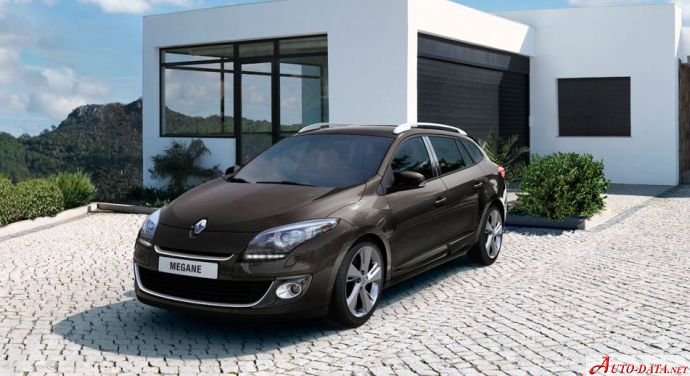
Introduction to the Renault Megane III Grandtour (Phase II, 2012) 1.5 dCi (110 Hp) EDC
The Renault Megane III Grandtour (Phase II, 2012) 1.5 dCi (110 Hp) EDC represents a pivotal offering in the highly competitive European C-segment, specifically targeting families and individuals seeking a blend of practicality, fuel efficiency, and modern technology. Introduced as part of the third generation Megane’s mid-cycle refresh (Phase II) in 2012, this particular variant highlights Renault’s commitment to diesel powerplants and advanced automatic transmissions for its primary markets. While the Megane line, and particularly its station wagon (estate) variant, was never officially imported into the United States, it carved out a significant niche in Europe and other international markets, where its combination of spacious interior, economical diesel engine, and convenient automatic gearbox made it a compelling choice.
The Megane III, launched in 2008, succeeded the second-generation model with a more conventional yet still distinctly French design language. The Phase II update, arriving for the 2012 model year, brought subtle styling enhancements, updated infotainment options, and often, refinements to the powertrain lineup. The Grandtour, or station wagon, body style was crucial for its market success, offering significantly more cargo volume and versatility than its hatchback sibling. The 1.5 dCi engine, a staple across many Renault and Nissan models, was renowned for its efficiency, while the EDC (Efficient Dual Clutch) automatic transmission aimed to provide smooth shifts and further enhance fuel economy. This article delves into the technical specifications, design philosophy, and market impact of this specific model, offering an expert perspective on its role in the global automotive landscape.
Engine and Performance: The Heart of the Renault Megane III Grandtour (Phase II, 2012) 1.5 dCi (110 Hp) EDC
At the core of this particular Megane Grandtour lies the venerable K9K 657 diesel engine, a 1.5-liter (1461 cm³ or 89.16 cu. in.) inline four-cylinder unit. This powerplant is a testament to Renault’s expertise in compact diesel engineering, designed to deliver a balance of usable power and exceptional fuel economy. It produces a respectable 110 horsepower at 4000 rpm, which, when combined with 240 Nm (177.01 lb.-ft.) of torque available from a low 1750 rpm, provides ample motivation for daily driving and highway cruising. The engine’s architecture features a front, transverse layout, and an inline configuration, utilizing two valves per cylinder for efficient operation.
The 1.5 dCi engine benefits from a sophisticated fuel injection system, specifically common rail direct injection, which precisely meters fuel for optimal combustion and efficiency. Further enhancing its performance and efficiency is a turbocharger paired with an intercooler, ensuring a dense air charge for improved power output across the rev range. This combination helps the Megane III Grandtour accelerate from 0 to 60 mph in a reasonable 11.5 seconds, with a top speed of 118.06 mph (190 km/h).
A key technological highlight for this variant is the EDC (Efficient Dual Clutch) automatic transmission. While the data specifies “1 gear, automatic transmission EDC,” this is a likely simplification or a misinterpretation of a multi-speed dual-clutch unit. In reality, Renault’s EDC transmissions are typically 6-speed or 7-speed units designed to offer the convenience of an automatic with the efficiency and responsiveness often associated with manual gearboxes. This type of transmission contributes significantly to the vehicle’s impressive fuel economy figures: an estimated 56 US mpg (4.2 l/100 km) combined, with urban consumption at 46.1 US mpg (5.1 l/100 km) and extra-urban at an outstanding 63.6 US mpg (3.7 l/100 km). With CO2 emissions of 110 g/km, the vehicle meets the Euro 5 emission standard, reflecting its environmentally conscious design for its era. A particulate filter is also included as part of its engine systems to reduce harmful emissions.
Design and Features: Practicality Meets European Styling
The Renault Megane III Grandtour (Phase II, 2012) adopts a five-door station wagon (estate) body type, a highly popular configuration in Europe for its blend of passenger comfort and cargo versatility. Its design, while updated for Phase II, maintained the Megane III’s generally clean and understated aesthetic, moving away from some of the more polarizing design cues of its predecessor. The exterior dimensions underscore its compact yet capable nature: a length of 179.49 inches (4559 mm), a width of 69.53 inches (1766 mm), and a height of 57.52 inches (1461 mm). The wheelbase of 106.42 inches (2703 mm) contributes to a stable ride and a spacious cabin for its class.
Inside, the Megane Grandtour is designed to comfortably accommodate five occupants across its two rows of seating. The true strength of the Grandtour lies in its cargo capacity. With the rear seats in place, it offers a generous 18.5 cu. ft. (524 liters) of trunk space. Folding down the rear seats expands this volume significantly to an impressive 56.33 cu. ft. (1595 liters), making it highly practical for hauling luggage, sports equipment, or larger items. The kerb weight of the vehicle stands at 2841.76 lbs (1289 kg), with a maximum permissible weight of 4078.55 lbs (1850 kg), allowing for a substantial maximum load of 1236.79 lbs (561 kg). It also boasts a substantial fuel tank capacity of 15.85 US gallons (60 liters), enabling long distances between fill-ups, particularly with its efficient diesel engine.
From a chassis and safety perspective, the Megane III Grandtour is equipped with a robust front-wheel-drive architecture. The front suspension employs an independent McPherson strut setup, known for its balance of comfort and handling, while the rear features a semi-rigid elastic beam, a common and cost-effective solution for compact cars that still provides adequate ride quality and packaging benefits. Braking is handled by ventilated discs at the front and solid discs at the rear, supported by an Anti-lock Braking System (ABS) for enhanced safety during emergency stops. Steering is managed by an electric power steering rack and pinion system, offering ease of maneuverability, particularly in urban environments, with a minimum turning circle of 36.25 ft (11.05 m). The vehicle comes standard with 195/65 R15 91H tires on 6.5J x 15 wheel rims.
Technical Specifications
| Category | Specification | US Equivalent |
|---|---|---|
General Information |
||
| Brand | Renault | |
| Model | Megane | |
| Generation | Megane III Grandtour (Phase II, 2012) | |
| Type (Engine) | 1.5 dCi (110 Hp) EDC | |
| Start of production | 2012 year | |
| End of production | 2013 year | |
| Powertrain Architecture | Internal Combustion engine | |
| Body type | Station wagon (estate) | |
| Seats | 5 | |
| Doors | 5 | |
Performance Specs |
||
| Fuel consumption (economy) – urban | 5.1 l/100 km | 46.1 US mpg |
| Fuel consumption (economy) – extra urban | 3.7 l/100 km | 63.6 US mpg |
| Fuel consumption (economy) – combined | 4.2 l/100 km | 56 US mpg |
| CO2 emissions | 110 g/km | |
| Fuel Type | Diesel | |
| Acceleration 0 – 100 km/h | 12.1 sec | |
| Acceleration 0 – 62 mph | 12.1 sec | |
| Acceleration 0 – 60 mph (Calculated) | 11.5 sec | |
| Maximum speed | 190 km/h | 118.06 mph |
| Emission standard | Euro 5 | |
| Weight-to-power ratio | 11.7 kg/Hp | 85.3 Hp/tonne |
| Weight-to-torque ratio | 5.4 kg/Nm | 186.2 Nm/tonne |
Engine Specs |
||
| Power | 110 Hp @ 4000 rpm | |
| Power per liter | 75.3 Hp/l | |
| Torque | 240 Nm @ 1750 rpm | 177.01 lb.-ft. @ 1750 rpm |
| Engine layout | Front, Transverse | |
| Engine Model/Code | K9K 657 | |
| Engine displacement | 1461 cm³ | 89.16 cu. in. |
| Number of cylinders | 4 | |
| Engine configuration | Inline | |
| Cylinder Bore | 76 mm | 2.99 in. |
| Piston Stroke | 80.5 mm | 3.17 in. |
| Compression ratio | 15.2:1 | |
| Number of valves per cylinder | 2 | |
| Fuel injection system | Diesel Commonrail | |
| Engine aspiration | Turbocharger, Intercooler | |
| Engine oil capacity | 4.5 l | 4.76 US qt |
| Coolant | 6.5 l | 6.87 US qt |
| Engine systems | Particulate filter | |
Space, Volume and Weights |
||
| Kerb Weight | 1289 kg | 2841.76 lbs. |
| Max. weight | 1850 kg | 4078.55 lbs. |
| Max load | 561 kg | 1236.79 lbs. |
| Trunk (boot) space – minimum | 524 l | 18.5 cu. ft. |
| Trunk (boot) space – maximum | 1595 l | 56.33 cu. ft. |
| Fuel tank capacity | 60 l | 15.85 US gal |
| Max. roof load | 80 kg | 176.37 lbs. |
| Permitted trailer load with brakes (12%) | 1500 kg | 3306.93 lbs. |
| Permitted trailer load without brakes | 680 kg | 1499.14 lbs. |
| Permitted towbar download | 75 kg | 165.35 lbs. |
Dimensions |
||
| Length | 4559 mm | 179.49 in. |
| Width | 1766 mm | 69.53 in. |
| Height | 1461 mm | 57.52 in. |
| Wheelbase | 2703 mm | 106.42 in. |
| Front track | 1546 mm | 60.87 in. |
| Rear (Back) track | 1547 mm | 60.91 in. |
| Front overhang | 862 mm | 33.94 in. |
| Rear overhang | 994 mm | 39.13 in. |
| Minimum turning circle (turning diameter) | 11.05 m | 36.25 ft. |
Drivetrain, Brakes and Suspension Specs |
||
| Drivetrain Architecture | The Internal combustion engine (ICE) drives the front wheels of the vehicle. | |
| Drive wheel | Front wheel drive | |
| Number of gears and type of gearbox | 1 gears, automatic transmission EDC | (Note: Typically a multi-speed dual-clutch transmission) |
| Front suspension | Independent type McPherson | |
| Rear suspension | Elastic beam | |
| Front brakes | Ventilated discs | |
| Rear brakes | Disc | |
| Assisting systems | ABS (Anti-lock braking system) | |
| Steering type | Steering rack and pinion | |
| Power steering | Electric Steering | |
| Tires size | 195/65 R15 91H | |
| Wheel rims size | 6.5J x 15 | |
Legacy and Market Impact
The Renault Megane III Grandtour (Phase II, 2012) 1.5 dCi (110 Hp) EDC, much like the broader Megane lineup, played a crucial role in Renault’s strategy within the highly competitive European compact car segment. In a market where diesel engines and station wagons were (and still are, though declining) immensely popular, this variant offered a compelling package. Its primary competitors included established players such as the Volkswagen Golf Variant, Ford Focus Estate, Opel Astra Sports Tourer, and Peugeot 308 SW, all vying for the attention of families and fleet buyers.
The Megane Grandtour distinguished itself through several key attributes. Firstly, its 1.5 dCi engine was widely recognized for its exceptional fuel economy and proven reliability, making it an attractive option for high-mileage drivers and those conscious of running costs. The integration of the EDC automatic transmission further enhanced its appeal, providing a smooth and effortless driving experience, a significant advantage over many competitors that still relied on less refined conventional automatics or continuously variable transmissions (CVTs) at the time. This combination of an efficient diesel engine and a modern automatic gearbox made the Megane an ideal choice for long-distance travel across Europe, where diesel infrastructure is robust and fuel prices often favor diesel over gasoline.
The vehicle’s generous cargo capacity, ranging from 18.5 cu. ft. to 56.33 cu. ft. with the rear seats folded, solidified its reputation as a practical family vehicle. This versatility, combined with comfortable seating for five and a generally pleasant ride quality, ensured its appeal to a broad demographic. While perhaps not as dynamically engaging as some rivals, the Megane prioritized comfort and ease of use, which resonated well with its target audience.
Historically, the Megane III Grandtour contributed to Renault’s image as a producer of sensible, value-oriented, and technically competent vehicles. It showcased Renault’s commitment to advanced powertrain technology, particularly in diesel engines and dual-clutch transmissions, which were becoming increasingly important for meeting stringent European emissions regulations while still delivering desirable performance. The Phase II update ensured the model remained fresh and competitive during its production run, bridging the gap to the fourth-generation Megane. Its legacy is one of a highly capable and efficient workhorse that served the needs of countless European motorists, embodying the practicality and technological advancements expected from a modern compact station wagon. Its absence from the American market underscores the distinct preferences and regulatory environments that shape automotive offerings across different continents.